Solutions

Archive and retrieve communications securely with cloud-native speed.

Orchestrate real-time, compliant interactions across every channel.

Simplify and standardize trade and relationship documentation workflows.

Industries

Improve customer engagement across policy, billing, and claims.

Create and deliver personalized, compliant customer communications at scale.

Heighten citizen experience with digital transformation.

Improve customer engagement across utilities.

Resources

Browse popular market research, articles, videos, written guides and more in one convenient location.

Explore upcoming events, webinars, and customer experiences shaping the future of customer conversations.

Get the latest updates on Smart Communications, including product news, and industry recognition.

Company

Learn more about our company, our leadership and how were growing the team!

Analysts

Access analyst research, market reports, and industry recognitions featuring Smart Communications.

Automating Insurance Workflows: A Smarter Experience for Your Members

By John Zimmerer, VP of Healthcare Marketing at Smart Communications 

Health insurers face mounting pressure to deliver exceptional member experiences, maintain compliance, and protect sensitive data—all while controlling costs. Manual processes in enrollment, care management, utilization management, and member services create inefficiencies, increase risk, and frustrate members. Automation offers a transformative solution, enabling insurers to streamline workflows, improve engagement, and strengthen security. This blog explores the benefits of automation across key functional areas, its impact on compliance and cybersecurity, and how Smart Communications helps insurers achieve these goals. 

What is Healthcare Automation? 

Simply put, automation in healthcare is anything that reduces or eliminates manual effort. Automation comes in many forms, including Business Process Management (BPM), Robotic Process Automation (RPA), and Artificial Intelligence (AI). Healthcare automation can also be accomplished through integration, so that tasks are triggered by some kind of event. 

Why Are Health Insurers Investing in Automation? 

Administrative inefficiency accounts for nearly 25% of U.S. healthcare expenditures—about $1 trillion annually. Manual processes in claims, prior authorizations, and appeals and grievances slow down service delivery and increase operational costs. Automation addresses these challenges by: 

  • Reducing processing times by up to 50% for claims and prior authorizations.
  • Cutting operational costs by 20–30% through streamlined workflows.
  • Improving compliance accuracy by 30–40% with automated reporting. 

Member Experience: Faster, Smarter, Personalized 

Automation enhances member experience by eliminating friction and enabling real-time engagement: 

  • Self-Service Enrollment: Digital forms powered by SmartIQ™ simplify onboarding, reducing errors and accelerating plan selection.
  • Real-Time Notifications: Automated updates keep members informed about claims, authorizations, and appeals and greivances, improving transparency.
  • Personalized Communications: AI-driven automation tailors content to member preferences, improving comprehension and trust.
  • Virtual Assistants: Chatbots and AI agents handle routine inquiries, reducing call center load and improving satisfaction. 

Operational Efficiency: Doing More with Less 

Automation drives efficiency across core functions: 

  • Enrollment: SmartIQ digitizes enrollment workflows, reducing manual data entry errors by up to 80–90%.
  • Care Management: Predictive models automate outreach for disease management programs, improving health outcomes and lowering costs.
  • Utilization Management: AI-enabled automation accelerates prior authorization decisions, reducing delays and administrative burden.
  • Claims Processing: Automated adjudication speeds up settlements, reducing errors and freeing staff for higher-value tasks. 

Compliance: Audit-Ready and Error-Free 

Compliance failures can lead to fines, reputational damage, and member distrust. Automation mitigates these risks: 

  • Automated Compliance Monitoring: Systems track regulatory changes and update workflows instantly.
  • Error Reduction: Automated audit trails and reporting improve accuracy and reduce human error.
  • HIPAA and GDPR Alignment: Automation ensures encryption, access controls, and real-time compliance checks.

Cybersecurity: Protecting Sensitive Data 

Cyberattacks in healthcare are escalating, with 720 breaches in 2024 affecting 186 million records. Automation strengthens security by: 

  • Automated Threat Detection: AI monitors data access patterns, flagging anomalies before breaches occur.
  • Predictive Risk Analysis: Machine learning identifies vulnerabilities and recommends proactive measures.
  • Secure Omnichannel Delivery: Omnichannel orchestration ensures encrypted communication across email, SMS, and print, with failover logic for uninterrupted delivery. 

Aligning Benefits to Functional Areas 

Functional Area 

Automation Benefit 

Enrollment 

SmartIQ digitizes forms, reducing errors and accelerating onboarding. 

Care Management 

Predictive analytics automate outreach for disease management programs. 

Utilization Management 

AI speeds prior authorizations, reducing delays and improving provider satisfaction. 

Member Services 

Chatbots and automated notifications enhance engagement and reduce call center load. 

Claims Processing 

Automated adjudication cuts processing time and improves accuracy. 

Smart Communications: Enabling Intelligent Automation 

Smart Communications’ Conversation Cloud™ delivers automation purpose-built for regulated industries: SmartIQ™ streamlines enrollment and servicing with dynamic, guided forms; SmartPATH™ orchestrates secure, real-time communications across channels, ensuring compliance and continuity; SmartCOMM™ generates personalized, compliant communications at scale; and SmartHUB™ archives all interactions for audit-ready transparency. 

Automation as a Strategic Imperative 

Automation is no longer optional—it’s a strategic imperative for health insurers. By aligning automation with member experience, operational efficiency, compliance, and cybersecurity, insurers can deliver better outcomes for members and stakeholders alike. 

Modernize your operations with Smart Communications’ Conversation Cloud™. Schedule a demo today! 

Frequently Asked Questions 

Q: What healthcare processes can be automated? 

A: Almost any healthcare business process can be automated, at least to some degree. Think about the manual processes that permeate healthcare, and you will realize that most are related to data collection (e.g., determining eligibility) or utilization (e.g., personalizing a communication). In some cases, gaps exist between workgroups which can be closed with a workflow tool. Many customer outreach and customer service functions can either be automated or converted into self-service options. 

Q: How does automation improve the member experience? 

A: Members crave transparency and timeliness. Automation helps increase transparency through automatic status updates or prompts to act. Shifting a task from a human to an automated solution not only frees up the human to do something else but also speeds up the response times enabling healthcare organizations to meet regulated timelines and customer expectations. 

Q: How does automation support compliance & cybersecurity? 

A: Automation supports compliance in several ways. Automation helps healthcare organizations meet regulated turnaround times. Automation can validate that all information required to satisfy an audit is complete, accurate, and retained. And automation can ensure that only approved content is sent to a member or patient. Automation also supports cybersecurity. The less data you expose to a human, the lower the risk of a bad actor compromising security. Also, automation can act at a lower layer in the OSI stack which ensures that proper encryption is used to secure personally identifiable information (PII) and protected health information (PHI). 

 

Modernizing Appeals and Grievances Processes with a Cloud-Native Platform

By John Zimmerer, VP of Healthcare Marketing at Smart Communications

Appeals and grievances (A&G) processes are mission-critical for health plans, yet traditional applications struggle to meet compliance, security, and member experience demands. Cloud-native solutions offer a transformative approach — delivering secure, scalable, and interoperable capabilities that streamline workflows and ensure audit readiness. 

This blog post explores how Smart Communications’ Conversation Cloud™ platform, featuring SmartIQ™, SmartCOMM™, SmartPATH™, and SmartHUB™, enables health plans to modernize A&G processes while reducing risk and improving outcomes.

The Compliance Challenge

Health plans face strict regulatory requirements from CMS, Medicaid, ACA, ERISA, and state regulators. Manual processes and legacy systems often lead to missed deadlines, incomplete documentation, and compliance risk. With timeframes as short as 72 hours for expedited appeals and complex notice requirements, organizations need technology that ensures accuracy, timeliness, and transparency.

Why Are Health Plans Moving to Cloud-Native Solutions?

Cloud-native architecture is more than a technology choice — it’s a strategic imperative for health plans operating in highly regulated environments. Unlike traditional on-premises systems, cloud-native platforms are designed from the ground up to deliver agility, resilience, and compliance at scale. 

Security is paramount: The Conversation Cloud adheres to HIPAA, SOC2, ISO 27001, and GDPR standards (among others), ensuring that sensitive health data remains protected throughout every interaction. (Learn more about our compliance with industry certifications and regulations.)

Scalability is equally critical. Appeals and grievances volumes can spike unexpectedly, especially during regulatory changes or public health events. Cloud-native elasticity allows organizations to handle these surges without performance degradation or costly infrastructure upgrades. 

Finally, interoperability ensures seamless integration with core systems such as Pega, Facets, and Salesforce. API-first design and prebuilt connectors eliminate silos, enabling real-time data exchange and reducing manual effort.

Conversation Cloud Architecture

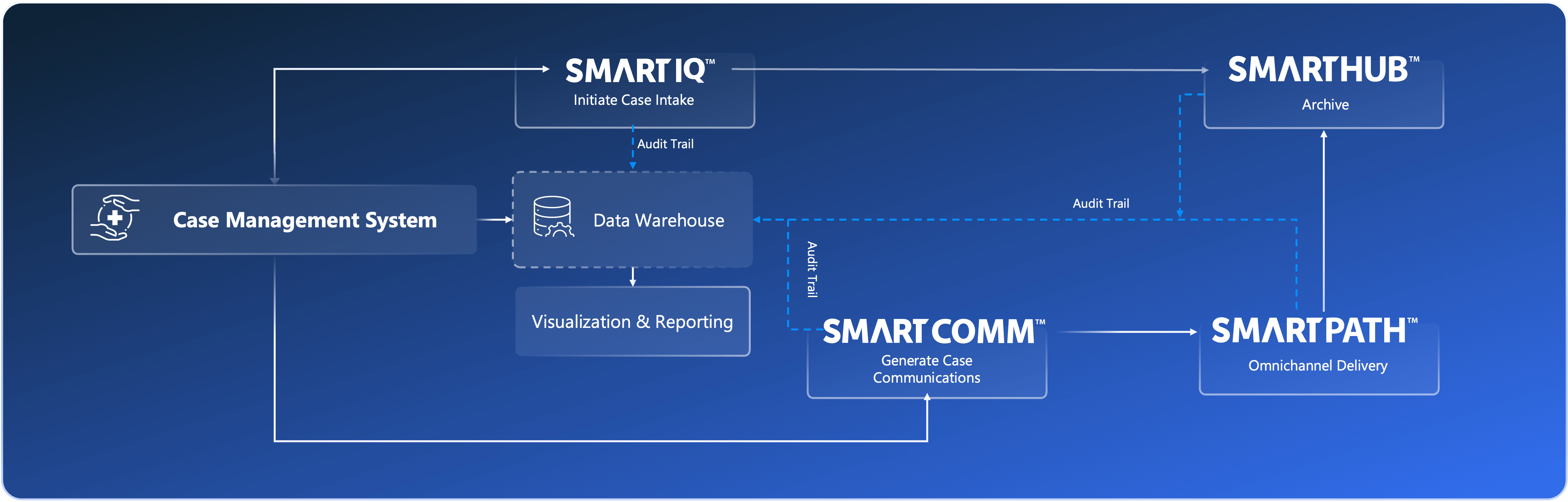
The Conversation Cloud platform unifies four best-in-class components to automate and streamline A&G processes: 

    • SmartIQ™ serves as the intelligent intake engine, guiding members through dynamic forms that reduce errors and accelerate submission.
    • SmartCOMM™ powers personalized, compliant communications, leveraging templates and AI-driven enhancements to ensure clarity and regulatory alignment.
    • SmartPATH™ orchestrates omnichannel delivery, guaranteeing that communications reach members via their preferred channels (email, SMS, print) with failover logic to prevent disruptions.
    • SmartHUB™ completes the ecosystem by archiving all interactions in a secure, searchable repository, enabling instant retrieval for audits and compliance reviews.

Together, these components create a frictionless, end-to-end workflow that transforms A&G from a compliance burden into a strategic advantage.

How It Works

    1. Member submits appeal or grievance via SmartIQ digital form.
    2. SmartIQ triggers SmartCOMM to generate compliant communications.
    3. SmartPATH delivers communications across channels with failover.
    4. SmartHUB archives all interactions for audit readiness and retrieval.

Benefits

    • Accelerate resolution by up to 40%.
    • Reduce compliance risk with automated workflows and audit trails.
    • Improve member experience through timely, personalized updates.
    • Lower operational costs by minimizing manual effort and print reliance.

Best Practices for Implementation

Successful implementation of a cloud-native A&G solution requires a structured approach. Governance should be established early, with clear roles for compliance oversight and IT security. Integration planning is critical — leveraging APIs and prebuilt connectors ensures seamless data flow between the Conversation Cloud and core systems.

Change management cannot be overlooked. Training staff on new digital workflows and compliance features fosters adoption and reduces resistance.

Finally, continuous monitoring through real-time dashboards and analytics enables organizations to track performance, identify bottlenecks, and adapt quickly to regulatory changes. By following these best practices, health plans can maximize ROI and achieve long-term success.

Improve Your A&G Process

Smart Communications’ Conversation Cloud™ platform empowers health plans to transform A&G processes into secure, scalable, and interoperable workflows. The best next step: Schedule a demo to see how the Conversation Cloud can help you achieve compliance, efficiency, and member satisfaction.

Frequently Asked Questions

1) How can cloud-native solutions improve appeals and grievances processes for health plans?

Cloud-native solutions provide flexibility and scalability to appeals and grievances, helping health plans:

    • Deliver communications over any channel
    • Orchestrate the process across locations, departments and organizations
    • Provide audit- and AI-ready archiving and reporting
    • Integrate with modern case management systems

2) What features should healthcare organizations look for in an A&G solution?

Healthcare organizations (HCOs) should look for a modular A&G solution that provides all intake, communication, orchestration, and archiving functionality and can be implemented selectively to best complement your existing enterprise architecture.

3) What drives appeals and grievances in healthcare insurance?

Grievances typically result from service experience issues, including claims and billing issues. The primary drivers of appeals are: 

    • Medical necessity denials
    • Administrative and technical denials
    • Coverage exclusions and out-of-network issues

The underlying cause is that members do not understand their benefits. This lack of clarity results in calls, appeals, and grievances.

4) How can cloud-based CCM software help reduce the volumes of calls, appeals, and grievances?


Leading CCM technologies help decrease these by:

  • Using AI to enhance readability and clarity of key communications
  • Enabling easier, more accurate data to support intuitive self-service experiences for members.
  • Reducing confusion around benefits, costs and coverage

Read our blog post to learn more about how you can streamline A&G processes and build trust.

Integrating with Epic, Meditech, and PointClickCare: A Quick Guide to SmartIQ™ Interoperability

By John Zimmerer, VP of Healthcare Marketing at Smart Communications 

When you’re evaluating customer data capture solutions, you don’t have time for generic promises. You need to know exactly how a solution like SmartIQ integrates with the systems you’re already using—namely Epic, Meditech, and PointClickCare. 

Let’s cut to the chase. If your healthcare organization is looking to streamline data intake, reduce administrative burden, and elevate patient experiences, SmartIQ delivers with plug-in flexibility and secure interoperability across the EHR market. 

Here’s what you need to know about using SmartIQ with the major players. 

How to Use SmartIQ with Epic 

You’re already using Epic to manage patient records, scheduling, billing, and more. SmartIQ helps you extend that ecosystem by automating data capture at the front end—before it ever hits Epic. 

With SmartIQ + Epic, you can: 

  • Prefill forms using data already stored in Epic, eliminating repetitive input
  • Route completed forms back into the patient record via HL7, FHIR, or API-based integration
  • Configure logic-driven workflows that align with your existing Epic modules 

Whether you’re collecting consent forms, intake questionnaires, or referral data (particularly from non-Epic users), SmartIQ lets you do it all without disrupting your clinical workflows. 

Using SmartIQ with Meditech 

Meditech’s EHR systems offer robust capabilities—but creating smooth, patient-facing digital experiences can be challenging. That’s where SmartIQ fits in. 

By integrating with Meditech, SmartIQ allows you to: 

  • Prepopulate digital forms using Meditech data
  • Collect structured inputs from patients or staff and push them directly back into the EHR
  • Customize data collection workflows that match Meditech’s clinical logic and security protocols

No need to rebuild your infrastructure or use AI or OCR to extract and structure data. SmartIQ connects to Meditech through secure APIs and interoperability standards you already trust. 

Connecting SmartIQ to PointClickCare 

If you’re in long-term or post-acute care, PointClickCare is likely your core EHR. SmartIQ enhances it with modern data capture flows designed for both staff and residents. 

You’ll be able to: 

  • Digitize and automate admission, discharge, and billing forms
  • Reduce errors by validating inputs before they ever reach PointClick
  • Care Improve compliance with audit trails and real-time record updates

SmartIQ’s flexibility means you can handle everything from HIPAA-compliant e-signatures to custom form logic—without retraining your teams or changing your EHR. 

Why SmartIQ Stands Out in Healthcare 

You’re not just looking for form software. You need a customer data capture solution that respects your workflows, speaks your compliance language, and integrates without compromise. 

SmartIQ gives you: 

  • Standards-based interoperability (FHIR, HL7, REST APIs)
  • Configurable form logic that adapts to multiple care settings
  • Security-first architecture built for healthcare-grade data
  • No-code form design so your team can move fast—without IT bottlenecks 

Whether you’re rolling out new patient intake journeys or automating staff onboarding, SmartIQ keeps you agile, compliant, and connected. 

See the Solution in Action 

Request a demo to see how SmartIQ can help you automate data collection and improve the patient experience—without ripping and replacing your tech stack. 

Frequently Asked Questions

How does SmartIQ connect to Epic, Meditech, or PointClickCare? 

SmartIQ uses standard integration protocols like FHIR, HL7, and REST APIs to connect securely with major EHR platforms. You can push and pull data in real time, enabling seamless front-end data capture. 

Does SmartIQ work with other EHR and practice management systems? 

Yes! Although some systems are easier to integrate with than others. Reach out to us to discuss integrating with your system. 

My system already offers digital forms. Why would I need SmartIQ ? 

We hear from providers that the built-in capabilities are great for simple use cases, but not for more complex workflows. Particularly when multiple parties (patient, provider, payer, etc.) need to participate. Or when integrations with other systems are required. 

Do I need to involve IT for SmartIQ integrations? 

SmartIQ is designed for minimal IT involvement. With no-code configuration tools, your business teams can create and manage digital workflows independently—though IT can step in for deeper API-level customization. 

What kinds of data can I collect with SmartIQ? 

You can capture any structured or unstructured data: patient intake forms, consent documents, staff onboarding, billing data, and more. All inputs are securely validated, routed, and stored. 

Is SmartIQ HIPAA-compliant? 

Yes. SmartIQ is fully compliant with HIPAA and supports healthcare-specific security protocols like encryption at rest and in transit, audit logging, and role-based access controls. 

Why Smart Communications Is a Vendor to Watch in Provider Data Management for Payers

By John Zimmerer, VP of Healthcare Marketing at Smart Communications

The provider data management (PDM) space for U.S. health plans is undergoing rapid, consequential change. The “IDC MarketScape: U.S. Provider Data Management for Payer 2025-2026 Vendor Assessment” captures this shift, assessing vendor platforms, emerging capabilities, and evolving expectations of payers, regulators, and members.

In this blog, we summarize IDC’s key findings, highlight its explicit mention of Smart Communications as a vendor to watch, and offer practical reasons why our Conversation Cloud should be top-of-mind for the use cases IDC underscores: outreach, enrollment, credentialing, contracting, directory publishing, and ongoing updates.

Key Market Trends and Challenges

Provider data has evolved from a back-office dataset supporting claims into a mission-critical enterprise asset. IDC notes:

“Provider data has moved from being a set of tangential reference data used to validate claims to become a core administrative asset that is being used for competitive advantage.”

Here’s why that’s the case:

    • Regulatory pressure & audit readiness: CMS and state mandates for directory accuracy and member access.
    • Network adequacy: Plans must demonstrate access and adapt for telehealth implications.
    • Consumer expectations: Members want granular provider search and trustworthy profiles.
    • Interoperability & scalability: API-first and FHIR-aligned integrations are key.
    • Operational efficiency: Manual workflows are now a strategic liability.

Smart Communications Included in Vendors to Watch

IDC explicitly calls out Smart Communications:

“Smart Communications, through its Conversation Cloud platform, provides adjunct solutions for the provider data management market, including through partners.”

Smart Communications’ cloud-based flagship offerings include:

    • SmartIQ™: Guides providers through credentialing, contracting, and enrollment workflows.
    • SmartCOMM™: Generates omnichannel communications and compliant provider directories.
    • SmartPATH™: Coordinates engagement and delivers communications (SMS, email).
    • SmartHUB™: Archives provider engagement data and documents.

Why Smart Communications Should Be Considered

    • Integration strength: Prebuilt connectors for Pega, Salesforce, and identity verification platforms.
    • Regulatory compliance: ACA Section 1557 compliance and multilingual content.
    • Digital transformation alignment: Supports omnichannel engagement and AI-powered content generation.
    • Operational efficiency: Reduces provider abrasion by streamlining workflows.

Smart Communications and PDM

IDC’s 2025–2026 MarketScape confirms what many payer leaders already feel on the ground: provider data is a strategic asset, and the way you collect, verify, communicate, and prove its accuracy is now central to competitiveness and compliance. While your PDM platform remains the authoritative source of truth, the provider-facing experiences—outreach, attestation, credentialing, contracting, directory publishing, and updates—determine whether your data stays clean, audits pass, networks are adequate, and members can confidently find care.

That’s the role Smart Communications was built to play. If your team is working through the challenges IDC outlines—reducing manual processes, tightening audit readiness, modernizing provider engagement, and scaling content across channels—our Conversation Cloud (SmartIQ, SmartCOMM, SmartPATH, SmartHUB) offers a proven, secure, and compliant way to deliver results fast, without disrupting your PDM backbone.

If you’d like to know more about how we can help you, contact us today, and check out the video below for more on key trends impacting healthcare organizations today!

Aspire on Modernizing Healthcare Communications: From Efficiency to Engagement

By John Zimmerer, VP of Healthcare Marketing at Smart  Communications

The U.S. healthcare industry is at a pivotal moment. But then, when isn’t it?

According to Aspire CCS’s Market Trend Report, “Modernizing Communications in American Healthcare,” the sector is undergoing a profound transformation—shifting from cost-control strategies toward engagement-driven communications that enhance patient and member experiences. This comprehensive research underscores a critical truth: Communications are no longer just operational necessities; they are strategic assets that can improve health outcomes, reduce costs, and create competitive advantage.

The report’s depth and clarity deserve recognition. It not only maps the current state of healthcare communications but also provides actionable insights for organizations navigating this complex landscape.

In this post, we’ll highlight some of the key findings, affirm their importance, and explore how these trends align with modern communication strategies, particularly those enabled by platforms like the Smart Communications Conversation Cloud.

The State of U.S. Healthcare Communications

Healthcare in the U.S. represents a staggering $4.9 trillion market, accounting for 17.6% of GDP. Within this ecosystem, communications play a critical role in connecting fragmented touchpoints across payers, providers, pharmacy benefit managers, and third-party administrators.

Historically, these communications were functional and compliance-driven—think Explanation of Benefits (EOBs) and similar managed communications. Today, they are evolving into strategic tools for engagement.

Aspire’s research highlights several forces driving this shift:

    • Consumer Expectations: One in five consumers globally—and one in four younger consumers—have switched providers due to poor communications.
    • Regulatory Evolution: Relaxation of print mandates and growing emphasis on accessibility are accelerating digital adoption.
    • Economic Pressures: Value-based care models demand proactive engagement to improve outcomes and reduce costs.
    • Technological Innovation: AI and automation are reshaping workflows and enabling personalization at scale.

Key Market Dynamics

Aspire estimates the U.S. healthcare communications technology and services market at $3.5 billion, spanning CCM software, print/document services, and system integration. The report breaks down adoption patterns and spending across these segments, revealing significant variation between the national payers, regional payers, Medicare/Medicaid organizations, and TPAs.

From Efficiency to Engagement

One of the most compelling insights from Aspire’s report is the industry’s pivot from efficiency metrics—like call center diversion—to engagement outcomes that support better health decisions. This means moving beyond transactional communications to contextual, personalized messaging aligned with individual health journeys.

Challenges and Priorities

Healthcare organizations face formidable barriers: compliance complexity, technical debt, organizational silos, and resource constraints. Yet, investment priorities are clear: strengthen governance, empower business users with self-service tools, accelerate print-to-digital initiatives, and leverage AI for compliance and readability.

The Role of AI and Emerging Technologies

While healthcare lags other industries in AI adoption, leading organizations are experimenting with generative AI for summarizing complex documents, improving readability, and ensuring compliance. AI-driven translation and accessibility support are also gaining traction, helping organizations meet diverse member needs.

Connecting the Dots: How Smart Communications Fits In

Aspire’s findings resonate strongly with the principles behind modern CCM platforms like the Smart Communications Conversation Cloud. Our emphasis on cloud-first architecture, integration capabilities, scalability, flexibility, and self-service tools are enablers of the strategic transformation Aspire advocates.

Blueprint for Success

Aspire’s recommendations offer a clear roadmap that addresses governance, infrastructure modernization, and the balance between digital transformation and regulatory compliance. The report provides detailed implementation guidance for each recommendation, including specific success metrics and common pitfalls to avoid.

Next Steps

Aspire CCS’s Market Trend Report is a wake-up call for U.S. healthcare organizations: Communications are no longer back-office functions—they are front-line drivers of experience and engagement. By combining strategic vision with enabling technologies, healthcare organizations can transform communications from a compliance obligation into a competitive advantage that improves lives while strengthening the bottom line.

To get access to this detailed and insightful report, visit the Aspire website.

5 Trends That Will Redefine Healthcare Customer Engagement in 2026

By John Zimmerer, VP of Healthcare Marketing at Smart Communications

As we enter 2026, healthcare organizations face unprecedented economic and regulatory uncertainty. These disruptions can put a strain on market analysis and strategic thinking. That’s where we can help.

Smart Communications’ 2026 Trends Report identifies five forces reshaping customer conversations across industries. For healthcare, these trends aren’t just interesting, they’re essential. They impact patient trust, compliance, operational efficiency, and member experience.

Healthcare operates in one of the most regulated, high-stakes environments imaginable. Every interaction matters—not just for satisfaction scores, but for outcomes and cost. These trends represent both a challenge and an opportunity to modernize engagement without losing the human touch, scale innovation responsibly, and build trust at every step.

Trend #1: AI-Ready Data Is the Foundation for Innovation

Artificial intelligence (AI) is transforming healthcare, but here’s the truth: AI is only as good as the data behind it. Fragmented data across claims, clinical systems, and engagement platforms creates incomplete and inconsistent information. Rushing to deploy AI without addressing data quality is a recipe for failure—and compliance risk.

The report highlights that 30% of generative AI projects will be abandoned after proof of concept due to poor data quality and inadequate risk controls. For payers and providers, that’s a wake-up call.

Actions for Healthcare Leaders:

Imagine a care coordinator preparing for outreach with an AI-generated summary of a member’s entire communication history. That’s the future of healthcare customer engagement, and it starts with clean, connected data.

Of course, AI-ready data is just one piece of the picture. Watch this overview of the healthcare trends shaping customer engagement before exploring the remaining trends below:

Trend #2: Modernization Through Incremental Transformation

“Rip-and-replace” is dead. Healthcare organizations know that replacing core systems overnight is unrealistic and risky. The smarter approach? Incremental modernization. Start with high-friction workflows—prior authorizations, claims appeals, onboarding—and layer in digital-first capabilities.

The report cites a health insurer that improved customer satisfaction and cut call volumes by 80% by modernizing its communications. (Watch the testimonial.) APIs are key here, enabling legacy systems to coexist with modern platforms.

Why It Matters:
Incremental modernization delivers agility, a critical advantage in a world of evolving regulations and consumer expectations. It’s not just about efficiency; it’s about resilience and scalability.

Trend #3: Agentic AI Will Reshape Healthcare Workflows

AI in healthcare isn’t new, but agentic AI is a game-changer. We’re moving beyond chatbots to embedded AI agents that can read, decide, and act within workflows—ideally under human oversight.

For payers, this could mean AI agents handling routine eligibility checks or claims intake, freeing human agents for complex cases that require empathy and judgment. For providers, it could be voice-driven patient registration or an agent helping to coordinate care. This isn’t about replacing people; it’s about augmenting them.

Key Consideration:
Human-centricity must remain at the core. Upskill teams for critical thinking and empathy, even as technology takes on more routine tasks. In healthcare, trust and transparency are non-negotiable.

Trend #4: Security and Trust Will Define the Limits of Innovation

If data is the fuel for AI, trust is the engine. In healthcare, trust isn’t optional; it’s existential. Healthcare consumers need confidence that their information is secure, and regulators demand proof.

The report emphasizes auditability, explainability, and consent management as critical trust signals. Healthcare organizations must show exactly how AI was used in a decision, from data source to output. That means investing in immutable audit trails, governed templates, and centralized archiving systems.

Cybersecurity adds another layer of complexity. As AI adoption grows, so does the sophistication of cyberattacks. Zero-trust frameworks, dynamic encryption, and AI-driven threat detection will become table stakes.

Bottom Line:
Innovation without security is a non-starter. Make compliance and transparency central to every initiative.

Trend #5: Ecosystem Convergence Will Redefine Customer Experience

The boundaries between marketing, service, and transactional communications are artificial, and patients don’t care about them. They want a seamless experience. The report predicts a shift toward integrated ecosystems that collapse silos and enable omnichannel orchestration.

For healthcare, this means moving beyond function-driven or channel-specific communications to connected journeys. A member who starts a journey on one channel should be able to complete it on any other channel without starting over.

Impact on Outcomes:
Fragmented communications lead to missed appointments and incomplete forms. Seamless engagement improves adherence and health outcomes.

The Bottom Line: Responsible Innovation Is the New Imperative

Scaling AI for its own sake is neither strategic nor sound. For healthcare organizations, the path forward is about responsible acceleration, modernizing engagement in ways that enhance trust, improve experience, and deliver measurable value.

Key Takeaways for Healthcare Leaders:

    • Treat data as a strategic asset.
    • Modernize incrementally with APIs and human-centered design.
    • Embed AI agents thoughtfully, with governance and oversight.
    • Make security and compliance central to every innovation.
    • Build integrated ecosystems that collapse silos and connect journeys.

Healthcare is complex. But complexity doesn’t have to mean friction. By embracing these trends, we can create experiences that are compliant, cost-effective, and compassionate.

Read the Full Trends Report

Want to dive deeper into these trends and see how they’re shaping customer conversations across industries? Access the full Smart Communications 2026 Trends Report and start building the future of healthcare engagement today.

Elevating Healthcare Provider CX: Key Insights from the 2025 Benchmark Report

By John Zimmerer, VP of Healthcare Marketing at Smart Communications

In addition to battling a host of existential crises, healthcare providers face mounting pressure to deliver seamless, personalized, and secure communication experiences. The 2025 Healthcare Benchmark Report from Smart Communications offers a comprehensive look into how patients perceive their interactions with healthcare organizations—and what providers must do to meet rising expectations.

This blog post distills the most critical findings from the report and explores how Smart Communications’ Conversation Cloud can empower providers to transform their customer experience (CX) strategies, improve operational efficiency, and build lasting patient trust.

The State of Healthcare Communications in 2025

The benchmark report, based on a global survey of 3,000 consumers, reveals a healthcare landscape in flux. While satisfaction with healthcare communications has improved—up 75% since the last benchmark—patients still report significant gaps in digital engagement, data transparency, and omnichannel consistency.

Key Findings for Providers:

1) Omnichannel Experience Gaps

  • Only 54% of patients are satisfied with their omnichannel experiences.
  • 71% prefer digital self-service over calling or visiting in person.
  • Channel preferences vary widely by region and generation, with email, SMS, encrypted messaging, and web portals all playing critical roles.

2) Trust Hinges on Consistency

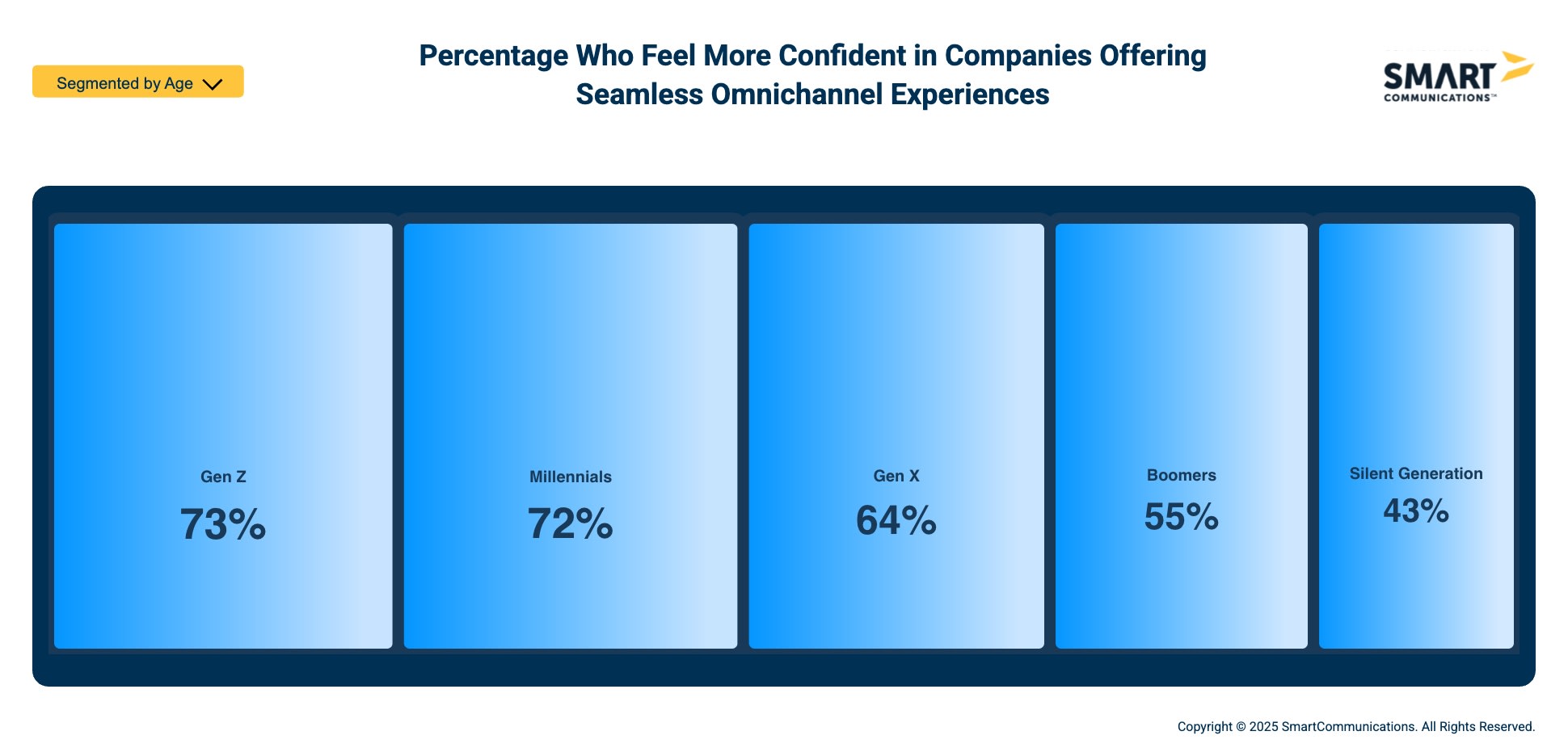
  • 60% of patients trust healthcare organizations more when experiences are consistent across channels.
  • This trust is especially high among Gen Z (73%) and in German-speaking countries (76%).

3) AI Adoption and Transparency

  • 54% of patients are open to AI-driven health recommendations.
  • However, 32% still express concerns about data security, and 31% worry about ethical AI use.

4) Communication Drives Loyalty

  • 84% say communications are central to their overall experience.
  • 67% would switch providers if communications don’t meet expectations.

These findings underscore a critical truth: communication is care. Providers who fail to modernize their engagement strategies risk losing patients—not just to competitors, but to frustration and disengagement.

The Provider Imperative: Modernize or Fall Behind

Healthcare providers are uniquely challenged by legacy systems, fragmented workflows, and regulatory complexity. Yet, patients increasingly expect the same frictionless experiences they receive from retail, banking, and tech brands.

To meet these expectations, providers must:

  • Automate and streamline data intake and form processes.
  • Deliver personalized, omnichannel communications that feel like one continuous conversation.
  • Build trust through transparent data practices and ethical AI use.
  • Ensure accessibility and compliance across all touchpoints.

This is where Smart Communications’ Conversation Cloud becomes a game-changer.

How the Conversation Cloud Solves the Provider CX Puzzle

The Conversation Cloud is a purpose-built platform designed to help healthcare organizations engage in smarter, more meaningful conversations with patients. It includes four integrated solutions:

  • SmartIQ™ – Digital forms and guided experiences
  • SmartCOMM™ – Personalized, omnichannel communications
  • SmartPATH™ – Journey orchestration and automation
  • SmartHUB™ – Centralized communication archive and retrieval

Let’s explore how each component addresses the report’s findings.

1. SmartIQ™: Closing the Digital Self-Service Gap

With 71% of patients preferring digital self-service, SmartIQ enables providers to replace outdated paper forms and manual intake processes with intelligent, mobile-friendly experiences.

Benefits for Providers:

  • Accelerates preregistration, consent, and financial assistance workflows.
  • Reduces staff burden and administrative errors.
  • Improves accessibility with multilingual and ADA-compliant forms.

By digitizing data collection, providers can meet patients where they are—on their devices—and create a smoother, more welcoming entry point into care.

2. SmartCOMM™: Delivering Personalized, Omnichannel Communications

SmartCOMM empowers providers to create and deliver communications that are personalized, compliant, and consistent across channels—email, SMS, print, portals, and more.

Benefits for Providers:

  • Ensures brand and message consistency across touchpoints.
  • Supports HIPAA-compliant communications with encryption and audit trails.
  • Enables personalized content based on patient preferences and data.

With SmartCOMM, providers can turn routine communications—appointment reminders, test results, billing notices—into moments of connection and trust.

3. SmartPATH™: Orchestrating the Patient Journey

SmartPATH helps providers design and automate communication journeys that guide patients through complex processes like referrals, chronic care management, and post-discharge follow-up.

Benefits for Providers:

  • Reduces drop-off and no-show rates.
  • Improves care coordination across departments and systems.
  • Enables real-time adjustments based on patient behavior and feedback.

This orchestration ensures that every interaction feels intentional and supportive, reinforcing the provider’s commitment to patient-centered care.

4. SmartHUB™: Centralized Communication Management and Analytics

SmartHUB provides centralized oversight of all communications, enabling providers to track performance, identify pain points, and continuously improve.

Benefits for Providers:

  • Offers analytics and dashboards to monitor satisfaction and engagement.
  • Supports A/B testing and iterative improvements.
  • Helps meet regulatory reporting requirements with built-in compliance tools.

With SmartHUB, providers can move from reactive to proactive CX management—aligning efforts with what truly matters to patients.

Building Trust in the Age of AI

The benchmark report highlights growing patient openness to AI—but also lingering concerns. Smart Communications addresses this by embedding transparency, security, and human oversight into every AI-powered interaction.

For example:

  • SmartCOMM uses AI to generate plain-language summaries of complex medical documents (think: discharge summaries, care plans, etc.).
  • SmartIQ can guide patients through forms using natural language prompts.
  • SmartPATH ensures that AI-driven journeys are auditable and explainable.

By leading with clarity and integrity, providers can harness AI to enhance—not replace—the human touch in healthcare.

Real-World Impact: Provider Success Stories

Several leading healthcare organizations have already leveraged the Conversation Cloud to transform their CX:

  • A large academic medical center reduced form completion time by 60% using SmartIQ.
  • A regional health system improved patient satisfaction scores by 30% after implementing SmartCOMM for appointment reminders and follow-ups.
  • A multi-specialty provider network used SmartPATH to automate post-discharge communications, reducing readmissions by 15%.

These outcomes demonstrate the tangible ROI of investing in smarter conversations.

The Future of Provider CX Starts Now

The 2025 Healthcare Benchmark Report makes one thing clear: patients are ready for better experiences. They want digital convenience, personalized communication, and ethical use of their data. Providers who rise to meet these expectations will not only retain patients—they’ll earn their trust and loyalty.

Smart Communications’ Conversation Cloud offers a proven path forward. By modernizing how providers engage, communicate, and orchestrate care journeys, it turns every interaction into an opportunity to deliver value, build relationships, and improve outcomes.

Click here to access an on-demand webinar where we dig deeper into the report.

Navigating the Future of Healthcare Engagement: Smart Communications Included in Forrester’s Q4 2025 Customer Experience Platforms Landscape

By John Zimmerer, VP of Healthcare Marketing at Smart Communications

Payers and providers looking to create personalized and empathetic healthcare customer experiences will need to modernize their engagement strategies. Forrester’s “The Customer Experience Platforms For Healthcare Landscape, Q4 2025” (Forrester Research, October 2025) offers a comprehensive overview of 27 vendors with engagement offerings. Among them, Smart Communications stands out for its robust capabilities in addressing extended use cases that are critical to improving healthcare customer experience.

This blog post summarizes key insights from the report and explores how Smart Communications’ suite of products—SmartCOMM™, SmartIQ™, SmartPATH™, and SmartHUB™—can help healthcare organizations meet rising consumer expectations, particularly in areas like benefits and coverage inquiries, chronic condition management, and estimating cost of care.

The Evolving Healthcare Experience Landscape

Forrester defines customer experience platforms for healthcare as technologies that orchestrate personalized experiences across every touchpoint—from plan selection to care delivery and payment. These platforms are designed to foster sustained engagement, build trust, and unlock operational efficiencies.

The report’s authors note that healthcare organizations (HCOs) are under pressure to:

  • Deliver a better total experience that drives loyalty.
  • Sustain engagement to improve clinical and financial outcomes.
  • Reduce costs through automation and streamlined operations.

The report highlights that the U.S. health insurance industry ranks lowest in customer experience among 10 tracked industries. This underscores the urgency for payers to invest in healthcare customer experience platforms that can clarify benefits, respond empathetically, and empower consumers with actionable information.

Smart Communications: A Notable Vendor in the CX Landscape

Smart Communications is one of the 27 vendors included in Forrester’s report. Our company is recognized for its focus on extended use cases that go beyond basic transactions like scheduling and care navigation. Specifically, Smart Communications selected the following top three extended use cases as areas of strategic focus:

  1. Benefits and Coverage Inquiry
  2. Chronic Condition Management
  3. Estimating Cost of Care

These use cases are increasingly important as consumers demand clarity, personalization, and transparency in their healthcare journeys. Smart Communications’ inclusion in this report signals its commitment to helping HCOs meet these healthcare customer experience demands through intelligent, scalable communication solutions.

Addressing Benefits and Coverage Inquiries with Smart Communications

One of the most frequent and frustrating pain points for healthcare consumers is understanding their benefits and coverage. Confusing language, inconsistent formats, and lack of personalization often lead to member dissatisfaction and increased call center volume.

Smart Communications addresses this challenge through:

  • SmartCOMM, which enables dynamic, personalized document generation—turning complex benefit information into clear, easy-to-understand communications.
  • SmartIQ, which powers intelligent forms that guide members through interactive coverage inquiries, reducing friction and improving self-service.
  • SmartPATH, which orchestrates communication workflows to ensure timely delivery of benefit updates and responses.
  • SmartHUB, which centralizes member communications across channels, allowing for compliant and cost-effective communication storage and retrieval.

By leveraging these tools, payers can reduce inbound inquiries, increase member satisfaction, and build trust through transparency and responsiveness. Providers can reduce patient effort and relieve staff burden while securely handling health information.

Supporting Chronic Condition Management

Managing chronic conditions requires ongoing engagement, personalized education, and proactive communication. Forrester notes that many vendors are investing in capabilities that support this use case, and Smart Communications is among them.

Smart Communications enables chronic condition management by:

  • Delivering personalized care plans and educational materials through SmartCOMM.
  • Using SmartIQ to collect patient-reported outcomes and health status updates via interactive digital forms.
  • Coordinating outreach campaigns through SmartPATH to remind patients of appointments, ensure medication adherence, and provide lifestyle tips.
  • Providing a centralized communication hub via SmartHUB that streamlines the storage and retrieval of critical communications.

These capabilities help providers stay connected with patients, reduce readmissions, and improve health outcomes—all while enhancing the patient experience.

Estimating Cost of Care: Empowering Consumers with Transparency

Cost transparency is a growing priority for healthcare consumers. Forrester’s healthcare customer experience report emphasizes the importance of clear, fast resolution to cost-related inquiries, which are often a source of confusion and anxiety and drive calls to call centers.

Smart Communications supports cost estimation by:

  • Generating personalized cost-of-care summaries using SmartCOMM, tailored to individual coverage and treatment plans.
  • Enabling members to submit cost estimation requests through SmartIQ forms that guide them through the necessary inputs.
  • Automating responses and follow-ups via SmartPATH, ensuring timely and accurate communication.
  • Providing a centralized view of cost-related communications through SmartHUB, helping members make informed decisions.

These tools empower consumers to understand their financial responsibilities, avoid surprise bills, and plan for care more effectively.

Why Smart Communications Stands Out

Smart Communications differentiates itself in several key ways:

  • End-to-end communication orchestration: Unlike point solutions, Smart Communications offers a unified platform that spans document generation, form automation, workflow orchestration, and omnichannel delivery.
  • Personalization at scale: The platform uses data-driven logic to tailor every interaction, ensuring relevance and clarity.
  • Compliance and trust: Smart Communications embeds data protection and privacy into its workflows, helping HCOs meet regulatory requirements while building consumer trust.
  • Flexibility and integration: The platform integrates with existing systems and adapts to evolving business needs, making it a future-proof investment.

The Road Ahead: What Forrester Predicts

Forrester’s report outlines several trends that will shape the future of healthcare customer experience platforms:

  1. Agentic AI will become essential—but must be deployed thoughtfully to avoid overpromising and underdelivering.
  2. Consolidation will accelerate, with HCOs seeking end-to-end platforms to replace fragmented point solutions.
  3. Rapid change will continue, driven by regulatory shifts, economic pressures, and rising consumer expectations.

Smart Communications is well-positioned to thrive in this environment. Its platform not only meets current needs but also provides the agility and innovation required to adapt to future challenges.

Smart Communications: A Strategic Partner for Healthcare Engagement

As healthcare organizations strive to improve engagement, reduce costs, and build trust, the choice of a healthcare customer experience platform becomes a strategic imperative. Forrester’s Q4 2025 report provides valuable guidance, and Smart Communications emerges as a strong contender for payers and providers looking to address complex use cases like benefits inquiries, chronic condition management, and cost estimation.

With its intelligent, integrated platform, Smart Communications helps HCOs transform transactional interactions into meaningful engagements, driving better outcomes for both consumers and organizations.

For more on the future of healthcare engagement, download a complimentary copy of Forrester’s report.

Meeting Section 1557 Language Access Requirements with SmartIQ: A Smarter Way to Translate Vital Forms

By John Zimmerer, VP of Healthcare Marketing at Smart Communications 

Ensuring equitable access to health services is more than a moral imperative, it’s now a legal requirement. Section 1557 of the Affordable Care Act (ACA) is the cornerstone of nondiscrimination in healthcare, prohibiting discrimination based on race, color, national origin, sex, age, or disability. One of its most impactful provisions mandates meaningful language access for individuals with limited English proficiency (LEP).

For health insurers, this means translating “vital documents” which includes forms, into multiple languages—a complex, resource-intensive task. Fortunately, there is a solution. 

Understanding Section 1557 and Its Language Access Mandate 

Section 1557 applies to any health program or activity that receives federal financial assistance, is administered by the Department of Health and Human Services (HHS) or was established under Title I of the ACA. This includes most health insurers, managed care organizations, and marketplace plans. 

The 2024 Final Rule, effective July 5, 2024, and enforceable by July 5, 2025, strengthens language access requirements. Covered entities must take “reasonable steps” to provide meaningful access to LEP individuals who are eligible to be served or likely to be directly affected by their health programs. This includes: 

  • Providing qualified interpreters and translators
  • Ensuring timely and accurate language assistance services
  • Translating written materials deemed “vital documents”
  • Avoiding reliance on unqualified interpreters or machine translation without human review 

What Are Vital Documents? 

Vital documents are those which are critical to accessing services, understanding rights, or making informed decisions. Examples include: 

  • Enrollment forms
  • Claims and appeals forms
  • Prior authorization requests
  • Consent forms
  • Appeal and grievance forms 

Failure to translate these documents can result in unintentional discrimination, legal liability, and poor health outcomes. 

The Challenge for Health Insurers 

Translating vital documents is not just about converting words, it’s about ensuring cultural and linguistic accuracy, maintaining regulatory compliance, and managing operational complexity. Health insurers face several challenges: 

  • Volume and variety of forms: Insurers manage hundreds of forms across different lines of business.
  • Multiple languages: Depending on the state, insurers may need to translate documents into the top 15 non-English languages spoken in their service area.
  • Frequent updates: Regulatory language, branding, and form content change regularly.
  • Decentralized processes: Forms are often managed by different departments, leading to inconsistencies and inefficiencies. 

These challenges make compliance with Section 1557 both critical and difficult. That’s where SmartIQ comes in. 

SmartIQ: A Smarter Way to Translate and Manage Forms 

SmartIQ by Smart Communications is a low-code enterprise forms automation platform designed to streamline data collection, form management, and digital workflows. For health insurers, SmartIQ offers a powerful solution to meet Section 1557’s language access requirements efficiently and effectively. 

Key Capabilities That Support Section 1557 Compliance 

1. Centralized Form Management 

SmartIQ enables insurers to manage all form processes from a single platform. Whether forms are used for enrollment, claims, appeals, or prior authorizations, SmartIQ centralizes design, updates, and deployment. This ensures consistency across departments and reduces the risk of non-compliance. A single digital experience can orchestrate data collection from multiple parties, with each person viewing the experience in their native language. At the end of the process, collected data and documents can be passed to core systems or archived (including in our SmartHUB™ solution). 

2. Multi-Language Support in a Single Project 

One of SmartIQ’s standout features is its ability to support multiple translations within a single form project. Form designers can upload translations for all text elements—titles, questions, instructions, and page names—using a CSV file. The platform then dynamically presents the form in the user’s preferred language based on their profile or a query string parameter (e.g., ?lang=es-ES).  

This eliminates the need to create and maintain separate form versions for each language, dramatically reducing administrative overhead. 

3. Human-Validated Translation Workflow 

Section 1557 requires that machine translations be reviewed by qualified human translators when accuracy is essential. SmartIQ supports this by allowing form designers to manually input and validate translations. The CSV export/import process ensures that translations are accurate, culturally appropriate, and compliant with regulatory standards. 

4. Mobile-Responsive and Accessible Design 

SmartIQ’s mobile-responsive technology ensures that translated forms are accessible on any device. This is crucial for reaching LEP individuals who may rely on mobile phones for internet access. The platform also supports accessibility standards, helping insurers meet broader nondiscrimination requirements under Section 1557. 

5. Role-Based Authorization and Audit Trails 

SmartIQ includes role-based access controls, ensuring that only authorized users can make changes to form projects. This supports compliance with privacy and data integrity requirements. Audit trails track changes and approvals, providing documentation for regulatory reviews. 

6. Real-Time Data Integration and Workflow Automation 

SmartIQ integrates with core systems using RESTful APIs and supports real-time data validation. This means that translated forms can be pre-filled with known information, reducing errors and improving user experience. Automated workflows route completed forms to the appropriate departments, speeding up processing and reducing delays. 

Real-World Impact: Efficiency, Compliance, and Equity 

By leveraging SmartIQ, health insurers can: 

  • Ensure compliance with Section 1557’s translation requirements
  • Reduce costs associated with manual translation and form duplication Improve speed to market for new or updated forms
  • Enhance member experience by providing culturally and linguistically appropriate services
  • Mitigate legal risk by maintaining accurate records and audit trails 

In essence, SmartIQ transforms a regulatory burden into an opportunity for operational excellence and health equity. 

Getting Started with SmartIQ 

Implementing SmartIQ is straightforward. The platform offers: 

  • Drag-and-drop design tools for non-technical users
  • Sandbox environments for testing translations and workflows
  • Training options ranging from online courses to hands-on sessions
  • Usage-based pricing aligned with form volume 

Health insurers can start by identifying their most critical forms—those classified as vital documents—and uploading translations using SmartIQ’s CSV template. From there, they can build workflows, integrate with core systems, and deploy forms across multiple languages. 

Conclusion: SmartIQ as a Strategic Compliance Asset 

Section 1557’s language access requirements are clear: health insurers must provide meaningful access to LEP individuals by translating vital documents and offering qualified language assistance services. While the mandate is complex, SmartIQ offers a smart, scalable, and compliant solution. 

By centralizing form management, supporting multi-language projects, and enabling human-validated translations, SmartIQ empowers health insurers to meet regulatory requirements while improving member engagement and operational efficiency. 

In a healthcare system striving for equity, SmartIQ is more than a technology platform—it’s a strategic partner in delivering inclusive, accessible care. 

To learn more about how SmartIQ handles language translation, request a demo to see how one project can support multiple languages. 

Budgeting for Innovation in Healthcare Customer Engagement: Unlocking ROI with the Conversation Cloud

By John Zimmerer, VP of Healthcare Marketing at Smart Communications 

In his 1986 Chairman’s Letter, Warren Buffett famously wrote that Berkshire Hathaway’s goal is “to be fearful when others are greedy and to be greedy when others are fearful.” His words proved prescient, as the following year brought Black Monday, one of the worst single-day stock market losses in history. True to form, Buffett was greedy when the rest of the world was fearful. That worked out well for Buffett and his shareholders: the company booked a 20% profit that year. They’ve prospered since, too. 

So why is a healthcare guy talking about a financial services guru? 

Because the lesson is very apt in today’s very uncertain geopolitical, economic, and regulatory climate. As I write this, a lot of healthcare providers and payers are fearful. Rightly so. But fortune favors the bold, as the old Latin saying goes. And now is the time to be bold while others are fearful. 

What should you be bold about? 

Investing in your digital customer experience. 

Payers, yours is terrible. Period. Forrester has tracked healthcare CX for many years. The industry used to be better than airlines and the government. As per the 2025 report, it’s now the absolute worst. 

Providers should not be snickering in the corner. You have been trying to get patients through your digital front doors for years now. Our 2025 Healthcare Benchmark Report shows that your customers aren’t impressed. 

It’s time to get back in the game. It’s time to innovate. This budget season. Now! 

The Conversation Cloud™ from Smart Communications offers a transformative approach to customer communications and engagement. But how can organizations budget for technology innovations while ensuring a measurable return on investment (ROI)? 

The Case for Innovation in Healthcare 

Healthcare organizations face mounting pressure to improve outcomes, reduce costs, and enhance customer satisfaction. Traditional communication methods—paper forms, fragmented systems, and siloed data—are barriers to achieving these goals. Customer experience platforms like The Conversation Cloud and the solutions within streamline and personalize interactions across the customer journey, from onboarding and claims to care coordination and billing.  

From guided experiences that replace static forms with intelligent workflows to digital-first communications that extend beyond print, you’ll get consistent, compliant, and personalized messaging across channels. The Conversation Cloud provides a unified engagement ecosystem that drives efficiency and satisfaction.

Budgeting for Healthcare Communication Transformation: A Strategic Investment

When budgeting for customer engagement solutions, healthcare leaders should treat the initiative as a strategic investment rather than a technology expense. Here’s how to approach it:

1. Assess Current Costs and Inefficiencies 

Start by quantifying the costs of current processes:

  • Manual data entry and form processing
  • Compliance risks and remediation
  • Call center volumes due to confusing communications
  • IT overhead from maintaining multiple legacy systems

For example, a mid-sized insurer processing 100,000 forms annually may spend $10 per form on labor and error correction—totaling $1 million. Replacing these with guided digital interviews could reduce costs by 60% to 80%.

2. Define ROI Metrics

Establish clear metrics to evaluate ROI:

  • Operational Efficiency: Reduction in processing time and labor costs
  • Customer Satisfaction: Improvements in Net Promoter Score (NPS) or CAHPS ratings
  • Compliance and Risk Mitigation: Fewer errors and audit findings
  • Revenue Impact: Faster onboarding and claims processing can accelerate revenue cycles

A provider consolidating communications may reduce template management costs by 50%, cut production time by 70%, and improve message consistency—leading to higher patient engagement and fewer missed appointments.

3. Model Financial Impact

Use a simple ROI formula: ROI (%) = [(Net Benefit – Investment Cost) / Investment Cost] × 100

Let’s say a health plan invests $500,000 in a Conversation Cloud implementation. If the solutions yield $1.2 million in annual savings and revenue gains, the ROI is:

[(1,200,000 – 500,000) / 500,000] × 100 = 140% 

This kind of return is not uncommon when our solutions are deployed strategically.

4. Plan for Scalability and Integration 

Budgeting should include:

  • Initial implementation and configuration
  • Integration with EHRs, CRMs, and claims systems
  • Training and change management
  • Ongoing optimization and analytics

The Conversation Cloud’s ability to consolidate disparate communication platforms can reduce IT complexity and licensing costs, freeing up budget for innovation.

Real-World Success: Quantifying the Value 

Healthcare organizations that have adopted our solutions report tangible benefits:

  • A regional health system reduced patient onboarding time by 50% and cut form abandonment rates by 40%.
  • A national insurer consolidated 12 communication platforms, saving $2 million annually in licensing and support costs.
  • A Medicaid plan improved member engagement by 35% through personalized, accessible, multilingual communications.  

These outcomes demonstrate that a customer engagement platform isn’t just a technology upgrade—it’s a catalyst for transformation.

Final Thoughts: Making the Case for Healthcare Communications Transformation

To secure budget approval, healthcare leaders must present a compelling business case. Focus on:

  • Quantifiable cost savings and efficiency gains
  • Strategic alignment with organizational goals (e.g., digital transformation, member experience)
  • Risk mitigation and compliance improvements
  • Competitive advantage in a consumer-driven market

Innovation in customer engagement is no longer optional. With a Smart solution, healthcare organizations can deliver experiences that are intelligent, personalized, and scalable—while achieving a strong ROI.

To learn more about optimizing policyholder communications, request a demo to see our document automation capabilities in action. 

Frequently Asked Questions

Q. What are common challenges healthcare organizations face when implementing customer engagement platforms? 

A. Healthcare data is often siloed across multiple systems (e.g., EHRs, RCM, etc.), which makes data integration and interoperability a challenge, and hinders personalized engagement. Using FHIR/HL7 or a data integration solution (e.g., MuleSoft) can help. Security is also a challenge, so making sure solutions are HIPAA certified, not just compliant, can help providers narrow vendor choices. Not all patients are comfortable using customer engagement platforms, so meeting them on their channel of choice (SMS, email, etc.) is essential. 

Q. How do platforms like the Conversation Cloud integrate with existing healthcare IT systems? 

A. The Conversation Cloud uses RESTful APIs and OAuth 2.0 to integrate with FHIR/HL7 servers and integration engines (e.g., Rhapsody, InterSystems, etc.).

Q. What metrics should healthcare leaders track post-implementation to measure success? 

A. Healthcare leaders should track in situ metrics to understand how users are interacting with the solution. This can include time-to-completion, abandonment rates, and error rates. They should also track delivery and engagement metrics, such as delivery failures (e.g., bad email address, phone number, etc.), open rates, and response rates. Adjacent metrics can also be useful, such as call volume related to the engagement platform, and customer satisfaction surveys.

Q. How can healthcare organizations ensure compliance while digitizing communications? 

A. The first hurdle is making sure each recipient has affirmatively opted in to using the engagement platform. HCOs must also make sure that communications comply with regulations, particularly when communicating protected health information. Choosing solutions that provide encryption, access controls, and audit logging is essential for compliance. Lastly, archiving digital communications with a solution such as SmartHUB will help HCOs evidence compliance to auditors and regulators.

Q. How can healthcare organizations budget for digital customer experience improvements during tight financial cycles? 

A. When done right, improving digital experience also improves operational metrics. Examples include: 

  • Shifting from printed and mailed communications to digital
  • Automating personalized communications and providing self-service options to reduce staff burden
  • Reducing no-shows or increasing patient retention to improve revenue