Solutions

Archive and retrieve communications securely with cloud-native speed.

Orchestrate real-time, compliant interactions across every channel.

Simplify and standardize trade and relationship documentation workflows.

Industries

Improve customer engagement across policy, billing, and claims.

Create and deliver personalized, compliant customer communications at scale.

Heighten citizen experience with digital transformation.

Improve customer engagement across utilities.

Resources

Browse popular market research, articles, videos, written guides and more in one convenient location.

Explore upcoming events, webinars, and customer experiences shaping the future of customer conversations.

Get the latest updates on Smart Communications, including product news, and industry recognition.

Company

Learn more about our company, our leadership and how were growing the team!

Analysts

Access analyst research, market reports, and industry recognitions featuring Smart Communications.

Elevate Your Strategy: Transforming Customer Engagement in 2026

By Scott Draeger, SVP of Product Marketing and Vertical Solutions at Smart Communications 

As you begin your 2025 planning process, avoid the common pitfall of simply copying your 2024 plan and renaming it. This approach may provide a baseline for budget and growth, but it also sets an unrealistic expectation of delivering 12% more with only 4% additional resources. Such thinking can lead to stagnation, which neither you nor your customers desire. Instead, consider how to position yourself as an innovative changemaker in your organization by executing a well-planned Minimum Viable Project (MVP) in Q1.  

This proactive strategy will transform how you engage with your customers from the very start of the year. With the right support, it’s more achievable than you might think—especially with assistance from SmartSTART. 

Join Forces with a Strategic Partner for Better Customer Engagement 

Smart Communications has been at the forefront of customer engagement for years. Whether you refer to it as CCM, IXM, WCA, DTM, or even a CX Platform tailored for highly regulated industries, our team has helped organizations like yours enhance customer conversations for decades. In today’s fast-paced, data-driven environment, your managers need to see rapid results. To effect real transformation, you must deliver measurable outcomes quickly and demonstrate your ability to acquire and apply new skills in service of your customers. Smart Communications offers you the opportunity to rapidly execute a successful project, building the confidence of an organization eager for change. Our SmartSTART program allows you to plan a project that aligns with the timelines and budget expectations of your managers, minimizing risk while ensuring clear outcomes.

What is SmartSTART?

The SmartSTART program from Smart Communications is a Professional Services offering designed to help new customers successfully implement the SmartCOMM™ solution within a six-to-eight-week timeframe. This program provides a best-practices framework, focusing on rapid configuration, template authoring, and the production of live customer communications. It offers a clear project plan, including solution design and testing, and ensures customers have a working use case ready for deployment. SmartSTART enables organizations to quickly realize value, reduce risks, and build confidence through efficient, scalable, and omnichannel customer communication solutions. To view more features, visit the SmartSTART page at the link below. 

Other common approaches put lengthy services contracts on top of large up-front software investments that may require you to pay for a year or more before you get into production.  The SmartSTART program is focused on design and requirements gathering, rapid configuration of your SmartCOMM tenancy, application of a repeatable template authoring guide, establishing reusable content, and generation of document output to deliver to your clients. At the end of the project, you have a successful project that is ready to show up on a management dashboard in green. That earns confidence from the organization and puts attention on successfully transformed communications. You will start to get fans, and colleagues from other departments asking you how you accomplished a transformation so quickly.  

A Unique Approach to Success 

On average, SmartSTART projects are completed in six to eight weeks. At the project’s conclusion, you and your peers will have production-ready work, the skills to scale your efforts, and the confidence to tackle additional challenges—all while utilizing the Conversation Cloud™ for transformed customer communications. You will also benefit from the support of the Smart Communications team. Each SmartSTART project draws on our extensive experience from hundreds of collaborations, allowing us to help you both navigate and anticipate challenges. Our guidance is especially valuable during the early stages when many organizations struggle to avoid repeating past mistakes with new technologies. SmartSTART is specifically designed to enhance your omnichannel engagements using the latest SaaS solutions. 

Start Planning for Quick Wins in 2025 

If you begin planning now, you could realize your first success in Q1, setting a positive tone for 2025. An early victory not only garners attention but also enhances collaboration among colleagues with diverse skills, improving your overall customer experience. You may discover just how much technical debt has previously held you back. A new cloud-based approach to omnichannel design, shared content, and collaboration empowers your team to bring the right skills to bear at the right time. 

The SmartSTART program reflects Smart Communications’ approach. We are aligned with your goals. We want to see you in production quickly. We want to see you empowered to scale out massive success from your first implementation. With an investment in a six-week program, you can prove to your team that you can transform your customer communications to deliver better experiences, reduce operating costs, and increase your organizational reaction time. After a quick win with a SmartSTART, you will see quick wins everywhere.  

Conclusion: Start Strong and Transform Customer Conversations 

As you embark on the planning process for 2025, resist the temptation to recycle last year’s strategy. Instead, leverage the SmartSTART program to drive meaningful change and deliver rapid results. By positioning yourself ahead of other organizations, you’ll not only enhance customer engagement but also cultivate a culture of collaboration and innovation.  

Begin your journey now and set the stage for a successful year ahead that transforms the way you connect with your customers. Get in touch to see how Smart Communications can help.

Closing Singapore’s Experience Gap: Why Trusted Digital Infrastructure Matters More Than Ever

By Smart Communications

New findings from our 2025 Benchmark Report reveal that for many Singaporean consumers, expectations for digital experiences continue to rise. In some cases, the gap between what customers expect and what they receive is widening.

Singaporeans are digital-first citizens, accustomed to seamless, intelligent experiences in every aspect of daily life. Yet even in one of the world’s most advanced markets, many organisations, especially those in highly regulated sectors like government and financial services, struggle to deliver the same level of speed, convenience, and personalisation customers have come to expect.

To close this gap, enterprises need to modernise how they collect, manage, and use data — building the digital and operational foundations for intelligent, compliant, and connected customer conversations.

Here are four key insights from the Benchmark Report that show why now is the time for change.

1. Singaporeans Expect Seamless Data Collection Processes

84% of Singaporeans say it’s important for companies to offer digital data collection instead of manual processes — compared to 77% globally.

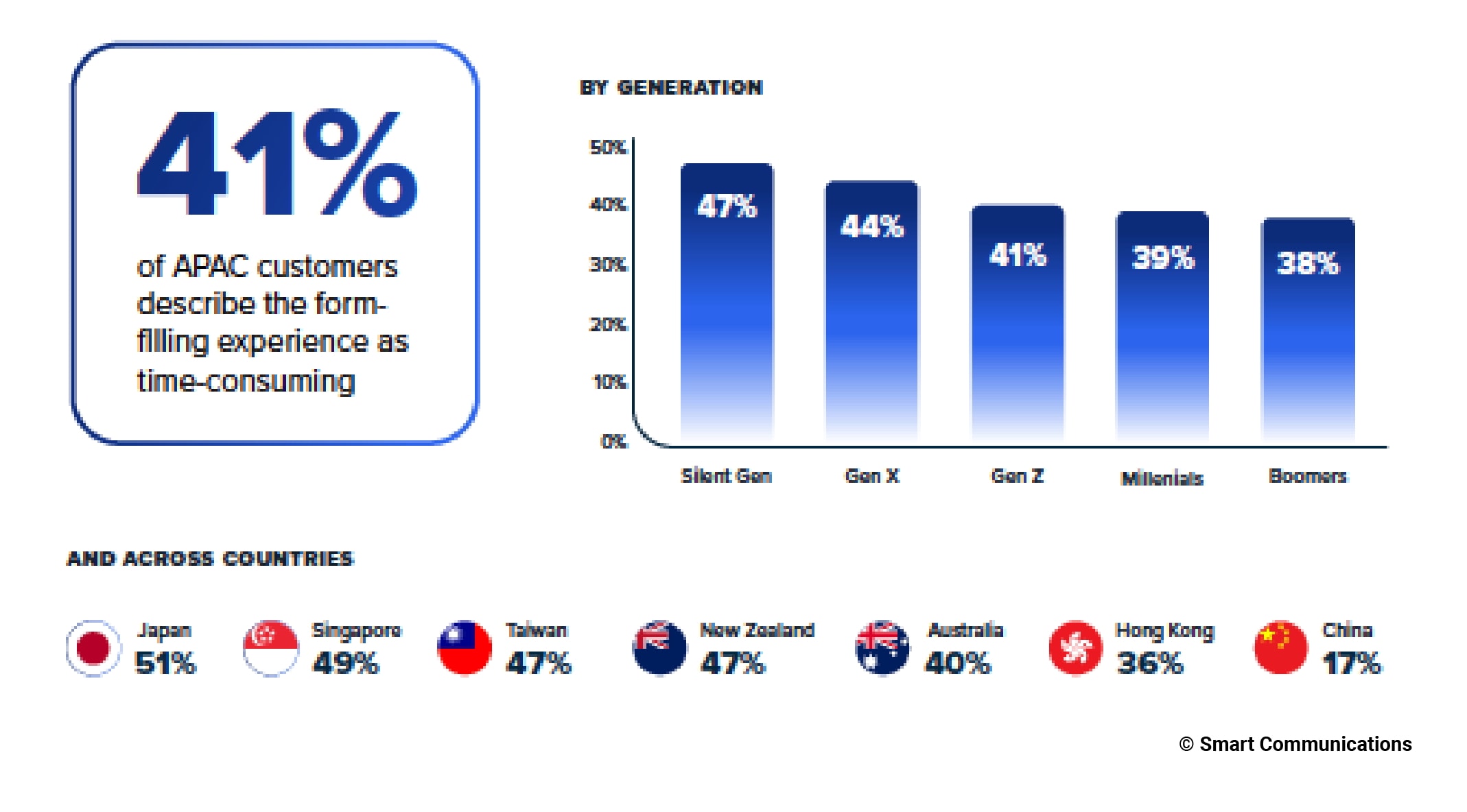
Manual or PDF-based processes don’t just slow things down; they frustrate customers and erode trust. Each inefficient form or manual handoff signals to customers that a brand isn’t keeping pace with their digital lives. In fact, nearly half of Singaporeans describe the form-filling experience as time-consuming (see chart below).

Quick Tip: Treat every data collection step as a chance to demonstrate ease, trust, and digital maturity.


2. Strong Communications Drive Stronger Loyalty

82% of Singaporeans are likely to recommend a provider if communications exceed expectations — the third highest globally of 12 countries surveyed.

Great communications don’t just build loyalty, they drive growth. When messages are timely, relevant, and personal, customers are far more likely to stay engaged and become advocates. The key is connecting the right data to the right message at the right time.

Quick Tip: Identify where personalisation can have the biggest impact. Do you have the mechanisms in place to collect, govern, and use that data effectively?


3. The Experience Gap Is Real

Only 49% of Singaporeans rate their communications as “very good” or “excellent,” compared to 61% globally.

Despite Singapore’s leadership in digital adoption, too many enterprises are still held back by legacy systems, data silos, and fragmented infrastructure. These limitations make it difficult to respond quickly, personalise effectively, or ensure consistency across channels.

Quick Tip: Conduct a CX audit across three dimensions: speed, personalisation, and channel preference. Identify where legacy systems are slowing you down.


4. The AI Opportunity Starts with Reliable Data

71% of Singapore consumers believe AI will improve customer experiences, compared to 61% globally.

Singaporeans are optimistic about AI, but readiness doesn’t always match enthusiasm. AI can only enhance customer experiences when the underlying data is accurate, accessible, and responsibly managed.

Quick Tip: Evaluate whether your current systems can support the speed and scale of AI-driven experiences. Legacy archives and data collection processes often can’t keep up. (Learn more in this article about archive strategy in the AI era.)


Bridging the Gap for Regulated Industries

For government agencies, banks, and insurers operating under strict regulatory frameworks, transforming the customer experience can feel like an impossible balance between innovation and compliance. But it doesn’t have to be.

That’s why Smart Communications has expanded its investment in Singapore with a new AWS-powered data centre — enabling local access to The Conversation Cloud™, the world’s leading Customer Engagement Platform purpose-built for highly regulated industries. (Read the press release.)

Designed with compliance, auditability, and governance at its core, the platform allows highly regulated enterprises to modernise with confidence — and to take advantage of practical, responsible AI that enhances productivity and personalisation without introducing risk.

Our approach to AI is grounded in transparency, control, and compliance — helping enterprises apply intelligence where it matters most, while staying within their regulatory guardrails. For Singapore’s financial institutions and government agencies, this means they can finally embrace AI safely, using data they can trust to deliver faster, more connected, and more human customer experiences.

Because the future of customer engagement in Singapore isn’t just about going digital — it’s about going smarter, safer, and faster.

Read more insights in the 2025 APAC Customer Conversations Benchmark Report.

Budgeting for Innovation in Healthcare Customer Engagement: Unlocking ROI with the Conversation Cloud

By John Zimmerer, VP of Healthcare Marketing at Smart Communications 

In his 1986 Chairman’s Letter, Warren Buffett famously wrote that Berkshire Hathaway’s goal is “to be fearful when others are greedy and to be greedy when others are fearful.” His words proved prescient, as the following year brought Black Monday, one of the worst single-day stock market losses in history. True to form, Buffett was greedy when the rest of the world was fearful. That worked out well for Buffett and his shareholders: the company booked a 20% profit that year. They’ve prospered since, too. 

So why is a healthcare guy talking about a financial services guru? 

Because the lesson is very apt in today’s very uncertain geopolitical, economic, and regulatory climate. As I write this, a lot of healthcare providers and payers are fearful. Rightly so. But fortune favors the bold, as the old Latin saying goes. And now is the time to be bold while others are fearful. 

What should you be bold about? 

Investing in your digital customer experience. 

Payers, yours is terrible. Period. Forrester has tracked healthcare CX for many years. The industry used to be better than airlines and the government. As per the 2025 report, it’s now the absolute worst. 

Providers should not be snickering in the corner. You have been trying to get patients through your digital front doors for years now. Our 2025 Healthcare Benchmark Report shows that your customers aren’t impressed. 

It’s time to get back in the game. It’s time to innovate. This budget season. Now! 

The Conversation Cloud™ from Smart Communications offers a transformative approach to customer communications and engagement. But how can organizations budget for technology innovations while ensuring a measurable return on investment (ROI)? 

The Case for Innovation in Healthcare 

Healthcare organizations face mounting pressure to improve outcomes, reduce costs, and enhance customer satisfaction. Traditional communication methods—paper forms, fragmented systems, and siloed data—are barriers to achieving these goals. Customer experience platforms like The Conversation Cloud and the solutions within streamline and personalize interactions across the customer journey, from onboarding and claims to care coordination and billing.  

From guided experiences that replace static forms with intelligent workflows to digital-first communications that extend beyond print, you’ll get consistent, compliant, and personalized messaging across channels. The Conversation Cloud provides a unified engagement ecosystem that drives efficiency and satisfaction.

Budgeting for Healthcare Communication Transformation: A Strategic Investment

When budgeting for customer engagement solutions, healthcare leaders should treat the initiative as a strategic investment rather than a technology expense. Here’s how to approach it:

1. Assess Current Costs and Inefficiencies 

Start by quantifying the costs of current processes:

  • Manual data entry and form processing
  • Compliance risks and remediation
  • Call center volumes due to confusing communications
  • IT overhead from maintaining multiple legacy systems

For example, a mid-sized insurer processing 100,000 forms annually may spend $10 per form on labor and error correction—totaling $1 million. Replacing these with guided digital interviews could reduce costs by 60% to 80%.

2. Define ROI Metrics

Establish clear metrics to evaluate ROI:

  • Operational Efficiency: Reduction in processing time and labor costs
  • Customer Satisfaction: Improvements in Net Promoter Score (NPS) or CAHPS ratings
  • Compliance and Risk Mitigation: Fewer errors and audit findings
  • Revenue Impact: Faster onboarding and claims processing can accelerate revenue cycles

A provider consolidating communications may reduce template management costs by 50%, cut production time by 70%, and improve message consistency—leading to higher patient engagement and fewer missed appointments.

3. Model Financial Impact

Use a simple ROI formula: ROI (%) = [(Net Benefit – Investment Cost) / Investment Cost] × 100

Let’s say a health plan invests $500,000 in a Conversation Cloud implementation. If the solutions yield $1.2 million in annual savings and revenue gains, the ROI is:

[(1,200,000 – 500,000) / 500,000] × 100 = 140% 

This kind of return is not uncommon when our solutions are deployed strategically.

4. Plan for Scalability and Integration 

Budgeting should include:

  • Initial implementation and configuration
  • Integration with EHRs, CRMs, and claims systems
  • Training and change management
  • Ongoing optimization and analytics

The Conversation Cloud’s ability to consolidate disparate communication platforms can reduce IT complexity and licensing costs, freeing up budget for innovation.

Real-World Success: Quantifying the Value 

Healthcare organizations that have adopted our solutions report tangible benefits:

  • A regional health system reduced patient onboarding time by 50% and cut form abandonment rates by 40%.
  • A national insurer consolidated 12 communication platforms, saving $2 million annually in licensing and support costs.
  • A Medicaid plan improved member engagement by 35% through personalized, accessible, multilingual communications.  

These outcomes demonstrate that a customer engagement platform isn’t just a technology upgrade—it’s a catalyst for transformation.

Final Thoughts: Making the Case for Healthcare Communications Transformation

To secure budget approval, healthcare leaders must present a compelling business case. Focus on:

  • Quantifiable cost savings and efficiency gains
  • Strategic alignment with organizational goals (e.g., digital transformation, member experience)
  • Risk mitigation and compliance improvements
  • Competitive advantage in a consumer-driven market

Innovation in customer engagement is no longer optional. With a Smart solution, healthcare organizations can deliver experiences that are intelligent, personalized, and scalable—while achieving a strong ROI.

To learn more about optimizing policyholder communications, request a demo to see our document automation capabilities in action. 

Frequently Asked Questions

Q. What are common challenges healthcare organizations face when implementing customer engagement platforms? 

A. Healthcare data is often siloed across multiple systems (e.g., EHRs, RCM, etc.), which makes data integration and interoperability a challenge, and hinders personalized engagement. Using FHIR/HL7 or a data integration solution (e.g., MuleSoft) can help. Security is also a challenge, so making sure solutions are HIPAA certified, not just compliant, can help providers narrow vendor choices. Not all patients are comfortable using customer engagement platforms, so meeting them on their channel of choice (SMS, email, etc.) is essential. 

Q. How do platforms like the Conversation Cloud integrate with existing healthcare IT systems? 

A. The Conversation Cloud uses RESTful APIs and OAuth 2.0 to integrate with FHIR/HL7 servers and integration engines (e.g., Rhapsody, InterSystems, etc.).

Q. What metrics should healthcare leaders track post-implementation to measure success? 

A. Healthcare leaders should track in situ metrics to understand how users are interacting with the solution. This can include time-to-completion, abandonment rates, and error rates. They should also track delivery and engagement metrics, such as delivery failures (e.g., bad email address, phone number, etc.), open rates, and response rates. Adjacent metrics can also be useful, such as call volume related to the engagement platform, and customer satisfaction surveys.

Q. How can healthcare organizations ensure compliance while digitizing communications? 

A. The first hurdle is making sure each recipient has affirmatively opted in to using the engagement platform. HCOs must also make sure that communications comply with regulations, particularly when communicating protected health information. Choosing solutions that provide encryption, access controls, and audit logging is essential for compliance. Lastly, archiving digital communications with a solution such as SmartHUB will help HCOs evidence compliance to auditors and regulators.

Q. How can healthcare organizations budget for digital customer experience improvements during tight financial cycles? 

A. When done right, improving digital experience also improves operational metrics. Examples include: 

  • Shifting from printed and mailed communications to digital
  • Automating personalized communications and providing self-service options to reduce staff burden
  • Reducing no-shows or increasing patient retention to improve revenue 

How the Conversation Cloud™ Earned Leader Status on Four Aspire Leaderboard Grids

By Scott Draeger, SVP of Product Marketing and Vertical Solutions 

Smart Communications is proud to see Conversation Cloud™ solutions placed in the Leader category on four distinct Aspire Leaderboard Grids in the July 2025 revision of the Aspire Leaderboard. Aspire CCS’ research recognizes early shifts in customer engagement technologies by technology capabilities, vertical industries, firmographics, location, and use cases.  

The Smart Communications team is excited to have fresh research that validates our strong market position and technology, but we’re prouder of how our customers engage with their clients every day. Visit our case study library for more on that. According to the updated vendor profile, “Smart Communications’ strategy is to empower enterprises to transform their customer communications through three core capabilities that directly impact business outcomes.”

Leadership Positions Across Four Market Categories 

Smart Communications earned leadership positions in the following categories on the Aspire Leaderboard’s July 2025 update: 

  • AnyPrem CCM
  • Vendor Hosted SaaS CCM
  • Interaction Experience Management (IXM)
  • CXP markets   

Furthermore, Smart Communications achieved a platform strength score of 97 in Vendor Hosted SaaS CCM—the highest score given to any vendor on any Aspire Leaderboard grid.  

Aspire’s scoring also reflects Smart Communications lead in Go to Market Strategy in both AnyPrem CCM and Vendor Hosted SaaS CCM, recognizing our focus on quickly solving the challenges of the highest stakes communications in highly regulated industries with leading SaaS capabilities.  

The Conversation Cloud Has Grown Since the 2024 Update 

The April acquisition of Joisto brought SmartHUB™’s powerful cloud-native archive capabilities to the Conversation Cloud in June. The addition enables our clients to seamlessly connect their communications and forms from creation to archival and retrieval and Aspire recognized this integrated approach with Leader placements in key Leaderboard grids. Check out the video below to learn more about SmartHUB:


Vendor Hosted SaaS CCM: Strong Platform Performance 

In the grid for Vendor Hosted SaaS, Smart Communications earned a platform strength score of 97. Out of 15 vendors evaluated, this represents the highest score for any vendor in any grid in this cycle of the Aspire Leaderboard. This score reflects the clear focus, maturity, and capabilities of Smart Communications’ cloud-native platform architecture.  

Smart Communications’ technology received the highest overall strategy score in this segment, supported by focused go-to-market execution. The Product and Vertical Marketing team members, including Eileen Potter for Insurance, John Zimmerer for Healthcare, Cindy Griffin for Financial Services, Sally Schulte for SmartIQ, and Chris Murphy for SmartCOMM, spend time with customers, prospects, and partners to collect data, refine use cases, and find solutions for the problems of complex communications in regulated industries.  

Interested in more industry- and technology-specific insights from our experts?
Click their names above for more advice to help you optimize the digital experiences you provide your customers. 

Customer Success Documentation 

While Smart Communications’ investment in people contributes to Smart Communications’ reputation as a reliable partner for enterprise transformation through their industry expertise and customer relationships, it also allows us to collect a lot of content. We maintain an extensive library of customer case studies and educational videos that demonstrate practical applications and business outcomes across various industry verticals, providing evidence of successful implementations. 

Our SmartIQ sample library has increased by a third since the last Aspire Leaderboard release, as more ready-to-use experiences are available for common data collection challenges across finance, insurance, and healthcare applications. Check out the video below to see how one our clients, The Bancorp, leveraged SmartIQ to reduce loan origination times by 98%, significantly enhancing the customer experience in this area: 


AnyPrem CCM: Navigating Market Evolution 

The AnyPrem CCM market reflects the present status of CCM technology as new communication applications move to the Vendor Hosted SaaS CCM market at increasing rates. As legacy technologies in the AnyPrem CCM market are decommissioned, this trend will continue to accelerate.  

Smart Communications earned Leader placement on this grid by offering a future-ready route  for organizations seeking to modernize customer and employee experiences. By providing clear migration paths away from many of the outdated technologies featured on this grid, Smart Communications empowers companies to meet the expanding needs of today’s digitally native customers as well as print-first customers. 

IXM: Advancing Interactive Experience Management 

Within the Interaction Experience Management grid, Smart Communications strengthened its position in IXM Differentiation. With a 2025 score of 67, Smart Communications broke from a four-vendor group with the same top score in 2024 to be recognized as the sole vendor with the top score in the differentiation category. Shifting to the scoring for the benefits of IXM, SmartIQ’s score of 70 represents a 40% advantage over the closest competitors, reflecting the transformational business outcomes, as demonstrated by customers like The Bancorp. 

Key Findings from Aspire 

The refreshed Aspire Leaderboards also include revised summaries and descriptions of the Smart Communications business and technology. Aspire observes, “Smart Communications has evolved from individual product offerings to an integrated platform approach, addressing enterprise requirements for seamless integration across multiple communication channels and consistent brand experience.” 

The research also offers, “This [Joisto] acquisition, as well as the launch of SmartPATH, puts Smart Communications in much stronger position for expansion in the rapidly evolving AI landscape, where communications tracking, real-time orchestration, and the analysis of document metadata is a vital component of superior customer experiences.”  


Market Position and Future Outlook 

Smart Communications’ recognition across four Aspire Leaderboard grids reflects a comprehensive strategy that has strengthened the company’s market position as well as the technology stacks of our customers. The combination of technical capabilities, strategic market approach, and customer focus has created competitive advantages across multiple market segments. 

As enterprises continue to prioritize customer communications management projects to meet rising customer expectations and reduce operating expenses, Smart Communications is positioned to support transformation initiatives while delivering measurable improvements in customer experience and operational efficiency. 

Ready to See What The Hype is All About?
Request a demo to see our products in action. Or, for more on how Smart Communications achieved the rankings outline in this blog, access the full Aspire Leaderboard Grids. 

Transforming Insurance Through Strategic Partnerships

By Eileen Potter, VP of Insurance Marketing at Smart Communications 

In an industry as complex and regulated as insurance, partnerships aren’t just a nice-to-have; they’re essential. The right collaborations help insurers streamline operations, improve customer experiences, and stay ahead of evolving policyholder expectations. That’s why Smart Communications continues to invest in deep, strategic relationships with industry leaders like Guidewire, AWS, and HTC Global. Each of these partnerships brings unique value to insurers looking to modernize their customer interactions while maintaining efficiency and compliance. 

Chuck Fazio, Smart Communications VP of Partnerships, has spent his career building relationships that demonstrate the collective power of complementary technologies and expertise. From his perspective, “Strategic partnerships are critical to helping insurers build technology ecosystems designed to adapt to future challenges and opportunities, and enable organizations to embrace a digital-first future with confidence.” 

Smart Communications and Guidewire: Delivering Streamlined Integrated Experiences 

For P&C insurers, the partnership between Smart Communications and Guidewire is all about making communications more streamlined and personalized. Policyholders expect clear, timely, and relevant interactions – whether they’re receiving a quote, filing a claim, or renewing a policy. 

By embedding Smart Communications’ Conversation Cloud™ into Guidewire InsuranceSuite, insurers can automate and personalize customer communications directly within their existing workflows. This means policy documents, claims correspondence, and billing statements can be dynamically generated, customized, and delivered without forcing users to jump between systems. The result? A smoother, more connected experience for both customers and internal teams. 

More importantly, this partnership helps insurers scale. As policyholder needs evolve, insurers can adapt their communications strategies without major overhauls, reducing operational burden while improving engagement. It’s about working smarter, not harder. 

“Customer expectations continue to grow and change, and P&C insurers must optimize their processes and offerings to meet these needs and remain competitive,” said Will Murphy, Vice President, Global Technology Alliances, Guidewire. “Together, Guidewire and Smart Communications have helped over 120 insurers modernize their business with the power of leading-edge core systems and customer communications solutions. Our integrated technologies enable insurers to automate processes and reduce IT burden, while enhancing the communications experience for policyholders to increase satisfaction.” 

The Smart Communications integrations with Guidewire are available for download now in the Guidewire Marketplace.  

Smart Communications and Amazon Web Services (AWS): Powering Secure, Scalable Digital Transformation

Digital transformation in insurance isn’t just about moving to the cloud – it’s about making that move strategically and purposefully. That’s where the partnership between Smart Communications and AWS comes in. Today’s insurers need a robust communication platform that not only scales with their business but ensures the highest levels of security and compliance. 

 Running on AWS, Smart Communications delivers the enterprise-grade reliability, scalability and security insurers require while enabling the business agility they need to stay competitive. With AWS’s advanced cloud capabilities, insurers can seamlessly process high volumes of customer interactions without latency or downtime. Plus, AWS’s global infrastructure ensures that insurers can meet regulatory requirements across different regions while maintaining consistent, seamless customer engagement. 

 Another key benefit is the ability to leverage AWS’s AI and machine learning capabilities. By integrating these technologies, insurers can drive more personalized, data-driven communications – whether through predictive analytics that anticipate policyholder needs or intelligent automated responses that enhance self-service options. The result is not just operational efficiency, but also a more proactive approach to customer engagement. 

“Insurers today are looking to deliver more personalized experiences while maintaining the highest levels of security and compliance. Through our partnership with Smart Communications, we’re helping insurance companies leverage the power of AWS’s global infrastructure and advanced capabilities like AI and machine learning to transform their customer communications. This collaboration enables insurers to scale their operations efficiently, meet regional regulatory requirements, and create more meaningful policyholder interactions – all while maintaining the security and reliability that the insurance industry demands.” 

-Terry Buechner, Principal Insurance Specialist, Global Core Systems Lead at Amazon Web Services (AWS) 

Smart Communications and HTC Global: Accelerating Implementation and Maximizing Value 

Technology is only as powerful as its implementation. That’s why Smart Communications’ partnership with HTC Global is so valuable for insurers looking to get the most out of their investment. HTC Global brings deep industry expertise and implementation capabilities that help insurers quickly deploy and optimize Smart Communications solutions within their existing tech ecosystems. 

HTC Global’s team works closely with insurers to ensure that Smart Communications’ solutions are configured to meet their specific business needs. Whether it’s integrating with legacy systems, streamlining workflows, or enabling new digital communication channels, HTC Global helps bridge the gap between strategy and execution. 

Beyond initial implementation, HTC Global also plays a role in ongoing support and optimization. As insurers’ needs evolve, they need a partner that can help them fine-tune their communication strategies without disrupting day-to-day operations. That’s exactly what this partnership delivers—practical expertise that translates into real business value. 

“Technology’s true power lies in its execution. Our partnership with Smart Communications empowers insurers to seamlessly integrate, optimize, and scale their digital communications – maximizing ROI while ensuring agility in a rapidly evolving industry” 

-Jayanthi Balu, Director, Insurance and Digital Practice Leader, HTC Global Services

The Power of Partnership:  Enabling Insurers’ Success

The role that partners can have in driving innovation was evident in the panel that I moderated at Guidewire Connections last November – Innovate to Elevate: Strategies and Stories from Insurers’ Guidewire Cloud Transformation. I was joined by Brad Lontz, CIO from CopperPoint Insurance and Sreenivas Gouraram, AVP, Systems Development & Guidewire Platform Lead, from CNA Insurance. They shared their experiences migrating from on-premises systems to Guidewire Cloud, discussing the strategic drivers behind their moves, the challenges they faced, and the significant benefits realized – including improved agility, scalability, and cost efficiency.  

With Smart Communications, AWS, and HTC Global playing key roles in their transformation, it was a great example of what’s possible when collaboration meets innovation, as the panel provided valuable insights into how insurers can modernize policyholder experiences and streamline operations through cloud adoption. 

Looking Ahead: Building on the Momentum 

Individually, each of these partnerships strengthens insurers’ ability to modernize customer communications. Together, they create a powerful ecosystem that enables smarter interactions, greater efficiency, and long-term scalability. I’m looking forward to connecting with all these partners at our customer conference, Innovate, which will be held in New Orleans from April 22-25.  

Guidewire and Smart Communications partnership enables P&C insurers to integrate intelligent communications directly into their core systems, enhancing policyholder interactions at every touchpoint. AWS provides the secure, scalable foundation insurers need to support digital transformation and future-proof their operations. HTC Global ensures that these technologies are implemented effectively, helping organizations maximize their investment and drive real business outcomes. 

For insurers, the takeaway is clear: the power of combining expertise and technology can enable them to achieve transformative outcomes that redefine how they interact with their customers, manage their operations, and stay ahead of the competition.  

To hear more from our Partners, download a complimentary copy of our latest report, ‘5 Trends Shaping Customer Conversations in 2025’ today. 


About the Author 
Eileen Potter is the Vice President of Vertical Marketing, Insurance at Smart Communications. She has more than 25 years of insurance and insurance technology experience with both Property & Casualty and Life & Annuity, including insurance operations on both the agency and company levels. Eileen has worked in independent agencies and MGA operations in a variety of roles, including commercial marketing and underwriting. Her software background includes systems marketing, sales support, and implementation roles with organizations such as ABBYY, Appian, One, Inc., and Duck Creek Technologies. 

4 Smart Moves for Life and Annuity Insurers to Navigate Change and Drive Innovation

By Eileen Potter, VP of Insurance Marketing at Smart Communications 

The life insurance and annuity (L&A) market is navigating a challenging landscape, balancing the pressures of increasing costs, competition, and evolving customer expectations. As customer demands shift, insurers must innovate to remain competitive, focusing on both growth and cost efficiency.

Our latest white paper identifies four critical areas of focus for L&A organizations, highlighting the importance of making strategic investments in technology that align with both their business goals and the need to increase customer satisfaction. In this article, we provide a quick dive into the key insights from the paper. 

1. From Cost-Savings to Customer-Centricity 

Today’s market demands that L&A organizations balance budget constraints and the need to become more customer centric. Insurers must prioritize omnichannel experiences to enhance engagement and future-proof their businesses. Digitization and automation play a central role in streamlining processes, making it easier to meet customers’ expectations while reducing operational costs. 

Modern conversation platforms are revolutionizing the customer experience, providing an end-to-end connected experience where insureds can engage in real-time, two-way communication via their preferred channels. By simplifying processes from quote submission to underwriting and issuance, insurers are speeding up the time to coverage, providing personalized, on-demand digital service that drives satisfaction and loyalty. 

2. Policy Servicing: An Overlooked Opportunity 

While most insurers place the bulk of their focus – and their technology budgets – on new business acquisition and claims, servicing in-force policies is just as critical. Whether it’s policy updates, billing inquiries, or service requests, these ongoing touchpoints represent valuable opportunities to build trust and deepen relationships. 

Investing in digital communication solutions to enhance these interactions reduces friction and administrative burdens, while also mitigating the risk of policyholder attrition. This shift in focus from just acquisition to long-term customer retention is vital for fostering loyalty and improving the bottom line. 

3. Reducing Operational Costs Through Strategic Efficiency 

With low investment returns and rising talent acquisition costs, increasing operational efficiency has never been more crucial. To achieve this, insurers must lower the cost of acquiring and servicing policies, while accelerating revenue growth. Operational excellence demands a continued emphasis on digital transformation and an improved customer experience. 

Automating manual processes, embracing cloud solutions, and streamlining workflows are all key to reducing operational costs. Insurers who prioritize efficiency through technology can respond quickly to market pressures, while maintaining high levels of service. 

4. Strategic Technology Investments for Long-Term Success 

Despite budget constraints, insurers recognize the need for strategic investments in technology that deliver business value. Increasingly, organizations are finding that breaking down the silos between the business and IT teams can help to ensure that technology spending aligns with business priorities, especially in areas that drive customer experience, operational efficiency, and compliance. 

Digital transformation is at the forefront of these investments, with insurers focusing on tools like customer portals, mobile applications, and advanced analytics to understand customer behavior. Cloud adoption is also on the rise, offering scalability, flexibility, I cost savings. By moving more systems to the cloud, insurers can innovate more and deploy new services faster. However, IT budgets are still under pressure, and insurers must prioritize projects with the highest return on investment. 

Transforming Challenges into Opportunities: How Insurers Can Thrive in 2025 and Beyond 

By shifting from a cost-centric approach to one that embraces customer engagement, optimizing operational efficiencies, and making strategic investments in technology, insurers can position themselves for future success. 

Download the white paper ‘Navigating the Future: 4 Key Focus Areas for Life & Annuity’, which provides a roadmap for life and annuity insurers to thrive in an increasingly complex environment. 


Report Ranks Healthcare Customer Experience Platform Vendors

By John Zimmerer, VP of Healthcare Marketing at Smart Communications 

A report entitled “The Forrester Wave™: Customer Experience Platforms For Healthcare, Q3 2024” (Forrester Research, Inc., September 23, 2024) evaluates and ranks eight member engagement and patient engagement solution vendors. Smart Communications was profiled in the report. 

In this post, I’m going to highlight a few points about the report itself and our placement in it. 

The Requirement for Data and Trust 

In the opening paragraphs of the report, Forrester observed that, “CX and digital leaders at healthcare organizations (HCOs) contend with legacy technology platforms with limited interoperability, analytical capabilities, and data integration.” Per the report, the symptoms of that underlying condition are: 

  • Lack of personalized guidance
  • Customer frustration
  • Low levels of consumer trust 

The prescription for relief, as written by the analysts, is for HCOs to “move beyond systems capable of only transactional engagements. To create value for customers, they must foster personalized customer experiences designed to sustain engagement, not just drive acquisition. CX platforms for healthcare can help HCOs eliminate point-solution fatigue and reduce a narrow focus on the digital front door.” 

Vendors Profiled in the Report 

This Wave report follows a market landscape report, where Forrester initially identified 29 vendors in the healthcare CX space. The Wave focuses on eight of those vendors. The inclusion criteria were rigorous. Vendors needed to demonstrate their ability to design, manage, and customize customer journeys with an omnichannel interface that appears seamless. Vendors also needed to evidence their ability to provide multiple customer experience (CX) solution types and categories. 

Vendors also needed to be, for lack of a better word, relevant in the marketplace. To be in the Wave, a vendor needed a history of effectively facilitating healthcare experiences, a significant market presence, and Forrester client mindshare. 

Smart Communications is ranked as a Challenger in this report, and we are identified as a non-participating vendor. 

Our take: We are a Challenger largely because the Conversation Cloud™ platform enables our customers to build a wide range of experiences that expand beyond the core use cases covered in the report, whereas the other vendors provide a set of those specific experiences out of the box. Customer experience management products have some features, such as audience segmentation, that our Conversation Cloud does not. And, as Forrester points out in our profile, we leverage a very large partner network to provide that and other functionality. That said, we have identified several of the evaluation criteria where we believe we’ll be able to demonstrate improvement in subsequent Wave evaluations. 

As for being a non-participating vendor, that comes down to how the Wave criteria and process were defined versus our unique offering. 

When analyst firms do evaluations like this one, they send vendors a description of the use cases they want the vendor to demonstrate, functionality to highlight, etc. Since we’re a platform for building experiences, we didn’t feel the criteria applied to us in the same way they would to the other products being evaluated. 

It’s important to note that Smart Communications is the only vendor of its kind listed in the Wave. No other vendor offering customer communication management (CCM), interaction experience management (IXM), or workflow and content automation solutions made the list. We believe our inclusion in this Wave validates our platform vision and reflects the investments we have made in our core vertical markets. This Forrester report pairs very well with those from Aragon, Aspire, Celent, IDC, Omdia, Quadrant Knowledge, and other analyst firms covering our core markets which identified us as a leader and scored us so highly for our strategy and capabilities for modernizing customer communications and streamlining data collection. We very clearly see where these industries need to go, and we’re blazing the trails to get there. 

A Smart Solution for Member Engagement and Patient Engagement 

The Conversation Cloud from Smart Communications is trusted by payers and providers to establish and increase member engagement and patient engagement. Our solutions can integrate with core systems to provide a highly secure enterprise-wide engagement platform.  

Contact us to learn more about how we support care referral coordination, chronic care management, and customer activation, among many other customer experience use cases.

McKinsey Offers Advice on Upcoming Changes to CMS Star Ratings

By John Zimmerer, VP of Healthcare Marketing at Smart Communications 

In an article (registration required) published August 13, 2024, McKinsey & Company provide an excellent analysis on the upcoming changes to the Centers for Medicare and Medicaid Services (CMS) Star Ratings program.  

In the article linked above, the firm underscores the significance of CMS’s shift toward health outcomes and highlights how member experience will continue to impact scoring. I’ve compiled those insights, what they mean for healthcare payers like you, and how Smart Communications’ solutions can help, in this article below. 

Key Findings from the Report 

The full report is well worth the read, but I’d like to call out a few points that caught my attention. 

I’ve written and presented in the past on the importance that Medicare beneficiaries place on the Star Ratings when choosing a plan. McKinsey has been surveying this population for several years, and noted in the report that Star Ratings, as the most important factor in plan selection, increased from 5% in 2020 to 24% in 2023. They also analyzed plan enrollment data and found that, as of the 2023 plan year, 76% of those enrolled in a Medicare Advantage plan were in plans rated four or more Stars, up 10 percentage points since 2015. Clearly, Star Ratings matter to potential enrollees. 

McKinsey called attention to the fact that, starting in 2025, quality of care and outcomes will be weighted more heavily in CMS Star Ratings. According to their analysis of plans with a high percentage of members in value-based contracts, McKinsey found that providers that do better on HEDIS and CAHPs surveys can be linked to a 0.5 to 1.5 percent reduction in medical loss ratio (MLR). So, focusing on quality should help Medicare Advantage plan members achieve better outcomes and the payers that offer those plans be more profitable. 

And while member experience measures will decline in weighting in rating year 2026, McKinsey pointed out that those measures will still make up a considerable portion of the aggregate Star score. McKinsey advises: “High performance in these competitive measures will continue to be critical to achieving a 4+ Star Rating for the foreseeable future.” 

What Payers Can Do to Improve CMS Star Ratings 

McKinsey suggests that, to help improve quality metrics, payers can strengthen provider relationships by developing digital provider-enablement tools that offer near-real-time member data. They called out that these capabilities will become increasingly critical as clinical Star measures become more time-bound (for example, requiring member-level follow-ups within 30 days after an event). 

They also noted that this year marks the first time in which CMS will collect data to benchmark performance for the Health Equity Index (HEI). As McKinsey puts it: This means that to maximize performance in rating year 2027 (RY2027), payers need to prioritize identifying—and engaging—members with HEI-defined social risk factors now.  

They suggest that two of the important demographics to focus on will be members of dual-eligible special needs plans (D-SNPs) and those eligible for the low-income subsidy (LIS). The article says, “Improving HEDIS scores is important, as their performance will have a greater effect on overall Star Ratings given that the newly introduced HEI is expected to comprise select HEDIS and pharmacy measures. While identifying D-SNP and disabled members from member profiles should be relatively easy, identifying LIS-eligible members could require more effort. CMS estimates up to three million seniors could benefit from this program but are not currently enrolled. To find likely LIS-eligible members, payers can consider claims, socioeconomic data, geospatial data, as well as information from screenings and surveys related to social needs and wellness, among other data types. Beyond current MA members, payers can also zero in on their own commercial or individual plan members who will age into Medicare in the near term.” 

McKinsey also states that, “…member outreach is imperative, and personalizing targeted messages can help ensure necessary actions are taken. Subsequently, tracking how such outreach initiatives affect results is important for reallocating resources away from low-ROI methods.” They suggest that the focus of this outreach should be on recommending that members consider higher-quality yet lower-cost care, and that enhancing member experience to address care gaps and identifying members with social risk factors are important next steps. 

McKinsey closes with this statement, which I’m including verbatim: 

“Investing in automation and other digital technologies such as generative AI is key to improving member experience. For example, automated prior authorization, customer self-service AI chatbots, targeted member messaging, and automated outreach could help plans’ Star performance. 

A Smart Solution for Improving Star Ratings 

Such tools, like The Conversation Cloud™, can also have the added benefit of helping reduce costs, especially administrative expenses. Our analysis indicates that in 2025, MA payers could face administrative and medical cost increases of $50 per member per month (PMPM), driven by increased healthcare utilization and administrative spend, and $30 PMPM revenue impact due to rate declines (Exhibit 3). Administrative efficiencies gained from improved digital tools will help offset these increases and the investments needed to fully integrate Star Rating improvements into the overall MA strategy.” 

The Conversation Cloud fits perfectly with these recommendations. Our solutions can integrate with core systems to provide a highly secure enterprise-wide engagement platform. Specifically: 

  • Payers can use SmartIQ™ to conduct HEDIS and CAHPS surveys.
  • Payers can use SmartIQ to survey and screen members on their social risk factors (SRFs).
  • Payers can use SmartIQ workflows to automate outreach messages to members.
  • Payers can feed data from SmartIQ, core systems, and third-party data sources to send targeted outreach messages to members (e.g., re: LIS eligibility and lower cost options), potentially using SmartCOMM to manage the communications.
  • Payers can use Conversation History as a data source for tracking responses to iteratively improve outreach initiatives.
  • Payers that implement these tools could recognize the cost savings that McKinsey estimates. 

Contact us to learn more about how our software can support your quality improvement efforts.

Omnichannel Customer Engagement: Connecting with Customers on Their Terms

By Smart Communications

Whether interacting with your company via desktop, tablet, or mobile—or through web, email, or an app—today’s customers have high expectations for what that customer experience should be. Most importantly, they want to connect with your company on their terms.  

But, what are those terms? Let’s explore them and why they’re important to delivering omnichannel customer engagement. 

1. Provide Truly Personalized Interactions

Customers give companies personal information. Knowing that they have that data and insight at their disposal, it only makes sense that today’s customers expect brands to deliver a more personalized experience–one that goes beyond just addressing them by name. Some of the ways you can supply a more personalized experience are by: 

  • Leveraging customer data to customize recommendations and offers via a centralized, modern customer communications management (CCM) solution that bridges data silos. Incorporating dynamic content that will modify based on customer behavior.
  • Delivering emails, messages, and advertisements that are targeted based on personalized data.
  • Proactively reaching out to the customer to provide guidance and value based on the products/services they have with your organization. 

The Business Benefit: By personalizing interactions, customers will feel more valued and understood by your brand. This will strengthen the relationship customers feel they have with your company and help promote brand loyalty. 

2. Be Available on the Channel They Prefer 

When it comes to what channel(s) they use to communicate with friends, family, and colleagues, everyone has their personal preferences. It’s no different when they want or need to engage with a company. Customers expect to be able to communicate using whatever channel they prefer. To make that possible your organization needs to commit to the following: 

  • Have a presence on your customers’ most-used platforms.
  • Offer live chat support on your website.
  • Ensure you are providing user-friendly web and mobile experiences.
  • Leverage an industry-leading CCM solution that enables you to create channel-agnostic customer communications delivered on your customers’ preferred channels. 

The Business Benefit: Being on your customers’ preferred channels will show that you’re a customer-centric company that believes interacting with your brand should be as convenient as possible for your customers. 

3. Offer Two-Way Conversations in Real Time 

Customer communication is no longer a one-way street. Speaking at customers isn’t good enough. In the world of omnichannel customer engagement, two-way conversation is the new norm. It’s about talking, listening and responding and, in most cases, in real time. It’s what customers expect from every company in every industry. Here’s how your company can facilitate two-way conversation in real time:  

  • Monitor all touchpoints for customer inquiries/feedback and respond.
  • Leverage known customer information to prepopulate forms and provide highly personalized, tailored experiences.
  • When emails or messages are received from customers, respond in a timely fashion. 

The Business Benefit: By having two-way conversations with customers in real time you will show that your company is responsive, which will enhance the trust customers have in your brand. 

4. Ensure Consistency Across All Communication Channels

Throughout communicating with your brand, a customer may begin engaging in the morning on their cell phone, continue the process at lunchtime on a laptop, and complete the task that evening on a tablet. No matter what the touchpoint though, your customer is expecting the experience to be cohesive. An omnichannel customer engagement experience can’t be considered seamless unless it is consistent. Your company can accomplish this by: 

  • Mirroring your messaging and branding across all channels.
  • Delivering the same degree of service and support across all channels.
  • Employing systems/software that enable continuity and consistency across all touchpoints. 

The Business Benefit: A seamless omnichannel experience across all channels will make the customer journey even smoother and take customer satisfaction and trust to new heights.  

5. Anticipate The Customers’ Needs

Within your database you have collected personal information about your customers. That information provides insight that your customers expect you to analyze and use to predict what solutions they need. To take your brand to this level, consider these omnichannel customer engagement strategies: 

  • Add predictive analytics to your toolbox so you can foresee what customers require.
  • Review past purchases by customers to determine what to recommend next.
  • Don’t wait for issues to arise; anticipate them instead and address them before they become reality. 

The Business Benefit: By anticipating their needs, each customer will feel like their experience with your brand is even more tailored to them. 

6. Protect Their Data

Data privacy is probably the biggest concern customers have when it comes to divulging their personal information to your brand. Their level of concern is underscored by the strict regulations and compliance standards governments have for data security, especially in the financial services, insurance and healthcare industries. Without a doubt, ensuring customer data is secure is an important component of the omnichannel customer engagement picture. Here are some ways your company can be compliant with customers and regulators:  

  • Deploy vigorous security measures to protect customer data.
  • Eliminate the need for manual rekeying by implementing an automated, intellilgent data collection solution.
  • Always ask for explicit consent before collecting and using personal information.
  • Stay up to date and comply with the latest data protection regulations. 

The Business Benefit: If customers are reassured that their personal data is safe with your brand, they are more likely to share it with you. In turn, by gaining that information and insight your brand will be empowered with the ability to deliver the personalized experience customers expect. 

A CCM Makes It Possible to Connect with Customers on Their Terms 

Connecting with customers on their terms is a tall order, especially if your organization is trying to do so with a hodge podge of legacy systems that are not capable of integrating with one another. 

The simple solution to achieving the omnichannel customer engagement you envision is to transition to a customer communications management (CCM) system. A cloud-based CCM solution will give you the centralized, scalable infrastructure you need to easily: 

  • Provide truly personalized interactions with your customers.
  • Communicate on whatever channel your customers prefer.
  • Facilitate two-way conversation in real time.
  • Ensure the customer experience is consistent across all channels.
  • Anticipate customer needs and take proactive action.
  • Deliver on your promise that personal data is safe and secure. 

Conclusion 

Omnichannel customer engagement is essential for your business to thrive in today’s digital-first marketplace. By implementing a CCM you’ll be able to connect with your customers on their terms. This will lead to stronger customer relationships, greater brand loyalty and fuel growth for your business. 

Searching for customer communications management (CCM) software? Then the “Ultimate Guide to CCM Software & Strategic Solutions” is for you.

Learn about CCM software, explore why a cloud-based CCM solution positions you for omnichannel customer engagement success, find questions you should ask when choosing a CCM vendor and much more. Read the guide now. 

Improving Patient Engagement: How the Conversation Cloud™ Leads the Way

By John Zimmerer, VP of Healthcare Marketing at Smart Communications 

Digital transformation in healthcare presents a mixed landscape, according to analyst firms IDC, Forrester, and Gartner1. These initiatives aim to enhance customer engagement, streamline processes, and improve patient outcomes, yet, per Gartner, as many as 60% fall short of expectations. 

Gartner points out that many of these efforts result in “optimization” rather than true “transformation”. Genuine digital transformation goes beyond digitizing existing processes – it reinvents them. This often involves transitioning from legacy point solutions to enterprise-wide platforms, typically cloud-native SaaS solutions. 

This blog explores how Smart Communications’ The Conversation Cloud helps providers reinvent patient engagement, forms and communication processes. Our solutions that make up the Conversation Cloud platform provide the convenience, personalization, and the data security your patients desire, while also aiming to increase health equity and improve outcomes. 

The Burden of Forms on Patient Engagement 

Forms are ubiquitous in healthcare, and patients despise them. They find these forms time-consuming, repetitive, and often riddled with irrelevant questions. 

This dissatisfaction affects both your top and bottom lines. A survey of physicians and patients found that: 


I would submit that a good chunk of that in-office waiting time is largely due to forms. When visiting a healthcare provider, patients may encounter (and staff are often asked to help with) various forms, including: 

  • Scheduling the appointment
  • Pre-registration and intake
  • Consent to treatment
  • Medical record release authorization
  • Authorization of representative
  • Financial assistance application 

Many providers still rely on paper forms to collect patient information. Scanning and using optical character recognition (OCR) on these forms can be cumbersome and carries the risk of data loss (no OCR program claims 100% accuracy) and breaches, since paper is portable. 

Some providers have moved to fillable PDF or HTML forms, but these often fall short of patient expectations. Patients want forms that pre-fill known information, provide a consistent experience across devices, allow progress to be saved, and ask only relevant questions. 

Our research identified these as top reasons why patients abandon forms. 

Typically, healthcare-related forms are difficult to modify without IT help and are challenging to manage and control. The software used to create forms often lacks integration with core systems or with third-party services (e.g., address verification or e-signature solutions) or has limited functionality. For example, most cannot support multiple parties contributing information, route to multiple signatories, or chain forms together.   

For instance, if a medical release form is being completed on behalf of another person, an appointment of representative forms is also required. Similarly, multiple admission forms may need to be combined into a single digital signing session to streamline the process for the patient and reduce the provider’s e-signature costs.  

Outdated Patient Forms Are a Symptom of a Larger Process Problem 

Forms are always part of a larger process: they collect data for purposes such as informing a treatment plan or managing revenue cycles. 

Examples of these larger processes include: 

  • Admissions
  • Care coordination
  • Referral management 

To truly digitally transform these crucial processes, simply moving to electronic forms is insufficient and only scratches the surface. Beyond the forms, supporting workflows must be built and automated. Additionally, the data gathered needs to be standardized and disseminated to the appropriate systems for reuse. This requires a single enterprise platform that integrates seamlessly with your existing systems, rather than a collection of point solutions. 

SmartIQ™, the forms automation and data collection part of The Conversation Cloud platform, meets all these requirements. 

How You Can Benefit from SmartIQ and Improve Patient Engagement 

  • Decreased abandonment rate. Easy-to-access, simple, and individually relevant forms increase submission rates. 

  • Shortened time to completion. Faster form completion leads to quicker patient care, improved compliance rates, better health outcomes, and shorter revenue cycles.  

  • Elimination of incomplete or inaccurate data. Structured data removes the need for scanning, OCRing, or rekeying forms, reducing the risk of missing or incorrect data. 

  • Lower administrative expenses. Reduced time spent on paperwork and follow-ups makes staff more productive and your organization more profitable. 

  • Improved security and compliance. A secure, HIPAA-certified SaaS platform keeps PII and PHI safe, minimizing risk and reputational damage. 

Loyalty and the Consequences of Poor Patient Communications 

Patient communications—from appointment reminders to treatment summaries and statements—are predominantly handled by the electronic health record (EHR), practice management, or similar health information systems. However, these systems often have gaps or limitations, particularly in handling revenue cycle management communications. 

Our recent healthcare benchmark research found that the importance of healthcare communications continues to increase. Globally, 85% of respondents said that communications are either somewhat or very important to patient experience, up from 81% the previous year. 

However, only 46% of patients rated the healthcare communications they received as very good or excellent. They noted that clarity, accuracy, and timeliness of communications significantly impact their trust in healthcare organizations. 

Alarmingly, 66% of respondents said they would switch providers if the quality of healthcare communications didn’t meet their expectations, up 15% from the previous year. 

Healthcare organizations need to operate efficiently, but this is strained by staffing shortages and a patchwork of point solutions. Gartner, IDC, and others identify technical debt from maintaining legacy solutions as a barrier to operational efficiency. This is driving many healthcare organizations to move to cloud solutions. 

Analyst firms recommend adopting artificial intelligence (AI) to address staffing shortages and productivity challenges. While healthcare organizations have been slow to adopt generative AI (GenAI), 47% of surveyed healthcare consumers see its potential to improve communications, although 66% have concerns about its use. While we provide several AI-powered features, we recommend taking a cautious, considered, and contained approach to leveraging GenAI in your organization. 

SmartCOMM™, the communications management part of The Conversation Cloud, is an ideal solution for managing your dunning letters, payment plans, invoices, and statements. It integrates with health information systems, patient and provider portals, mobile applications, chatbots, and other channels and systems, providing a single platform for managing content and communications. 

How You Can Improve Patient Engagement with SmartCOMM

  • Enhance clarity. Use built-in AI-powered content analysis and enhancement tools to improve the readability of patient communications, increasing compliance and reducing complaints. 

  • Improve accuracy. Integrate with core systems and use simple-to-construct business logic to tailor communications with patient-specific information. 

  • Ensure timeliness. Connect with patient touchpoints to trigger timely communications through preferred channels such as web, email, SMS, or print. 

  • Address equity. Adapt communications to your population’s language, literacy, and ability levels, ensuring compliance with Section 508 and other accessibility standards. 

  • Increase efficiency. Consolidate communications onto a single SaaS solution accessible across your organization, reducing costs and improving efficiency.  

Conclusion 

Turn to Smart Communications as your trusted partner for digitally transforming your patient engagement and communications. Our Conversation Cloud helps refactor your patient forms and rationalize your content, transitioning from managing transaction-driven touchpoints to cultivating ongoing customer conversations. 

It’s Time to Get Smart!

Contact us today to discuss your unique needs or to see a demonstration of how our solutions can help. 

1 U.S. Healthcare Payers 2024 CIO Agenda Insights and Data. Available online.