Solutions

Archive and retrieve communications securely with cloud-native speed.

Orchestrate real-time, compliant interactions across every channel.

Simplify and standardize trade and relationship documentation workflows.

Industries

Improve customer engagement across policy, billing, and claims.

Create and deliver personalized, compliant customer communications at scale.

Heighten citizen experience with digital transformation.

Improve customer engagement across utilities.

Resources

Browse popular market research, articles, videos, written guides and more in one convenient location.

Explore upcoming events, webinars, and customer experiences shaping the future of customer conversations.

Get the latest updates on Smart Communications, including product news, and industry recognition.

Company

Learn more about our company, our leadership and how were growing the team!

Analysts

Access analyst research, market reports, and industry recognitions featuring Smart Communications.

5 Financial Services Trends Shaping Customer Conversations in 2026

By Cindy Griffin, Financial Services Vertical Marketing Lead at Smart Communications

With the backdrop of global uncertainty in the financial markets, 2026 is sure to be an inflection point for financial services companies, particularly those in wealth management and private banking. As the Great Wealth Transfer marches on, the industry will be seeing trillions moving from older generations to the next generations, and with that shift, there will be changing expectations.

Every year, Smart Communications releases our annual trends report detailing the factors shaping customer conversations globally. In financial services, where customer engagement is evolving alongside regulatory demands, understanding these trends take on heightened importance in an industry where trust, data integrity, and relationship continuity are all mission-critical.

Let’s review the five trends most affecting customer conversations in financial services for 2026.

Trend 1: Data Readiness as the Catalyst for AI Innovation in Financial Services

It’s no surprise to anyone that works in a data-intense industry like financial services that garbage in means garbage out. But with the rise of AI use in the financial services industry, the imperative to have clean, governed, and usable data becomes paramount. Our 2026 trends report supports this view and informs our first trend: Data readiness is crucial to AI innovation. Without a trusted data foundation, AI projects will fail and result in negative outcomes.

The current reality for many wealth management firms and private banks is that client data is fragmented across PDFs, emails, legacy tools, CRM systems, or wherever an advisor might keep their notes. This means that AI cannot safely scale without strong data governance and data provenance.

Both client expectations and regulatory pressure make this imperative clear:

    1. The next generation of wealth holders will demand hyper-personalized experiences.
    2. AI-related regulations will required that data is auditable and data provenance is demonstrable.

Practically speaking, this means that communications like suitability explanations need to be highly tailored to each client and how recommendations were made needs to be memorialized, especially if AI was introduced in the communication in any way.

The bottom line? Financial services firms need to collect structured data right from the start—at the very first point of contact. Once collected, that data becomes the master version that stays consistent as it moves between systems.

This approach pays off in multiple ways. The same reliable data can be used throughout the entire customer journey—from onboarding through ongoing service—making operations more efficient while enabling better personalization. The added benefit is that getting clean data from step one means that AI readiness is built in and not retrofitted later, thus setting a foundation for successful AI innovation in the future.

Trend 2: Incremental Modernization Over “Big Bang” Transformation

For many financial services firms, large scale IT transformations equal significant risk. Regulations like the EU’s DORA, and in the U.S. rules such as SEC Regulation S-P (alongside other cyber/third-party/recordkeeping requirements), raise the stakes by requiring demonstrable controls, rapid incident response, and clear accountability. 

Even when services are outsourced, the regulated firm remains responsible for outcomes. Our 2026 trend report reveals an alternative to “rip-and-replace”: Incremental innovation will become the strategy to successfully implement new technologies while managing risk and reducing tech debt.  

In wealth management, the advisor-to-support staff ratio isn’t scaling linearly. The complexity of new clients grows faster than headcount and systems can handle. And finally, as firms expand and deal with multiple jurisdictions and even more complex clients, the legacy systems are exposed for their fragility.

That’s why many firms are taking the incremental approach to modernization. They’re modernizing conversations first: improving the client and advisor experience where work begins, then layering digital capabilities over existing platforms. Instead of rip-and-replace, firms that combine incremental modernization with an API-led approach ensure seamless interoperability while keeping familiar legacy systems at hand for staff.

When incremental modernization is done well, the outcomes compound:

    • Firms see faster time-to-value because clients are onboarded sooner and service requests are responded to more quickly.
    • API-led integrations allow increased advisor capacity by giving teams back time otherwise spent navigating fragmented tools.
    • Ultimately, incremental modernization lowers enterprise risk while still reducing tech debt through deliberate, stepwise transformation initiatives.

Trend 3: From Chatbots to Agentic AI Embedded in Financial Services Workflows

AI adoption is shifting in the financial services industry. If 2025 was the year of generative AI, 2026 will be the year of agentic AI. Firms that experimented with agentic AI will move multiple agents into production. This highlights our third trend from our 2026 trends report: autonomous and agentic AI will reshape workflows.

What does this mean for financial services?

    • First, we will see AI moving away from standalone chat tools to AI agents handling routine client service requests. This means that AI agents will be able to support tasks in the onboarding of new clients, portfolio or account reviews, and other service requests under specific policy control. 
    • Second, the implications for trust are twofold: First, clients need to trust that AI agents can provide correct information and responses to their requests, which means the data the agents are using must be structured and governed. Second, when AI is used, regulators will want to know, which means that auditability and explainability become paramount.

When financial services firms build reliable AI agents, the business outcomes are evident. Not only will firms see a reduced operational burden as AI agents take on lower-value tasks, but clients will see faster turnaround times to service requests. Ultimately, this allows staff to focus on higher-value, revenue-generating interactions with clients, which increases client engagement and trust. However, even successful firms will need to take care to ensure their regulatory stance remains sound by ensuring that AI use is relevant, explainable, and auditable.

I share more about agentic AI and its financial services implications in the video below:

Trend 4: Security and Trust as the Boundaries of Innovation

Building on the idea of trust, our fourth trend explores how security and trust will define the limits of innovation. Cybersecurity is a perennial area of scrutiny by regulators in the financial services industry. And trust—from clients and regulators alike—underpins the entire operation of financial services firms. Thus, innovation needs to coexist and can only succeed within the twin obligations of trust and security.

Financial services firms handle some of the most sensitive and personal data available. So, it makes sense that regulators make this issue a priority when it comes to examinations, as the SEC has done for 2026. Further, clients want to know that their data is being handled securely. Layering on AI further complicates trust and security as clients want to know when AI is being used and regulators want to know when and how AI is being used. Even if regulation is vague or indeterminate, firms need to prepare for future accountability.

How do financial services firms future-proof their operations so that they are functioning with future accountability in mind? In practice, it means:

    • Agentic AI must be designed like any other regulated capability, with clear controls, transparent decisioning, and evidence you can produce on demand.
    • Consent management needs to be embedded into digital journeys, clearly showing when AI is involved, what data is being used, and what clients are authorizing, with consent captured and versioned.
    • Firms need end-to-end audit trails for every interaction, logging agent actions, data sources, outputs, and handoffs to support internal oversight and regulatory examination.
    • Automation must be policy-controlled rather than opaque, with agents operating inside defined guardrails aligned to firm policy.

Trend 5: Ecosystem Convergence Redefines the FS Client Experience

The client experience in financial services used to be just the interaction between the advisor or client service associate and the client. Today, with the rise of multiple communication channels and ease of doing business through mobile technology, the real client experience now spans:

    • Client services
    • Marketing
    • Operations
    • Compliance

Financial services clients are interacting with each of these areas of their financial institutions, and the full client experience is evolving with it. This brings us to our final trend: client experience is going to be redefined through ecosystem convergence.

While financial services clients don’t think of their experience in terms of a specific department, transaction, or channel, how they interact with their financial services providers across these areas remains a challenge. The client experience is inconsistent due to disconnected systems. Because information is siloed and systems are not integrated, not only does the client experience suffer, but so does the employee experience.

Firms that successfully confront this challenge break down these silos. Cloud-based platforms, API integrations, and omnichannel orchestration provide an advantage to firms by ensuring information is seamlessly shared across the enterprise.

In turn, this information informs a consistent client experience no matter what type of request or channel, and a “white glove” client experience can mean high-touch from a human combined with seamless, intuitive digital experiences. Additionally, breaking down these silos and integrating the tech ecosystem has the added benefit of increasing client trust and regulatory compliance as data governance, client experience, and even AI converge. 

Conclusion: Turning 2026 Trends into Action for Wealth and Private Banking Leaders

Taken together, these five trends constitute one connected concept:

    • Data readiness enables responsible AI innovation
    • Incremental modernization makes change survivable—and thrivable
    • Agentic workflows raise the bar for accountability
    • Security and trust set the guardrails
    • Tech ecosystem convergence increases consistency and trust

For financial services firms, the stakes are higher and the rewards greater because every interaction carries real value and outsized scrutiny.

Firms that modernize these client experience areas will feel the compounding impact: They will onboard clients faster with cleaner data, empower employees with smarter workflows and fewer swivel-chair moments, and scale growth without sacrificing the “white glove” experience clients demand. In 2026, the winners won’t be the firms that adopt the most AI or pursue transformation for transformation’s sake, but the ones that elevate client experience by operationalizing trust and personalization.


Explore the full 2026 Trends Report for deeper insights!

Reinventing Enterprise AI: Key Takeaways from AWS re:Invent 2025

By Simon Tindal, CTO, Smart Communications

This year’s AWS re:Invent made one thing clear: We’re entering an era defined not just by AI adoption, but by AI accountability, observability, and real-world value.

From keynotes to analyst sessions to roundtables with fellow CTOs and CIOs, a few clear themes emerged about where enterprise AI is heading next, and what leaders should be thinking about as they plan for 2026 and beyond.

Here are my key takeaways:


1. Agentic AI needs guardrails, not just power

A lot of the buzz this year centered on intelligent agents and their ability to take action, not just generate content. The big question that kept coming up was, “How do we trust agents to act autonomously without losing control?”

AWS introduced new capabilities focused on observability. In practice, that means being able to see what agents did, how they reasoned, and where their behavior drifted from what was expected. This shift from “can we build an agent” to “can we understand and explain what it just did” is a very important one.

For enterprises, especially in regulated industries, this is where AI maturity will be won or lost. It’s not enough for agents to be clever. They need to be auditable, predictable, and accountable.


2. Don’t just automate the status quo. Reimagine the workflow.

A recurring message across the event, especially highlighted in a strong session from Forrester, was that simply recreating your current processes with AI is a missed opportunity.

Most organizations begin with the idea of “let’s take this process and make it faster.” That can be a good starting point, but it’s not where the real value is. The more impactful questions are:

    • If we were starting fresh, without the constraints of legacy processes, how would we design this today?
    • What could agents do that we would never expect a human to manage manually?

This mindset shift, moving from basic automation to genuine reinvention, is what will transform onboarding, claims, servicing, and other complex workflows. It’s not about shaving a few seconds off a task. It’s about changing the experience entirely.


3. Pricing and ROI are shifting toward outcome-based value

Another theme that surfaced repeatedly was the need for AI pricing that feels predictable. There was a lot of discussion about a long-term goal within the industry: moving from consumption-based pricing toward outcome-based pricing.

That could mean tying value to improved NPS, shorter onboarding times, higher first-contact resolution, or other business metrics that resonate with executives outside of IT.

This evolution will take time, but it reflects an important reality. AI investments are no longer purely experimental. Leaders want to understand:

    • What outcomes will this drive?
    • When will we see value?
    • How predictable is the spend compared to the benefit?

Any AI strategy that cannot answer those questions in straightforward business language will struggle to earn long-term support.


4. AI is now everyone’s job, not just IT’s

One theme that came up again and again, both in roundtables and in hallway conversations, is that AI can no longer sit solely within technical teams.

For AI to succeed at scale, it needs to be:

    • Expressed in simple, business-friendly terms
    • Built into the tools frontline teams already use
    • Governed in a way that is transparent and easy to explain

AI may be technically complex, but the experience of using it should feel straightforward to the people closest to the customer.


5. Empathy still matters: the Kando principle

One session from Sony really stuck with me. It centered on the idea of Kando, a Japanese word that captures the feeling of being deeply moved or inspired. It’s the sense of awe you get when something delivers exceptional quality or significance.

The core message was clear. Even as automation and intelligent agents become more capable, emotion and empathy still matter. This is especially true in customer communications, where moments of clarity, reassurance, and understanding can define the experience.

Whether someone is applying for a loan, updating a policy, submitting a claim, or handling a difficult situation, how an interaction makes them feel is often just as important as the information being exchanged.

AI can help scale responsiveness and personalization, but it should never remove the human element. The goal is to design experiences that are both efficient and emotionally intelligent.


6. SmartIQ Agent at re:Invent: modernizing legacy workflows

One of the highlights of the week was seeing SmartIQ™ Agent featured in the session, “Migrate and Modernize Legacy Workflows to Intelligent Agents.”

The session used SmartIQ Agent to show how organizations can:

    • Move away from static, form-based interactions
    • Use conversational experiences to collect structured data
    • Apply existing business rules and validations in the background
    • Modernize legacy workflows without giving up compliance or oversight

In simple terms, SmartIQ Agent turns complex forms into natural, guided conversations, while still ensuring the data is complete, compliant, and ready for downstream systems.

Watch the session

The full PEX304 session is now available on AWS’s YouTube channel. It’s worth watching in full for the broader discussion on intelligent agents. You can also skip to around the 60-minute mark to see the SmartIQ segment:


7. What this means for our collaboration with AWS

re:Invent is always useful for the announcements, but the real value is the alignment it creates.

A few things stood out this year:

    • We’re building on the right foundations with AWS and Amazon Bedrock, especially as observability, governance, and model flexibility become more important.
    • The industry’s direction of travel aligns closely with our focus on practical, transparent, and scalable AI.
    • There is growing interest in packaged, multivendor solutions on AWS Marketplace, which opens up new opportunities for joint innovation.

Our goal remains the same: help organizations modernize customer and citizen interactions with AI that are powerful, compliant, and grounded in real-world workflows.


Looking ahead

I left re:Invent feeling both excited and clear-headed. Excited because the progress around agentic AI, observability, and outcome-based thinking is accelerating quickly. Clear-headed because the path forward for enterprises is becoming more concrete:

    • Treat AI as a core business capability
    • Build for trust, transparency, and empathy
    • Rethink processes rather than simply automating existing ones

We will continue building in that direction, working closely with AWS, our partners, and our customers to turn AI into measurable and sustainable value.

View More AI-Related Content:

1) Blog: “Your Archive Strategy Isn’t Ready for the AI Era”

2) Video: “Beyond the Hype: What GenAI Can’t Fix Without the Right Foundation”

3) Blog: “AI in Financial Services: Why Incremental Innovation is a Smart Path Forward”

Closing Singapore’s Experience Gap: Why Trusted Digital Infrastructure Matters More Than Ever

By Smart Communications

New findings from our 2025 Benchmark Report reveal that for many Singaporean consumers, expectations for digital experiences continue to rise. In some cases, the gap between what customers expect and what they receive is widening.

Singaporeans are digital-first citizens, accustomed to seamless, intelligent experiences in every aspect of daily life. Yet even in one of the world’s most advanced markets, many organisations, especially those in highly regulated sectors like government and financial services, struggle to deliver the same level of speed, convenience, and personalisation customers have come to expect.

To close this gap, enterprises need to modernise how they collect, manage, and use data — building the digital and operational foundations for intelligent, compliant, and connected customer conversations.

Here are four key insights from the Benchmark Report that show why now is the time for change.

1. Singaporeans Expect Seamless Data Collection Processes

84% of Singaporeans say it’s important for companies to offer digital data collection instead of manual processes — compared to 77% globally.

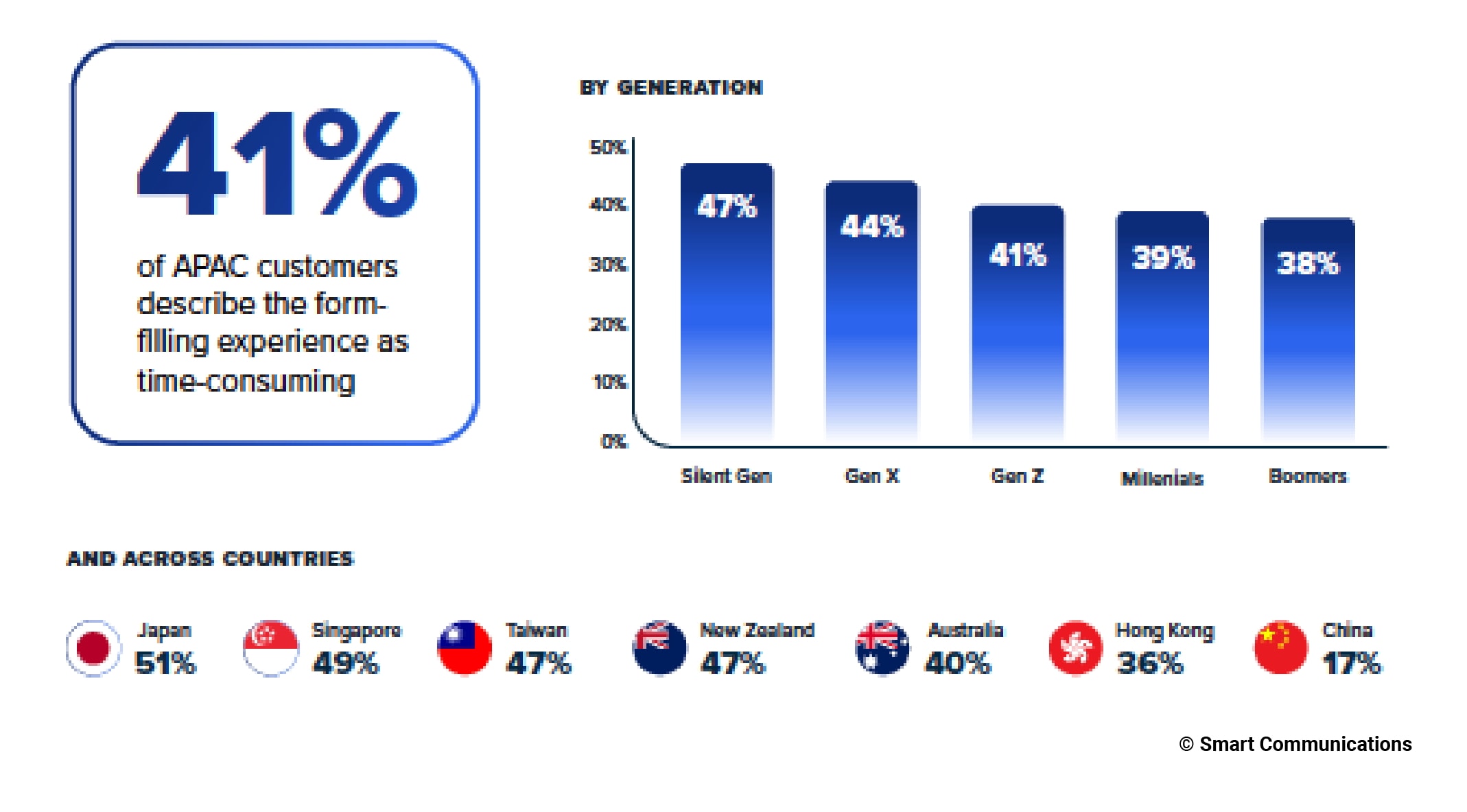
Manual or PDF-based processes don’t just slow things down; they frustrate customers and erode trust. Each inefficient form or manual handoff signals to customers that a brand isn’t keeping pace with their digital lives. In fact, nearly half of Singaporeans describe the form-filling experience as time-consuming (see chart below).

Quick Tip: Treat every data collection step as a chance to demonstrate ease, trust, and digital maturity.


2. Strong Communications Drive Stronger Loyalty

82% of Singaporeans are likely to recommend a provider if communications exceed expectations — the third highest globally of 12 countries surveyed.

Great communications don’t just build loyalty, they drive growth. When messages are timely, relevant, and personal, customers are far more likely to stay engaged and become advocates. The key is connecting the right data to the right message at the right time.

Quick Tip: Identify where personalisation can have the biggest impact. Do you have the mechanisms in place to collect, govern, and use that data effectively?


3. The Experience Gap Is Real

Only 49% of Singaporeans rate their communications as “very good” or “excellent,” compared to 61% globally.

Despite Singapore’s leadership in digital adoption, too many enterprises are still held back by legacy systems, data silos, and fragmented infrastructure. These limitations make it difficult to respond quickly, personalise effectively, or ensure consistency across channels.

Quick Tip: Conduct a CX audit across three dimensions: speed, personalisation, and channel preference. Identify where legacy systems are slowing you down.


4. The AI Opportunity Starts with Reliable Data

71% of Singapore consumers believe AI will improve customer experiences, compared to 61% globally.

Singaporeans are optimistic about AI, but readiness doesn’t always match enthusiasm. AI can only enhance customer experiences when the underlying data is accurate, accessible, and responsibly managed.

Quick Tip: Evaluate whether your current systems can support the speed and scale of AI-driven experiences. Legacy archives and data collection processes often can’t keep up. (Learn more in this article about archive strategy in the AI era.)


Bridging the Gap for Regulated Industries

For government agencies, banks, and insurers operating under strict regulatory frameworks, transforming the customer experience can feel like an impossible balance between innovation and compliance. But it doesn’t have to be.

That’s why Smart Communications has expanded its investment in Singapore with a new AWS-powered data centre — enabling local access to The Conversation Cloud™, the world’s leading Customer Engagement Platform purpose-built for highly regulated industries. (Read the press release.)

Designed with compliance, auditability, and governance at its core, the platform allows highly regulated enterprises to modernise with confidence — and to take advantage of practical, responsible AI that enhances productivity and personalisation without introducing risk.

Our approach to AI is grounded in transparency, control, and compliance — helping enterprises apply intelligence where it matters most, while staying within their regulatory guardrails. For Singapore’s financial institutions and government agencies, this means they can finally embrace AI safely, using data they can trust to deliver faster, more connected, and more human customer experiences.

Because the future of customer engagement in Singapore isn’t just about going digital — it’s about going smarter, safer, and faster.

Read more insights in the 2025 APAC Customer Conversations Benchmark Report.

Elevating Healthcare Provider CX: Key Insights from the 2025 Benchmark Report

By John Zimmerer, VP of Healthcare Marketing at Smart Communications

In addition to battling a host of existential crises, healthcare providers face mounting pressure to deliver seamless, personalized, and secure communication experiences. The 2025 Healthcare Benchmark Report from Smart Communications offers a comprehensive look into how patients perceive their interactions with healthcare organizations—and what providers must do to meet rising expectations.

This blog post distills the most critical findings from the report and explores how Smart Communications’ Conversation Cloud can empower providers to transform their customer experience (CX) strategies, improve operational efficiency, and build lasting patient trust.

The State of Healthcare Communications in 2025

The benchmark report, based on a global survey of 3,000 consumers, reveals a healthcare landscape in flux. While satisfaction with healthcare communications has improved—up 75% since the last benchmark—patients still report significant gaps in digital engagement, data transparency, and omnichannel consistency.

Key Findings for Providers:

1) Omnichannel Experience Gaps

  • Only 54% of patients are satisfied with their omnichannel experiences.
  • 71% prefer digital self-service over calling or visiting in person.
  • Channel preferences vary widely by region and generation, with email, SMS, encrypted messaging, and web portals all playing critical roles.

2) Trust Hinges on Consistency

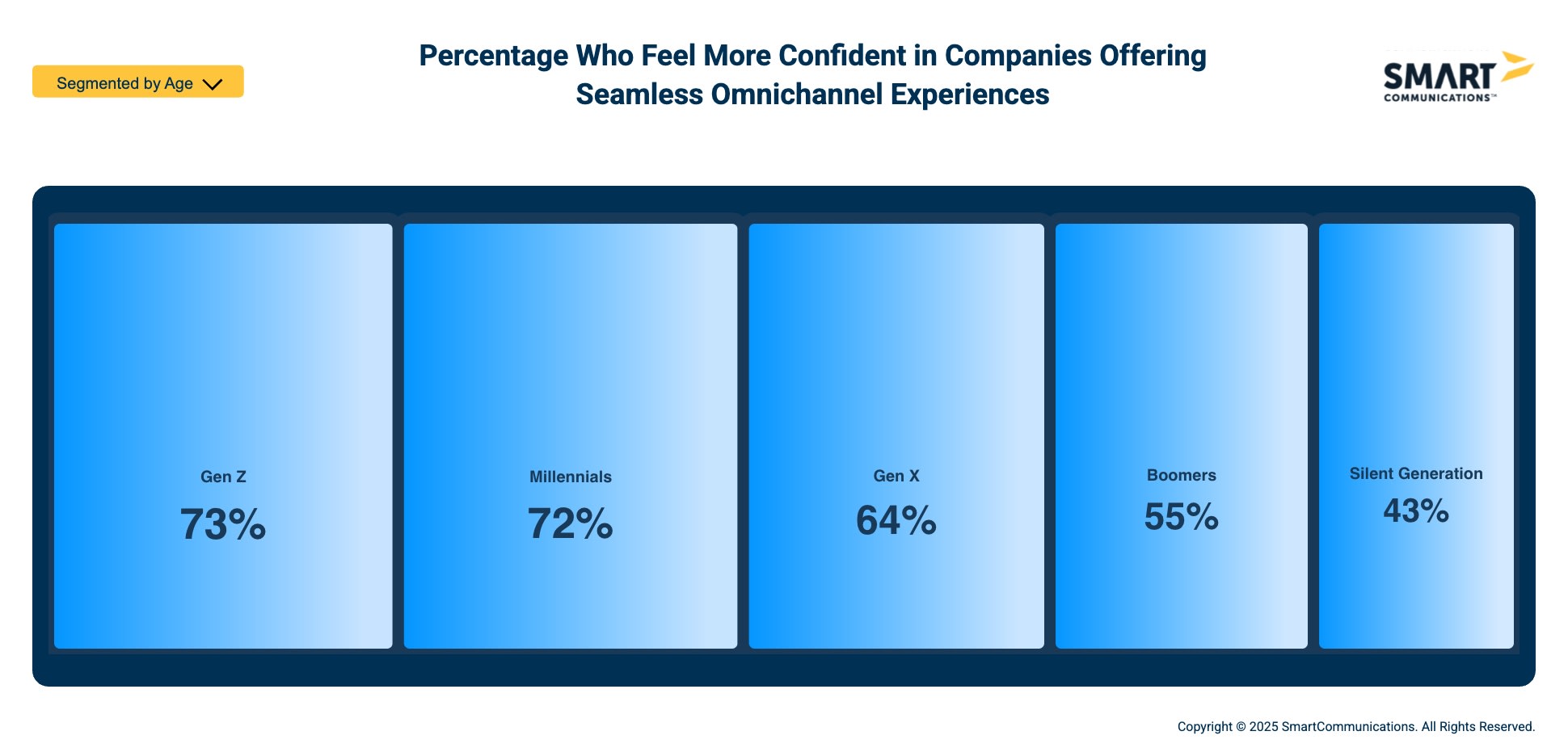
  • 60% of patients trust healthcare organizations more when experiences are consistent across channels.
  • This trust is especially high among Gen Z (73%) and in German-speaking countries (76%).

3) AI Adoption and Transparency

  • 54% of patients are open to AI-driven health recommendations.
  • However, 32% still express concerns about data security, and 31% worry about ethical AI use.

4) Communication Drives Loyalty

  • 84% say communications are central to their overall experience.
  • 67% would switch providers if communications don’t meet expectations.

These findings underscore a critical truth: communication is care. Providers who fail to modernize their engagement strategies risk losing patients—not just to competitors, but to frustration and disengagement.

The Provider Imperative: Modernize or Fall Behind

Healthcare providers are uniquely challenged by legacy systems, fragmented workflows, and regulatory complexity. Yet, patients increasingly expect the same frictionless experiences they receive from retail, banking, and tech brands.

To meet these expectations, providers must:

  • Automate and streamline data intake and form processes.
  • Deliver personalized, omnichannel communications that feel like one continuous conversation.
  • Build trust through transparent data practices and ethical AI use.
  • Ensure accessibility and compliance across all touchpoints.

This is where Smart Communications’ Conversation Cloud becomes a game-changer.

How the Conversation Cloud Solves the Provider CX Puzzle

The Conversation Cloud is a purpose-built platform designed to help healthcare organizations engage in smarter, more meaningful conversations with patients. It includes four integrated solutions:

  • SmartIQ™ – Digital forms and guided experiences
  • SmartCOMM™ – Personalized, omnichannel communications
  • SmartPATH™ – Journey orchestration and automation
  • SmartHUB™ – Centralized communication archive and retrieval

Let’s explore how each component addresses the report’s findings.

1. SmartIQ™: Closing the Digital Self-Service Gap

With 71% of patients preferring digital self-service, SmartIQ enables providers to replace outdated paper forms and manual intake processes with intelligent, mobile-friendly experiences.

Benefits for Providers:

  • Accelerates preregistration, consent, and financial assistance workflows.
  • Reduces staff burden and administrative errors.
  • Improves accessibility with multilingual and ADA-compliant forms.

By digitizing data collection, providers can meet patients where they are—on their devices—and create a smoother, more welcoming entry point into care.

2. SmartCOMM™: Delivering Personalized, Omnichannel Communications

SmartCOMM empowers providers to create and deliver communications that are personalized, compliant, and consistent across channels—email, SMS, print, portals, and more.

Benefits for Providers:

  • Ensures brand and message consistency across touchpoints.
  • Supports HIPAA-compliant communications with encryption and audit trails.
  • Enables personalized content based on patient preferences and data.

With SmartCOMM, providers can turn routine communications—appointment reminders, test results, billing notices—into moments of connection and trust.

3. SmartPATH™: Orchestrating the Patient Journey

SmartPATH helps providers design and automate communication journeys that guide patients through complex processes like referrals, chronic care management, and post-discharge follow-up.

Benefits for Providers:

  • Reduces drop-off and no-show rates.
  • Improves care coordination across departments and systems.
  • Enables real-time adjustments based on patient behavior and feedback.

This orchestration ensures that every interaction feels intentional and supportive, reinforcing the provider’s commitment to patient-centered care.

4. SmartHUB™: Centralized Communication Management and Analytics

SmartHUB provides centralized oversight of all communications, enabling providers to track performance, identify pain points, and continuously improve.

Benefits for Providers:

  • Offers analytics and dashboards to monitor satisfaction and engagement.
  • Supports A/B testing and iterative improvements.
  • Helps meet regulatory reporting requirements with built-in compliance tools.

With SmartHUB, providers can move from reactive to proactive CX management—aligning efforts with what truly matters to patients.

Building Trust in the Age of AI

The benchmark report highlights growing patient openness to AI—but also lingering concerns. Smart Communications addresses this by embedding transparency, security, and human oversight into every AI-powered interaction.

For example:

  • SmartCOMM uses AI to generate plain-language summaries of complex medical documents (think: discharge summaries, care plans, etc.).
  • SmartIQ can guide patients through forms using natural language prompts.
  • SmartPATH ensures that AI-driven journeys are auditable and explainable.

By leading with clarity and integrity, providers can harness AI to enhance—not replace—the human touch in healthcare.

Real-World Impact: Provider Success Stories

Several leading healthcare organizations have already leveraged the Conversation Cloud to transform their CX:

  • A large academic medical center reduced form completion time by 60% using SmartIQ.
  • A regional health system improved patient satisfaction scores by 30% after implementing SmartCOMM for appointment reminders and follow-ups.
  • A multi-specialty provider network used SmartPATH to automate post-discharge communications, reducing readmissions by 15%.

These outcomes demonstrate the tangible ROI of investing in smarter conversations.

The Future of Provider CX Starts Now

The 2025 Healthcare Benchmark Report makes one thing clear: patients are ready for better experiences. They want digital convenience, personalized communication, and ethical use of their data. Providers who rise to meet these expectations will not only retain patients—they’ll earn their trust and loyalty.

Smart Communications’ Conversation Cloud offers a proven path forward. By modernizing how providers engage, communicate, and orchestrate care journeys, it turns every interaction into an opportunity to deliver value, build relationships, and improve outcomes.

Click here to access an on-demand webinar where we dig deeper into the report.

Your Archive Strategy Isn’t Ready for the AI Era

By Scott Draeger, SVP of Product Marketing and Vertical Solutions at Smart Communications 

When you think about what you archive, you expect your data to be static, stored, and tucked away. But in an environment of constant disruption, your archive needs to be searchable, connected, and ready on demand. 

Too often, organizations assume their archive solution still offers predictable costs, proven technology, and lasting relationships. That’s the complacency talking, because your archive systems and strategies have likely been in place for 10-plus years.  

Your archive and retrieval strategy is probably not ready for the AI Era, and it needs your fresh thinking now. Trends toward customer self-service and AI summarization technology put retrieval-optimized archive technologies like SmartHUB™ in position to transform your organization when legacy approaches may fail to scale while costing you more than you anticipate. 

Why Is Older Technology Problematic?

If you’ve had your archive technology longer than a full retention period, you may consider it reliable and dependable. This may have been true for the scale you operated at when your predecessors initially selected the technology, but a lot has changed since then.  

Most archive solutions deployed around the time of the Sarbanes-Oxley Act were architected around the challenges of the day, which were rising retention periods and high storage costs. The use cases of that era focused mainly on storage and less on retrievals, so they missed opportunities to: 

  • Incorporate metadata for better search and context
  • Manage multiple file formats
  • Reduce retrieval times 

As the context window of LLMs increases, so does the LLM’s appetite for data, documents, and attachments. Some legacy systems attempt to mask these limitations by adding real-time cache technology that sits on top of the legacy architecture. This introduces complex data mapping and prevents your archive from being a single source of truth. 

Today, customers requesting a document from an archive system have attention spans that are in the hundredths of a second. As your CX and Operations teams demand you move more of your customer experiences to self-service, your retrieval needs will exponentially increase. You may be archiving more types of communications from a wider variety of channels. When you add AI summarization to the mix, you may be summarizing thousands or tens of thousands as many documents. This strain will inevitably test your system, adding further delays that erode customer trust. 

Why Will Costs Be Unpredictable?  

Legacy archive solutions were priced around the assumption that storage activity was common, and retrieval activity was rare. To offer more predictability to clients, models about the ratio of storage to retrieval drove pricing discussions. Since storage outnumbered retrievals, vendors and customers agreed that focusing the discussion on storage resulted in a more predictable arrangement for both parties. The storage to retrieval ratio was thousands, or even tens of thousands, to one. 

As organizations look to reduce costs through automation and self-service, the archive’s storage to retrieval ratio starts to change. Customers are using the portal to look at documents and communications in the archive to verify a transaction, share information, or understand more before they expand their relationship. The more they look at older records, the more retrievals they create. Add in AI summarization, and now an AI Agent may read five to 20 documents from your archive to answer a question. This could boost retrieval activity hundreds, or even thousands, of times. 

If your legacy offering attempts to offer a real-time cache solution to reduce retrieval costs, that complexity will come with an additional price tag. As your complexity increases, so does your budget. 

What About My Valuable Vendor Relationships? 

As you look at your legacy technology provider, you may put a lot of value on the relationships you have with your account team. But if your account team hasn’t helped you plan for the impacts that customer self-service and AI summarization place on your archive system, they may not be the best partner. In fact, your account team may eagerly anticipate your CX and AI initiatives, because an extra zero (or two, or three, or four) on your retrieval counts might be the expansion that gets them to President’s Club. 

There’s a Better Way Forward 

The challenges with legacy archive systems aren’t insurmountable—rather, they require a fundamentally different approach. Sophisticated archive solutions like SmartHUB enable rapid migration, migrating hundreds of millions of pages (or more) per week with scalable cloud-based ingestion capabilities. You can retire your legacy technology in months, while bringing the benefits of retrieval–optimized archiving to your customers, employees, and even AI agents.  

To learn more about how Smart Communications helps customers bring their archive and retrieval strategy into the AI era, check out the video below and request a demo of SmartHUB today. 

5 Key Takeaways from the 2025 AWS Partner Summit

By Simon Tindal, CTO, Smart Communications 

Dirty data, AI ethicists, and the resurgence of IoT were just a few of the hot topics at the recent Amazon Web Services (AWS) Partner Summit in New York City. I was honored to attend the event and participate in two roundtables alongside fellow CTOs and CIOs, where we explored the evolving role of generative AI in enterprise environments—particularly how it can enhance customer experience at scale. 

The timing couldn’t be better. According to Gartner, 33% of all applications will be agentic AI-enabled by 2028. That’s just around the corner, and it’s why events like these are critical not just for inspiration, but for alignment. They offer a window into where the market is heading, and how we as technology leaders can deliver innovation responsibly, flexibly, and quickly. 

At Smart Communications, we’ve been fortunate to deepen our partnership with AWS at the perfect moment. It’s a strategic relationship that informs not only the infrastructure we build on, but the way we innovate: safely, at scale, and with our customers always at the center. 

Below are five key takeaways from the Summit, and how they connect back to our approach at Smart Communications. 

1. Dirty Data Is Not the Fuel You Want Powering Your AI

One of the most resonant lines from the Summit: “Data is the fuel of GenAI. You wouldn’t run your vehicle on dirty fuel.” 

Put another way, if your data is fragmented, outdated, or unstructured, it doesn’t matter how powerful your AI models are. You’re not going to get reliable results. Across both roundtables I joined, data quality and governance dominated the conversation. 

That’s why our SmartIQ™ solution was designed to securely capture and validate data so companies can act on it with confidence, whether using it for service center interactions or feeding it into generative workflows. It’s also why we lean on Amazon Bedrock to give us multi-model flexibility without compromising data privacy. Our customers, particularly in financial services and healthcare, need to know that sensitive data isn’t being used to train public Large Language Models (LLMs). With Bedrock, we have the peace of mind that it’s not. 

2. A Holistic, Integrated Approach to AI Implementation Is Critical

There was a clear consensus at the Summit: AI success comes from end-to-end thinking. For businesses to truly improve customer experience, AI should be embedded across the user journey, with a clear strategy for how it supports customer outcomes. 

This mirrors one of our own AI Guiding Principles at Smart Communications: relevance. We build AI features that are directly embedded into the workflows our users already rely on—like tone refinement or language simplification in SmartCOMM™’s Design Assistant. They’re designed to meet users where they are and improve both efficiency and how they engage with customers. 

We’re not building AI for AI’s sake. We’re building it to make digital experiences more thoughtful, personalized, and effective—while reducing friction for the people creating them. 

3. Responsible AI Use Requires Increased Emphasis and Attention

A theme that surfaced repeatedly was the ethical use of AI. One keynote slide even highlighted the emergence of a new organizational role: an AI ethicist focused on analyzing and addressing the implications of AI. That speaks volumes. 

At Smart Communications, accountability and compliance are core to our approach. We’ve invested in capabilities like AI logging in template editors, AI identification in conversation history, and other process tracking so our customers can prove, not just assume, how AI is being used. 

We’ve long championed a “human in the loop” approach to AI technology. Now, as discussed at the AWS Summit, we’re entering a new phase the industry calls “human on the loop.” Rather than validating every output, people are shifting to a more supervisory role focused on optimizing AI performance over time. This evolution aligns with our vision for responsible AI—empowered, but never unchecked. 

Whether it’s logging communications for applications considered Limited Risk under the EU AI Act, or ensuring AI translations are marked as enhanced content, Smart Communications is innovating to reduce compliance risk. When we say our AI solutions are enterprise-grade, this is what we mean. We ensure content provenance is maintained within the communication value chain, providing full auditability of where AI is used and enabling our clients to stay aligned with evolving regulations worldwide. 

4. A Flexible Approach to AI Will Ease and Accelerate Scaling

In a fast-moving space like this, rigidity is a risk. One of the biggest reasons we chose to build on Amazon Bedrock is the flexibility it gives us to switch in and out different models as needs evolve. 

We’ve already seen this in action. When we first launched some of our AI capabilities, we started with Anthropic’s Claude model, which was the right choice for speed and geographic availability. Since then, we’ve added services (connected through Amazon Bedrock) to both AWS Translate and Amazon’s Nova Lite—bringing more value to our customers and striking the right balance between speed, safety, and availability. 

That ability to adapt quickly, without having to start from scratch, has been a game-changer. And it’s exactly the kind of agility that enterprises are looking for. With Bedrock, we can match the right LLM to the right task. 

5. Build and Deliver Use Cases That Actually Deliver Value

Agentic AI isn’t just about capability—it’s about continuity. Unlike traditional AI interactions (ask a question, get a response), agentic systems maintain context over time, enabling more lifelike conversations. This persistent context opens the door to a resurgence in connected, conversational devices—a kind of second wave for IoT, now made smarter and more useful through agentic intelligence. 

That’s also where our data collection and omnichannel orchestration solutions shine. We’re building systems that don’t just respond—they remember, connect, and evolve across channels. And the use cases are only growing: from hyper-personalized insurance cover letters, to multilingual financial services responses, to context-aware knowledge assistants that elevate user efficiency. 

But all of it must deliver measurable value. That’s why our AI innovations are relevant to business outcomes, such as faster document creation, better tone control, and reduced compliance risk. If a feature doesn’t solve a real problem, we deprioritize it. 

A Strategic Partnership That Helps Us Move Faster and Smarter 

This focus on value creation is one of the many reasons our partnership with AWS is so important. Together, we’re bringing secure, compliant, and intelligent solutions to market, helping organizations optimize their digital interactions with customers in new and exciting ways. 

As Sudeep John, AWS — Technology Partnerships, put it: 

“The collaboration between Smart Communications and Amazon Web Services (AWS) builds on an existing and mutually beneficial relationship.

Smart Communications is deepening its use of Amazon Bedrock by integrating Amazon Nova Lite — enabling faster, safer, and more reliable agentic decision-making to support critical customer conversations.

Together, the companies are delivering a robust cloud services and management portfolio that empowers enterprise customers with secure, scalable, and intelligent access to cloud-powered customer communications.” 

It’s a relationship that keeps evolving—through product integration, go-to-market alignment, and joint events. And with SmartCOMM and SmartIQ both available on the AWS Marketplace, it’s never been easier for organizations to procure and deploy our solutions within their cloud environments. 

Looking Ahead 

I left the 2025 AWS Partner Summit with a deep sense of excitement. From data integrity and AI transparency to scalable infrastructure and smart orchestration, we’re not just keeping up with the pace of change. We’re helping to set it. 

And this is only the beginning. Stay tuned for more innovation to come—built on Amazon Bedrock, aligned with our AI Guiding Principles, and designed to help organizations create digital customer experiences that are as intelligent as they are compliant. 

Archive and Retrieval in the AI Era: Why Legacy Solutions Fall Short

By Scott Draeger, SVP of Product and Vertical Solutions at Smart Communications 

The artificial intelligence revolution is fundamentally changing how organizations interact with their archived communications—and your legacy archive and retrieval systems simply weren’t built for the challenges of today. 

The Legacy Problem: Built for a Different Era 

Traditional archive and retrieval technologies were built generations ago, with a spike for Sarbanes Oxley-driven retention requirements. Back then, storage was expensive, and retrieval requests during a seven–year retention period were rare.  

These systems met the legal needs of archiving single-channel communications for long periods of time. However, they were optimized around a simple assumption: Organizations would store vast amounts of data but rarely access it. These vendors’ pricing models and technical architectures assumed a low retrieval-to-storage ratio. The AI era is set to radically challenge those assumptions. SmartHUB™ is prepared to meet tomorrow’s challenges.   

The AI-Driven Shift: From Storage to Active Intelligence 

Today’s AI-powered applications are transforming archived communications from static repositories into dynamic, intelligent resources that streamline operations and improve customer experiences. Three key use cases are driving unprecedented demand for retrieval capabilities: 

Customer Self-Service: AI-guided applications now help clients navigate their communication history independently, and SmartHUB surfaces the most relevant documents and interactions with easy integrations. What once required extensive cross-system integrations is now easily available via scalable cloud applications that support your intelligent search and recommendation systems. 

Context-Rich Employee Interactions: Customer-facing applications create AI-generated summaries of months of multichannel communications in real-time, enabling more informed, personalized interactions that access PDF, HTML, email, SMS, and other communication channels. SmartHUB’s scalable retrieval quickly delivers relevant communications to reduce interaction times and increase customer satisfaction. 

AI Training and Optimization: Organizations are mining their communication archives to train AI systems, using historical customer experiences to improve future interactions and identify patterns that enhance service delivery. SmartHUB’s scalable retrieval can quickly supply millions of documents for analysis.  

The Cost Reality Check

As the AI era unfolds, it’s time to evaluate your legacy solutions against the new metrics that matter today and tomorrow: 

  • What will happen when your retrievals multiply by 10x, 100x, or even 1,000x? Legacy pricing models weren’t designed for AI applications’ appetite for data, information, and documents.
  • How will you integrate decades-old archive systems with cutting-edge AI technologies? Most legacy platforms lack the APIs and flexibility required to integrate with today’s AI technologies, especially on– premises technologies.
  • Can you deliver the real-time context that today’s customer experiences demand? Slow, batch-oriented retrieval processes can’t support AI applications that need instant access to communication history.

SmartHUB: Archive and Retrieval – Ready for AI 

SmartHUB addresses these challenges head-on with three core capabilities: 

Efficient Storage: Modern compression and indexing technologies that reduce storage costs while maintaining full searchability and compliance. 

Scalable Retrieval: High-performance architecture designed for the frequent, complex queries that AI applications demand—without the cost penalties of legacy systems. 

Rapid Migrations: A cloud-native architecture built with migration in mind lets you leave behind your legacy archiving technology, preserving decades of valuable communication data without the burdens of your legacy technologies. 

The Time to Act is Now 

The AI era isn’t coming—it’s here. Organizations that adapt their archive and retrieval strategies now will gain competitive advantages through better customer experiences, more efficient operations, and AI-powered insights drawn from their communication history. 

Those that wait risk being trapped by legacy systems that can’t scale to meet AI’s demands, facing spiraling costs and missed opportunities as their competitors leverage decades of communication data to deliver superior customer experiences. 

SmartHUB provides the foundation for archive and retrieval in the AI era. Are you ready to future proof your communication archives? 

About the Author 
Scott Draeger is the SVP of Product Marketing and Vertical Solutions at Smart Communications. He has a passion for collaboration, and over 25 years of innovating customer communications technology, around the globe. He focuses on improving communications for the recipient while improving performance for the business. He started as a document designer using a collection of hardware and software technologies, before moving to the software side of the industry. He finds connections across disciplines with certifications in graphic design, customer experience, electronic documents, and an MBA in international business.

AI in Financial Services: Why Incremental Innovation is a Smart Path Forward

By Cindy Griffin, Financial Services Vertical Marketing Specialist at Smart Communications 

News about artificial intelligence (AI) in financial services is everywhere. From new model launches to agentic AI to meme prompts (e.g., turning your pet into a human), it’s inescapable. Many organizations, however, are struggling with how to implement AI in a responsible way while also quickly taking advantage of AI’s capabilities.  

In particular, AI is magnifying security risks in the financial sector. JPMorgan’s Chief Information Security Officer’s recent Open Letter to Third Party Suppliers emphasizes “prioritizing security over rushing features” by “placing it equal to or above launching new products.” So, how does an organization operating in a highly regulated industry like financial services carry out this dual mandate to integrate AI and prioritize security? 

JPMorgan has taken a top-down approach to AI, with the appointment of a Chief Data and Analytics Officer to oversee AI initiatives in 2023 and the deployment of a proprietary large language model, LLM Suite, in 2024. However, since most financial services firms don’t have the resources of JPMorgan, AI implementation in this way isn’t typically practical. Likewise, most firms don’t have the luxury of having a powerful Chief Information Security Officer who can tell third–party suppliers how they need to approach security.  

Incremental Innovation in AI 

Incremental innovation offers a solution for financial services firms that lack JPMorgan’s resources but want to implement AI in a responsible, secure way. What is incremental innovation? Cutter Associates defines incremental innovation as “leveraging technology to make small tweaks to existing workflows and processes to create outsized gains in operational efficiency.” 

In addition to being more budget friendly, incremental innovation builds on existing applications using AI, which allows for manageable scaling and risk mitigation. For example, many firms already use AI or machine learning for predictive analytics in areas like fraud detection or risk assessment. Building on existing AI use cases could help firms advance AI within their organizations while keeping security top of mind. Each incremental advancement would be, by definition, small and could be tested in focused groups to avoid exposing the entire organization to potential security threats. Incremental innovations would also allow firms to be more agile in responding to potential process breakdowns. 

However, not all AI progress will come from within. As firms look to scale more rapidly or solve complex problems, they may turn to third-party suppliers offering comprehensive AI solutions. While these integrations can promise significant improvements, they also introduce a different set of risks. If a third-party supplier’s AI integration is advertised as the solution to a whole host of issues, consider the impact on the organization if something went wrong. 

AI Adoption Vs. Financial Services Regulations 

The emerging regulatory environment will also guide financial services firms’ adoption of AI. For example, the EU Artificial Intelligence (AI) Act classifies AI use according to risk. Financial services firms find many activities fall under high risk or limited risk, which require strict obligations before going to market or specific transparency obligations, respectively. The EU AI Act helps organizations determine the overall business risk when deploying AI. Financial services firms should be prepared that the influence of the EU AI Act may arrive in the U.S., one state at a time, each with intricate differences. 

Financial regulators in the U.S. have been cautious about adopting AI-specific rules, preferring to provide guidance around existing rules. Even this information can influence how AI is used in financial services firms. For example, in May 2024, FINRA provided guidance on Rule 2210 (Communications with the Public) in an FAQ. The report also noted that communications with the public—whether generated by a human or AI (chatbot)— would be governed by the same rules. In addition, an early executive order of the current administration seeks to remove barriers to American leadership in AI. While the executive order doesn’t have any new AI-specific rules or regulations, it’s indicative of the potential for rapid change in AI regulations.   

Regardless of the regulatory environment, financial services organizations that rely on incremental innovation to adapt to new regulations over time reduce the risk of non-compliance caused by rapid changes. 

Not sure what questions you should ask vendors about AI and customer communications? Take the guesswork out of it with ‘11 Questions to Ask When Evaluating CCM Software’. 

How Does Smart Communications Approach AI Innovation? 

To help organizations safely and strategically incorporate AI, Smart Communications provides a customer communications management solution with integrated AI. SmartCOMM™ establishes a solid foundation for financial services firms to balance incremental innovation in AI with a strong security and governance posture. Integrated AI technology offers the ability to translate content into different languages and adjust the reading level, tone, and formality of customer communications.  Why does our approach to AI matter?  

  • Governance is in your hands. SmartCOMM’s AI integration is an opt-in feature; it is turned off by default. If your firm is not ready to deploy AI in this manner, it’s not a required feature of SmartCOMM.
  • Content provenance matters. In highly regulated industries like financial services, the ability to audit data or content is not only helpful, but in most cases required by regulators. SmartCOMM logs events where AI is employed enabling ease in forensic searches of AI-impacted communications.
  • Your data won’t be used as training data. SmartCOMM does not share your organization’s data to train the LLM.
  • Security comes first. Any AI use will not come at the expense of jeopardizing our commitment to data security and governance.
  • Function is prioritized over flash. Any AI integration will be based on usefulness to our customers and how it helps them achieve their goals. We’re not integrating AI for AI’s sake alone.  

Ultimately, when leveraging AI in financial services use cases, organizations will need to be transparent, explanatory, and secure in client communications. Firms that adopt AI through incremental innovation and stay compliant with evolving regulations will strengthen, not weaken, their client relationships. 

To discover how your organization can leverage AI in financial services through incremental innovation, request a demo.  


About the Author 
Cindy Griffin is the Financial Services Vertical Marketing Specialist at Smart Communications. She has more than 25 years of experience in financial services marketing and business development, performance analysis, product and risk management, and compliance integration. Cindy has broad knowledge of the financial services space having worked for institutional investment managers, retirement services providers, and wealth managers in a variety of roles. In addition, Cindy worked in business development for a software provider with a primary focus on the financial services vertical. 

The Role of AI in Improving Healthcare Communications

By John Zimmerer, VP of Healthcare Marketing at Smart Communications 

I’ve previously written about the need to use plain language in healthcare communications. According to a recent Forrester report, the need not only still exists, but the urgency to address that need is now greater than ever. 

In Health Insurers: Communicate Clearly To Help Your Customers Decide With Confidence (Forrester Research Inc., February 24, 2025), the authors provide compelling evidence that poor communication is harming health insurers and their members. In this post, I will present snippets of that evidence, as well as the role AI can now play in improving healthcare communications. 

Interested in learning more about using AI to analyze and improve your content?  
Check this demo out later! 

Members Do Not Understand Their Plans or Your Healthcare Communications 

As part of their ongoing research into customer experience, Forrester regularly surveys consumers about their experiences with a variety of organizations, including healthcare insurers. Their most recent survey data shows that “only half of US online adults who are health insurance customers say it’s easy for them to understand their coverage.”  

Forrester’s data also shows that the number has been dropping over the last two years. Contrast that with what the Kaiser Family Foundation (KFF) reported: at least 90% of insured US adults want clearer communications from insurers, with a focus on what’s covered and how much they’ll have to pay. 

The Forrester report linked the lack of understanding to four economic impacts: 

  1. Revenue Risk: The authors contend that members who do not understand their coverage may have a reduced feeling of the value of that coverage. They warn that “customers may conclude that they aren’t getting the best value and choose a lower–cost offering that falls short on coverage needs.” I will go one step further: These members may very well switch carriers. At the very least, payers will see less revenue if members downgrade plans. 

  1. Higher Expenses: Forrester’s data shows that members who do not understand their benefits pick up the phone and call their insurer. The report cites benefit inquiries as the top driver of calls. KFF found that confusion about coverage and responsible portion also drives a significant number of appeals, the majority of which are ultimately decided in the member’s favor. 

  1. Product Differentiation: The authors point out that members who can choose their plans (e.g., ACA and Medicare Advantage members) may find it difficult to choose a plan if they do not understand the benefits included in the myriads of offerings available to them. 

  1. Trust Erosion: The Forrester report points out that “communicating clearly is a great way to demonstrate empathy, a key driver of trust.” That is important because trust correlates with the propensity to spend money…or not. 

Member Expectations and How to Communicate More Clearly 

The report goes on to define key moments that matter to members, including shopping for and enrolling in a plan, onboarding, and servicing. The authors specifically call out explanations of benefits and claims communications as moments where plain language matters. The report includes a graphic showing key customer experience drivers, and how health insurer ratings on every one of these drivers fell from 2023 to 2024. Of the five key drivers measured by Forrester, “Communicates with me using plain language” fell the most. 

Thankfully, the authors provide clear recommendations on how to remedy the situation. You’ll need to read the report to get the details, but I will summarize them as: 

  1. Mine Your Data: Your customers are speaking to you. Are you listening to them? Every engagement you have with a member provides insights into their pain points and what you could do to improve their experience. Forrester provides clear questions in the report that you should use to interrogate your data (e.g., call recordings, surveys). 

  1. Revise Your Content: The authors point to multiple resources and provide examples to help you improve the clarity of your communications. Yes, some communications have content that regulations require you to use verbatim. However, the report suggests ways that you can balance the spirit of plain language with the literal letter of the law. 

  1. Mind Accessibility: There are already regulations that require you to produce communications in accessible formats. The report offers creative ways that you can use accessibility to promote communicating more clearly with a broad audience. 

  1. Assess Your Approach: The authors recommend an approach to cocreating or iterating your content with your members. This approach will require you to make an investment; however, that investment will pay dividends in reflected calls and reduced appeal volume. 

  1. Best Practices: Lastly, the authors provide guidance on how to institutionalize what you learn into an enterprise-wide approach to communicating using plain language. 

The Role of AI in Communicating Using Plain Language 

With proper governance, artificial intelligence (AI) can play a key role in communicating using plain language. AI can help you evaluate your content for readability, tone, and sentiment. It can help you to revise content, reducing the use of jargon and distilling legalese into more relatable (and often more concise) language. It can find and help you to address accessibility issues. And now, with agentic AI, it can even mine your data and provide insights into ways to improve your member experience. 

This might sound like science fiction or may even be a bit scary. But tools exist today that can help you do your job faster with better outcomes for you and your members. 

Here are three examples of what AI can do to help you to communicate in plain language: 

  1. Content Analysis: As we learned, clarity communicates empathy, which engenders trust. So, you’ll want to use AI-based content analysis tools that can evaluate your tone, sentiment, and readability. The best content analysis tools combine neurolinguistic processing (NLP) with machine learning (ML) and reference standards like the Flesch scale to score your current content and create a baseline. 

  1. Writing Assistance: Once you have that baseline, you can use generative AI (GenAI) tools to revise your content to improve your scores. You simply provide instructions (also known as prompts) on what changes you‘d like to see, and prompt using plain language. You might use the tool to revise the content to increase empathy, or to hit a target reading level score. Then, GenAI goes to work and provides revised content that you can reanalyze and rescore. 

  1. Accessibility Tools: A combination of AI tools can look at your content and tell you where you are not meeting accessibility guidelines like WCAG 2.1. Maybe the contrast ratio of text on a background color is too low. Or you forgot to tag an image with alternate text. The AI can find these flubs and then guide you in remediating your communication. AI tools can also provide initial language translations for review and approval by a certified human translator. 

Smart Communications Can Help You Communicate Using Plain Language 

Are you excited by the possibilities? Then you are ready to switch to a customer communication management (CCM) solution that uses AI to help you communicate in plain language. Our CCM platform, called SmartCOMM™, has built-in AI tools including content analysis, a writing assistant, and an accessibility checker. We also have pre-built integrations for agentic AI platforms that can use our data and other sources to deliver powerful, actionable insights for increasing the effectiveness of the content you manage in SmartCOMM. 

If you’re looking to improve member experience, operational efficiency, or revenue, consider using SmartCOMM and its built-in AI tools and integrations. By adopting our CCM solution, you can increase member trust, satisfaction, and loyalty while also improving your bottom line. 

Ready to get started? 

Request a demo of SmartCOMM to discover how it can help your organization supercharge its customer communications and create an exceptional customer experience. 

About the Author 
John Zimmerer is the Vice President of Vertical Marketing, Healthcare at Smart Communications, where he acts as a subject matter expert on the digital transformation of customer communications and data-centric, often form-based workflows. Most recently, John has been researching and writing about improving customer experience in healthcare and is regarded as a thought leader in this area. John has over 20 years of software product marketing experience. His areas of expertise include market research, analyst relations, public relations, and digital marketing. 

Revolutionizing Medicare Member Engagement: A Guide to Seamless Advantage Enrollment

By John Zimmerer, VP of Healthcare Marketing at Smart Communications 

Navigating the world of senior market member engagement poses unique challenges for healthcare payers. As you strive to enhance member satisfaction and enrollment processes, it’s crucial that you address the rising complexities within the Medicare Advantage landscape.  

This blog will shed light on key challenges and provide insights into revolutionizing member engagement for a seamless enrollment process. 

The Challenge of Medicare Member Engagement 

Let’s delve into the pressing issues and explore how a strategic approach can transform the member engagement experience.  

Increased Competition 

Picture this: in the 2023 plan year, the average Medicare beneficiary found themselves amidst a sea of choices, with over 40 plans to sift through, as per CMS data reported by KFF. This staggering number reflects a doubling of available plans over just five years. As a healthcare payer, the challenge lies not only in offering competitive plans but also in ensuring that your members can navigate this abundance with ease. 

Poor Customer Experience 

Adding to the complexity, the US Health Insurers Customer Experience Index Rankings for 2023, presented by Forrester, highlighted a persistent issue. The average health insurer’s customer experience (CX) remained stagnant, placing them at the lower end of the ranking. What’s more, Forrester’s findings revealed that the CX of commercial plans tend to trail behind that of government plans. 

The Influence of Star Ratings 

Amidst the challenges mentioned above, the influence of customer experience on Star Ratings has undergone a significant shift. CX measures currently constitute a substantial 57% of a plan’s Rating. This evolution is pivotal because Star Ratings, as numerous studies affirm, play a decisive role in driving enrollment. As healthcare payers, the question that beckons is clear: In the evolving Medicare landscape, are you positioned to retain or lose members as they transition into this critical phase of healthcare decision-making? Keep reading for strategies to not only meet these challenges head-on but also to redefine the Medicare member engagement experience at your organization. 

Trends Driving the Need for Better Medicare Member Engagement 

According to internal and external research, we’ve highlighted the key trends that will have an impact on Medicare member engagement for the 2024 plan year and beyond. 

1. CX Will Continue to Make a Big Impact to Member Enrollment 

For decades, Forrester has researched the realm of customer experience, consistently revealing its profound impact on customer loyalty and retention. Our latest Healthcare benchmark report aligns with Forrester’s insights, emphasizing that simply one negative experience can drive customers away. Given the weight Star Ratings places on CX, this trend should be top of mind as you plan how you’ll prioritize enhancement to your customer. 

2. Technology Will Play a Pivotal Role in Attracting and Retaining Members 

While commercial plan members may find themselves with limited choices, the scenario shifts when it comes to Medicare Advantage, Medicare Supplement, or prescription (Part D) plans. KFF’s data underscores that merely 18% of Medicare Advantage enrollees are in employer- or union-sponsored plans. Now, consider this: Most Medicare Advantage enrollees (88-94%) rarely switch plans voluntarily. It’s a one-shot opportunity for you as a healthcare insurer to secure a new Medicare Advantage enrollee.  

The potential lies in leveraging data, artificial intelligence (AI), research, and technology to guide existing commercial members seamlessly into the “right” Medicare Advantage plan for them – and crucially, to retain them. Even if you haven’t delivered optimal CX to your commercial members, offering them a seamless Medicare enrollment process—like the one made possible by SmartCOMM™ and SmartIQ™—can alter their perception of your company for the better. 

3. Seamless Processes Will Make or Break Your Medicare Member Engagement Strategy 

Let’s dive into the numbers. An analysis of CMS data by KFF unveils a revealing insight. One-third of Medicare beneficiaries reported finding it challenging to compare plan options. This underscores the key role you play as a healthcare payer. By enhancing the enrollment experience, you’re not just facilitating a process; you’re transforming perceptions and cementing lasting connections with your members. The evolving landscape demands more than traditional approaches; it calls for a strategic shift in how you engage with and guide your members through the complexities of Medicare enrollment. 

Roadblocks to Increasing Medicare Member Engagement 

You know that the process of developing Medicare plans can be demanding and stressful, especially with disjointed systems. It’s a full-time job to enable members to retain their current (in-network) providers, to curate drug formularies, and meet regulated timelines. It doesn’t have to be, though. With the lack of integration and siloed processes, your current enrollment tools can’t harness essential claim data that’s locked within your core systems. This limits your capacity to make personalized plan recommendations. By dismantling these silos, you can unlock valuable and necessary insights, empowering you to provide guidance to your members during the Medicare plan selection process. 

Cognizant’s Medicare Navigator, Powered by SmartIQ™ 

Streamlining the enrollment process for your Medicare Advantage (MA) plan can make all the difference. The American Economic Association emphasizes that reducing customer effort leads to higher completion rates. Building on this, Forrester’s body of research has consistently shown that enhancing customer experience aids in retaining existing members and expanding your market share in the fiercely competitive MA landscape.  

The stickiness of MA plans offers a unique advantage, creating members for life and boosting Customer Lifetime Value (CLV) due to their higher profitability compared to commercial plans. With a simple, efficient enrollment process, you position yourself for greater competitive differentiation in a crowded marketplace, where happy members become your advocates. 

The good news is that the technology now exists to help you leverage members’ historical claim data, enabling you to identify the best plan option(s) for them. Cognizant’s Medicare Navigator, powered by our SmartIQ software, provides a friction-free process for your members to select and enroll into a plan. Together, we can integrate the front-end plan selection process seamlessly with solutions such as TriZetto® Elements Enrollment Administrations Manager (EAM) to streamline operations. Ultimately, a better process for enrollments will increase retention and profitability. 

Addressing Fear, Uncertainty, and Doubt 

If you’re on the verge of losing members as they transition from commercial plans to the Medicare population, Smart Communications’ leading solutions are the key to boosting your conversion and retention rates. While your competitors lack the tools, experience, and relationships needed, we, in partnership with Cognizant, provide solutions that set your business apart. 

Through our large partner network and the integrations that make possible your Medicare member engagement goals, our solutions offer more than the necessary functionality. We’re uniquely positioned to help your organization shine in the eyes of prospects, current members, and the C-Suite. 

And the best part? Our sophisticated cloud software has been proven to save money for enterprises in highly regulated industries, freeing up valuable resources for the initiatives your company leaders keep striking out of the budget. It’s time to embrace a cloud solution that not only enhances Medicare member engagement but also propels you toward professional success. 

RELATED READING | ‘Forrester Opportunity Snapshot: Disjointed Experiences Cost Insurers Members and Money’ 

Conclusion 

You’re on a mission to boost senior market enrollment and retention, but member fear, uncertainty, and doubt (FUD)— coupled with past experiences with commercial plans— are roadblocks. The key lies in enhancing the plan selection and enrollment process and offering personalized plan recommendations based on individual claim histories to foster trust and convert commercial members into Medicare Advantage (MA) members. 

Partnering with Cognizant, we’re here to guide you through the entire process, from segmentation and outreach to plan selection and enrollment. Cognizant’s research validates our approach, analyst accolades showcase our capability, and customer testimonials, including success stories from healthcare payers like you, assure success. 

Streamlining the enrollment process holds the promise of lower abandonment rates, higher conversion rates, upselling opportunities, and reduced administrative costs. 

The cost of doing nothing outweighs the benefits of taking action. The resulting revenue and savings not only mitigate opportunity risk but also secure your position. It’s time to turn challenges into triumphs with a solution designed to drive Medicare engagement. 

To learn more, access the on-demand webinar with Cognizant and Smart Communications hosted by Fierce Healthcare or request a demo of SmartIQ for Enrollment.