Solutions

Archive and retrieve communications securely with cloud-native speed.

Orchestrate real-time, compliant interactions across every channel.

Simplify and standardize trade and relationship documentation workflows.

Industries

Improve customer engagement across policy, billing, and claims.

Create and deliver personalized, compliant customer communications at scale.

Heighten citizen experience with digital transformation.

Improve customer engagement across utilities.

Resources

Browse popular market research, articles, videos, written guides and more in one convenient location.

Explore upcoming events, webinars, and customer experiences shaping the future of customer conversations.

Get the latest updates on Smart Communications, including product news, and industry recognition.

Company

Learn more about our company, our leadership and how were growing the team!

Analysts

Analysts

Access analyst research, market reports, and industry recognitions featuring Smart Communications.

Is Your Food More Traceable Than Your Data? Why Data Provenance Matters for AI and Compliance

By Sally Schulte, Senior Product Marketing Director

When you go out for a meal, you assume that someone, somewhere, could tell you how the ingredients got from the farm to your plate—and prove to you that the food is safe to consume. And strict regulations like the FDA’s Food Traceability Final Rule and the EU’s Regulation 178/2002, coupled with sophisticated tracking systems, mean your assumption is probably correct. From the farm or ranch to the store shelf or restaurant, every step is logged, verified, and auditable.

But what about your company’s data? Like the food you consume, your company’s products and services exist in a heavily regulated market, chock full of checks and balances. But can you provide the same level of traceability for the data flowing through and being consumed by your organization that your local grocers can for the food on their shelves?

For most organizations, the honest answer is “no.” In most cases, the food on your plate is far more traceable than your data—and that’s a growing problem, especially as enterprises race to gain efficiency by sharing data across the organization, use data to drive automation, and feed data to train new AI tools.

This blog explains why data provenance has become a critical requirement for regulatory compliance, trustworthy AI, and sound decision-making. It explores how poor data traceability creates risk as organizations scale automation and AI initiatives, and why tracking data origins and usage is foundational to responsible business processes.


The Data Provenance Problem

Roughly 403 million terabytes of data are generated daily (that’s 4.03 x 10²⁰) as part of today’s business processes, with the volume of data stored globally doubling approximately every four years. And there are innumerable data sources: customers, advisors, agents, approvers, third-party contractors, etc. But ask where a specific dataset originated, if it’s been manipulated in any way, or whether it’s up to date, and you’ll likely be met with blank stares.

This lack of “data provenance”—the ability to trace data back to its original source—has serious consequences. Without it, data can’t (or shouldn’t) be trusted. And if data isn’t trustworthy, it shouldn’t be shared, reused, or leveraged to train AI systems that depend almost entirely on quality inputs. (Related reading: “Why Data Quality and Data Literacy Matter—For Everyone in Your Organization.”)

Imagine training an LLM on data that was scraped from unverified sources, or worse, on information that violates data privacy laws or internal policies. The consequences go beyond ethical or compliance issues: The outcomes become technical and strategic nightmares. Models trained on untraceable data risk embedding bias, misinformation, or even legal liability.


Why Data Traceability Matters More Than Ever

Traceability ensures that organizations can answer three critical questions about their data:

    1. Where did the data come from? — The original source, owner, and collection method.
    2. How has it been changed? — The transformations, filters, and enrichments applied along the way.
    3. Can the data be trusted? — Whether it meets quality, timeliness, and compliance standards.

Without this lineage, enterprises operate blind. Teams waste time debating data definitions. Business decisions rely on outdated or inconsistent numbers. And AI teams spend more time cleaning and verifying data than building models.

In regulated industries, traceability isn’t just good practice, it’s a requirement. From international laws such as GDPR and PIPL to regional regulations like the Sarbanes-Oxley Act in the U.S. and the Privacy Act in New Zealand, governments are holding companies accountable, requiring them to prove data origins and usage. Yet even with tight government requirements, full data lineage remains a challenge.


We’ve Solved Harder Problems, So Why Not Data?

The irony is that, as a global society, we’ve solved far more complex traceability challenges in other industries. Food, pharmaceuticals, and aerospace all manage supply chains that span continents, yet they can track every component from origin to destination.

If a batch of lettuce is contaminated, it can be traced back to the exact farm and field in hours. If a jet engine part is faulty, it can be identified and replaced before it causes harm.

So why can’t we do the same with data?

The answer lies in legacy systems, siloed architectures, and the sheer speed of data creation. But new tools—including metadata management platforms, data catalogs, and AI-driven lineage mapping—are beginning to change that.

In this context, the interoperability of forms automation solution SmartIQ™ lends itself to being a key factor in this improved connectivity, offering a way to trace precisely when and where information entered the organization, from whom and in what context. Companies can determine what steps were taken to validate identity, and they can replay data submissions in the context in which they were originally submitted.


Data Traceability: The Foundation for Responsible Business Decisions and AI Initiatives

As enterprises test the boundaries of workflow automation and explore how to safely integrate AI, trustworthy data will determine who succeeds and who stumbles—because you can’t build responsible business processes with data that can’t be traced to an authenticated, original source.

Just as we demand to know where our food comes from, the institutions protecting our financial and physical investments should demand the same transparency for the data being used to make critical business decisions. If they don’t, our steaks may be more traceable than our spreadsheets, and that should make every business leader a little uncomfortable.

Ready to improve data accuracy and traceability at the source? Explore our “Ultimate Guide to Forms Automation” to learn how you can streamline data collection, enhance customer experience, and ensure data provenance and compliance.


Frequently Asked Questions

1) What is data provenance?

Data provenance is the documented history of data, revealing its origin, movements, usage, and transformations. Data provenance offers a way to determine when information was provided, how it was provided, and by whom. This ultimately validates data’s authenticity and reliability, which separates it from data lineage (more focused on flow). Data provenance is focused on why and how data was originally created.

2) Why is data provenance important?

Tracing data to its origins and understanding how it has been used or applied is essential to meet today’s regulatory requirements, particularly in the financial services, healthcare, and insurance sectors. Data provenance helps ensure data is valid and can be used with confidence to drive business processes and decisions. Data provenance is also a fundamental pillar of most data governance strategies.

3) How does SmartIQ improve data provenance and traceability?

Interoperability—and the ability to automatically transfer data to the systems and people that need it, when they need it—is essential to improving overarching data traceability. By removing manual intervention and automatically passing data through secure connections, SmartIQ lets critical data provenance details follow information through a process, and those details can be stored and recalled for auditing and compliance in the future if necessary. Read the SmartIQ solution brief.


Closing Singapore’s Experience Gap: Why Trusted Digital Infrastructure Matters More Than Ever

By Smart Communications

New findings from our 2025 Benchmark Report reveal that for many Singaporean consumers, expectations for digital experiences continue to rise. In some cases, the gap between what customers expect and what they receive is widening.

Singaporeans are digital-first citizens, accustomed to seamless, intelligent experiences in every aspect of daily life. Yet even in one of the world’s most advanced markets, many organisations, especially those in highly regulated sectors like government and financial services, struggle to deliver the same level of speed, convenience, and personalisation customers have come to expect.

To close this gap, enterprises need to modernise how they collect, manage, and use data — building the digital and operational foundations for intelligent, compliant, and connected customer conversations.

Here are four key insights from the Benchmark Report that show why now is the time for change.

1. Singaporeans Expect Seamless Data Collection Processes

84% of Singaporeans say it’s important for companies to offer digital data collection instead of manual processes — compared to 77% globally.

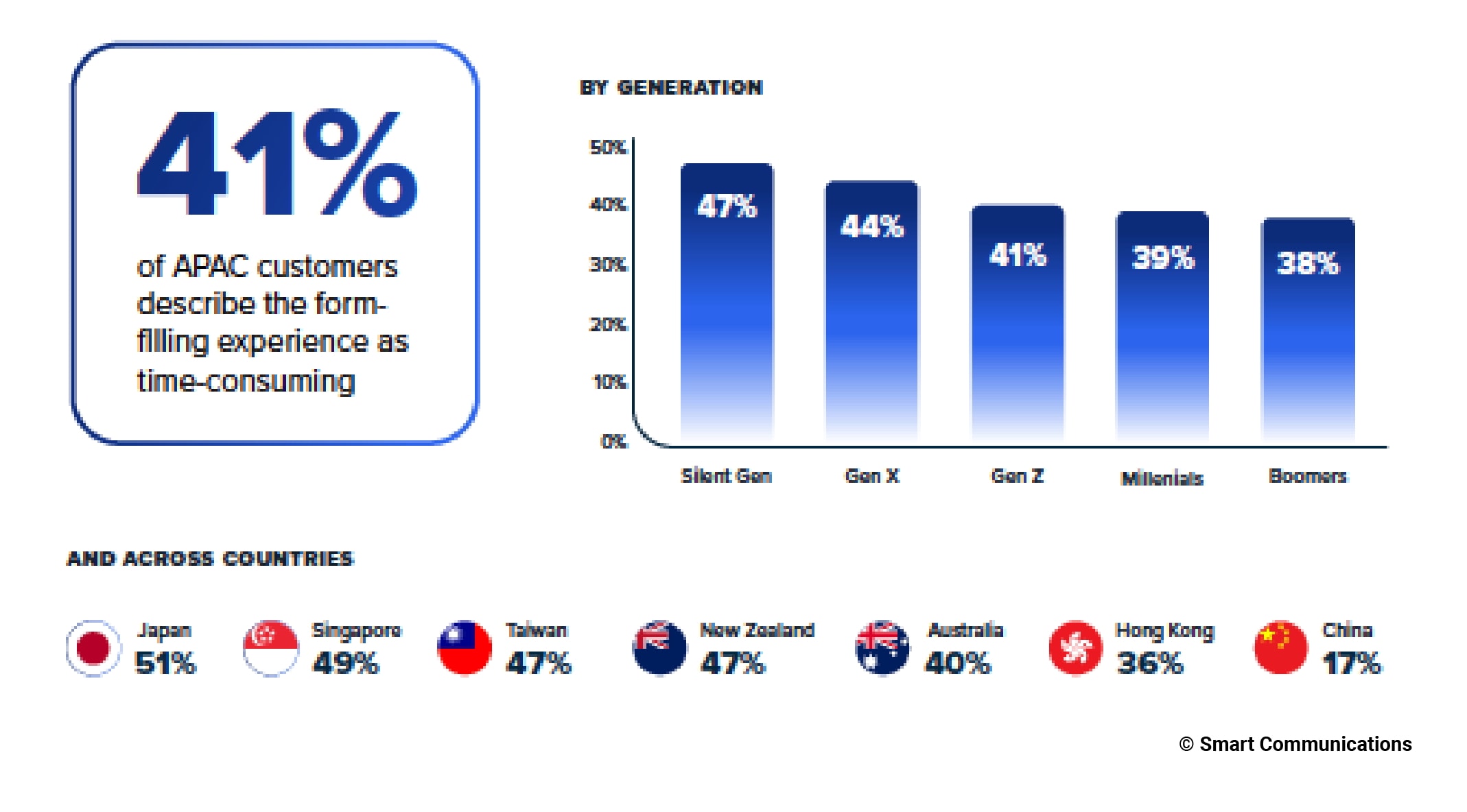
Manual or PDF-based processes don’t just slow things down; they frustrate customers and erode trust. Each inefficient form or manual handoff signals to customers that a brand isn’t keeping pace with their digital lives. In fact, nearly half of Singaporeans describe the form-filling experience as time-consuming (see chart below).

Quick Tip: Treat every data collection step as a chance to demonstrate ease, trust, and digital maturity.


2. Strong Communications Drive Stronger Loyalty

82% of Singaporeans are likely to recommend a provider if communications exceed expectations — the third highest globally of 12 countries surveyed.

Great communications don’t just build loyalty, they drive growth. When messages are timely, relevant, and personal, customers are far more likely to stay engaged and become advocates. The key is connecting the right data to the right message at the right time.

Quick Tip: Identify where personalisation can have the biggest impact. Do you have the mechanisms in place to collect, govern, and use that data effectively?


3. The Experience Gap Is Real

Only 49% of Singaporeans rate their communications as “very good” or “excellent,” compared to 61% globally.

Despite Singapore’s leadership in digital adoption, too many enterprises are still held back by legacy systems, data silos, and fragmented infrastructure. These limitations make it difficult to respond quickly, personalise effectively, or ensure consistency across channels.

Quick Tip: Conduct a CX audit across three dimensions: speed, personalisation, and channel preference. Identify where legacy systems are slowing you down.


4. The AI Opportunity Starts with Reliable Data

71% of Singapore consumers believe AI will improve customer experiences, compared to 61% globally.

Singaporeans are optimistic about AI, but readiness doesn’t always match enthusiasm. AI can only enhance customer experiences when the underlying data is accurate, accessible, and responsibly managed.

Quick Tip: Evaluate whether your current systems can support the speed and scale of AI-driven experiences. Legacy archives and data collection processes often can’t keep up. (Learn more in this article about archive strategy in the AI era.)


Bridging the Gap for Regulated Industries

For government agencies, banks, and insurers operating under strict regulatory frameworks, transforming the customer experience can feel like an impossible balance between innovation and compliance. But it doesn’t have to be.

That’s why Smart Communications has expanded its investment in Singapore with a new AWS-powered data centre — enabling local access to The Conversation Cloud™, the world’s leading Customer Engagement Platform purpose-built for highly regulated industries. (Read the press release.)

Designed with compliance, auditability, and governance at its core, the platform allows highly regulated enterprises to modernise with confidence — and to take advantage of practical, responsible AI that enhances productivity and personalisation without introducing risk.

Our approach to AI is grounded in transparency, control, and compliance — helping enterprises apply intelligence where it matters most, while staying within their regulatory guardrails. For Singapore’s financial institutions and government agencies, this means they can finally embrace AI safely, using data they can trust to deliver faster, more connected, and more human customer experiences.

Because the future of customer engagement in Singapore isn’t just about going digital — it’s about going smarter, safer, and faster.

Read more insights in the 2025 APAC Customer Conversations Benchmark Report.

Elevating Healthcare Provider CX: Key Insights from the 2025 Benchmark Report

By John Zimmerer, VP of Healthcare Marketing at Smart Communications

In addition to battling a host of existential crises, healthcare providers face mounting pressure to deliver seamless, personalized, and secure communication experiences. The 2025 Healthcare Benchmark Report from Smart Communications offers a comprehensive look into how patients perceive their interactions with healthcare organizations—and what providers must do to meet rising expectations.

This blog post distills the most critical findings from the report and explores how Smart Communications’ Conversation Cloud can empower providers to transform their customer experience (CX) strategies, improve operational efficiency, and build lasting patient trust.

The State of Healthcare Communications in 2025

The benchmark report, based on a global survey of 3,000 consumers, reveals a healthcare landscape in flux. While satisfaction with healthcare communications has improved—up 75% since the last benchmark—patients still report significant gaps in digital engagement, data transparency, and omnichannel consistency.

Key Findings for Providers:

1) Omnichannel Experience Gaps

  • Only 54% of patients are satisfied with their omnichannel experiences.
  • 71% prefer digital self-service over calling or visiting in person.
  • Channel preferences vary widely by region and generation, with email, SMS, encrypted messaging, and web portals all playing critical roles.

2) Trust Hinges on Consistency

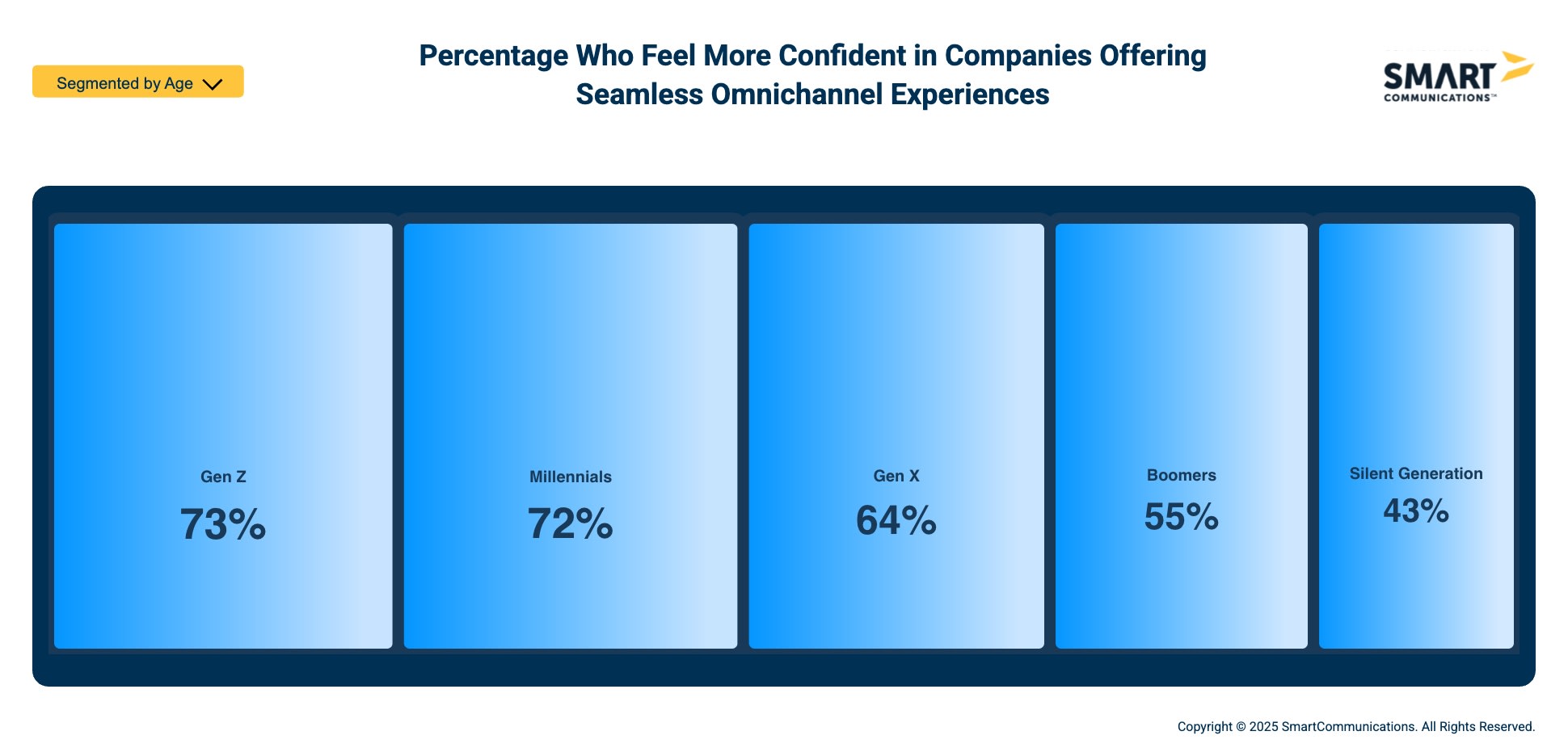
  • 60% of patients trust healthcare organizations more when experiences are consistent across channels.
  • This trust is especially high among Gen Z (73%) and in German-speaking countries (76%).

3) AI Adoption and Transparency

  • 54% of patients are open to AI-driven health recommendations.
  • However, 32% still express concerns about data security, and 31% worry about ethical AI use.

4) Communication Drives Loyalty

  • 84% say communications are central to their overall experience.
  • 67% would switch providers if communications don’t meet expectations.

These findings underscore a critical truth: communication is care. Providers who fail to modernize their engagement strategies risk losing patients—not just to competitors, but to frustration and disengagement.

The Provider Imperative: Modernize or Fall Behind

Healthcare providers are uniquely challenged by legacy systems, fragmented workflows, and regulatory complexity. Yet, patients increasingly expect the same frictionless experiences they receive from retail, banking, and tech brands.

To meet these expectations, providers must:

  • Automate and streamline data intake and form processes.
  • Deliver personalized, omnichannel communications that feel like one continuous conversation.
  • Build trust through transparent data practices and ethical AI use.
  • Ensure accessibility and compliance across all touchpoints.

This is where Smart Communications’ Conversation Cloud becomes a game-changer.

How the Conversation Cloud Solves the Provider CX Puzzle

The Conversation Cloud is a purpose-built platform designed to help healthcare organizations engage in smarter, more meaningful conversations with patients. It includes four integrated solutions:

  • SmartIQ™ – Digital forms and guided experiences
  • SmartCOMM™ – Personalized, omnichannel communications
  • SmartPATH™ – Journey orchestration and automation
  • SmartHUB™ – Centralized communication archive and retrieval

Let’s explore how each component addresses the report’s findings.

1. SmartIQ™: Closing the Digital Self-Service Gap

With 71% of patients preferring digital self-service, SmartIQ enables providers to replace outdated paper forms and manual intake processes with intelligent, mobile-friendly experiences.

Benefits for Providers:

  • Accelerates preregistration, consent, and financial assistance workflows.
  • Reduces staff burden and administrative errors.
  • Improves accessibility with multilingual and ADA-compliant forms.

By digitizing data collection, providers can meet patients where they are—on their devices—and create a smoother, more welcoming entry point into care.

2. SmartCOMM™: Delivering Personalized, Omnichannel Communications

SmartCOMM empowers providers to create and deliver communications that are personalized, compliant, and consistent across channels—email, SMS, print, portals, and more.

Benefits for Providers:

  • Ensures brand and message consistency across touchpoints.
  • Supports HIPAA-compliant communications with encryption and audit trails.
  • Enables personalized content based on patient preferences and data.

With SmartCOMM, providers can turn routine communications—appointment reminders, test results, billing notices—into moments of connection and trust.

3. SmartPATH™: Orchestrating the Patient Journey

SmartPATH helps providers design and automate communication journeys that guide patients through complex processes like referrals, chronic care management, and post-discharge follow-up.

Benefits for Providers:

  • Reduces drop-off and no-show rates.
  • Improves care coordination across departments and systems.
  • Enables real-time adjustments based on patient behavior and feedback.

This orchestration ensures that every interaction feels intentional and supportive, reinforcing the provider’s commitment to patient-centered care.

4. SmartHUB™: Centralized Communication Management and Analytics

SmartHUB provides centralized oversight of all communications, enabling providers to track performance, identify pain points, and continuously improve.

Benefits for Providers:

  • Offers analytics and dashboards to monitor satisfaction and engagement.
  • Supports A/B testing and iterative improvements.
  • Helps meet regulatory reporting requirements with built-in compliance tools.

With SmartHUB, providers can move from reactive to proactive CX management—aligning efforts with what truly matters to patients.

Building Trust in the Age of AI

The benchmark report highlights growing patient openness to AI—but also lingering concerns. Smart Communications addresses this by embedding transparency, security, and human oversight into every AI-powered interaction.

For example:

  • SmartCOMM uses AI to generate plain-language summaries of complex medical documents (think: discharge summaries, care plans, etc.).
  • SmartIQ can guide patients through forms using natural language prompts.
  • SmartPATH ensures that AI-driven journeys are auditable and explainable.

By leading with clarity and integrity, providers can harness AI to enhance—not replace—the human touch in healthcare.

Real-World Impact: Provider Success Stories

Several leading healthcare organizations have already leveraged the Conversation Cloud to transform their CX:

  • A large academic medical center reduced form completion time by 60% using SmartIQ.
  • A regional health system improved patient satisfaction scores by 30% after implementing SmartCOMM for appointment reminders and follow-ups.
  • A multi-specialty provider network used SmartPATH to automate post-discharge communications, reducing readmissions by 15%.

These outcomes demonstrate the tangible ROI of investing in smarter conversations.

The Future of Provider CX Starts Now

The 2025 Healthcare Benchmark Report makes one thing clear: patients are ready for better experiences. They want digital convenience, personalized communication, and ethical use of their data. Providers who rise to meet these expectations will not only retain patients—they’ll earn their trust and loyalty.

Smart Communications’ Conversation Cloud offers a proven path forward. By modernizing how providers engage, communicate, and orchestrate care journeys, it turns every interaction into an opportunity to deliver value, build relationships, and improve outcomes.

Click here to access an on-demand webinar where we dig deeper into the report.

Why Data Quality and Data Literacy Matter—For Everyone in Your Organization

By Sally Schulte, Senior Product Marketing Director

In today’s data-driven world, the success of any organization hinges not just on having data, but on having pristine, consistent, traceable data. High-quality, reliable data is no longer a “nice to have.” It’s a strategic asset that powers speed, decision-making, innovation, and growth.

Despite this, many organizations still treat data as a necessary burden to conduct business versus a strategic product that offers a competitive edge. And many employees view data as someone else’s responsibility—something technical and distant from their day-to-day work. But bad data impacts every part of the business, from product development and analytics to automation and efficiency.

That’s why data literacy must extend beyond IT departments and data teams. Everyone in your organization, from marketing and communications to operations and customer service, needs to recognize the value of reliable, accurate, and accessible information—and understand the role they play in ensuring and protecting good data.

Treating Data as a Strategic Product

To succeed today, organizations must adopt a new mindset where data is seen not as a secondary output of operations, but as a core product—deliberately gathered, maintained, and optimized for use. Making this shift requires intentional decisions from business leaders to:

  • Assign ownership across the organization
  • Enforce standardization to ensure consistency
  • Maintain version control and tracking
  • Align on how data will be used across the company

In the CIO.com article “5 actions to build an AI-ready data culture,” executives like Mike Kreider, CIO of DHL Supply Chain North America, explain why their organizations have fully embraced this approach. “We don’t want orphaned data products no one feels responsible for,” explains Kreider, because shipment data products support everything from daily operations to business development and also fuel generative AI tools like DHL’s proposal generator. “If the data product doesn’t exist or isn’t clean, the tool won’t work,” he emphasizes.

The Hidden Cost of Poor Data

When data is incomplete, inaccurate, and old, the effects ripple across the organization:

  • Inefficiency: Teams spend hours making corrections, chasing down missing information, and entering the same data in multiple systems.
  • Flawed decisons: Business strategies get built on erroneous assumptions.
  • Eroded trust: Customers feel the pain through incorrect outcomes, delayed service, and irrelevant (and potentially insensitive) messaging.

According to Gartner, bad data can cost organizations as much as $12.9 million per year. That’s not just inefficiency—it’s an alarmingly large, missed opportunity.

While your company deals with databases that don’t reconcile or forms that never made it back from the mailroom, your competitors are making real-time decisions, extending automation, and strategically capitalizing on AI-based initiatives. They’re innovating faster, responding to customers quicker, and identifying trends before you do. In the modern landscape, poor data isn’t just a nuisance—it’s a competitive risk.

Outdated Collection Methods Are Holding You Back

Legacy data collection processes—like fillable PDFs, mailed forms, or manually entered spreadsheets—are unreliable and inefficient. They’re prone to human error, data loss, and delays. Worse, they create silos that slow down collaboration and decision-making.

Organizations that still rely on these outdated processes are falling behind. Cloud-based digital tools, automated workflows, and real-time data integration have raised the bar. If your team is still waiting on mailed-in forms or deciphering handwritten notes, you’re not just behind the times—you’re making decisions in the dark.

Data Literacy is Everyone’s Job

To unlock the value of high-quality data, organizations must foster a culture of data fluency where every employee understands how data is used, why accuracy matters, and how their work contributes to data quality. This doesn’t mean everyone needs to become a data scientist. It means giving people the tools and training to handle data responsibly and thoughtfully.

From the frontline employee entering customer data, to the manager interpreting reports, to the executive setting strategy—everyone plays a role. One careless entry or one unvalidated data source can ripple across systems and decisions.

The Bottom Line

High-quality data fuels confident decision-making, better customer experiences, and faster innovation. But it doesn’t happen by accident. It requires modern tools, reliable collection processes, and a shared commitment across your organization.

Companies that continue to rely on legacy methods and treat data as someone else’s job will find themselves increasingly outpaced by more agile, data-savvy competitors. In contrast, organizations that prioritize data quality and fluency will be positioned not only to survive—but to lead.

Now’s the time to ask: Is your organization treating data like the critical asset it is?

Ready to take your data collection up a notch? Our “Ultimate Guide to Forms Automation” is packed with info you can use to optimize data intake and deliver more impactful interactions with customers. Read it now.

The State of Digital Transformation in 2024: Overcoming Legacy Technology Barriers and Elevating Customer Experience

By Leigh Segall, CEO at Smart Communications 
 
Reflecting on the challenges of the past four years, organizations have faced unprecedented uncertainty and pressure to adapt. In 2023, innovation was stifled as organizations grappled with the looming specter of economic recessions. This led many to shelve critical digital transformation initiatives, putting them on hold as they navigated economic uncertainties. Now, emerging from this hiatus, we see a new chapter swiftly unfolding, marked by renewed momentum and a reinvigorated push towards digital transformation. 

Closing the Digital Maturity Gap in 2024 

Recent research has uncovered a remarkable surge in IT spending for 2024, with 72% of digital leaders doubling down on investments to propel their digital initiatives forward. This surge reflects a broader trend towards digital transformation, with global spending projected to reach a staggering 3.4 trillion US dollars by 2026—a nearly 3x increase over the last five years.  

Yet, despite this momentum, significant challenges remain. According to Forrester, a mere 6% of organizations have attained advanced digital maturity, highlighting the pervasive gap between aspiration and achievement in the digital realm.  

Legacy systems continue to consume a substantial portion of the overall IT budget, impeding innovation. In fact, 87% of CIOs cite the complexity of existing systems as a barrier to investing in next-generation services. Additionally, 34% of CIOs have identified replacing legacy technology as a top digital transformation goal for 2024, underscoring the urgency of modernization efforts.

Retiring Legacy Technology for Enhanced Engagement 

When it comes to managing customer communications, organizations must address the lingering challenge of legacy communications technology. While many enterprises have made strides in modernizing their customer communications with cloud-based solutions, a significant number still grapple with outdated, on-premise, channel-based systems.  

These legacy solutions, acquired over time, pose a multitude of challenges—they are costly to maintain, lead to duplication of efforts, impede business agility, and detract from the customer experience. To truly harness the benefits of a modern CCM platform, we see many organizations looking to retire these outdated systems and transition to a centralized, cloud-based approach. By streamlining and automating customer communications processes across all delivery channels, organizations can deliver a seamless customer experience, maximize their return on investment, and position themselves for success in the digital age. 

Rethinking Forms Processes: Digitally Transforming Transactions into Engaging Interactions 

This imperative extends beyond customer communications to encompass forms processes—a critical yet often overlooked aspect of the customer experience.  

Over the past several years, analysts like Kaspar Roos, the Founder and CEO of Aspire CCS, have been vocal about the evolution of Customer Communications Management (CCM) to Customer Experience Management (CXM).  

According to Roos, the forms sector, mirroring the broader CCM market, is undergoing its own transformation. He emphasizes the growing need for dedicated solutions to facilitate interactive data collection, validation, and processing as the market moves towards greater bi-directional interactions.  

The combination of customer communications and customer data collection, once modernized and transformed, together play pivotal roles in shaping the omnichannel customer interactions of tomorrow. 

Once modernized, the combination of customer communications and data collection together play criticial roles in shaping the future of omni-channel customer interactions. 

Legacy forms processes, characterized by manual, outdated, and disconnected practices, present a significant barrier to delivering seamless and cohesive customer experiences. Forms serve as a vital touchpoint between organizations and their customers, facilitating data collection and driving internal and external processes. Yet, despite their importance, forms processes have been largely neglected in the broader CX strategy, leading to a noticeable gap between digitally transformed customer communications and legacy-style form processes. 

According to Forrester, 82% of organizations still use paper-based processes to some extent. The ramifications of this oversight are profound. Customers are confronted with outdated, cumbersome forms processes that fail to meet their expectations for convenience and efficiency. Frustrated by the complexity and repetitive nature of these processes, customers are left feeling dissatisfied—a stark contrast to the seamless experiences they encounter in other digital interactions. In an era where every interaction should leave customers feeling recognized and valued, outdated forms processes fall short of meeting customer expectations for convenience and efficiency. 

Forrester reserach shows that 82% of organizations use paper-based processes to some extent.
 
Transitioning From Static Forms to Smarter Data Collection 

However, the tide is turning. By redefining what a “form” entails, organizations can transform static transactions into dynamic, intelligent interactions that leave customers feeling valued and empowered. 

Smart forms or data collection solutions leverage automation and intelligence to guide users through complex processes, adapting dynamically based on the information provided. By eliminating unnecessary fields and pre-filling data from existing databases, you will minimize customer effort, improve data accuracy, and enhance overall efficiency. 

Moreover, forms of the future facilitate bi-directional communication, simplifying interactions between customers and employees. Whether online or on a mobile device, these digital experiences enable seamless data exchange, leveraging features such as mobile cameras for enhanced functionality. By mimicking a conversation between the customer and the organization, smart data collection solutions foster engagement and reduce the likelihood of customer abandonment. 

Recognizing the critical role it plays in the CX landscape, organizations are beginning to integrate intelligent data collection into their broader CCM strategies. Smart Communications™ leads the charge with SmartIQ™—a revolutionary forms management solution designed to automate and transform data collection processes. 

Delivering Future-Ready Customer Conversations 

SmartIQ empowers organizations to create and manage digital forms with ease, leveraging a low-code web-based design tool that requires minimal IT intervention. By automating data sharing and streamlining business processes, SmartIQ enhances operational efficiency and reduces technical debt. 

Furthermore, SmartIQ’s analytics engine provides organizations with invaluable insights into process performance, enabling continuous improvement and optimization. Armed with detailed analysis, organizations can identify bottlenecks, refine processes, and enhance the overall customer experience. 

By embracing solutions like SmartIQ, organizations can bridge the gap between customer communications and forms processes, delivering future-ready customer conversations and reducing customer effort.  

The synergy between SmartCOMM™ and SmartIQ enables organizations to consolidate, centralize, and automate data collection processes and customer communications across all channels, unlocking a myriad of benefits. From reducing manual work and operating costs to ensuring data security and regulatory compliance, our industry-leading SaaS solutions empower organizations to keep pace with evolving customer expectations and drive sustainable growth. 

If you’re interested in learning how you can consolidate and modernize your customer communications solutions, one of our experts would be happy to provide a free consultation. If you’re looking to transform your forms processes with SmartIQ, I encourage you to request a demo, or visit our demo zone to see it in action. 

What Great CX Looks Like in Life Insurance (2025 Benchmark Research)

By Eileen Potter, VP of Insurance Marketing at Smart Communications 

In a market defined by complex products and long customer lifecycles, delivering exceptional experiences can be a key differentiator for Life & Annuity organizations. 

Customers want clarity, empathy, and convenience across every touchpoint, but many organizations still struggle with manual, paper-based processes and impersonal communications. In this post, I’ll explore what defines “great” customer experience in life insurance today, drawing on fresh 2025 insights into CX performance across the industry. From onboarding to claims, let’s dive into what leaders are doing right—and where many still fall short. 

Curious about how your experience measures up? While this isn’t a benchmark deep dive, we’ll share themes inspired by recent life insurance CX benchmarking data—helping you understand how customer expectations are shifting and what CX benchmarks for life insurance look like in 2025. 

Why CX Is Mission-Critical in Life Insurance 

Customer experience requires a deeper level of empathy in life insurance. The stakes are higher, the journeys longer, and the trust required is deeper. 

Done right, great CX in life insurance builds loyalty over decades, not months. It reduces churn, boosts referrals, and opens the door for future product conversations. 

5 CX Benchmark Takeaways in Life Insurance in 2025 

Here’s what’s rising to the top among today’s strongest-performing life insurance brands—based on emerging patterns from 2025 customer data: 

1. Frictionless onboarding is non-negotiable. Customers consistently rated an intuitive, streamlined start to the customer journey as a top driver of positive experience. Long forms, confusing steps, or a lack of status updates were top friction points. 

2. Omnichannel isn’t optional anymore. Policyholders increasingly expect to move seamlessly between digital, agent, and call center experiences—with minimal repetition required. 

3. Human + digital beats either/or. Customers value both speed and support—meaning hybrid models are winning. One trend in the data: customers and beneficiaries who had access to digital tools and real human help reported higher satisfaction. 

4. Claims transparency is a growing CX lever. Respondents pointed to proactive status updates and clear claims timelines as factors strongly linked to loyalty. 

5. Customers now expect personalization, speed, and proactive outreach. For example, nearly 60% of customers who received relevant check-ins (like reminders or policy education) said they were more likely to recommend their insurer—hinting at the value of contextual engagement. Moreover, overwhelming majorities across regions and generations indicated communications were critical to their overall experience.


Common Gaps and CX Pitfalls in Life Insurance 

While some insurers are raising the bar, others are still held back by: 

  • Legacy tech and siloed systems—resulting in clunky, inconsistent experiences
  • Disconnects between digital and agent touchpoints—leading to repeated questions or broken handoffs
  • Low clarity on coverage and next steps—which ranked among the top frustrations in recent feedback
  • Lack of proactive communication—especially during emotionally important or time-sensitive moments
  • Paper-based, manual processes–many organizations still expect customers to download and fill out forms by hand and mail them to the insurance company to make changes 

These pain points don’t just annoy customers, they erode trust. 

Moving from Good to Great: What Leaders Are Doing Differently 

The data shows a growing divide between brands that meet expectations and those that exceed them. Here’s what the top performers are doing differently: 

→ Journey orchestration, not just journey mapping. Leading teams are designing CX with intentionality—thinking end-to-end across departments, not in silos. 

→ Customer feedback loops that drive change. The highest-scoring organizations act on real-time signals, rather than relying solely on annual surveys. 

→ Empowered agents who understand digital-first customers. Many top performers are re-skilling frontline teams to better support hybrid customer journeys, blending empathy with tech fluency. 

How to Start Elevating Your CX Today 

Even if you’re early in your CX transformation, there are simple, strategic steps you can take now: 

  1. Audit your top 3 customer journeys (e.g., onboarding, claims, policy changes) and look for friction.
  2. Identify moments of silence or confusion and build in communication touchpoints.
  3. Align your CX metrics to customer outcomes—such as clarity, ease, and confidence—not just speed or cost. 

Conclusion 

Customer expectations won’t slow down in 2025—and neither should your CX evolution. The most successful life insurers are the ones who treat experience not as an add-on, but as a core value driver. 

Want to know what top-tier CX really looks like this year? Our latest report reveals how real customers are engaging, what’s working (and what isn’t), and what you can do to move from average to exceptional. 

The High Price of Bad Data: Why It’s Hurting Your Business More Than You Think

By Smart Communications

You rely on data to guide everything from customer interactions to strategic decisions. But what if the data you’re using is flawed? Whether it’s incomplete, outdated, or just plain wrong, bad data is silently eating away at your business performance—and it’s costing you more than you realize. 

In our recent webinar, “Intelligent Interactions to Drive Intelligent Content,” we explored how content is a key component for organizations to engage and support customers. Critically, business leaders are also recognizing that the way the company interacts with its customers is a cornerstone of retention.  

We explored those themes in an earlier post, which you can read here. In this article, we’ll focus on how the data your business is able to capture will inevitably inform the content you deliver. 

The Hidden Costs of Inaccurate or Incomplete Data 

It’s easy to underestimate the real impact of poor data quality. Maybe your CRM has duplicate records, or perhaps your forms aren’t capturing all the necessary fields. These issues may seem minor, but they can snowball into bigger problems fast. Before you know it, you’re spending hours manually cleaning records, chasing down missing information, or reworking campaigns that never should’ve launched in the first place. 

Every misstep adds up: wasted marketing spend, lost revenue, poor customer segmentation, and missed sales opportunities. And the damage isn’t limited to your marketing team—every function across your business feels the effects. When your data’s off, your outcomes will be too. 

How Bad Data Impacts Decision-Making and Customer Trust 

When your decisions are built on shaky data, your strategy suffers. You might be prioritizing the wrong markets, personalizing the wrong messages, or automating journeys that don’t resonate. Poor targeting leads to poor results, plain and simple. 

More importantly, bad data erodes trust. Your customers notice when emails are addressed incorrectly, when they’re asked for the same information multiple times, or when your digital experiences just don’t line up. These gaps chip away credibility—and once trust is gone, it’s hard to win back. 

You’re also limiting the potential of your AI and analytics investments. Intelligent systems are only as good as the data they’re trained on. Feed them bad data, and you’ll get unreliable insights and automated processes that miss the mark. 

Intelligent Content Starts with Intelligent Data 

If you’re serious about delivering intelligent content, you need intelligent data. That means structured, complete, and actionable information from the start. And that starts with how you collect it. 

SmartIQ™ empowers you to capture better data through intelligent digital forms and adaptive interviews. You’ll eliminate rework, reduce human error, and accelerate workflows across departments. It’s not just about collecting information. Your organization should focus on capturing customer data in a way that’s validated, integrated, and ready to use. 

With sophisticated data collection software, you can bolster integrity in the content creation process. That means your content isn’t just accurate—it’s dynamically tailored, personalized, and delivered with speed and confidence. 

Turning Things Around: A Smarter Approach to Data Collection 

So how do you fix a bad data problem? You start at the source. Your data collection processes need to be as smart as the insights you want to deliver. Look at the front lines and ask yourself these questions:  

  • Are your forms and workflows designed to reduce friction?
  • Are they integrated into your core systems so data flows where it needs to go—cleanly and automatically?
  • Are you minimizing manual entry and validating fields in real time? 

Equipped with a no-code data collection platform, business users can build intelligent, guided digital interactions that not only improve customer experiences but ensure that every piece of data is complete, accurate, and instantly usable. 

Stronger data means more personalized journeys, more reliable analytics, more impactful automation, and better business outcomes overall. 

Bad data isn’t just a technical issue, it’s a strategic one; or rather, a lack of strategy. If you want to serve up better content, ultimately enhancing customer experiences and retention, you have to fix your foundation first. 

Like What You’ve Read and What to Dig Deeper? 

Watch the on-demand webinar to explore more insights or reach out to our team if you’re ready to think differently about how your content can work smarter. 


Is it Too Late to Streamline your Discretionary Commission Arrangements (DCA) Claims Process? Not With SmartIQ™

By Scott Draeger, SVP Product and Vertical Marketing at Smart Communications 

With coverage ranging from the BBC to the Money Saving Expert, everyone is being made aware of potential claims against violations of the 2021 Financial Conduct Authority (FCA) ban on rate-based dealer commissions bundles from auto finance lenders.  

As the story gains coverage and filing deadlines are extended to December 4, 2025, consumers are being instructed to contact their dealer or lender to see if they have been impacted. There is no clear direction for consumers, and financial institutions are expecting to receive an influx of claims. Without intervention, confusion and frustration are the likely outcomes. 

 In this article, you’ll find helpful information on how to avoid these missteps, along with a better way to manage the DCA complaint process. 

Are You Accidentally Creating Confusion? 

As an auto lender, the decision to postpone action may be an expensive one. The cost of an unclear inbound call escalates quickly as the call moves through the contact center, increasing the cost, time, and frustration level. There has been no clear identification of what constitutes a claim, which creates chaos and opportunities to make data governance mistakes. What is clear is that potentially impacted customers have been instructed to contact their dealers and lenders, which means your contact center will receive the calls.  

Lenders can eliminate confusion while removing frustration by accepting claims efficiently with a digital data collection experience that helps consumers gather the required information, provide the necessary information, and submit their claim. This puts lenders in a position to accept, evaluate, and process the claim as efficiently as possible during a difficult situation. A digital forms automation solution like SmartIQ handles even the most complex aprocesses and can rapidly implement applications like multiple vehicles per claimant, early payoffs, trade ins, fleet vehicles, and more.  

What’s the Difference Between a Static PDF Form and Forms Automation?  

If a customer decides to file a claim, it is best to quickly accept their claim, draw your conclusions, and make your response. Maybe this sounds like a job for a simple web form. But, a simple web form can cause more questions than it answers. A digital-first experience can add context to the experience with embedded videos, tooltips, and links to resources that can help a customer determine if they have a claim. These experiences build accessibility into the process, unlike typical legacy forms.  

Digital experiences ensure data is entered correctly, documentation is uploaded, and consent has been documented before the claim is accepted, which improves straight through processing rates. Lastly, a digital experience continues after the customer hits “submit” and is part of the workflow that results in completion of the claim, keeping your customer informed to avoid incurring additional status calls to your organization.

In contrast, your static PDF forms are inflexible. From your customers’ perspective, they lack contextual help and are missing accessibility features many of your clients need. From your organizational perspective, the results often contain incorrect or incomplete information. Static forms also make it difficult for your organization to conform to your security standards regarding protected information, their loan number, registration numbers, and personal details. Smart forms automation experiences deliver the experience and drive completion of the process while supporting compliance.  

As Coverage Increases, More Customers Will Submit Claims. Will You Be Ready? 

As coverage continues and the deadline nears, more customers will check to see if they are eligible to make a claim. In order to avoid the expense of manually handling calls, it is time to consider how rapidly implementing a digital experience with SmartIQ can reduce the cost of DCA claims by offering a complete self-service experience that maximizes straight through processing and reduces the number of expensive inbound calls.   

Ready to Streamline Your Organization’s DCA Complaint Process?

Learn more about how SmartIQ can help, request a demo.

The Role of Form Automation in Secure Data Collection

By Smart Communications 

Securing accurate data has become the backbone of modern enterprise success. However, traditional collection methods – often reliant on manual entry – fall short, introducing errors, inefficiencies, and security risks.  

Form automation offers a solution, providing a streamlined and secure way to capture and manage data. This blog explores how form automation improves secure data collection, making it indispensable for enterprise businesses. 

What is Form Automation?

Automation leverages cloud-based software to design, manage, and process data collection without the need for manual intervention. It transforms traditional (sometimes paper-based) manual processes into automated digital experiences today’s customers love. 

This technology significantly reduces the time, effort, and risks associated with traditional data collection methods. By automating these processes, businesses can ensure that data is collected securely, accurately, and efficiently, which is vital in an era where data breaches and privacy concerns are on the rise. 

Automated forms are widely utilized across various industries:  

  • Healthcare: Securely captures patient data while adhering to regulations like HIPAA.  

  • Finance: Safeguards sensitive financial information and ensures compliance with industry standards. 

  • Insurance: Streamlines the first notice of loss (FNOL) process and claims appeals.  

How Form Automation Enhances Secure Data Collection 

Transforming your data intake process via a modern forms automation solution provides numerous security advantages:  

  1. Minimizes Human Error 

Manual data entry is highlight prone to mistakes, which can compromise both data quality and security. Automated forms are designed to capture data in a standardized and controlled environment, ensuring enforced data validation rules and standardized input fields.  

  1. Secure Data Handling 

Form automation ensures data is securely transferred to encypted storage systems, reducing the risk of breaches during transit. Modern solutions integrate seamlessly with existing systems, providing a secure pipeline for sensitive data. 

  1. Real-Time Monitoring and Auditing 

With real-time monitoring, businesses can detect and address potential security threats quickly. Automated auditing provides a transparent overview of data collection activities, reducing vulnerabilities and supporting compliance efforts. 

Benefits of Form Automation for Secure Data Collection

  1. Error Reduction 

 Automated forms eliminate errors by enforcing data validation rules and standardizing input fields, ensuring that only accurate data is captured. This accuracy is critical for maintaining data integrity and reducing the risk of security breaches caused by incorrect information. 

  1. Integration with Existing Systems 

Solutions like SmartIQ seamlessly integrate with an organization’s existing tech infrastructure, enabling secure data transfer to encrypted databases, and streamlining workflows that create a single source of truth.  

  1. Compliance with Data Privacy Regulations 

Regulations such as GDPR, CCPA, and HIPAA demand stringent data privacy measures. Form automation helps organizations meet these requirements by: 

  • Embedding consent forms directly into the process.
  • Encrypting data during collection and storage.
  • Offering automated audit trails to demonstrate adherence and compliance.  

Ready to Automate Your Data Collection? 

Form automation transforms secure data collection for enterprise businesses, offering error reduction, seamless integration with core systems, and compliance with data privacy regulations. As businesses face growing pressures to protect sensitive information and maintain regulatory compliance, embracing automated solutions for data collection is no longer just an option—it’s a necessity.  

By leveraging form automation, businesses can achieve more secure, accurate, and efficient data collection, ultimately leading to better outcomes and a stronger competitive advantage. 

Find out how SmartIQ can enhance the security and efficiency of your business processes.

Focus on CX: “IDC MarketScape: Worldwide Automated Document Generation and Customer Communication Management 2024 Vendor Assessment”

By Scott Draeger, SVP of Product Marketing and Vertical Solutions at Smart Communications

IDC has earned a great reputation for identifying the upcoming trends in the CCM market, and Marci Maddox’ 2024 research builds upon a strong body of work that has covered several generations of Automated Document Generation Customer Communications Management (ADG/CCM) CCM technology[SD1] . In this blog, we will explore how Smart Communications helps clients focus on CX to avoid falling behind in a time where organizations are under pressure to improve experiences or lose business to competitors.

The research suggests that organizations that have postponed projects to improve customer communications are about to fall behind in terms of both customer experience (CX) and employee experience (EX,) as leading ADG/CCM technologies deliver benefits to prospects, customers, and employees that are beyond the capabilities of legacy CCM technologies. The report targets technology evaluators by suggesting; “Buyers should proactively consider an expansive set of use cases across automated document generation and customer-facing functions to fully leverage the value an ADG/CCM application can provide.” The ADG/CCM technology is designed not to address communication obligations one document or channel at a time, but to enable seamless, journey-wide customer engagement. It achieves this by sharing content across channels, ensuring accessibility, and supporting consistent, cohesive interactions throughout the entire customer journey. 

ADG/CCM technology has grown to support more steps of the customer journey by including more types of communication across more channels. According to the research, “ADG/CCM applications tailor the user experience to generate documents and communications within the context of a task, use case, or business value stream.” Legacy ADG/CCM technologies focus on discreet communications, almost totally ignoring context. With features like Conversation History, Smart Communications captures communication metadata for later repurposing in downstream systems to optimize customer experience and reduce costs. 

If you haven’t looked at CCM technology to improve customer experience, you risk falling behind as advancements continue to accelerate while you remain static. As a Leader in the space, Smart Communications has continuously improved on our award-winning cloud-native CCM technology for automated document generation. In the market, “Vendors have advanced document generation to include personalization elements by pre-populating communication workflows with data-driven rules or the newer AI and generative AI (GenAI) capabilities.” Smart Communications is ready to support you as you make your next move.

In the automated document generation space of CCM, our SmartCOMM™ technology stands out by offering a unified environment. It transforms applications capable of generating billions of batch communications into self-service, on-demand communications – or even employee-assisted interactive experiences – all without the need for redundant designs, deployments, or approval cycles.  Additionally, SmartCOMM can deliver tailored communications to multiple parties using multiple channels by leveraging capabilities like interactive merge, editions, and draft editor.

As we look to the future of your customer conversations, consider this important message from the report; “Despite the level of change, planning should start immediately to outline a communication strategy focusing on the CX or risk of falling behind customer expectations and its implications for customer loyalty, lifetime value, and profit margins for the business.” If you have been sitting out of the market by postponing investments, your competitors may be beating you on experiences. 

The good news is that Smart Communications cloud-native technologies have a reputation for delivering value quickly by combining flexible low code interfaces with the instant availability of cloud-based architecture. You can catch up to your competitors, and pass them, faster than you think.

Download the report today and get started on your CCM transformation.

About the Author
Scott Draeger is the SVP of Product Marketing and Vertical Solutions at Smart Communications. He has a passion for collaboration, and over 25 years of innovating customer communications technology, around the globe. He focuses on improving communications for the recipient while improving performance for the business. He started as a document designer using a collection of hardware and software technologies, before moving to the software side of the industry. He finds connections across disciplines with certifications in graphic design, customer experience, electronic documents, and an MBA in international business.