Solutions

Archive and retrieve communications securely with cloud-native speed.

Orchestrate real-time, compliant interactions across every channel.

Simplify and standardize trade and relationship documentation workflows.

Industries

Improve customer engagement across policy, billing, and claims.

Create and deliver personalized, compliant customer communications at scale.

Heighten citizen experience with digital transformation.

Improve customer engagement across utilities.

Resources

Browse popular market research, articles, videos, written guides and more in one convenient location.

Explore upcoming events, webinars, and customer experiences shaping the future of customer conversations.

Get the latest updates on Smart Communications, including product news, and industry recognition.

Company

Learn more about our company, our leadership and how were growing the team!

Analysts

Access analyst research, market reports, and industry recognitions featuring Smart Communications.

Cloud-based Customer Communications: Choosing the Best CCM Solution for Your Business

By Simon Tindal,  CTO of Smart Communications

No longer a buzzword, the cloud is here to stay! With an anticipated 17.3 percent growth in public cloud revenue in 2019, more and more organizations are turning toward cloud-based customer communications to strengthen satisfaction and retention. Anyone who has done their research already knows there are a multitude of terms being used to describe cloud deployment models.  And even the most tech-savvy agree that interpretations of “the cloud” can get a bit foggy.

If your organization is starting to warm up to the idea of a cloud-based customer communications solution, it’s time to familiarize yourself with the various deployment options available to find the solution that best fits your needs. To help guide you in your cloud-buying journey, here are four criteria to look for as you choose a modern CCM system to ensure you find the solution the best fits your needs and allows you to fully reap the benefits only a solution truly built for the cloud can deliver.

Faster Time to Market

According to a Keypoint Intelligence-InfoTrends report, speed of production and execution was a top reason many enterprises opt for a cloud-based customer communications solution. Sure, your on-premise solution will eventually get the job done, but is the downtime and maintenance hindering your speed to market? Those still holding on to their legacy systems are likely leaving innovation on the table and falling behind the competition.  A cloud-based solution improves speed by drastically reducing time spent maintaining a local IT infrastructure, freeing up resources to allow organizations to better prepare for anticipated market changes. The cloud also improves business agility, allowing companies to go to market faster, thus maintaining a competitive edge. On-premise legacy solutions that are now hosted in the cloud are limited with fixed resources, making it challenging to scale.

PRO TIP: Ask vendors how frequently their platform is updated. Platforms that are updated frequently and automatically push these updates live to their customers (vs. relying on IT departments to manage complicated upgrades), making it easy to stay ahead of the curve.

Interoperability

Legacy platforms initially built for on-premise deployment likely still rely on outdated technology standards, offer limited APIs, and are unable to integrate with key elements within the customer’s technology stack. As cloud services become more important to today’s organizations, so is the need for interoperability, or the ability for cloud services to connect with and understand each other’s APIs. A true cloud-based CCM solution is equipped with a suite of API integrations and is built with modern standards to enable seamless implementations, giving enterprises immediate access to the latest innovative tools. For example, SmartCOMMTM’s Conversation CloudTM is an all-in-one cloud solution that connects all your data, applications, and history to build conversations that are relevant and impactful, time after time, making it easier to increase internal efficiencies and scale personalized interactions.
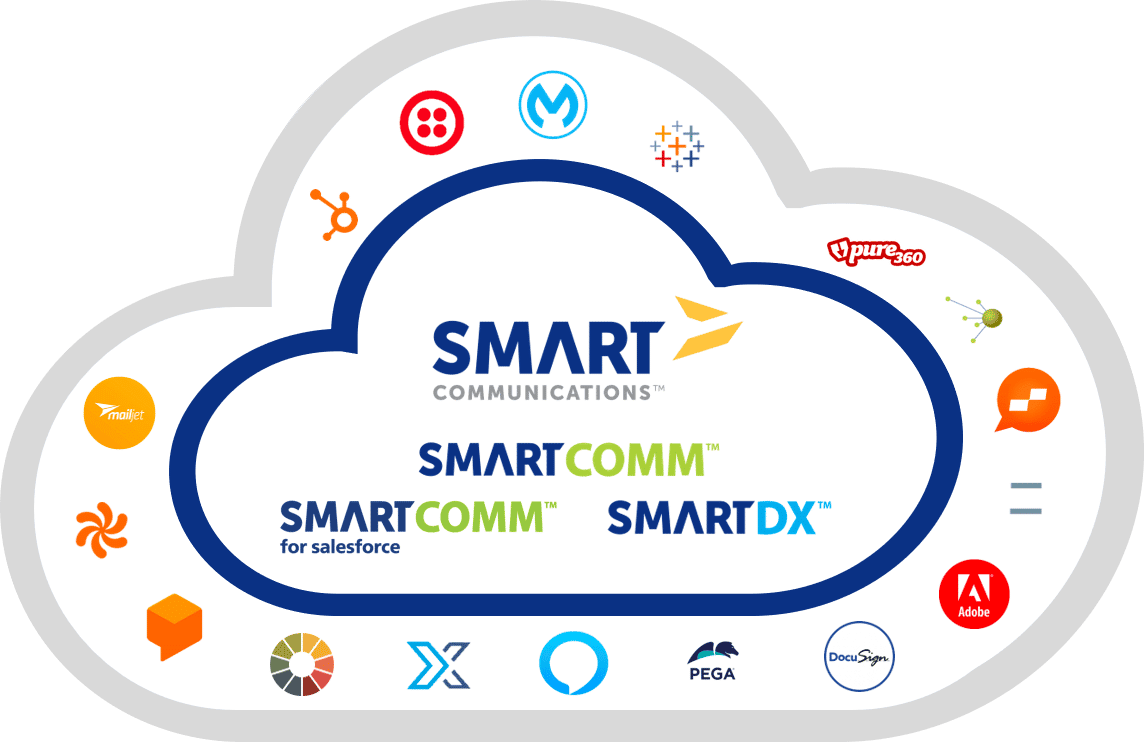
The key is finding a platform that offers the flexibility needed to take your customer communications to the next level.

PRO TIP: Examine how extensive a vendor’s API suite is and look for technology that’s built with modern standards to facilitate interoperability. Look for vendors that have a published API set as this will lead to easier interoperability.

Enhanced Organizational Efficiency

A CCM solution that’s truly built with the cloud in mind increases productivity by enabling employees to work together through the number of tools available in the cloud. Cloud-based communications solutions have the power to break down organizational data silos, making it easier for employees, customers and third-parties to communicate and collaborate. Rather than relying on IT as the go-to data source, a cloud-based CCM solution equips organizations with enhanced data visibility across departments, making it easier to decide which users have what level of access to what data. This also streamlines work efficiencies and increases collaboration as staff will know which communication documents are directly assigned to them.  Imagine having one version of a document that can be worked on by different people – with the cloud, there’s no need to have multiple copies of the same document in circulation!

PRO TIP: Ask vendors how users can interact with the software to avoid reliance on other divisions within the company for data insights and how quickly important upgrades are implemented. A software that’s truly designed with business users in mind should be more than willing to demonstrate these essential capabilities.

Improved Customer Satisfaction

Easier access to customer data allows organizations to create a more consistent and rewarding experience throughout the entire lifecycle as they have greater insight into behavior patterns and individual communication preferences.  As technology continues to grow and evolve, customers expect organizations to keep up or else they will gladly find another option that better serves their communication preferences. As you explore cloud-based communications solutions, it’s important to look for platforms that can easily deliver communications via multiple channels based on customer preferences and allow for recent interactions to inform subsequent outreach to that customer—even allowing a conversation to start on one channel and continue on to another.

PRO TIP: Look for a platform that is poised to deliver interactive, on-demand, and batch communications across multiple delivery channels, and can future-proof your customer preferences as new channels emerge.

Making the choice to invest in a cloud-based customer communications solution is an important step in an organization’s digital transformation journey. It’s also likely one of the biggest investments your business will make. Make sure you fully understand the nuances and the benefits only a platform built from the cloud up can deliver.

For more insight to help guide your cloud-based CCM buying journey, download our latest thought leadership, Conquering the Brave New World of Modern, Cloud-Based Customer Communications Management: A Buyer’s Guide.

An Exciting New Chapter in Next-Generation CCM

By James Brown, CEO of Smart Communications

On July 18, we announced our acquisition of global digital transformation software company, Intelledox. We are thrilled about this exciting new chapter as the combination of our companies is a game-changer, resulting in the industry’s only cloud-based, next-generation customer communications management platform. We truly are SMARTer together, and enterprises that want to intelligently transform the conversations they have with customers in today’s increasingly digital world will reap the benefits.

To be successful today, companies must deliver personalized, relevant and interactive communications – all at tremendous scale. Ensuring the best possible customer experience means these communications must be consistent and meaningful throughout the entire customer lifecycle—from acquisition to servicing, and every interaction in between. By joining forces with Intelledox, we will redefine customer engagement, allowing enterprises to deliver best-in-class, two-way customer conversations throughout the entire customer journey while improving internal efficiency and creating ROI that is unmatched in our industry.

If you are not already familiar with Intelledox, its cloud platform connects to any system of record and provides next-generation forms, built-in workflow, and on-demand customer communications. It is designed to digitally transform traditional forms-based processes into intelligent, conversational user experiences that streamline internal systems, manage risk and reduce demand for support services and, as a result, deliver more customers ready to transact. The company has enabled hundreds of enterprise and government organizations and more than 22 million users globally to rapidly transform paper or PDF-based processes into intelligent, data-driven customer experiences.

We couldn’t be more excited to welcome them to the Smart Communications family and look forward to sharing more details in the coming weeks and months about what this means for our current customers and what it could mean for any enterprise who wants to take its customer communications programs to the highest level possible.

In the meantime, we invite you to watch this video to learn even more!


Achieving Digital Transformation the SMART Way

By Hitesh Bhindi, Director of  Professional Services at Smart Communications


According to IDC, worldwide spending on digital transformation initiatives will reach nearly $2 trillion by 2022. So, what’s keeping your organization from jumping onboard? Let’s face it, digital transformation for any organization large or small is a huge commitment, not to mention a big financial investment. There are reasons why some are hesitant to pull the trigger, but that doesn’t hide the fact that digital is here to stay. Transforming to a digital-first organization and in turn, selecting a modern customer communications management (CCM) platform are both critical decisions for any company that wishes to maintain its competitive edge.

While revamping your customer communications strategy and incorporating new technologies does invite certain complexities, the tradeoff of improved communications across a wide range of channels will be well worth it. But, before you reach out to your boss with an exciting new idea on how to push your organization along the digital route, take some time to think things through and develop a comprehensive plan of action.

Why Upgrade to a Modern, Cloud-Based CCM Solution?

It’s important to clarify why now is the time to modernize your customer communications strategy and emphasize the need for change. Shockingly, many people still have the mindset, “If it’s not broken, why fix it?” According to Forbes, a recent study found 83 percent of enterprise workloads will be running on cloud servers instead of on-premises platforms by 2020. The cloud has come of age! Companies that don’t embrace the cloud, and the internal and customer-facing benefits it affords, risk falling behind their competition.

How to Gain Buy-in Across Your Organization

Key to the success of a digital transformation project is employee engagement. Barriers to this often include people feeling that either the new program doesn’t relieve their pain points, or it was imposed on them with little or no input. It’s important to be aware of these sentiments within your organization to identify how going digital can help address their needs. In our latest whitepaper, Setting the Stage for Change in the Digital Age: How to Gain Organizational Buy-In, we reveal five key steps to follow that will help the process run smoothly.

Crafting a Plan for Digital Transformation

Once you’ve done your homework and connected with key stakeholders across your organization, it’s time to develop a proposal for your executive team. You’ll want to start by articulating how a cloud-based CCM will help your organization improve your communications. Then, you’ll need to address how you’ll update your operational model to match a new, digital-focused communications strategy. Using the data gathered during the fact-finding process, you can create a digital content roadmap highlighting where digital communications can be incorporated. Finally, you’ll want to showcase areas of opportunity for quick wins and demonstrate ROI early. Seems straightforward, right?

While it might not be a one-day project, it will be well worth the process!

7 Signs It’s Time to Upgrade Your Current Document Generation Solution

By Sienna Quirk, Senior Director, Product Marketing at Smart Communications

Legacy document generation solutions are fine for basic communication, but what happens when you need to create or change templates or want to build in more complex logic? Often these watershed moments of change occur when your current solution lets you down. Changing regulations, expansion into new markets and channels, mergers and brand updates can be a nightmare for those in your organization responsible for managing template updates and creation.

Is it time to rethink your current document generation solution? Here are seven signs you’ve outgrown your current solution and what to look for when evaluating a new one.

  1. If your current solution requires coding, IT resources, or professional service dollars to make necessary updates, it’s time to upgrade. If you want a solution that makes faster updates, look for one that is built to be user-friendly and includes a modern user interface (UI) for admins and users with features like a drag and drop editor, if/then logic, and shared content. These features ensure updates are done in real time, without the headache of waiting on IT or spending your day coding templates one by one.
  2.  If your solution requires a template for EACH AND EVERY variation, it’s time to upgrade. No one wants to manage a template library in the thousands. Instead, look for a solution that can address multiple channels, languages, and brands all within a single template. Cutting down on the number of templates in rotation means less time spent managing and updating and more time dedicated to on meaningful projects.
  3. If your solution was built for a single channel or limited channels, it’s time to upgrade. Customer engagement should start where your customers are, which today could be through various channels including text, email, and voice assistants, and less and less in the mailbox. Look for a solution that can address multiple communication channels and is built with changing technology in mind. Solutions that contain features like open APIs can more easily adjust their channels as new technologies emerge.
  4. If your solution struggles to handle complexities like charts, graphs, images, and videos, it’s time to upgrade. Look for a solution with a proven track record of incorporating the type of content into your document that allows you to better communicate and connect with your customers.
  5. If your solution lacks the ability for users to personalize their message, it’s time to upgrade. Document templates are great for locking down content and ensuring the right messaging and branding leaves your company the right way, every time. But a locked template can still offer personalization without risk. A templated approach to communication doesn’t have to mean your company is void of personality. Look for a solution that allows a business user to connect with their customer in approved areas of a template that show that they’ve listened, and they care.
  6. If you struggle to quickly address changing compliance regulation in your templates, you’re putting your company at risk and it’s time to upgrade. Look for a solution where updates can be made once and flow through to all the templates that are affected, in real-time. This removes the risk of outdated templates making their way into the market during times of change.
  7. If your solution requires business users to work outside of your system of record or requires your users to email Word documents back and forth, it’s time to upgrade. Look for a solution that provides a seamless experience inside Salesforce, or your systems of record, to increase adoption and ensure compliance.

How quickly you can adjust templates when regulations or company priorities shift could make the difference between a smooth go-to-market strategy and a clunky time-consuming project that takes high-value employees away from important activities.  To avoid these risks for your company, make sure you have a solution that can scale with your changing business and that is set up to change with you as technology and customer expectations grow. When done right, having the right document generation solution in place can increase efficiency, reduce risk, and allow your business to scale.

Curious to learn more about the needs of today’s sales teams and how a modern document generation can increase your ability to scale with a rapidly changing market? Tune in to our webinar, Improving Sales Efficiencies with Modern Document Generation, to start your journey toward SMARTer document transformation.

4 Emerging Trends Revolutionizing Customer Communications

customer communications


By James Brown, CEO of Smart Communications

It became clear in 2018 that the drive for meaningful customer communications has become a major focus for businesses looking to gain a competitive edge. As the communications landscape continues to evolve, companies must look to new tools and technologies to meet growing consumer demands. So, what customer communication trends can we expect to see in 2019?  We gathered insights from several key industry analysts and experts to identify some common themes.

Increased Adoption of Cloud-based Platforms

Nine out of 10 companies are expected to have some portion of their infrastructure in the cloud this year. Cloud adoption has officially come of age and enterprises are starting to act smarter when it comes to workload migration and scalable communication strategies. Previous security concerns have been eased and the benefits that accompany cloud computing are resonating. There’s no denying, however, that communicating with customers has become more complex. Having a cloud-based customer communications solution in place gives enterprises the functionality needed to provide more timely and relevant conversations. As a result, we’ll see a tremendous surge in businesses buckling up for their cloud journey in 2019 – especially at the enterprise level.

More Unified Communications Architecture

In 2019, a growing number of enterprises will build or revamp their communications architecture so that it can more effectively be leveraged across business units. According to Deviprasad Kuppuswamy, Cognizant CCM practice lead, “connecting to marketing and CRM platforms will help communications platforms to provide better message visualizations to customers, enabling them to take quicker actions.” Consumers are becoming more accustomed to seeking out information on their own, they now expect nearly instant responses to their needs and requests. Especially as more communication channels are added to the mix, speed and agility will provide a massive advantage for enterprises looking to scale. A unified communications architecture will help businesses meet these growing demands.

Heightened Focus on Analytics to Fuel Personalization

A more unified communications architecture allows for deeper analytics that can be used to drive personalization across various touchpoints. In 2019, we expect enterprises will start to deliver this more personalized customer experience. Enterprises will no longer be able to rely solely on the traditional methods of communication, such as print or email. To create new digital experiences, business users will have to rely on data-driven insights across various stages of the customer lifecycle to determine the customers preferred channel for communications and more.

From Transformation to Automation

Naturally, the drive toward digital transformation presents a need for further automation. Big data analytics and machine learning capabilities only work well when information is captured in a central database. Breaking down silos is key to internal success. In 2019 enterprises will want to have more control, either by enhancing internal capabilities or choosing vendors who offer more business-friendly capabilities that give them more control at every touchpoint. The landscape for service providers and technology vendors is undoubtedly changing. According to Kaspar Roos, founder and CEO of Aspire, vendors “will need to operate much closer with their partners and start driving innovations through co-creation.”

Curious to see what else leading industry experts have to say? Download our 2019 Predictions piece for a deeper dive into the trends above and more.

3 Ways Financial Services Companies Can Keep Pace with Ever-Changing Customer Expectations


By Neil Greathead,  CCO of Smart Communications

We’re all aware that the balance of power has shifted from companies to customers. Customers don’t want to be communicated to – they want to be communicated with and have a two-way dialogue with companies. When it comes to the current quality of communications within the financial services industry, our recent benchmark study revealed only 33 percent of customers surveyed feel that the companies they do business with always communicate through their preferred methods.

With easier access to what competitors are offering, maintaining customer loyalty is more challenging than ever before. According to PWC, one in three customers will leave a brand they love after just one bad experience. Customer demands are at an all-time high and still growing! Every communication sent, every contract, every email, every account statement, text message or push notification is all a part of the larger, ongoing conversation with your customer.

Ultimately, every business will reach a point where customer communications are at risk of breaking down due to growing complexities. With more channels, more customers, more touchpoints, more interactions, and more disruptions, now is the time for businesses to take the proper steps in order to provide the exceptional communication experiences that today’s customers expect.

Here are three ways companies within the financial services industry can proactively scale customer communications and keep up with ever-changing customer expectations.

Embrace Digital Transformation

As stated by industry expert and keynote speaker Greg Verdino, “Digital transformation closes the gap between what digital customers already expect and what analog businesses actually deliver.” To succeed in today’s digitally connected world, companies must embrace digital transformation. Yet with 75 percent of CIOs stating their enterprises will fail to meet all their digital objectives in 2019, we realize this is no easy feat. Whether companies are being held back by conflicting priorities, budget restrictions legacy systems, or simply the fear of the unknown or uncertainty over where to start, there’s still an underlying pressure to bolster the customer experience.

The good news is, while it might not be easy, it will be worth it. The promised benefits of digital transformation remain huge for companies – especially those within the financial services industry. How do we know? We’ve witnessed these successes firsthand! For example, after migrating to our cloud-based customer communications management (CCM) solution Smart Communications helped one multinational US investment bank successfully condense their template change process from 160 hours to 16 hours. We’ve also seen a leading financial services company receive a total cost-benefit of $16.7 million in just three years, achieving an ROI of 260 percent. Saved time, resources, and an increased ROI are only a few examples of how digital transformation ultimately enables businesses to focus more on the customer experience.

Automate Processes to Deliver Personalized, Scalable Conversations

​As your customer base grows, personalization becomes more challenging. To be successful, enterprises must deliver highly personalized communications at tremendous scale. Modern CCM technology can make this possible by improving internal efficiencies and automating processes. Cloud-based platforms can go a long way in making this vision a reality by making it easier for different groups within an organization to collaborate—thus breaking down departmental silos.  They are also able to more easily integrate with other pieces of technology in an enterprise’s ecosystem, which ultimately leads to a more comprehensive and holistic view of the customer which makes providing a more consistent and personalized customer experience (CX) throughout the entire lifecycle much more attainable.

Our platform alone has facilitated more than 50 billion conversations between our users and their customers to date. And we’re communicating to more than 125 million credit card users on an ongoing basis – scaling the conversations related to more than $2 trillion in annual spend!

Introduce New Channels to Retain Customers

While print is not going away entirely, now is the time for a strong shift toward digital – and enterprises must be prepared to deliver. ​Our benchmark study found that while email is the preferred communication channel for customers in both the US and UK, 66 percent of business leaders admit that less than 40 percent of their communications are being distributed via email. Clearly, there’s still a lot of room for improvement.

To meet customers’ expectations of recognizing their individual preferences – while also handling the many ways your customers now interact with your brand, a CCM solution must be poised to deliver interactive, on-demand, and batch communications – and to do so via multiple delivery channels. Companies that get this right, stand to benefit substantially. According to research conducted by the Aberdeen Group, companies with extremely strong omnichannel customer engagement retain on average 89 percent of their customers, compared to 33 percent for companies with weak omnichannel customer engagement.

Looking for more customer communications inspiration? Watch our webinar, Timely, Relevant, Meaningful: Building Powerful Customer Communications in Financial Services, and gain expert insight into how financial services companies can effectively scale their customer communications to succeed in today’s high expectation environment.

Embracing the Future of Customer Communications Management Today


By Chris Murphy, Senior Director of Product Marketing at Smart Communications

The customer communications management (CCM) industry has been around for some time. Born out of a need for companies to be able to produce compliant, yet highly personalized communications, enterprises invested in platforms that allowed them to produce mission-critical business and customer communications at massive scale.  

Yet, despite its extensive and tenured history and the disruption caused by industry consolidation, innovation is still alive in the CCM space. During a recent webinar, Craig LeClair, vice president and principal analyst of Forrester Research, painted a vision for where the industry is moving and where vendors who support customer communications will need to shift focus in order to realize success for the modern customer. With movement to the cloud, eDelivery promotion across digital channels, and customer experience improvements, the future of SMARTer customer communications is looking bright. 

Communication Types Require Specialty Focus Areas  

Craig adeptly broke down the types of customer communication management areas of focus, and the different business use cases that each are well-designed to meet.  

  • Structured offerings are largely on-premise and are ultimately designed to handle high-volume print outputs.  
  • Interactive offerings allow for deeper personalization and afford high-levels of business user control in order to customize the type, channel, and content of the communication.  
  • Cloud-based offerings, often delivered via hybrid-cloud or in a true multi-tenant fashion, signify a future where they can interact with cloud-based analytics services to gain an understanding of the customer’s true intent and to then seamlessly choose from an array of dynamic templates in order to deliver the right content.  

Movement to the Cloud 

One of the key trends mentioned in the webinar was the movement of CCM vendors to the cloud. This pivotal shift will allow CCM to begin to play a much more integrated role in the wider technology ecosystem and can be more easily informed by analytics from other technologies will be predominantly cloud-based in the future. The modern customer is not predictable, nor linear in the methods and channels that they engage with you through. The ability to consume information from these third-party analytics systems will allow CCM vendors to hone in on what the customer is ultimately trying to achieve, and how to get them there with hyper-focused communications. Ultimately CCM vendors will adopt a Communications-as-a-Service (CaaS) strategy, where a callable infrastructure is used to generate and initiate communications based on real-time customer actions as well as triggers from third-party systems.  

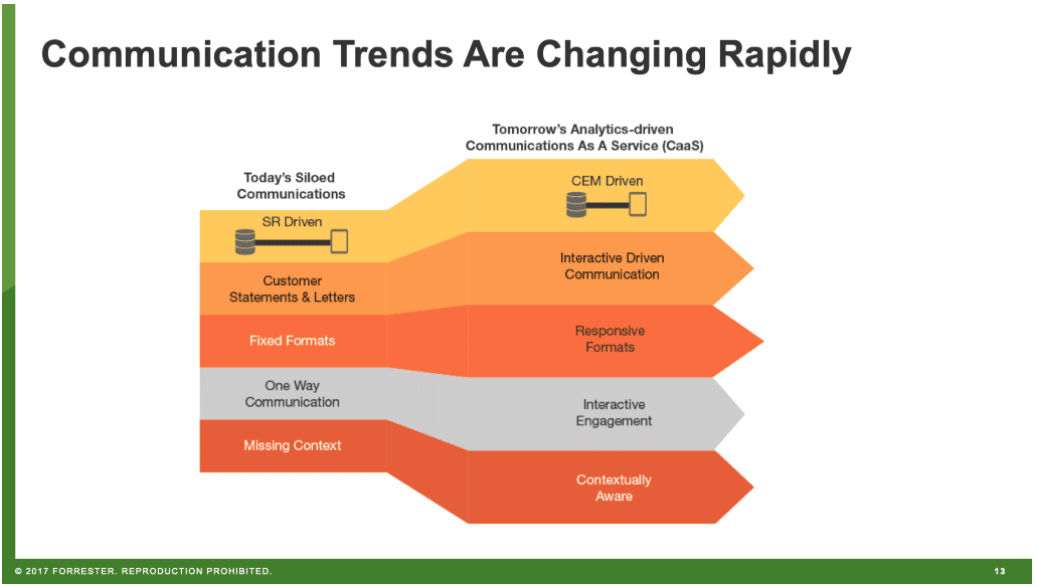
Communication Trends are Changing………Toward the Customer 

Communications trends are changing from a siloed, line-of-business run approach to one that is much more centralized and has the customer firmly in the center. There has been a movement from focusing on the template approach driven by systems of record to reimagining how these communications are received – and perceived – by the end customer.  

customer communications management

Image courtesy of Forrester Research.


With an emphasis on interactivity, responsiveness, engagement, and contextual understanding, the future of communications will be analytics-based and incorporate digital communications. 

The Critical Impact of Language 

“You say tomato, I say tomahto.” While we’re all familiar with the song, I think that we can agree that this approach just doesn’t work in print. Similarly, much of the language used in current communications often fails to articulate the core message we’re trying to portray to our customers and makes it difficult to understand the meaning, definitions and ultimately next steps. As a result of overly stringent legal input into the language used in these communications, what often ends up protecting the company can also end up confusing the end recipient. There is a growing trend to begin to use shared language libraries made up of definitions and shared content that is easily understood and leveraged across a variety of communications.  

Key Areas to Look for When Building Next-Gen CCM 

While everything should be driven by core business requirements, there is an energetic movement of CCM vendors to the cloud. As a result, Craig cautioned against falling into the trap of assuming managed services are the same as true cloud-based solutions. 

In Craig’s words, “You want to look for a cloud-ready solution. You want something that has proven multi-tenancy, that has browser and thin-based clients, and a good set of APIs that can work to get to on-premise information. Look for an architecture that has a more generic type of format as core content to make it easy to switch from one channel to another.” 

Future Innovations Driving CCM and Customer Experience Innovation 

The growing interest in customer journey mapping and Design Thinking will firmly move the focus towards a customer-centric point of view and this will be the driver for the next generation of communications. The combination of core system data with a customer’s behavioral activity will represent the foundation of machine-readable content to which machine learning can be applied to analyze, learn and ultimately predict the most optimized communication, content and even channel to engage through.  

As customer experience (CX) becomes a source of competitive advantage for more companies, customer communications – both the communications that you share with them as well as the opportunities that you provide for them to communicate with you – will continue to play a crucial role in the creation of those experiences.  

To listen to a complimentary recording of this webinar, please visit the following page. 

How Artificial Intelligence Will Power Smarter Customer Communications

artificial intelligence


By Simon Tindal, CTO of Smart Communications

From voice assistants like Amazon’s Alexa and Google Assistant to behavioral algorithms, chatbots and self-driving cars, artificial intelligence (A.I.) has quickly become a hot topic in tech news. While we may not know exactly how this emerging technology will continue to impact our daily routines over the next few years, there’s one thing we can bank on – it’s here to stay. PWC predicts that A.I. will contribute $15.7 trillion to the global economy by 2030. In addition to the economic shift, consumers are becoming more comfortable and, in some ways, increasingly dependent on A.I. Think about the last time you asked Siri to call a contact or asked Alexa to place an order on Amazon. A.I. can be so seamlessly integrated into our day-to-day lives that sometimes we don’t even realize we’re using it. So, what impact will this technology have on your organization’s relationship with your customers? Here are a couple of ways we can expect A.I. to power smarter customer communications.

Better Meet Customer Expectations

Today’s customers are increasingly in control. They can easily gather the information they need – and they expect near real-time responses to their questions. According to Hubspot Research, 90 percent of consumers feel that an immediate response is important when they have a customer service question. Make them wait longer than 10 minutes and you risk testing their patience! Voice-assistants and chatbots are available 24/7, so clearly, they can play a key role in reducing response times and better meeting consumers’ expectations. When customers speak to a representative to discuss a statement or file a claim, they don’t want to wait days for the requested forms or a follow-up. They want the issue to be resolved at the moment, and more agile and scalable solutions, like A.I., can deliver this —in less time than it takes to compose a tweet. A.I. technologies can also be used to help customers conduct the research they need to make more informed decisions, which helps them feel in control throughout all stages of their journey.

Increase Opportunity for Personalization

Imagine saying “Alexa, when is my auto policy renewal due” or “Hey Google, ask my insurance advisor what total vehicle loss means” and instantly receiving relevant answers from trusted providers. A.I. represents a significant step forward in transforming customer communications into personalized conversations. Also, let’s not forget about the power of data. We now have an incredible opportunity to connect data with valuable insights, which fundamentally changes the way we can reach and engage our customers. Therefore, more businesses are turning to cloud-based solutions, such as Smart CommunicationsTM to better manage their customer communications by easily connecting all of their data, applications, and history to build conversations that are relevant, timely and impactful. Now that we can anticipate behaviors based on historical data with customers, businesses can better understand the impact of their customer communications more clearly and leverage trends to evolve these interactions into meaningful, personalized conversations over time.

The SMARTer Way to A.I.

According to the MIT Sloane Management Review, almost 85 percent of executives believe A.I. will enable their companies to gain or withstand a competitive advantage. But only one in five companies has incorporated A.I. in some offerings or processes. The truth is, companies can’t afford to put A.I. on the backburner for much longer. As customer expectations continue to evolve and communication channels continue to expand, businesses will need to be prepared for a new set of challenges and opportunities. Embracing a modern Customer Communications Management strategy is key for businesses that want to incorporate multiple channels while still delivering a personalized experience for each customer. It’s important to be mindful that a customer’s interests and needs change as they move through their customer journey with a company. This also means their communication preferences are likely to change several times. Having the right mix of communication channels in place will help keep your business ahead of digital transformation and will strengthen your relationships with your customers.

Not sure where to begin when it comes to incorporating A.I. into your customer communication strategy? Contact us and one of our experienced communications experts will help you get started.

The Cloud Is Now: Why 2019 Is the Year to Go Cloud-First

AWS cloud


By Simon Tindal, CTO of Smart Communications

It’s no surprise that a growing number of today’s organizations are implementing a cloud-first strategy as they shift their spending away from servers, and other on-premise, legacy systems and technologies. In fact, Gartner predicts that 28% of spending within key enterprise IT markets will shift to the cloud by 2022, up from 19% in 2018. Furthermore, Forbes recently released the State of Enterprise Cloud Computing which revealed that 77% of enterprises currently have at least one application, or a portion of their computing infrastructure, in the cloud. With the public cloud services market projected 17.3% percent growth, totaling $206.2 billion in 2019, it’s clear that a cloud-first approach is no longer just an option – it’s becoming a necessity for organizations to scale.

As cloud becomes widely adopted, it will begin to influence even greater portions of enterprise IT decisions as organizations aim to improve their system infrastructures. We’ve already touched on how moving to the cloud can lead to more personalized and impactful customer conversations, but there are even more reasons migrating to the cloud should be at the top of your to-do list in 2019.

Overcoming the Fear of Digital Disruption

These days, “digital disruption” is no longer a concern for the future, it’s a reality NOW! Whether it’s a fear of migration, a need to adhere to strict compliance regulations, stringent privacy issues, or geographic barriers, every organization is experiencing their own set challenges, regardless of the stage of digital transformation they are in.

Knowing Your Options

The good news is, there are several cloud deployment options designed to fit your unique business needs. Here’s a quick overview of the three main cloud deployment models that could transform your business:

  • Public Cloud: Public Cloud services are offered by third-party providers over the public internet, meaning they are available to anyone willing to purchase them. Amazon Web Services (AWS), Microsoft Azure, IBM Cloud and Google Cloud platforms are some of the more well-known public cloud providers.
  • Private Cloud: A private cloud model is a single-tenant environment where the hardware, storage and network are purchased and provisioned for a single client or company.
  • Hybrid Cloud: One of the more popular deployment models, the hybrid cloud uses a combination of public/private cloud with on-premise services.

Why We’re Running With AWS

Earlier this year, we announced our plans to support SmartCOMMTM, and SmartCOMMTM for Salesforce solutions on the AWS to provide additional deployment flexibility to our already available cloud and hybrid-cloud options. Running on the AWS infrastructure adds yet another layer of innovation to our platform and additional deployment flexibility. In addition to receiving amazing benefits including elastic scalability, and improved efficiency, our customers are better positioned to be at the forefront of digital transformation within their respective industries.

As demand has increased for our technology to support AWS across APAC and EMEA, as well as in the US and UK. AWS is a mature, globally-enabled secure environment – enterprises can trust that it will continue to enable them to scale as their needs and volumes evolve over time.

To learn more about our latest AWS announcements, visit our resources page or click here.