Solutions

Archive and retrieve communications securely with cloud-native speed.

Orchestrate real-time, compliant interactions across every channel.

Simplify and standardize trade and relationship documentation workflows.

Industries

Improve customer engagement across policy, billing, and claims.

Create and deliver personalized, compliant customer communications at scale.

Heighten citizen experience with digital transformation.

Improve customer engagement across utilities.

Resources

Browse popular market research, articles, videos, written guides and more in one convenient location.

Explore upcoming events, webinars, and customer experiences shaping the future of customer conversations.

Get the latest updates on Smart Communications, including product news, and industry recognition.

Company

Learn more about our company, our leadership and how were growing the team!

Analysts

Analysts

Access analyst research, market reports, and industry recognitions featuring Smart Communications.

The State of Digital Transformation in 2024: Overcoming Legacy Technology Barriers and Elevating Customer Experience

By Leigh Segall, CEO at Smart Communications 
 
Reflecting on the challenges of the past four years, organizations have faced unprecedented uncertainty and pressure to adapt. In 2023, innovation was stifled as organizations grappled with the looming specter of economic recessions. This led many to shelve critical digital transformation initiatives, putting them on hold as they navigated economic uncertainties. Now, emerging from this hiatus, we see a new chapter swiftly unfolding, marked by renewed momentum and a reinvigorated push towards digital transformation. 

Closing the Digital Maturity Gap in 2024 

Recent research has uncovered a remarkable surge in IT spending for 2024, with 72% of digital leaders doubling down on investments to propel their digital initiatives forward. This surge reflects a broader trend towards digital transformation, with global spending projected to reach a staggering 3.4 trillion US dollars by 2026—a nearly 3x increase over the last five years.  

Yet, despite this momentum, significant challenges remain. According to Forrester, a mere 6% of organizations have attained advanced digital maturity, highlighting the pervasive gap between aspiration and achievement in the digital realm.  

Legacy systems continue to consume a substantial portion of the overall IT budget, impeding innovation. In fact, 87% of CIOs cite the complexity of existing systems as a barrier to investing in next-generation services. Additionally, 34% of CIOs have identified replacing legacy technology as a top digital transformation goal for 2024, underscoring the urgency of modernization efforts.

Retiring Legacy Technology for Enhanced Engagement 

When it comes to managing customer communications, organizations must address the lingering challenge of legacy communications technology. While many enterprises have made strides in modernizing their customer communications with cloud-based solutions, a significant number still grapple with outdated, on-premise, channel-based systems.  

These legacy solutions, acquired over time, pose a multitude of challenges—they are costly to maintain, lead to duplication of efforts, impede business agility, and detract from the customer experience. To truly harness the benefits of a modern CCM platform, we see many organizations looking to retire these outdated systems and transition to a centralized, cloud-based approach. By streamlining and automating customer communications processes across all delivery channels, organizations can deliver a seamless customer experience, maximize their return on investment, and position themselves for success in the digital age. 

Rethinking Forms Processes: Digitally Transforming Transactions into Engaging Interactions 

This imperative extends beyond customer communications to encompass forms processes—a critical yet often overlooked aspect of the customer experience.  

Over the past several years, analysts like Kaspar Roos, the Founder and CEO of Aspire CCS, have been vocal about the evolution of Customer Communications Management (CCM) to Customer Experience Management (CXM).  

According to Roos, the forms sector, mirroring the broader CCM market, is undergoing its own transformation. He emphasizes the growing need for dedicated solutions to facilitate interactive data collection, validation, and processing as the market moves towards greater bi-directional interactions.  

The combination of customer communications and customer data collection, once modernized and transformed, together play pivotal roles in shaping the omnichannel customer interactions of tomorrow. 

Once modernized, the combination of customer communications and data collection together play criticial roles in shaping the future of omni-channel customer interactions. 

Legacy forms processes, characterized by manual, outdated, and disconnected practices, present a significant barrier to delivering seamless and cohesive customer experiences. Forms serve as a vital touchpoint between organizations and their customers, facilitating data collection and driving internal and external processes. Yet, despite their importance, forms processes have been largely neglected in the broader CX strategy, leading to a noticeable gap between digitally transformed customer communications and legacy-style form processes. 

According to Forrester, 82% of organizations still use paper-based processes to some extent. The ramifications of this oversight are profound. Customers are confronted with outdated, cumbersome forms processes that fail to meet their expectations for convenience and efficiency. Frustrated by the complexity and repetitive nature of these processes, customers are left feeling dissatisfied—a stark contrast to the seamless experiences they encounter in other digital interactions. In an era where every interaction should leave customers feeling recognized and valued, outdated forms processes fall short of meeting customer expectations for convenience and efficiency. 

Forrester reserach shows that 82% of organizations use paper-based processes to some extent.
 
Transitioning From Static Forms to Smarter Data Collection 

However, the tide is turning. By redefining what a “form” entails, organizations can transform static transactions into dynamic, intelligent interactions that leave customers feeling valued and empowered. 

Smart forms or data collection solutions leverage automation and intelligence to guide users through complex processes, adapting dynamically based on the information provided. By eliminating unnecessary fields and pre-filling data from existing databases, you will minimize customer effort, improve data accuracy, and enhance overall efficiency. 

Moreover, forms of the future facilitate bi-directional communication, simplifying interactions between customers and employees. Whether online or on a mobile device, these digital experiences enable seamless data exchange, leveraging features such as mobile cameras for enhanced functionality. By mimicking a conversation between the customer and the organization, smart data collection solutions foster engagement and reduce the likelihood of customer abandonment. 

Recognizing the critical role it plays in the CX landscape, organizations are beginning to integrate intelligent data collection into their broader CCM strategies. Smart Communications™ leads the charge with SmartIQ™—a revolutionary forms management solution designed to automate and transform data collection processes. 

Delivering Future-Ready Customer Conversations 

SmartIQ empowers organizations to create and manage digital forms with ease, leveraging a low-code web-based design tool that requires minimal IT intervention. By automating data sharing and streamlining business processes, SmartIQ enhances operational efficiency and reduces technical debt. 

Furthermore, SmartIQ’s analytics engine provides organizations with invaluable insights into process performance, enabling continuous improvement and optimization. Armed with detailed analysis, organizations can identify bottlenecks, refine processes, and enhance the overall customer experience. 

By embracing solutions like SmartIQ, organizations can bridge the gap between customer communications and forms processes, delivering future-ready customer conversations and reducing customer effort.  

The synergy between SmartCOMM™ and SmartIQ enables organizations to consolidate, centralize, and automate data collection processes and customer communications across all channels, unlocking a myriad of benefits. From reducing manual work and operating costs to ensuring data security and regulatory compliance, our industry-leading SaaS solutions empower organizations to keep pace with evolving customer expectations and drive sustainable growth. 

If you’re interested in learning how you can consolidate and modernize your customer communications solutions, one of our experts would be happy to provide a free consultation. If you’re looking to transform your forms processes with SmartIQ, I encourage you to request a demo, or visit our demo zone to see it in action. 

Archive and Retrieval in the AI Era: Why Legacy Solutions Fall Short

By Scott Draeger, SVP of Product and Vertical Solutions at Smart Communications 

The artificial intelligence revolution is fundamentally changing how organizations interact with their archived communications—and your legacy archive and retrieval systems simply weren’t built for the challenges of today. 

The Legacy Problem: Built for a Different Era 

Traditional archive and retrieval technologies were built generations ago, with a spike for Sarbanes Oxley-driven retention requirements. Back then, storage was expensive, and retrieval requests during a seven–year retention period were rare.  

These systems met the legal needs of archiving single-channel communications for long periods of time. However, they were optimized around a simple assumption: Organizations would store vast amounts of data but rarely access it. These vendors’ pricing models and technical architectures assumed a low retrieval-to-storage ratio. The AI era is set to radically challenge those assumptions. SmartHUB™ is prepared to meet tomorrow’s challenges.   

The AI-Driven Shift: From Storage to Active Intelligence 

Today’s AI-powered applications are transforming archived communications from static repositories into dynamic, intelligent resources that streamline operations and improve customer experiences. Three key use cases are driving unprecedented demand for retrieval capabilities: 

Customer Self-Service: AI-guided applications now help clients navigate their communication history independently, and SmartHUB surfaces the most relevant documents and interactions with easy integrations. What once required extensive cross-system integrations is now easily available via scalable cloud applications that support your intelligent search and recommendation systems. 

Context-Rich Employee Interactions: Customer-facing applications create AI-generated summaries of months of multichannel communications in real-time, enabling more informed, personalized interactions that access PDF, HTML, email, SMS, and other communication channels. SmartHUB’s scalable retrieval quickly delivers relevant communications to reduce interaction times and increase customer satisfaction. 

AI Training and Optimization: Organizations are mining their communication archives to train AI systems, using historical customer experiences to improve future interactions and identify patterns that enhance service delivery. SmartHUB’s scalable retrieval can quickly supply millions of documents for analysis.  

The Cost Reality Check

As the AI era unfolds, it’s time to evaluate your legacy solutions against the new metrics that matter today and tomorrow: 

  • What will happen when your retrievals multiply by 10x, 100x, or even 1,000x? Legacy pricing models weren’t designed for AI applications’ appetite for data, information, and documents.
  • How will you integrate decades-old archive systems with cutting-edge AI technologies? Most legacy platforms lack the APIs and flexibility required to integrate with today’s AI technologies, especially on– premises technologies.
  • Can you deliver the real-time context that today’s customer experiences demand? Slow, batch-oriented retrieval processes can’t support AI applications that need instant access to communication history.

SmartHUB: Archive and Retrieval – Ready for AI 

SmartHUB addresses these challenges head-on with three core capabilities: 

Efficient Storage: Modern compression and indexing technologies that reduce storage costs while maintaining full searchability and compliance. 

Scalable Retrieval: High-performance architecture designed for the frequent, complex queries that AI applications demand—without the cost penalties of legacy systems. 

Rapid Migrations: A cloud-native architecture built with migration in mind lets you leave behind your legacy archiving technology, preserving decades of valuable communication data without the burdens of your legacy technologies. 

The Time to Act is Now 

The AI era isn’t coming—it’s here. Organizations that adapt their archive and retrieval strategies now will gain competitive advantages through better customer experiences, more efficient operations, and AI-powered insights drawn from their communication history. 

Those that wait risk being trapped by legacy systems that can’t scale to meet AI’s demands, facing spiraling costs and missed opportunities as their competitors leverage decades of communication data to deliver superior customer experiences. 

SmartHUB provides the foundation for archive and retrieval in the AI era. Are you ready to future proof your communication archives? 

About the Author 
Scott Draeger is the SVP of Product Marketing and Vertical Solutions at Smart Communications. He has a passion for collaboration, and over 25 years of innovating customer communications technology, around the globe. He focuses on improving communications for the recipient while improving performance for the business. He started as a document designer using a collection of hardware and software technologies, before moving to the software side of the industry. He finds connections across disciplines with certifications in graphic design, customer experience, electronic documents, and an MBA in international business.

Cybersecurity Regulations Drive Healthcare Organizations to Act

By John Zimmerer, VP of Healthcare Marketing at Smart Communications 

The healthcare industry has become a prime target for cybercriminals due to the sensitive nature of health data and the increasing reliance on digital systems. Recent cybersecurity breaches in Australia, Germany, the UK, and the United States have highlighted the urgent need for robust cybersecurity measures.  

This blog post will detail these breaches, discuss ongoing security threats, reference recently introduced regulations, and provide recommendations for healthcare organizations to improve their security posture.  

Additionally, we’ll explore how SmartIQ™ and SmartCOMM™ from Smart Communications can help healthcare organizations meet regulatory requirements and combat cybersecurity threats. 

Cybersecurity Breaches in Healthcare 

Australia has witnessed several significant cybersecurity breaches in its healthcare sector. In 2024, 41% of healthcare organizations experienced cyberattacks, with 102 data breaches reported between January and June 2024. One of the most notable breaches involved Medibank, where millions of records were compromised. Another major incident was the ransomware attack on Saint Vincent’s Health network, which resulted in stolen data from hospitals and aged care centers. 

Germany’s healthcare sector has also been under siege. In 2024, Germany saw a surge in ransomware attacks on healthcare institutions, emphasizing the need for enhanced protection. A recent attack targeted the Catholic Youth Welfare Department of the Diocese of Augsburg, compromising sensitive patient and financial data. In addition, the University Hospital Düsseldorf ransomware attack in 2020 led to significant operational disruptions and a patient fatality 

The UK has faced its share of cybersecurity challenges in healthcare. The Cyber Security Breaches Survey 2024 revealed that half of businesses and a third of charities reported cybersecurity breaches in the last 12 months. In 2022, a ransomware attack on Advanced Computer Software Group disrupted NHS services and compromised the data of tens of thousands of patients. 

The United States has experienced some of the largest healthcare data breaches. The healthcare sector saw 276,775,457 records compromised in 2024, a 64.1% increase from the previous year. In 2024, Change Healthcare suffered a massive breach affecting 190 million individuals. Other notable breaches included those at Ascension Health and Acadian Ambulance Service. 

Ongoing Security Threats in Healthcare 

Healthcare organizations face a variety of ongoing security threats, including ransomware attacks, phishing, and data breaches. The increasing use of Internet of Medical Things (IoMT) devices and electronic health records (EHRs) has expanded the attack surface for cybercriminals. Legacy systems and limited cybersecurity budgets further exacerbate vulnerabilities. 

Recently Introduced Regulations 

The Cyber Security Act 2024 mandates minimum cybersecurity standards for smart devices, introduces mandatory ransomware payment reporting, and establishes a Cyber Incident Review Board. These measures aim to close legislative gaps and align Australia with international best practices. 

Germany is implementing the NIS2 Implementation Act, which transposes the EU NIS2 Directive into German law, broadening the scope and tightening cybersecurity requirements across various sectors. This includes enhanced reporting requirements and IT risk management protocols. 

The NHS will be adopting a new cybersecurity framework for health and social care organizations. The cyber assessment framework (CAF) will allow these organisations to adapt to the rapidly changing landscape of technology and cyber threats. 

The US Department of Health and Human services has proposed updating the HIPAA Security Rule. The proposed rule “would require updates to existing cybersecurity safeguards to reflect advances in technology and cybersecurity, and help ensure that doctors, health plans, and others providing health care meet their obligations to protect the security of individuals’ protected health information across the nation.” Additionally, new state-level privacy laws are being enacted, with 11 new comprehensive privacy laws slated to take effect in 2025 and 2026. 

Recommendations for Healthcare Organizations 

To improve their security posture and conform to new regulations, healthcare organizations should consider the following recommendations: 

  1. Implement Multi-Factor Authentication (MFA): MFA is essential for securing access to systems and preventing unauthorized access. 

  1. Conduct Regular Security Audits: Regular audits help identify and mitigate vulnerabilities in the system. 

  1. Employee Training: Continuous training on phishing and other social engineering attacks is crucial to prevent breaches. 

  1. Develop Incident Response Plans: Having a robust incident response plan ensures quick recovery from breaches. 

  1. Upgrade Legacy Systems: Replacing outdated systems with modern, secure alternatives reduces vulnerabilities. 

  1. Adopt Encryption: Encrypting sensitive data protects it from unauthorized access and breaches. 

  1. Compliance with Regulations: Ensure adherence to industry regulations such as HIPAA, GDPR, and local data protection laws. 

How SmartIQ and SmartCOMM Can Help 

SmartIQ and SmartCOMM from Smart Communications offer solutions that can help healthcare organizations meet regulatory requirements and combat cybersecurity threats. 

SmartIQ 

  • Forms Automation: Transforms traditional paper forms and manual data entry processes into digital, two-way conversations, reducing the risk of data breaches. 

  • Secure Data Collection: Ensures secure, scalable, business-driven member engagement and accelerates omnichannel patient engagement with guided digital journeys 

  • Compliance: Helps organizations comply with IT standards and introduces no risk to business processes. 

SmartCOMM 

  • Customer Communications Management (CCM): Provides personalized, omnichannel conversations across the entire customer experience, enhancing security and compliance. 

  • Document Generation: Increases agility and flexibility in document generation processes, ensuring secure and compliant communications. 

  • Integration: Works with best-in-class technology directly and through consulting companies to offer integrated solutions that complement healthcare organizations’ cybersecurity efforts. 

Enhance Cybersecurity with Smart Communications 

The healthcare industry faces significant cybersecurity challenges, with recent breaches highlighting the urgent need for robust security measures. By adhering to new regulations and implementing best practices, healthcare organizations can improve their security posture and protect sensitive health data. Solutions like SmartIQ and SmartCOMM from Smart Communications can play a crucial role in helping healthcare organizations meet regulatory requirements and combat cybersecurity threats, ensuring a safer and more secure healthcare environment. 

To learn more about how Smart Communications can help, get in touch with one of our experts today. 

About the Author 
John Zimmerer is the Vice President of Vertical Marketing, Healthcare at Smart Communications, where he acts as a subject matter expert on the digital transformation of customer communications and data-centric, often form-based workflows. Most recently, John has been researching and writing about improving customer experience in healthcare and is regarded as a thought leader in this area. John has over 20 years of software product marketing experience. His areas of expertise include market research, analyst relations, public relations, and digital marketing. 

Is Legacy CCM a Hidden Liability in Your Enterprise CX Stack?

By Scott Draeger, SVP of Product Marketing and Vertical Solutions at Smart Communications 

In today’s digital transformation landscape, organizations continue to rely on Customer Communications Management (CCM) implementations that predate smartphones. The recent 2025 SPARK Matrix™: Customer Communication Management (CCM) from QKS Group highlights the risks of keeping legacy CCM technology in production past its useful life.  

The report compares Smart Communications’ cloud-native architecture against competitive offerings; “unlike legacy CCM solutions that rely on containerized deployments, this platform is designed with microservices, enabling dynamic scalability and optimized resource utilization.” Ultimately, operating your legacy CCM technology past its useful life risks both new and existing customers at a time when customer experience (CX) is critical to customer acquisition and retention.  

These once–effective deployments struggle to meet today’s expectations for agility, personalization, and seamless customer experiences—creating business risk as technology gaps widen.   

What Are the Architectural Limitations of “Containerized Deployments?“ 

Many legacy CCM vendors boast about “moving to the cloud” in marketing materials and RFP responses. When you look deeper, their cloud-moves are “too little too late” as legacy vendors deliver containerized deployments of legacy technology in an attempt to look current. At Smart Communications, we refer to these as “SOSIAC“ solutions for short, as they are the “Same Old Software in a Container.” Upon further examination, during an RFP process or evaluation, CCM buyers discover these offerings lack the flexibility and scalability inherent in cloud-native offerings like SmartCOMM™. 

SmartCOMM delivers the standards of today and tomorrow. According to QKS’ SPARK Matrix for CCM, Smart Communications has a “modern cloud-native architecture, allowing enterprises to scale communications efficiently without infrastructure constraints.” While legacy vendors attempt to modernize through incremental updates and SOSIAC-solutions, SmartCOMM leverages “microservices, enabling dynamic scalability and optimized resource utilization” according to the report. 

The SPARK Matrix highlights the benefits of Smart Communications’ cloud-native architecture:  

“The availability of an API-driven architecture ensures flexibility in deployment, enabling organizations to connect their communication workflows to external data sources, automation tools, and business intelligence platforms. This approach supports a composable enterprise strategy, where organizations can extend their customer communication capabilities without significant IT dependencies.”  

Evidently, legacy CCM platforms are on the wrong side of an expanding capability gap. 

How Do Silos Fragment Customer Experience? 

Legacy CCM solutions encourage what QKS identifies as silos within communication channels. These silos are created by disconnected systems that force teams into redundant template creation in a channel-by-channel approach. This approach makes consistent, cross-channel messaging nearly impossible while adding cost and risk. Inconsistent messages drive outcomes that inspire confusion, create inbound calls, and—in extreme situations—drive customer churn. 

QKS’ 2025 SPARK Matrix agrees, stating that “[SmartCOMM] eliminates the silos commonly found in traditional CCM systems, where different communication types require separate workflows. By allowing real-time adjustments across digital and print channels, Smart Communications ensures consistency in messaging without requiring redundant template creation.” SmartCOMM’s approach eliminates the fragmentation that increasingly frustrates today’s customers. 

What Are the Costs of Delayed Modernization? 

Every quarter that your organization postpones the decommissioning of legacy CCM represents measurable opportunity costs. While “restructuring existing templates, workflows, and data models to align with a SaaS-based architecture requires extensive planning,” the alternative of maintaining data access, security, design consistency, and integrations between increasingly outdated systems is costing you more than you think. Delaying your digital transformation creates quantifiable, competitive disadvantages in customer satisfaction, operational efficiency, and market responsiveness. 

Conclusion 

The recent perspectives from QKS suggest that legacy CCM is approaching an inflection point where maintaining these systems presents escalating business risk. Organizations continuing to rely on outdated communication platforms aren’t simply deferring modernization, they are failing to meet today’s customer needs by accepting constraints on customer experience capabilities and operational efficiency.  

As the market evolves faster, decommissioning legacy technology and migrating to modern platforms isn’t an option; it’s a requirement.  

Ready to learn more about how your organization can stay ahead of the game? Download a complimentary copy of the QKS Spark Matrix report here. 

About the Author 
Scott Draeger is the SVP of Product Marketing and Vertical Solutions at Smart Communications. He has a passion for collaboration, and over 25 years of innovating customer communications technology, around the globe. He focuses on improving communications for the recipient while improving performance for the business. He started as a document designer using a collection of hardware and software technologies, before moving to the software side of the industry. He finds connections across disciplines with certifications in graphic design, customer experience, electronic documents, and an MBA in international business.
 

Navigating the Shifting Terrain of Life & Annuity Organizations: Regulatory Shifts and Digital Transformation Solutions

By Eileen Potter, VP of Insurance Marketing at Smart Communications 

In the first part of our series, we explored how evolving customer expectations are reshaping the life and annuity (L&A) industry. Now, we turn our attention to two other critical forces driving change: regulatory shifts and technological advancements. These factors are not only altering the competitive landscape but also introducing new opportunities for L&A organizations through life insurance digital transformation solutions 

The Regulatory Maze: Leveraging Digital Transformation Solutions to Adapt 

Regulation has always been a defining feature of the insurance industry, and the L&A sector is no exception. In recent years, however, the regulatory landscape has become more complex, influenced by factors such as consumer protection, financial stability, and technological innovation. For L&A organizations, keeping up with these changes requires innovative digital transformation solutions to stay compliant. 

One of the most significant regulatory shifts in recent years has been the introduction of stricter data privacy laws, such as the General Data Protection Regulation (GDPR) in Europe and the California Consumer Privacy Act (CCPA) in the United States. These regulations impose stringent requirements on how insurers collect, store, and use customer data. Non-compliance can result in hefty fines and reputational damage. 

This challenge presents a prime opportunity for digital transformation in life insurance. Investing in robust data governance frameworks, cybersecurity measures, and insurance automation solutions allows L&A organizations to protect customer information and meet regulatory demands. In fact, compliance is not just regulatory checkbox – it’s a trust-building opportunity, demonstrating to consumers that their data is secure.  

Another regulatory challenge comes from the evolving standards for financial disclosures and reporting. Regulators are increasingly focused on ensuring that insurers provide clear, accurate, and timely information to policyholders and stakeholders. This includes everything from detailed breakdowns of fees and charges to transparent reporting on the financial health of the company. 

To meet these requirements, L&A organizations must modernize their reporting systems and processes. Digital transformation solutions can streamline data collection, analysis, and reporting, helping organizations comply with evolving regulatory demands while improving operational efficiency. 

The Technological Revolution: Harnessing Life Insurance Digital Transformation Solutions 

Technological advancements are revolutionizing the L&A industry, from product development to customer service. Innovations like artificial intelligence (AI) – specifically Generative AI – and machine learning are opening a wealth of digital transformation solutions for life insurance providers.  

AI and machine learning, for example, are revolutionizing how insurers assess risk, underwrite policies, and engage with customers. These transformative solutions enable insurers to analyze vast amounts of data in real-time, uncovering patterns and insights that were previously hidden. This allows for more accurate risk assessments, personalized product offerings, and proactive customer engagement. 

However, implementing AI and machine learning is not without its challenges. Legacy infrastructure and data silos can impede the integration and successful adoption of AI-driven technology. To overcome these obstacles, insurers are turning to digital transformation consulting services, ensuring that their tech stack is optimized for innovation.  

Balancing Innovation with Tradition in Digital Transformation 

As L&A organizations pursue digital transformation, they must also strike a balance between innovation and tradition.  Digital-first technologies are essential for staying competitive, but insurers must also be mindful of   their existing customer base, many of whom value the stability and security that traditional insurance products offer.  

The right life insurance digital transformation solutions strike this balance. Customer-centric innovations, such as self-service platforms, personalized policy options, and transparent communication tools, ensure that technology serves to improve the customer experience. At the same time, they should continue to offer products and services that meet the needs of their traditional customers, who may prefer more conservative options. 

The Road Ahead: Futureproofing with Digital Solutions 

Looking ahead, success for L&A organizations will depend on their ability to anticipate emerging trends and disruptions. Those who embrace life insurance digital transformation solutions will be able to seamlessly navigate regulatory shifts, leverage technological advancements, and position themselves as industry leaders. 

The rapidly changing landscape of the L&A industry presents significant challenges, but it also offers immense opportunities for those who are willing to adapt and innovate. By staying ahead, insurers are prepared to meet the needs of regulators and customers. And as the life insurance industry continues to transform, those who adopt these solutions will thrive in this dynamic environment.  

InsureTech Connect 2024 is just a few weeks away, and there is no better place to talk about innovation and the future of the industry. If you’re headed to the conference, please stop by to say hello. I’ll be at booth 1850 with the rest of the Smart Communications team and I’m looking forward to the opportunity to discuss how your organization can stay ahead of the curve. 

Beyond Integration: How to Achieve CCM Consolidation for Operational Success

By Chris Murphy, VP of Product Marketing at Smart Communications 

It’s a typical Monday morning, and you’re gearing up for a new project at the office. The company’s call center phone number is changing, and you’ve been tasked to track down every instance of its existence across all communication technologies, both physical and digital. As you dive into the maze of legacy systems and diverse communication channels, it becomes evident that this won’t be a quick fix; it’ll end up being an initiative that will unfold over the coming weeks and months.

Now, imagine all customer communications are managed – regardless of delivery channel – by one centralized system, allowing you to make those changes in just a few mouse clicks and with the right controls in place to fully understand each instance of where the phone number is used and any dependencies from a single location. With the ease and speed with which you can make these updates, you’ll enhance the customer experience and reduce risks for the company. This might be like scenarios that you’ve experienced in the past, especially when you consider how businesses are ever mindful of increased regulations and improving operational efficiency but can’t quite figure out how to reach those goals with their current legacy customer communications management (CCM) systems.

In this article, we’ll shed light on the downsides of managing customer communications across multiple systems and the benefits of CCM consolidation. First, let’s look at what CCM consolidation means.

What is CCM Consolidation?

CCM consolidation involves unifying disparate customer communication processes and tools into one streamlined, enterprise-grade CCM solution. CCM is the linchpin of meaningful customer interactions, and operational efficiency. Many large organizations have acquired channel-specific tools and solutions for managing customer communications over many years. This approach to creating, delivering, and managing customer communications has proven to be a waste of resources and money, often requiring manual upgrades and maintenance from already stretched departments.  

As organizations adopt cloud-based solutions to stay agile and responsive, integrating CCM becomes key to maintaining a unified and effective communication strategy, reducing costs, and increasing efficiency.  

The Top 5 Benefits of CCM Consolidation

Here are five benefits to consolidating your customer communications management systems. 

1. Enhanced Optimization & Efficiency 
Organizations today need to do more with less. CCM consolidation serves as the catalyst for optimizing and streamlining communication processes and driving operational efficiency. By centralizing tools and processes, businesses can reduce redundancies, eliminate silos, and operate with peak efficiency, ultimately delivering a more responsive and agile customer experience. 

2. Attract the Right Talent 
Candidates in the market who possess the necessary skills to manage and maintain legacy applications is becoming more difficult. In fact, a report from Aspire asserted that 25% of employees with some level of communications responsibility overwhelmingly cite outdated technology as the primary driver behind their efforts to seek new employment. Modern, user-friendly solutions will help your business attract and retain top talent who have the skills to focus on more innovative projects that help your company grow into a future-ready brand. 

3. Cost Reduction  
Beyond operational efficiency, CCM consolidation brings substantial financial benefits by eliminating the ongoing maintenance costs of having multiple CCM solutions. As we touched on in the point above, doing away with aging platforms means you won’t need to sift through a diminishing group of skilled resources to find someone who knows how to make manual upgrades and/or perform maintenance on legacy systems.  

Furthermore, a consolidated approach not only enhances compliance but also reduces the costs associated with managing disparate systems. It’s a strategic move that aligns financial prudence with operational excellence. 

4. Improved Customer Experience 
In a world where customer experience reigns supreme, a unified and consistent approach is paramount. CCM consolidation plays a pivotal role in crafting a seamless and engaging digital communication experience for customers. By ensuring consistency across all touchpoints, businesses can elevate customer satisfaction, loyalty, and glean invaluable insights for continuous improvement. 

5. Empowered Digital Transformation 
Digital transformation is no longer a buzzword but a strategic imperative for businesses. CCM consolidation emerges as a linchpin in aligning with broader digital transformation goals. By integrating seamlessly into a single, modern CCM solution, your business can focus on what any modern business needs to do: enhance agility, adapt to shifting consumer demands, launch new products and services, add new channels, and integrate with key technologies. 

What’s Your Stake in CCM Consolidation?

Depending on your job role, the stake you place in CCM consolidation and its importance in achieving business priorities/goals, may vary. We’ve taken this into account and compiled job function insights below: 

IT Decision Makers
In this role, the weight of strategic technology decisions rests on your shoulders. The alignment of infrastructure with consolidated CCM platforms is more than just a cornerstone—it’s the bedrock of your responsibilities. Consolidation ensures not only the robustness of your technological backbone, it also gears it towards maintaining a tech-savvy and customer-centric environment. Integrating and streamlining communication systems helps you empower your team to navigate the digital landscape with agility, fostering an environment where technology is not just a tool but a strategic asset. 

Customer Experience Executives 
As a Customer Experience Executive, orchestrating an exceptional care plan and customer journey is your mission. With consolidated communication platforms, you can ensure that every communication touchpoint contributes to a cohesive narrative, elevating customer satisfaction and loyalty. Your pursuit of excellence in CX finds its perfect partner in CCM consolidation. 

Digital Transformation Leads 
If you’re at the helm of digital transformation initiatives, you undoubtedly recognize the pivotal role of CCM consolidation in shaping the future. Making CCM consolidation a big part of your strategic digital plans is super important for accomplishing a transformation. When you blend consolidation into your existing projects, you’re setting your company up to not just keep up with tech changes, but to use them for long-term success. 

Operational Heads 
Operational efficiency is your domain, and as a leader in this space, CCM consolidation will help you enhance processes across the business. It’s more than streamlining communication processes; it’s about enhancing workflow management and contributing to overall operational efficiency. Consolidating your communication platforms will lead to cost-effectiveness and a more efficient, responsive operational landscape. 

Line of Business Users 
Line of Business Users need the ability to take ownership over certain aspects of customer communications. As subject matter experts, they understand the impact of being able to make changes quickly and without the reliance on IT. This is made possible by consolidating to a cloud based CCM solution that empowers users to make updates easily and efficiently. 

Recognizing and addressing these challenges is not just a hurdle; it’s a strategic maneuver towards ensuring a successful implementation. It’s a proactive stance that prepares you for the process of CCM consolidation. 

Conclusion 

In short, CCM consolidation streamlines operations, amplifies customer engagement, and ensures a future-ready approach to communication.  

As your business stands at the crossroads of digital evolution, the call to action is clear: embrace CCM consolidation to achieve operational efficiency and elevated customer experiences.  

If you’re ready to take the first step into a transformative journey, visit our CCM consolidation webpage to learn more. Or, get in touch with one of our experts today to begin the process of seamless CCM migration.

5 Reasons CCM Software and a Customer Experience Management Strategy Work Well Together

By Smart Communications

Businesses today are operating in an era where customers demand that the brands they interact with provide a personalized, consistent, and seamless experience. If the goal of your organization’s customer experience management strategy is to meet this requirement, then a cloud-based customer communications management (CCM) software solution should be a critical component of your comprehensive strategy.  

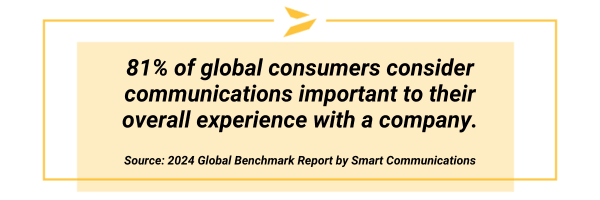
Graphic quote: 81% of global consumers consider communications important to their overall experience with a company.

Why cloud-based CCM software? 

Because the majority of on-premise legacy customer communications platforms are outdated. These systems were fine in the past when it was acceptable to deliver one-way, transactional communications. That isn’t the case anymore. 

Today’s customers want and expect two-way, interactive conversations with brands. Legacy systems can’t provide this. Instead of creating pathways, their lack of flexibility and capabilities create roadblocks.  

With a pure cloud communications tool in place, you’ll have a solution that is more customizable, agile, and scalable—enabling you to produce better customer experiences on your customers preferred channels. This article dives into the five ways employing cloud-based communications can have a positive—and oftentimes dramatic—impact on the customer experiences you deliver as well as your overall business success. 

 1. Cloud CCM Makes Personalized Conversations Possible

By leveraging data from various sources, a cloud-based communications platform will allow your company to generate messages tailored to individual customer preferences and needs, whether through email, SMS, or direct mail. This level of personalization will not only enhance customer satisfaction but also drive engagement and loyalty. 

Business Type 

Personalization Benefit Example 

Insurers 

CCM software could be used to send personalized policy updates, reminders, and renewal notices based on individual customer profiles.  

Financial Services Institutions 

CCM software could be employed to send customized financial advice and product recommendations to clients based on their transaction history and financial goals.  

Healthcare Providers 

CCM software could be leveraged to deliver personalized health tips, appointment reminders, and follow-up care instructions to patients.  

Healthcare Payers 

CCM software could help expedite resolution times, reduce administrative costs, and enhance trust and engagement between payers and their members. 

Engage Customers on Their Terms
Reach customers via their preferred channels with cloud-based CCM software designed to optimize their experience. Request a Demo of SmartCOMM™ Today! 

2. Enhance Operational Efficiency 

Cloud-based customer communications software streamlines the process of creating, managing, and distributing customer communications. This will significantly reduce manual effort and errors and allow your company to send out communications in a timely and accurate manner, ultimately enhancing the overall customer experience. 

Business Type 

Operational Efficiency Benefit Example 

Insurers 

CCM software can be used to automate claims processing notifications which would ensure customers receive timely updates on their claims status, reducing call center inquiries and improving customer satisfaction. 

Financial Services Institutions 

Account statements and transaction alerts can be generated automatically with CCM software reducing manual effort, minimizing errors, and ensuring clients receive accurate and timely information. 

Healthcare Providers 

CCM software can automate appointment scheduling and reminder notifications,helping to reduce no-show rates, improve operational efficiency, and ensure patients receive timely care. 

Healthcare Payers 

CCM software can streamline communication, personalize member engagement, ensure regulatory compliance, reduce costs, improve resource allocation, and enable data-driven decision-making. 

3. Ensure Consistency Across Channels 

Your customers can interact with your brand through multiple channels i.e., social media, website, call center, physical location, etc. Having a centralized, cloud-based communications software as a component of your comprehensive customer experience management strategy will ensure that no matter which touchpoint a customer uses, the experience will be in alignment with your brand’s voice, messaging and values. Having this consistency will reinforce your brand identity and build trust. 

Business Type 

Brand Consistency Across Channels Example 

Insurers 

By using CCM software to standardize communication templates across email, SMS, and mail, insurance companies can ensure that customers receive consistent messages whether they interact through digital or traditional channels. 

Financial Services Institutions 

With CCM software, financial services companies can produce marketing campaigns and customer service communications that have consistent branding across online banking, mobile apps, and in-branch interactions. 

Healthcare Providers 

CCM software will allow healthcare providers to ensure that patient communications–from appointment reminders to health education materials–maintain a consistent tone and branding across email, SMS, and patient portals. 

Healthcare Payers 

CCM software will make for clear, unified communication which will enhance member trust, reduce confusion, improve compliance, and streamline operations. 

4. Drive Customer Engagement and Loyalty

At the end of the day your customer experience management strategy will be judged by the level of engagement and loyalty it produces. Engagement and loyalty are the cornerstones of a successful strategy. A cloud-based communications platform will enable you to create proactive, timely, and relevant customer communications that foster engagement and loyalty. This will help build long-term relationships, reducing churn, and increasing customer lifetime value. Plus, engaged and loyal customers are more likely to promote your brand to others, which will help boost inquiries, trial and your customer base. 

Business Type 

Driving Customer Engagement and Loyalty Example 

Insurers 

An insurance company can use CCM software to send proactive risk management tips and personalized policy recommendations which will help customers feel valued and build loyalty. 

Financial Services Institutions 

CCM software can be leveraged by financial institutions to provide personalized financial education content and exclusive offers to keep clients engaged and strengthen customer loyalty. 

Healthcare Providers 

With CCM software it’s possible for healthcare providers to deliver personalized health management plans and wellness tips. This  helps patients feel supported and connected to their care providers. 

Healthcare Payers 

By implementing CCM software healthcare payers will be able to deliver personalized, timely, and consistent communications, enhancing member satisfaction, fostering trust, and ensuring members feel valued and informed about their healthcare options. 

5. Leverage Data for Informed Decision-Making

To fine tune and optimize a comprehensive customer experience management strategy going forward you’ll need insightful data. This is another benefit to having a cloud-based communications tool embedded into your strategy and your tech stack. It will track and measure the performance and effectiveness of your communications initiatives, providing you with a window into the behaviors, preferences, and feedback of your customers. This data can then be analysed to identify trends and leveraged to make better-informed decisions on enhancements to your brand’s customer experience management strategy and communication initiatives. 

Business Type 

Leveraging Data for Informed Decision-Making Example 

Insurers 

An insurance company could analyze data from CCM software to identify trends in customer inquiries and adjust their communication strategies and initiatives accordingly.  

Financial Services Institutions 

A bank could use data from CCM software to track the effectiveness of different communication channels and tailor future campaigns based on customer preferences and engagement rates. 

Healthcare Providers 

A healthcare provider could use CCM software data to identify patient engagement patterns and adjust communication strategies to improve patient outcomes and satisfaction. 

Healthcare Payers 

A healthcare payer could leverage CCM software to analyze patient data and identify trends and patterns, track costs and outcomes to assess the effectiveness of care, optimize reimbursement rates and contract negotiations, and develop targeted interventions to improve patient care and reduce costs. 

Conclusion

Cloud-based CCM software is not just a tool for managing customer interactions but a vital component of a comprehensive customer experience management strategy. By integrating a cloud-based communications platform within your strategy your business will be empowered with the engine it needs to generate customer experiences that are able to meet and, in many cases, exceed customer expectations.

Discover why leading enterprises like yours have switched to SmartCOMM. Review our case studies and see how SmartCOMM is enabling companies to deliver the personalized, seamless customer experience they envisioned.

Simplifying Legacy CCM to Cloud Vendor Migration

By Scott Draeger, SVP of Product Marketing and Vertical Solutions at Smart Communications

When confronted with technical debt, it’s easy to look the other way. Many organisations have customer communications applications that have been running for ten, or even twenty, years. As technology improves, you may find that your team feels like they are working for the technology, rather than having the technology work for your team. As budget cycles pass, these applications get older. They consume more resources, create more risk, and block innovations that your customers deserve. But, with cloud-based Customer Communications Management (CCM), modernising your CCM technology doesn’t have to be taxing. 

Cloud-native applications like SmartCOMM™ and SmartIQ™ are proven to create effective communications at scale, while meeting security requirements and flexibly scaling to handle peak loads at the most demanding times of your team’s year. Leading Australian banks can produce over 60 million pages per hour with SmartCOMM. High–profile and high–security use cases, like passport and visa communications, have shifted away from home-grown systems to transformed experiences using SmartIQ. Smart Communications’ recent cybersecurity assessment boasts high scores in every category. Leading government agencies in Australia, and elsewhere, are reducing costs and increasing flexibility by moving to cloud-based solutions. 

Transformation is Faster Than You Think

Many agencies believe they are saddled with technical debt, because migration is expensive. Your current vendor may offer an upgrade to newer technology, but that upgrade may not have migration tools, skilled migration practices, or experience with your applications. Often, upgrades require your agency to pay to maintain two complete systems while also paying time and materials for expensive vendor-supplied services staff. With that type of expense, it’s no wonder upgrades are avoided for a decade or more. 

Smart Communications uses a combination of software, AI technology, and experts to quickly turn your existing output into the first communications of your transformed customer experience. Smart Communications’ approach to omnichannel communications emphasises content to make it easier to communicate clearly across the full range of your customers, using a wide array of channels, accommodating diverse accessibility needs, and conforming to data privacy legislation. This approach automates the migration of text content, images, data and other key assets. This accelerates the transformation of your customer communications.  

After completing the swift migration, we transition the project to the customer, allowing them to focus on internal enhancements and ongoing sustainment. Customers establish in-house centres of excellence, empowering business users to take ownership of their processes. This shift puts you in position to improve employee experience by eliminating hard coded changes to multiple systems, removing redundant channel-based design work, and reducing the risk of errors due to application complexity.  

Ready to Integrate?

Legacy technology is not always compatible with current technology. As a result, agencies spend a lot of effort developing around software limitations. Leading solutions are cloud-native, allowing for easy integration with systems via APIs that accelerate your deployments, increase flexibility, and reduce risk. As you consider portfolios, some CCM vendors offer a wide variety of technology, but it is often not integrated, not available in the cloud, or not compatible with other technologies you need. As the leader in cloud-native CCM, Smart Communications can provision your system in under two hours, while others require many meetings and delays before your tenancies can be created. 

Regain Control of Critical Agency Applications 

Over time, applications on legacy platforms become difficult to manage. Incompatible software and hardware upgrade cycles collide with integration requirements to make even simple changes difficult to execute. None of this matches your budget and planning calendars. Over time, this increases reliance on external contractors with increasingly expensive sets of highly specialized domains of expertise. When simple changes take considerably more time from increasingly more expensive contractors, your organization loses time, budget, and control of how you communicate with your customers.  

How Do You Work with Agencies? 

Smart Communications understands your organisation as well as we understand your application. Because we understand your business, Smart Communications can create transformation programs that closely match your investment to your savings. This is done by creating multi-year transactions that consider your lower initial volumes, to phase in your investment while you phase in your new technology. Additionally, professional services expenses can be spread over the term of the agreement as well, allowing you to propose a solution that doesn’t triple your year one expenses. 

Understanding your staff, budget cycles, and organisational needs allows Smart Communications to propose solutions that can pass your planning process, deploy rapidly, and deliver early initial results. 

Smart Communications has tools, technology, partners, and experts to support rapid transformations which enable you to secure a long-postponed CCM upgrade through your planning process, to your team, and most importantly to your customers.

Unlocking Digital Inclusion: Embracing Global Accessibility Awareness

By Chris Murphy, VP of Product Marketing at Smart Communications 

One billion people. That’s three times the population of the United States—and the number of people around the world who are reported to have a disability or impairment. Imagine a world where every individual, regardless of their circumstances, can seamlessly navigate the digital realm. May 16, 2024 is the 13th Global Accessibility Awareness Day (GAAD) which shines a light on the importance of making our digital world a place where everyone feels empowered and valued. Most importantly, it encourages companies to think holistically about improving digital access and offering digital services in a more inclusive way.  

The need for digitally accessible solutions and services isn’t just about meeting regulations; it’s about creating a more inclusive and vibrant digital landscape. When individuals face barriers online, it not only affects their ability to interact with businesses but also hampers the valuable contributions employees can make to their organizations. However, this growing awareness of digital accessibility sheds light on the shift in compliance and gives due recognition to the importance of ensuring equal access and engagement for all individuals in the digital sphere. 

According to the GAAD (Global Accessibility Awareness Day) Foundation, here are where most digital experiences fall short:  A blue rectangular object with black text

Description automatically generated 

Source: https://accessibility.day

Drivers for Digital Accessibility Interest 

There are several key drivers pushing organizations to evaluate their accessibility and build accessibly-oriented business practices, guidelines, and compliance frameworks. Those are: 

1. Compliance: Accessibility rules and regulations can vary broadly from region to region (for example, the Americans with Disabilities Act, the EU Accessibility Act, the Accessible Canada Act), but it is fair to say that there is a growing trend in both the number and strictness of the legislative oversight—as well as the number of lawsuits and value of fines for noncompliance.  

2. Customer Experience: Organizations have also focused on accessibility initiatives to help provide better experiences for their consumers and to serve a broader pool of their target market more effectively.  

3. Employee Experience: According to IDC’s Digital Accessibility Survey from September 2022, providing a better user experience to internal employees was one of the main reasons to implement digital accessibility – more than customer experience, business benefit, and corporate value reasons.

Who Benefits from Digital Accessibility Initiatives?

The short answer: more than you think. Digital accessibility guidelines and regulations have primarily been put in place to protect the pockets of individuals impacted by a disability or impairment. It’s easy to imagine how someone with a visual limitation—complete or partial blindness, for example—might struggle with digital experiences. Those with visual impairments often benefit from improvements around color/text contrast ratios, the ability to zoom without loss of clarity, and the ability to utilize common technologies like screen readers that can translate these digital interactions into auditory experiences. Alternatively, individuals with auditory impairments typically benefit from captions or descriptions discerned from screen readers and visual media transcripts.  

Good accessibility practices benefit everyone. Being able to zoom in on a document or see text with a good contrast ratio creates a more inclusive experience for people with declining eyesight as well as for those who are partially blind/visually impaired. Communications written in plain, understandable language—that avoid using jargon or slang—can help individuals with cognitive impairments as well as those where English (or the communication language) may not be their first language or who read at a lower-than-average reading level.   

How Software Vendors Can Help With Your Digital Accessibility Frameworks  

Increasingly, leading organizations are leaning on their software value-chain partners and vendors for support with their accessibility initiatives—with Customer Communications Management (CCM) and form process automation solutions being a major part of their accessibility strategy. There are several areas in which this is happening;  

  • Accessible Customer Communications: Leading CCM solutions are able to help organizations create and manage accessible experiences for their customers.  Some examples include accessible PDFs, and communications that can be effectively read by a screen reader. Communications can also be exported in XML format that can then be ingested into third-party solutions for transformation to Braille, Large Print, and other formats that may be required.  

  • Accessible Customer Form Experiences: Much like standard customer communications, digital forms need to offer a range of tools that can offset a consumer’s physical disabilities or impairments. The ability to include images with alternative text or build a question sequence that guides the experience (and avoids ever having to reference a specific place within a form) are “small” but significant steps toward creating accessible data collection processes. Taking it one step further, companies can compensate for various reading levels by including helper text to offer clarification and data validation messages to help the end-user feel confident that what they are providing is correct and will take them to the next desired step in the process.  

  • Accessible Software and UI Experiences: While improving the customer experience and being able to serve a more diverse and broadened customer base through improved accessibility remain important drivers, enhancing the employee experience is also a key motivator for accessibility projects. Ensuring the software and solutions employees utilize everyday meet accessibility standards is becoming a prerequisite for procurement and commercial teams. Accessible software solutions offer features that maximize the number of individuals who can use them effectively. Common requirements include keyboard shortcuts, keyboard focus, semantic ordering of content, standardized tab order to navigate to different sections of the user interface, ARIA role attributes, appropriate contrast ratios and other functions that are important in promoting inclusivity.  

When considering a new software vendor, leading organizations will be able to provide you with a Voluntary Product Accessibility Template (or VPAT for short). This type of document is often administered by a third-party accessibility firm and identifies areas of the software under consideration that either comply with or are out of conformance with specific accessibility standards.  

Additional questions around the development strategy and testing regime for new functionality or applications within the software will help you understand how well a vendor’s R&D team is operationalizing accessibility for the future. 

Conclusion

By prioritizing accessibility in our digital designs, communications, and interactions, we not only meet legal requirements but also unlock the potential for innovation, creativity, and empathy. 

Through our dedicated efforts and ongoing initiatives, we at Smart Communications strive to lead by example, ensuring that our digital solutions prioritize inclusivity and empower individuals of all abilities to fully engage with the digital world. We’re proud of our track record in assisting our customers in producing accessible communications and forms experiences, and we remain committed to our dedicated roadmap of innovative enhancements. These efforts not only position our customers as leaders in compliance but also elevate their customer and employee experiences, ensuring inclusivity and empowerment for individuals of all abilities.   

Let us continue to champion accessibility not just today, but every day, as we strive to create a world where barriers are replaced with bridges, and inclusion becomes the norm.

Navigating the Regulatory Landscape of Customer Communications in 2024

By Scott Draeger, SVP of Product Marketing at Smart Communications 

In today’s digital age, customer communications are increasingly reliant on data-driven personalization. With that said, companies face a daunting challenge: how to navigate the evolving regulatory requirements while still delivering tailored experiences to their customers.  

With new regulations and stricter enforcement measures shaping the way businesses interact with their clientele, your company needs the right tools and processes to remain compliant. In this blog, you’ll find insights to empower you as you develop communications that strike the right balance between personalization and privacy. 

The Evolving Regulatory Landscape in 2024 

New regulations and stricter enforcement measures are reshaping how companies like yours handle customer data. From the far-reaching impact of GDPR, CCPA, to the stringent requirements of HIPAA, you’re at the forefront of compliance efforts.  

In our recent report, ‘5 Trends Shaping Customer Conversations in 2024’, Sameer Hajarnis, Senior Vice President & GM of Digital Agreements at OneSpan—and one of the many subject matter experts/thought leaders we interviewed—urges vigilance, stating, “Stricter regulations and enhanced security measures are imperative to safeguard consumer data in today’s digital ecosystem.” 

Striking a Balance in Customer Communications: Personalization vs. Privacy

Your challenge lies in harmonizing personalized experiences with regulatory compliance. Eileen Potter, VP of Insurance Marketing at Smart Communications, underscores the need to prioritize data privacy regulations. Potter emphasized consumer concerns about data misuse. As you strive to strike this balance, remember that respecting privacy is non-negotiable.  

One way you can do so is by investing in pure cloud solutions to help you keep pace with changing regulatory requirements. For example, one Consumer Duty requirement dictates that firms must “provide helpful and accessible customer support.” That means getting consumers answers quickly and not making them wait so long that they give up. Compliance will require centralized processes for collecting information so it’s available to support agents on demand, as well as more robust self-serve options.    

How AI Will Influence New Regulations/Challenges  

If you implement or plan to implement generative AI in your CX strategy or customer communications, proceed with caution and take extra steps to ensure it’s being used only as intended. Kaspar Roos, CEO and Founder at Aspire, details some of the graver concerns, below:  

“We can unfortunately expect to see AI used in an increasing tide of fraudulent and nefarious activities that will range from the criminal, like using deepfake audio or video to lure consumers into scams, to the more broadly destabilizing and anarchistic generation of fake news.”  

The Safe, Secure, and Trustworthy AI Executive Order 

In October of 2023, the Biden administration issued a landmark executive order on “Safe, Secure, and Trustworthy Artificial Intelligence,” which established new standards for AI safety and security as well as privacy protection. Neeraj Gupta, Insurance Consulting Partner at EY, said the order “represents a significant contribution to the subject of accountability in how AI is developed and deployed across organizations.”  

 “Given the breadth of recommendations and actions provided, [the Biden administration’s Executive Order] is likely to have an effect on organizations across all sectors of the economy, from the most mature AI implementers to first-time adopters.” —Neeraj Gupta, Insurance Consulting Partner at EY  

While Gupta noted that the definition of AI systems is broad, it is inclusive of systems which have been built over the last several years. The EU is looking to similarly advance its regulatory standards and requirements around AI, meaning global businesses should plan to keep a close eye on regulatory developments. This includes domestic companies that do business overseas. 

As your business increases its use of AI or other advanced systems, remember that innovation comes with an increased risk. As the regulations continue to evolve in 2024, prepare to adapt your customer communications strategy to balance personalization and privacy while maintaining compliance.  

Conclusion  

In the ever-evolving regulatory landscape of 2024, mastering customer communications requires finesse. Remember, adaptability is your company’s greatest asset. However, without insights and the right solutions/vendor partner on your side, it can be difficult to know where to start. Be sure you’re preparing your business to proactively respond to regulatory bodies rather than waiting for them to come knocking with an expensive lesson. 

Discover how SmartCOMM™ can help you build customer communications journeys that are effective, compliant, and secure.