Solutions

Archive and retrieve communications securely with cloud-native speed.

Orchestrate real-time, compliant interactions across every channel.

Simplify and standardize trade and relationship documentation workflows.

Industries

Improve customer engagement across policy, billing, and claims.

Create and deliver personalized, compliant customer communications at scale.

Heighten citizen experience with digital transformation.

Improve customer engagement across utilities.

Resources

Browse popular market research, articles, videos, written guides and more in one convenient location.

Explore upcoming events, webinars, and customer experiences shaping the future of customer conversations.

Get the latest updates on Smart Communications, including product news, and industry recognition.

Company

Learn more about our company, our leadership and how were growing the team!

Analysts

Analysts

Access analyst research, market reports, and industry recognitions featuring Smart Communications.

Superannuation at a Crossroads: Why Member Experience Needs a Rethink

By Cindy Griffin, Financial Services Vertical Marketing Specialist at Smart Communications 

The superannuation industry is continuing to undergo profound change. At our recent Melbourne roundtable, one theme came through loud and clear: Member experience (MEX) must evolve if super funds are to thrive in the next decade. 

From regulatory reform and shifting demographics to rising member expectations, funds are facing a wave of change that will reshape how they communicate, engage, and deliver value. Paul Schroeder, CEO of AustralianSuper, recently underscored this urgency at his National Press Club address, calling for legislative changes that simplify retirement and place member outcomes at the centre. 

The Forces Reshaping Superannuation 

1. Structural Changes in Retirement Accounts 

Schroder’s proposal to unify accumulation and retirement accounts, and integrate super with the aged pension, represents more than just a regulatory proposal. It requires funds to rethink how they guide members through retirement. Manual applications and fragmented processes will need to give way to seamless transitions that demand smarter, more intuitive communications. This is a fundamental shift in how members experience their retirement journey. 

2. Rising Regulatory Pressures 

At the same time, regulatory pressure is mounting. SPS 515, effective July 2025, requires Australian trustees to demonstrate that all aspects of their operations—including communications—support member outcomes. This means funds must go beyond generic notices and show alignment with the best financial interests duty.  

Meanwhile, Payday Super, expected to roll out in July 2026, will significantly increase communication volume and complexity. Members will expect real-time updates with every pay cycle, and employers will need clear guidance to navigate new contribution processes.

3. Inclusivity and Trust as Strategic Imperatives 

Australia’s super system must serve diverse and under–represented groups — women returning from career breaks, gig economy workers, Indigenous Australians, and non-English speakers. Inclusivity equals trust, and it’s rising to the top of the agenda. Communication must evolve to be inclusive, accessible, and transparent. Inclusivity is no longer a nice-to-have; it’s a strategic imperative to build trust. 

AI and Trust in Superannuation 

At a recent superannuation roundtable, delegates raised concerns about members turning to popular AI tools for financial advice—despite these systems not being designed for accuracy in regulated domains. The risk of misinformation is real, especially as AI becomes more embedded in how members interact with their funds.  

According to KPMG’s “Trust, Attitudes and Use of Artificial Intelligence: A Global Study 2025,” only 36% of Australians broadly trust AI, with many more wary of its risks than excited by its potential. Yet, 65% still expect AI to deliver benefits like reduced manual tasks, improved efficiency, and more personalised experiences.  

Get More AI Insights From Our 2025 APAC Benchmark Report. 

For super funds, this presents a dual challenge: harnessing AI to enhance engagement while ensuring transparency, reliability, and ethical standards that resonate across generations.  

One of the attendees of the roundtable, Mario Garrido, co-authored this paper on trust, which emphasizes that for older generations, drivers of trust are more grounded in traditional cues: character, capability, and benevolence. Older members are less likely to be impressed by promises of innovation alone; they want proof of consistent performance, regulatory compliance, and clear ethical standards. 

For super funds, this generational divide means communications must be far more sophisticated and adaptive:  

  • Younger members expect transparency on how AI is used to personalise experiences and protect data
  • Older cohorts look for proof of reliability, governance, and ethical standards.  

Meeting both expectations requires modern platforms that can capture accurate member data, generate compliant communications across channels, and tailor messaging to different trust drivers at scale. 

How Smart Communications Helps Super Funds Lead Through Change 

At Smart Communications, we enable super funds to modernise their member engagement strategy with personalised, compliant, and scalable communications. Our solutions – SmartCOMM™, SmartIQ™, SmartHUB™  and SmartPATH ™– help funds meet regulatory obligations while improving the member experience. 

Compliance with Evidence: With SmartCOMM, super funds can standardise communications through pre-approved templates and centralised content management, ensuring every notice and disclosure is compliant, consistent, and on-brand. A full audit trail is captured, making it straightforward to demonstrate SPS 515 compliance. Automated version control further reduces risk, ensuring any regulatory changes are reflected across member touchpoints. 

SmartIQ supports compliance by guiding members through adaptive digital interviews that align with regulatory requirements. By capturing structured, validated data at the source, SmartIQ reduces the likelihood of incomplete or incorrect submissions and seamlessly feeds data into SmartCOMM-generated documents. 

Member Engagement by Life Stage: SmartCOMM orchestrates omnichannel, personalised communications tailored to member needs while SmartIQ powers guided digital interviews, enabling funds to capture member data once and reuse it across forms, advice documents, and onboarding workflows. Both solutions support multilingual and accessible formats to ensure that inclusivity is prioritised and every member is included.  

Employer Readiness for Payday Super: When it comes to the rollout of Padyday Super, SmartPATH ensures members receive real-time transparency through event-triggered contribution confirmations each pay cycle. SmartPATH orchestrates these communications across email, SMS, and online portals. By delivering clear, proactive communications, SmartPATH enables funds to reduce confusion, alleviate pressure on call centres, and lower overall service costs. 

Reimagine Member Experience: SmartPATH replaces manual, fragmented processes with intelligent, omnichannel orchestration—ensuring members receive timely, compliant, and personalised updates across email, SMS, and print. SmartPATH supports inclusive formats and AI-powered decisioning to guide diverse member cohorts through complex journeys like retirement transitions or Payday Super updates, while maintaining transparency and control to meet SPS 515 obligations and build trust across generations. 

Meet Customer Expectations: SmartHUB helps superannuation funds meet rising expectations for transparency, compliance, and inclusivity by securely storing all member communications—from emails to case records—in a central, audit-ready archive. With fast retrieval and seamless integration across SmartCOMM and SmartIQ, SmartHUB supports SPS 515 obligations, enables secure digital delivery, and reduces operational costs. It ensures members and staff can access the right information, at the right time, building trust through clarity and control. 

Turning Compliance into a Competitive Edge 

Super funds are truly standing at a crossroads. As Schroder noted in his address, more people with more savings are approaching retirement than at any other time Australian history. With Smart Communications, super funds can go beyond compliance to deliver the personalised, timely, and trustworthy experiences members expect and turn regulatory changes into a strategic advantage. 

Be Prepared For Change with Modern Solutions

If your fund is preparing for SPS 515, Payday Super, or broader retirement reform, now is the time to modernise your communications. Let’s talk about how Smart Communications can help you stay compliant, build trust, and improve outcomes. 

The State of Digital Transformation in 2024: Overcoming Legacy Technology Barriers and Elevating Customer Experience

By Leigh Segall, CEO at Smart Communications 
 
Reflecting on the challenges of the past four years, organizations have faced unprecedented uncertainty and pressure to adapt. In 2023, innovation was stifled as organizations grappled with the looming specter of economic recessions. This led many to shelve critical digital transformation initiatives, putting them on hold as they navigated economic uncertainties. Now, emerging from this hiatus, we see a new chapter swiftly unfolding, marked by renewed momentum and a reinvigorated push towards digital transformation. 

Closing the Digital Maturity Gap in 2024 

Recent research has uncovered a remarkable surge in IT spending for 2024, with 72% of digital leaders doubling down on investments to propel their digital initiatives forward. This surge reflects a broader trend towards digital transformation, with global spending projected to reach a staggering 3.4 trillion US dollars by 2026—a nearly 3x increase over the last five years.  

Yet, despite this momentum, significant challenges remain. According to Forrester, a mere 6% of organizations have attained advanced digital maturity, highlighting the pervasive gap between aspiration and achievement in the digital realm.  

Legacy systems continue to consume a substantial portion of the overall IT budget, impeding innovation. In fact, 87% of CIOs cite the complexity of existing systems as a barrier to investing in next-generation services. Additionally, 34% of CIOs have identified replacing legacy technology as a top digital transformation goal for 2024, underscoring the urgency of modernization efforts.

Retiring Legacy Technology for Enhanced Engagement 

When it comes to managing customer communications, organizations must address the lingering challenge of legacy communications technology. While many enterprises have made strides in modernizing their customer communications with cloud-based solutions, a significant number still grapple with outdated, on-premise, channel-based systems.  

These legacy solutions, acquired over time, pose a multitude of challenges—they are costly to maintain, lead to duplication of efforts, impede business agility, and detract from the customer experience. To truly harness the benefits of a modern CCM platform, we see many organizations looking to retire these outdated systems and transition to a centralized, cloud-based approach. By streamlining and automating customer communications processes across all delivery channels, organizations can deliver a seamless customer experience, maximize their return on investment, and position themselves for success in the digital age. 

Rethinking Forms Processes: Digitally Transforming Transactions into Engaging Interactions 

This imperative extends beyond customer communications to encompass forms processes—a critical yet often overlooked aspect of the customer experience.  

Over the past several years, analysts like Kaspar Roos, the Founder and CEO of Aspire CCS, have been vocal about the evolution of Customer Communications Management (CCM) to Customer Experience Management (CXM).  

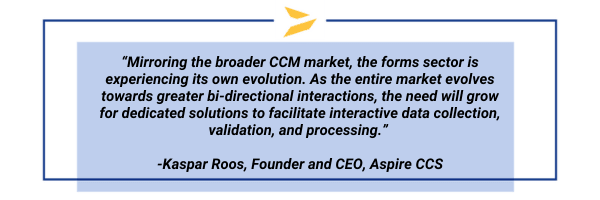
According to Roos, the forms sector, mirroring the broader CCM market, is undergoing its own transformation. He emphasizes the growing need for dedicated solutions to facilitate interactive data collection, validation, and processing as the market moves towards greater bi-directional interactions.  

The combination of customer communications and customer data collection, once modernized and transformed, together play pivotal roles in shaping the omnichannel customer interactions of tomorrow. 

Once modernized, the combination of customer communications and data collection together play criticial roles in shaping the future of omni-channel customer interactions. 

Legacy forms processes, characterized by manual, outdated, and disconnected practices, present a significant barrier to delivering seamless and cohesive customer experiences. Forms serve as a vital touchpoint between organizations and their customers, facilitating data collection and driving internal and external processes. Yet, despite their importance, forms processes have been largely neglected in the broader CX strategy, leading to a noticeable gap between digitally transformed customer communications and legacy-style form processes. 

According to Forrester, 82% of organizations still use paper-based processes to some extent. The ramifications of this oversight are profound. Customers are confronted with outdated, cumbersome forms processes that fail to meet their expectations for convenience and efficiency. Frustrated by the complexity and repetitive nature of these processes, customers are left feeling dissatisfied—a stark contrast to the seamless experiences they encounter in other digital interactions. In an era where every interaction should leave customers feeling recognized and valued, outdated forms processes fall short of meeting customer expectations for convenience and efficiency. 

Forrester reserach shows that 82% of organizations use paper-based processes to some extent.
 
Transitioning From Static Forms to Smarter Data Collection 

However, the tide is turning. By redefining what a “form” entails, organizations can transform static transactions into dynamic, intelligent interactions that leave customers feeling valued and empowered. 

Smart forms or data collection solutions leverage automation and intelligence to guide users through complex processes, adapting dynamically based on the information provided. By eliminating unnecessary fields and pre-filling data from existing databases, you will minimize customer effort, improve data accuracy, and enhance overall efficiency. 

Moreover, forms of the future facilitate bi-directional communication, simplifying interactions between customers and employees. Whether online or on a mobile device, these digital experiences enable seamless data exchange, leveraging features such as mobile cameras for enhanced functionality. By mimicking a conversation between the customer and the organization, smart data collection solutions foster engagement and reduce the likelihood of customer abandonment. 

Recognizing the critical role it plays in the CX landscape, organizations are beginning to integrate intelligent data collection into their broader CCM strategies. Smart Communications™ leads the charge with SmartIQ™—a revolutionary forms management solution designed to automate and transform data collection processes. 

Delivering Future-Ready Customer Conversations 

SmartIQ empowers organizations to create and manage digital forms with ease, leveraging a low-code web-based design tool that requires minimal IT intervention. By automating data sharing and streamlining business processes, SmartIQ enhances operational efficiency and reduces technical debt. 

Furthermore, SmartIQ’s analytics engine provides organizations with invaluable insights into process performance, enabling continuous improvement and optimization. Armed with detailed analysis, organizations can identify bottlenecks, refine processes, and enhance the overall customer experience. 

By embracing solutions like SmartIQ, organizations can bridge the gap between customer communications and forms processes, delivering future-ready customer conversations and reducing customer effort.  

The synergy between SmartCOMM™ and SmartIQ enables organizations to consolidate, centralize, and automate data collection processes and customer communications across all channels, unlocking a myriad of benefits. From reducing manual work and operating costs to ensuring data security and regulatory compliance, our industry-leading SaaS solutions empower organizations to keep pace with evolving customer expectations and drive sustainable growth. 

If you’re interested in learning how you can consolidate and modernize your customer communications solutions, one of our experts would be happy to provide a free consultation. If you’re looking to transform your forms processes with SmartIQ, I encourage you to request a demo, or visit our demo zone to see it in action. 

How Smarter Archiving Builds Stronger Businesses 

By Smart Communications 

For years, archiving has taken a backseat—a necessary function, but rarely a priority. It was where documents went to be stored, just in case. But the world has changed. Today, organizations are under increasing pressure to retain, access, and prove the integrity of their data. That makes archiving more than a compliance checkbox—it’s becoming a vital part of delivering better service, protecting the business, and staying ahead.  

If your current system still lives on-premise or was added as an extension to an ERP or ECM years ago, it may be time for a rethink. Chances are, it’s not keeping up with today’s demands—and it could be holding you back. 

Why Archiving Deserves a Closer Look  

In recent years, regulators have made it clear: archiving isn’t optional, and it can’t be sloppy. By mid-2023, the U.S. Securities and Exchange Commission (SEC) had issued 30 enforcement actions and over $1.5 billion in penalties to firms that failed to properly retain electronic records like texts and chats, while data protection authorities across Europe issued €1.2 billion in fines in 2024. Some individual US banks were fined up to $125 million.   

These weren’t isolated incidents—they were warning signs. For financial services, insurance, healthcare, and government organizations, the message is clear: outdated, fragmented archiving tools are no longer good enough.  

And it’s not just about storing PDF documents and emails anymore. Customers now engage across dozens of channels. At the same time, regulations like GDPR, and ISO standards are getting stricter—demanding that organizations store, retain, and dispose of data securely and responsibly. The right archiving software helps automate that process and puts your team in a better position to respond when it matters most. 

A Smarter Way to Archive 

Archiving might not always be in the spotlight, but when it’s done right, it quietly powers better outcomes across the business:  

Speed and responsiveness – Teams can instantly find and retrieve critical documents—like contracts, statements, or policy details—when a customer or regulator needs them.  

Compliance and peace of mind – Built-in audit trails, encryption, and retention rules help meet evolving regulations and reduce risk.  

IT and operational efficiency – Cloud-native platforms lighten the load for internal teams, with no hardware to maintain and updates that happen automatically.  

In healthcare, for example, HIPAA requires certain records to be stored for at least six years—and securely deleted after that. A 2024 industry survey found that nearly half of U.S. healthcare providers still rely on local servers or EHR systems for archiving, and about 50% plan to retire seven or more legacy systems in the next few years.  

Modernizing this infrastructure isn’t just about compliance. It’s about making life easier for the people using it.

Better for Customers. Better for Teams.  

When a customer requests a copy of their agreement, plan, or notification, they’re often doing so at a critical moment—during a claim, a renewal, or a major life event. A slow or incomplete response can erode trust. With a modern archiving platform, role-based access controls enable select employees to search, find, and deliver what’s needed in seconds—or better yet, customers can securely access the documents themselves through self-service. No delays. No IT tickets. Just answers when they matter most. 

What to Look for in Archiving Software Today  

If you’re re-evaluating your archiving strategy, here’s what modern solutions like SmartHUB™ offer:  

  • Immutable and audit-ready storage – Secure, tamper-proof data with clear trails of access and activity. 
  • Lightning-fast retrieval – Locate what you need, instantly—even across millions of communications. 
  • Cloud-native scalability – Built for growth, with zero on-prem maintenance and always-on updates. 
  • Granular access controls – Role and department-specific permissions with rich metadata tagging. 
  • Built-in compliance – Support for GDPR, ISO 14641, and WCAG 2.1 Level AA compliance and more. 
  • Automated retention policies – No more manual deletions—let the system handle it. 
  • User-friendly experience – Multilingual, intuitive design drives faster onboarding and adoption. 
  • Flexible integrations – Works easily with CRMs, ERPs, and other everyday tools. 
  • Unified access across teams – A single source of truth for archived communications. 
  • Low lift for IT – Quick deployment with minimal ongoing maintenance.   

Archiving for the AI Era

 Archiving needs have changed—and they’ll keep changing as AI plays a bigger role in how we work. Historically, most archived documents were rarely accessed. But that’s no longer the case.  

Today, AI-enhanced tools are increasingly retrieving archived communications to provide context during customer interactions, fuel smarter self-service, and help teams make better decisions faster. That shift makes high-speed, high-volume retrieval just as important as secure storage—and it highlights the need for modern platforms designed to support a new era of speed, intelligence, and scale.  

Moving Forward with Confidence  

Modern communications require modern archiving. It’s not just about storing documents—it’s about building a smarter, more connected foundation for how your organization handles information.  

It’s time to move beyond outdated systems. Explore how SmartHUB makes modern archiving work for your business—securely, efficiently, and at scale.  

Is Legacy CCM a Hidden Liability in Your Enterprise CX Stack?

By Scott Draeger, SVP of Product Marketing and Vertical Solutions at Smart Communications 

In today’s digital transformation landscape, organizations continue to rely on Customer Communications Management (CCM) implementations that predate smartphones. The recent 2025 SPARK Matrix™: Customer Communication Management (CCM) from QKS Group highlights the risks of keeping legacy CCM technology in production past its useful life.  

The report compares Smart Communications’ cloud-native architecture against competitive offerings; “unlike legacy CCM solutions that rely on containerized deployments, this platform is designed with microservices, enabling dynamic scalability and optimized resource utilization.” Ultimately, operating your legacy CCM technology past its useful life risks both new and existing customers at a time when customer experience (CX) is critical to customer acquisition and retention.  

These once–effective deployments struggle to meet today’s expectations for agility, personalization, and seamless customer experiences—creating business risk as technology gaps widen.   

What Are the Architectural Limitations of “Containerized Deployments?“ 

Many legacy CCM vendors boast about “moving to the cloud” in marketing materials and RFP responses. When you look deeper, their cloud-moves are “too little too late” as legacy vendors deliver containerized deployments of legacy technology in an attempt to look current. At Smart Communications, we refer to these as “SOSIAC“ solutions for short, as they are the “Same Old Software in a Container.” Upon further examination, during an RFP process or evaluation, CCM buyers discover these offerings lack the flexibility and scalability inherent in cloud-native offerings like SmartCOMM™. 

SmartCOMM delivers the standards of today and tomorrow. According to QKS’ SPARK Matrix for CCM, Smart Communications has a “modern cloud-native architecture, allowing enterprises to scale communications efficiently without infrastructure constraints.” While legacy vendors attempt to modernize through incremental updates and SOSIAC-solutions, SmartCOMM leverages “microservices, enabling dynamic scalability and optimized resource utilization” according to the report. 

The SPARK Matrix highlights the benefits of Smart Communications’ cloud-native architecture:  

“The availability of an API-driven architecture ensures flexibility in deployment, enabling organizations to connect their communication workflows to external data sources, automation tools, and business intelligence platforms. This approach supports a composable enterprise strategy, where organizations can extend their customer communication capabilities without significant IT dependencies.”  

Evidently, legacy CCM platforms are on the wrong side of an expanding capability gap. 

How Do Silos Fragment Customer Experience? 

Legacy CCM solutions encourage what QKS identifies as silos within communication channels. These silos are created by disconnected systems that force teams into redundant template creation in a channel-by-channel approach. This approach makes consistent, cross-channel messaging nearly impossible while adding cost and risk. Inconsistent messages drive outcomes that inspire confusion, create inbound calls, and—in extreme situations—drive customer churn. 

QKS’ 2025 SPARK Matrix agrees, stating that “[SmartCOMM] eliminates the silos commonly found in traditional CCM systems, where different communication types require separate workflows. By allowing real-time adjustments across digital and print channels, Smart Communications ensures consistency in messaging without requiring redundant template creation.” SmartCOMM’s approach eliminates the fragmentation that increasingly frustrates today’s customers. 

What Are the Costs of Delayed Modernization? 

Every quarter that your organization postpones the decommissioning of legacy CCM represents measurable opportunity costs. While “restructuring existing templates, workflows, and data models to align with a SaaS-based architecture requires extensive planning,” the alternative of maintaining data access, security, design consistency, and integrations between increasingly outdated systems is costing you more than you think. Delaying your digital transformation creates quantifiable, competitive disadvantages in customer satisfaction, operational efficiency, and market responsiveness. 

Conclusion 

The recent perspectives from QKS suggest that legacy CCM is approaching an inflection point where maintaining these systems presents escalating business risk. Organizations continuing to rely on outdated communication platforms aren’t simply deferring modernization, they are failing to meet today’s customer needs by accepting constraints on customer experience capabilities and operational efficiency.  

As the market evolves faster, decommissioning legacy technology and migrating to modern platforms isn’t an option; it’s a requirement.  

Ready to learn more about how your organization can stay ahead of the game? Download a complimentary copy of the QKS Spark Matrix report here. 

About the Author 
Scott Draeger is the SVP of Product Marketing and Vertical Solutions at Smart Communications. He has a passion for collaboration, and over 25 years of innovating customer communications technology, around the globe. He focuses on improving communications for the recipient while improving performance for the business. He started as a document designer using a collection of hardware and software technologies, before moving to the software side of the industry. He finds connections across disciplines with certifications in graphic design, customer experience, electronic documents, and an MBA in international business.
 

5 Smart Moves to Prepare for the Trends Shaping Customer Conversations in 2025

By Smart Communications 

In industries like healthcare, financial services, and insurance, businesses face the dual challenge of meeting customer expectations while also navigating an increasingly complex regulatory landscape. Emerging technologies, changing regulations, and a push toward greater personalization are all playing key roles in reshaping customer engagement.  

In this article, you’ll read the five trends driving this transformation and the smart moves your organization can make to keep pace. 

Smart Move #1: Enhance Data Quality to Support AI Initiatives 

Why It Matters: Businesses that harness the power of AI to improve customer experience need high-quality data to fuel those AI initiatives. Whether it’s using AI for predictive customer service, personalization, or operational efficiencies, poor data can lead to inaccurate results, regulatory violations, or missed opportunities. For highly regulated industries, this is especially critical. 

How to Prepare: Implement robust data governance frameworks to ensure the accuracy, completeness, and compliance of your data. Invest in data cleaning and validation tools that ensure all customer interactions are backed by high-quality, secure data. In regulated sectors like healthcare, financial services, and insurance, proper data management is foundational to both AI success and regulatory compliance. 

Example: A healthcare provider using AI to predict patient outcomes needs a centralized, high-quality dataset to generate reliable predictions and comply with privacy laws like HIPAA. 

Smart Move #2: Navigate Regulatory and Ethical AI Challenges 

Why It Matters: With AI becoming more pervasive, the regulatory landscape is evolving. Companies in healthcare, financial services, and insurance must contend with a maze of regulations that govern everything from data privacy to algorithmic transparency. Ethical concerns, such as bias in AI models and the security of customer data, are also top priorities. 

How to Prepare: Review current and upcoming regulations in your industry to ensure AI models are designed with compliance and ethics in mind. Develop and document an ethical framework for AI use, considering fairness, transparency, and data privacy. By aligning AI strategies with both regulatory requirements and ethical standards, your organization can reduce legal risk and build customer trust. 

Example: A financial services company using AI for loan approvals must ensure its models don’t unintentionally discriminate based on race, gender, or other protected factors, in compliance with fair lending laws. 

Smart Move #3: Modernize Technology Stack to Overcome Technical Debt 

Why It Matters: Technical debt is a growing issue for many businesses, particularly those with legacy systems in place. The risk? Slow, outdated technology can hinder innovation, frustrate customers, and result in costly delays. For industries like healthcare and financial services, technical debt can also complicate compliance and data management efforts. 

How to Prepare: Begin by assessing your current tech stack and identifying areas where modernization will have the most impact. Whether it’s moving to the cloud, upgrading legacy systems, or adopting new platforms for customer communication, taking action now will set your company up for future success. Prioritize scalability and flexibility to ensure your infrastructure can support changing customer expectations and regulatory requirements. 

Example: An insurance company could modernize its claims management system to speed up processing times, reduce errors, and stay in line with evolving regulatory demands. 

Smart Move #4: Leverage Data and AI to Create Personalized Experiences 

Why It Matters: Customers expect personalized, real-time interactions. By leveraging data and AI, companies can deliver tailored recommendations, anticipate customer needs, and provide proactive solutions. In regulated industries, personalization also means ensuring compliance with privacy regulations while still offering a personalized experience. 

How to Prepare: Integrate AI-driven customer engagement platforms that use data to personalize interactions. This could mean offering personalized health advice, investment recommendations, or insurance policy renewals. However, it’s crucial to ensure that these interactions comply with privacy laws like GDPR in the EU or HIPAA in the U.S., especially when dealing with sensitive customer data. 

Example: A financial institution using AI to offer personalized savings or investment tips based on customer spending behavior can enhance customer loyalty while staying compliant with financial regulations. 

Smart Move #5: Prioritize Continuous Innovation to Drive Market Share 

Why It Matters: The fast pace of technological change means businesses can’t afford to stand still. Continuous innovation is crucial for staying competitive and retaining market share. For highly regulated industries, this means finding ways to enhance operational efficiency, improve customer satisfaction, and ensure compliance—all while remaining agile. 

How to Prepare: Foster a culture of innovation by continuously exploring new technologies, from AI to automation. Implement agile processes that allow your business to adapt to market shifts, customer demands, and regulatory changes. Companies that prioritize innovation are better positioned to capture market share and drive long-term success. 

Example: An insurance company focused on continuous improvement might invest in automation to streamline claims processing, reducing response times and improving customer satisfaction, all while remaining compliant with insurance regulations. 

Preparing for the Future of Customer Conversations 

The trends shaping customer conversations in 2025 offer both challenges and opportunities for businesses in highly regulated industries. From enhancing data quality to embracing AI-driven personalization, the key to customer loyalty lies in adapting to these shifts in a way that meets expectations while staying compliant with ever-changing regulations. By focusing on data governance, ethical AI, strategic modernization, and continuous innovation, your company will be better positioned to thrive in 2025 and beyond. 

Start preparing today by evaluating your current strategies and investing in the technologies that will help you build stronger, more compliant customer relationships. The future of customer communication is here—and it’s evolving fast. 

Ready for Deeper Insights? 

For more information about the 5 Trends Shaping Customer Conversations in 2025, download your complimentary copy of the report today. 

4 Smart Moves for Life and Annuity Insurers to Navigate Change and Drive Innovation

By Eileen Potter, VP of Insurance Marketing at Smart Communications 

The life insurance and annuity (L&A) market is navigating a challenging landscape, balancing the pressures of increasing costs, competition, and evolving customer expectations. As customer demands shift, insurers must innovate to remain competitive, focusing on both growth and cost efficiency.

Our latest white paper identifies four critical areas of focus for L&A organizations, highlighting the importance of making strategic investments in technology that align with both their business goals and the need to increase customer satisfaction. In this article, we provide a quick dive into the key insights from the paper. 

1. From Cost-Savings to Customer-Centricity 

Today’s market demands that L&A organizations balance budget constraints and the need to become more customer centric. Insurers must prioritize omnichannel experiences to enhance engagement and future-proof their businesses. Digitization and automation play a central role in streamlining processes, making it easier to meet customers’ expectations while reducing operational costs. 

Modern conversation platforms are revolutionizing the customer experience, providing an end-to-end connected experience where insureds can engage in real-time, two-way communication via their preferred channels. By simplifying processes from quote submission to underwriting and issuance, insurers are speeding up the time to coverage, providing personalized, on-demand digital service that drives satisfaction and loyalty. 

2. Policy Servicing: An Overlooked Opportunity 

While most insurers place the bulk of their focus – and their technology budgets – on new business acquisition and claims, servicing in-force policies is just as critical. Whether it’s policy updates, billing inquiries, or service requests, these ongoing touchpoints represent valuable opportunities to build trust and deepen relationships. 

Investing in digital communication solutions to enhance these interactions reduces friction and administrative burdens, while also mitigating the risk of policyholder attrition. This shift in focus from just acquisition to long-term customer retention is vital for fostering loyalty and improving the bottom line. 

3. Reducing Operational Costs Through Strategic Efficiency 

With low investment returns and rising talent acquisition costs, increasing operational efficiency has never been more crucial. To achieve this, insurers must lower the cost of acquiring and servicing policies, while accelerating revenue growth. Operational excellence demands a continued emphasis on digital transformation and an improved customer experience. 

Automating manual processes, embracing cloud solutions, and streamlining workflows are all key to reducing operational costs. Insurers who prioritize efficiency through technology can respond quickly to market pressures, while maintaining high levels of service. 

4. Strategic Technology Investments for Long-Term Success 

Despite budget constraints, insurers recognize the need for strategic investments in technology that deliver business value. Increasingly, organizations are finding that breaking down the silos between the business and IT teams can help to ensure that technology spending aligns with business priorities, especially in areas that drive customer experience, operational efficiency, and compliance. 

Digital transformation is at the forefront of these investments, with insurers focusing on tools like customer portals, mobile applications, and advanced analytics to understand customer behavior. Cloud adoption is also on the rise, offering scalability, flexibility, I cost savings. By moving more systems to the cloud, insurers can innovate more and deploy new services faster. However, IT budgets are still under pressure, and insurers must prioritize projects with the highest return on investment. 

Transforming Challenges into Opportunities: How Insurers Can Thrive in 2025 and Beyond 

By shifting from a cost-centric approach to one that embraces customer engagement, optimizing operational efficiencies, and making strategic investments in technology, insurers can position themselves for future success. 

Download the white paper ‘Navigating the Future: 4 Key Focus Areas for Life & Annuity’, which provides a roadmap for life and annuity insurers to thrive in an increasingly complex environment. 


Navigating the Shifting Terrain of Life & Annuity Organizations: Regulatory Shifts and Digital Transformation Solutions

By Eileen Potter, VP of Insurance Marketing at Smart Communications 

In the first part of our series, we explored how evolving customer expectations are reshaping the life and annuity (L&A) industry. Now, we turn our attention to two other critical forces driving change: regulatory shifts and technological advancements. These factors are not only altering the competitive landscape but also introducing new opportunities for L&A organizations through life insurance digital transformation solutions 

The Regulatory Maze: Leveraging Digital Transformation Solutions to Adapt 

Regulation has always been a defining feature of the insurance industry, and the L&A sector is no exception. In recent years, however, the regulatory landscape has become more complex, influenced by factors such as consumer protection, financial stability, and technological innovation. For L&A organizations, keeping up with these changes requires innovative digital transformation solutions to stay compliant. 

One of the most significant regulatory shifts in recent years has been the introduction of stricter data privacy laws, such as the General Data Protection Regulation (GDPR) in Europe and the California Consumer Privacy Act (CCPA) in the United States. These regulations impose stringent requirements on how insurers collect, store, and use customer data. Non-compliance can result in hefty fines and reputational damage. 

This challenge presents a prime opportunity for digital transformation in life insurance. Investing in robust data governance frameworks, cybersecurity measures, and insurance automation solutions allows L&A organizations to protect customer information and meet regulatory demands. In fact, compliance is not just regulatory checkbox – it’s a trust-building opportunity, demonstrating to consumers that their data is secure.  

Another regulatory challenge comes from the evolving standards for financial disclosures and reporting. Regulators are increasingly focused on ensuring that insurers provide clear, accurate, and timely information to policyholders and stakeholders. This includes everything from detailed breakdowns of fees and charges to transparent reporting on the financial health of the company. 

To meet these requirements, L&A organizations must modernize their reporting systems and processes. Digital transformation solutions can streamline data collection, analysis, and reporting, helping organizations comply with evolving regulatory demands while improving operational efficiency. 

The Technological Revolution: Harnessing Life Insurance Digital Transformation Solutions 

Technological advancements are revolutionizing the L&A industry, from product development to customer service. Innovations like artificial intelligence (AI) – specifically Generative AI – and machine learning are opening a wealth of digital transformation solutions for life insurance providers.  

AI and machine learning, for example, are revolutionizing how insurers assess risk, underwrite policies, and engage with customers. These transformative solutions enable insurers to analyze vast amounts of data in real-time, uncovering patterns and insights that were previously hidden. This allows for more accurate risk assessments, personalized product offerings, and proactive customer engagement. 

However, implementing AI and machine learning is not without its challenges. Legacy infrastructure and data silos can impede the integration and successful adoption of AI-driven technology. To overcome these obstacles, insurers are turning to digital transformation consulting services, ensuring that their tech stack is optimized for innovation.  

Balancing Innovation with Tradition in Digital Transformation 

As L&A organizations pursue digital transformation, they must also strike a balance between innovation and tradition.  Digital-first technologies are essential for staying competitive, but insurers must also be mindful of   their existing customer base, many of whom value the stability and security that traditional insurance products offer.  

The right life insurance digital transformation solutions strike this balance. Customer-centric innovations, such as self-service platforms, personalized policy options, and transparent communication tools, ensure that technology serves to improve the customer experience. At the same time, they should continue to offer products and services that meet the needs of their traditional customers, who may prefer more conservative options. 

The Road Ahead: Futureproofing with Digital Solutions 

Looking ahead, success for L&A organizations will depend on their ability to anticipate emerging trends and disruptions. Those who embrace life insurance digital transformation solutions will be able to seamlessly navigate regulatory shifts, leverage technological advancements, and position themselves as industry leaders. 

The rapidly changing landscape of the L&A industry presents significant challenges, but it also offers immense opportunities for those who are willing to adapt and innovate. By staying ahead, insurers are prepared to meet the needs of regulators and customers. And as the life insurance industry continues to transform, those who adopt these solutions will thrive in this dynamic environment.  

InsureTech Connect 2024 is just a few weeks away, and there is no better place to talk about innovation and the future of the industry. If you’re headed to the conference, please stop by to say hello. I’ll be at booth 1850 with the rest of the Smart Communications team and I’m looking forward to the opportunity to discuss how your organization can stay ahead of the curve. 

Beyond Integration: How to Achieve CCM Consolidation for Operational Success

By Chris Murphy, VP of Product Marketing at Smart Communications 

It’s a typical Monday morning, and you’re gearing up for a new project at the office. The company’s call center phone number is changing, and you’ve been tasked to track down every instance of its existence across all communication technologies, both physical and digital. As you dive into the maze of legacy systems and diverse communication channels, it becomes evident that this won’t be a quick fix; it’ll end up being an initiative that will unfold over the coming weeks and months.

Now, imagine all customer communications are managed – regardless of delivery channel – by one centralized system, allowing you to make those changes in just a few mouse clicks and with the right controls in place to fully understand each instance of where the phone number is used and any dependencies from a single location. With the ease and speed with which you can make these updates, you’ll enhance the customer experience and reduce risks for the company. This might be like scenarios that you’ve experienced in the past, especially when you consider how businesses are ever mindful of increased regulations and improving operational efficiency but can’t quite figure out how to reach those goals with their current legacy customer communications management (CCM) systems.

In this article, we’ll shed light on the downsides of managing customer communications across multiple systems and the benefits of CCM consolidation. First, let’s look at what CCM consolidation means.

What is CCM Consolidation?

CCM consolidation involves unifying disparate customer communication processes and tools into one streamlined, enterprise-grade CCM solution. CCM is the linchpin of meaningful customer interactions, and operational efficiency. Many large organizations have acquired channel-specific tools and solutions for managing customer communications over many years. This approach to creating, delivering, and managing customer communications has proven to be a waste of resources and money, often requiring manual upgrades and maintenance from already stretched departments.  

As organizations adopt cloud-based solutions to stay agile and responsive, integrating CCM becomes key to maintaining a unified and effective communication strategy, reducing costs, and increasing efficiency.  

The Top 5 Benefits of CCM Consolidation

Here are five benefits to consolidating your customer communications management systems. 

1. Enhanced Optimization & Efficiency 
Organizations today need to do more with less. CCM consolidation serves as the catalyst for optimizing and streamlining communication processes and driving operational efficiency. By centralizing tools and processes, businesses can reduce redundancies, eliminate silos, and operate with peak efficiency, ultimately delivering a more responsive and agile customer experience. 

2. Attract the Right Talent 
Candidates in the market who possess the necessary skills to manage and maintain legacy applications is becoming more difficult. In fact, a report from Aspire asserted that 25% of employees with some level of communications responsibility overwhelmingly cite outdated technology as the primary driver behind their efforts to seek new employment. Modern, user-friendly solutions will help your business attract and retain top talent who have the skills to focus on more innovative projects that help your company grow into a future-ready brand. 

3. Cost Reduction  
Beyond operational efficiency, CCM consolidation brings substantial financial benefits by eliminating the ongoing maintenance costs of having multiple CCM solutions. As we touched on in the point above, doing away with aging platforms means you won’t need to sift through a diminishing group of skilled resources to find someone who knows how to make manual upgrades and/or perform maintenance on legacy systems.  

Furthermore, a consolidated approach not only enhances compliance but also reduces the costs associated with managing disparate systems. It’s a strategic move that aligns financial prudence with operational excellence. 

4. Improved Customer Experience 
In a world where customer experience reigns supreme, a unified and consistent approach is paramount. CCM consolidation plays a pivotal role in crafting a seamless and engaging digital communication experience for customers. By ensuring consistency across all touchpoints, businesses can elevate customer satisfaction, loyalty, and glean invaluable insights for continuous improvement. 

5. Empowered Digital Transformation 
Digital transformation is no longer a buzzword but a strategic imperative for businesses. CCM consolidation emerges as a linchpin in aligning with broader digital transformation goals. By integrating seamlessly into a single, modern CCM solution, your business can focus on what any modern business needs to do: enhance agility, adapt to shifting consumer demands, launch new products and services, add new channels, and integrate with key technologies. 

What’s Your Stake in CCM Consolidation?

Depending on your job role, the stake you place in CCM consolidation and its importance in achieving business priorities/goals, may vary. We’ve taken this into account and compiled job function insights below: 

IT Decision Makers
In this role, the weight of strategic technology decisions rests on your shoulders. The alignment of infrastructure with consolidated CCM platforms is more than just a cornerstone—it’s the bedrock of your responsibilities. Consolidation ensures not only the robustness of your technological backbone, it also gears it towards maintaining a tech-savvy and customer-centric environment. Integrating and streamlining communication systems helps you empower your team to navigate the digital landscape with agility, fostering an environment where technology is not just a tool but a strategic asset. 

Customer Experience Executives 
As a Customer Experience Executive, orchestrating an exceptional care plan and customer journey is your mission. With consolidated communication platforms, you can ensure that every communication touchpoint contributes to a cohesive narrative, elevating customer satisfaction and loyalty. Your pursuit of excellence in CX finds its perfect partner in CCM consolidation. 

Digital Transformation Leads 
If you’re at the helm of digital transformation initiatives, you undoubtedly recognize the pivotal role of CCM consolidation in shaping the future. Making CCM consolidation a big part of your strategic digital plans is super important for accomplishing a transformation. When you blend consolidation into your existing projects, you’re setting your company up to not just keep up with tech changes, but to use them for long-term success. 

Operational Heads 
Operational efficiency is your domain, and as a leader in this space, CCM consolidation will help you enhance processes across the business. It’s more than streamlining communication processes; it’s about enhancing workflow management and contributing to overall operational efficiency. Consolidating your communication platforms will lead to cost-effectiveness and a more efficient, responsive operational landscape. 

Line of Business Users 
Line of Business Users need the ability to take ownership over certain aspects of customer communications. As subject matter experts, they understand the impact of being able to make changes quickly and without the reliance on IT. This is made possible by consolidating to a cloud based CCM solution that empowers users to make updates easily and efficiently. 

Recognizing and addressing these challenges is not just a hurdle; it’s a strategic maneuver towards ensuring a successful implementation. It’s a proactive stance that prepares you for the process of CCM consolidation. 

Conclusion 

In short, CCM consolidation streamlines operations, amplifies customer engagement, and ensures a future-ready approach to communication.  

As your business stands at the crossroads of digital evolution, the call to action is clear: embrace CCM consolidation to achieve operational efficiency and elevated customer experiences.  

If you’re ready to take the first step into a transformative journey, visit our CCM consolidation webpage to learn more. Or, get in touch with one of our experts today to begin the process of seamless CCM migration.

What is Interaction Experience Management (IXM)?

By Smart Communications

Regardless of your industry, customer expectations will (and should) always drive your organization’s innovative investments. When it comes to crafting an exceptional customer communications strategy, staying ahead means more than just delivering information – it’s about creating meaningful interactions that truly resonate with your audience. 

Enter Interaction Experience Management (IXM)—a transformative approach that reshapes how organizations collect data from and communicate with their customers. IXM enables personalized, seamless customer experiences across preferred channels, allowing you to scale meaningful interactions like never before. 

Watch the video, ‘Introduction to IXM’ to hear more about this topic from Aspire’s Research Director, George Parapadakis. 

What is IXM? 

IXM, or Interaction Experience Management, is an emerging market segment focused on technologies that facilitate seamless customer interactions across digital channels. IXM covers solutions that transform traditional one-way interactions such as manual or paper-based forms into two-way, interactive conversations. These technologies streamline the process of collecting and managing customer data, ensuring they are efficient, personalized, and consistent.  

Industry analysts such as Aspire, Madison Advisors, and IDC have long emphasized that while many companies have made significant strides in improving their customer communications management, many have overlooked the importance of modernizing their forms processes. Traditional forms, whether paper-based or digital, have remained static and disconnected from the broader customer experience strategy. This gap has created friction in interactions, leading to operational inefficiencies and missed opportunities for personalization and growth. 

This is a graphic: “Mirroring the broader CCM market, the forms sector is experiencing its own evolution... As the entire market evolves towards greater bi-directional interactions, the need will grow for dedicated solutions to facilitate interactive data collection, validation, and processing.” 

Why IXM Matters Now

With the explosion of communication channels, customers now expect more than just a transactional relationship. They want to interact through their preferred channels, have a streamlined experience, and engage in conversations that feel personal and efficient. Research from our latest Benchmark report found that 83% of customers stated a mobile/web-friendly experience is among one of the most important factors when completing a form. 

While businesses historically had a laser focus on reducing costs and minimizing risks, the new obligation is to meet consumer demand by enhancing the experiences they provide. There’s no doubt that the streaming giant, Netflix, and eCommerce king, Amazon, played a large part in guiding how consumers expect to interact with brands. They want their interactions to be fast (instant), personalized, and efficient.  

With this expansion of priorities, future-forward organizations are connecting the dots between data collection and communications while simultaneously breaking down the barriers thar prevent data from being shared across the organization and used for consistent, accurate interactions. However, the traditional approach isn’t aligning with these evolving priorities.  

Many businesses still gather data via a number of point solutions and manual processes. The data is stored across disconnected systems, limiting their ability to leverage the data to create highly personalized experiences. This not only exposes them to regulatory risk, but it also increases compliance costs and makes for low-quality, unstructured data that requires cleanup before it can be used to offer additional services or make important business decisions.  

Do you know which channels your customers prefer to interact on? Access the 2024 Global Benchmark Report to find out how to leverage a multigenerational, omnichannel approach to customer conversations. 

Benefits of IXM For Your Business 

1. Enhanced Customer Engagement: With the ability to integrate multiple interaction channels, IXM ensures that customers can reach you in the way they prefer, leading to more engaging and efficient touchpoints. 

2. Personalized Experiences: IXM technology allows your brand to provide tailored , digital-first data collection experiences, making customers feel like their needs are being met with precision. 

3. Relevant High-Quality Data: IXM helps collect and manage data effectively, in a structured format, allowing you to make informed business decisions and improve overall customer satisfaction. Consider that low-quality data may be worse than no data at all, potentially leading to manual cleanup, compliance risk, and ill-informed business decisions that can set your company (or worse, the customer journey) back. 

4. Cost Efficiency: Leveraging intuitive forms and self-service applications to facilitate the data collection processes lead to a reduction in expensive calls to customer support/call centers.  

5. Reduced Compliance Risk: Errors throughout sensitive interactions—like the collection of personal identifiable information in a healthcare or financial services setting—can put your business at risk, leading to punitive fines and reputational damage. Traditional methods that are managed and overseen by humans are known to be more error-prone than those that are automated. 

6. Improved Employee Experience: With such a diverse workforce, including employees working remotely or on a hybrid basis, maintaining and boosting productivity has been at the forefront of business leaders’ minds. Giving staff the right solutions and information they need to effectively manage customer interactions (from wherever they’re working) is a necessity.  IXM has the propensity to improve the employee experience by doing just that, which also leads to a better customer experience. 

Conclusion

With 74% of enterprises expanding their CX spend, IXM is the next logical iteration for your customer experience tech stack. If you’re curious about how IXM can specifically impact your industry, stay tuned. In upcoming posts, we’ll delve into industry-specific examples and explore how IXM will elevate your customer relationships. 

Register today to gain complimentary access to the Aspire Leaderboard IXM Grid.

Unlocking Trust and Loyalty: Effective Wealth Management Communication Strategies for Multigenerational Clients

By Scott Draeger, SVP of Product Marketing and Vertical Solutions at Smart Communications 

In wealth management, effective communication is the cornerstone of building lasting relationships across generations. As younger demographics increasingly play a role in financial planning, the ability to understand their distinct preferences becomes imperative for firms like yours that are aiming to secure trust and loyalty over the long term. 

Different Generations, Different Communication Expectations 

Your longest serving clients may associate respect and trust with face-to-face meetings to review custom generated reports. They may want time to review physical documents in larger print, or positively associate a wet signature with the close of an important transaction. These traditional preferences have been emblematic of trust and reliability.  

However, as younger generations become involved, the same style of interaction may no longer resonate. In fact, that same treatment may send the opposite message. Printed pitchbooks may be viewed as wasted time as cumbersome reports are not searchable. Instead, interactive, digitally driven communication channels are favored, with a preference for dynamic visuals and streamlined processes. The last thing they want to do is take time out of their day to sign and return a stack of physical documents. As your client base changes, your wealth managers need to deliver the right experiences to the right client at the right time. 

Adapting to Multigenerational Expectations 

It is possible to deliver a wide range of tailored customer communication experiences without creating a cumbersome technology stack, adding to compliance burdens, or increasing operating costs. With a leading customer communication management (CCM) solution with integrated forms automation technology, you can deliver client experiences that range from high touch to high tech in a way that delights your clients, regardless of their age. When technology is flexible, your wealth managers can provide better experiences in less time, so they can focus more on their clients and less on technology. 

Personalized, Compliant, Consistent: The Power of CCM 

With a leading CCM solution, wealth managers are empowered to send communications that are personalized across various channels, yet compliant. Communications are consistent, whether they are printed or digital. The same technology creates and delivers prospectus, pitch books, reviews, compliance documents, confirmations, and other critical documents to your customers’ channels of choice. By integrating compliance measures seamlessly, risks are minimized, and valuable time is saved for both clients and wealth managers.  

Channel Preferences Across Generations 

Smart Communications™ commissioned original customer research on the generational communication preferences of financial services clients. Our 2023 Benchmark study revealed that channel preferences varied with each age group , emphasizing the need for a multichannel approach to effectively serve all clients.  

Supporting Diverse Clientele with One Solution 

Integrating customer-facing technology with self-service forms automation enables wealth managers to efficiently serve both high-touch and high-tech clients. Whether it’s creating personalized communication or facilitating self-service transactions, seamless integration ensures a cohesive client experience. The same technology serves tech savvy clients who want to check in on their assets, model some transactions, and make changes without interacting with a wealth manager. If the tech savvy client encounters something that needs clarification, that experience is immediately transferrable to a wealth manager that has the full context of the information already entered, respecting the client’s time and delivering the high-end service they deserve. 

When situations become highly complicated, Smart Communications’ new feature, Business Events, it becomes easy to create and assemble complex packets of information. When your advisors need copies of some documents, clients’ need copies and summaries, client’s attorneys need to file copies with certain fields redacted, and data needs to be protected; Smart Communications easily assembles complex packages of enclosures, attachments, and carbon copies of critical experiences to make transactions move smoothly while protecting privacy and reducing risk. 

Taking Client Service to the Next Level  

Preparing for the impending wealth transfer requires a proactive approach to client service. Smart Communications offers insights on crafting a client service that resonates with generational cohorts, setting the stage for lasting trust and loyalty. Explore our white paper to learn how to navigate the evolving expectations of wealth management customers and position your firm for success in the digital age.