Solutions

Archive and retrieve communications securely with cloud-native speed.

Orchestrate real-time, compliant interactions across every channel.

Simplify and standardize trade and relationship documentation workflows.

Industries

Improve customer engagement across policy, billing, and claims.

Create and deliver personalized, compliant customer communications at scale.

Heighten citizen experience with digital transformation.

Improve customer engagement across utilities.

Resources

Browse popular market research, articles, videos, written guides and more in one convenient location.

Explore upcoming events, webinars, and customer experiences shaping the future of customer conversations.

Get the latest updates on Smart Communications, including product news, and industry recognition.

Company

Learn more about our company, our leadership and how were growing the team!

Analysts

Analysts

Access analyst research, market reports, and industry recognitions featuring Smart Communications.

How to Access and Use the 2022 Aspire CCM-CXM Leaderboard


By: Chris Murphy, VP of Product Marketing, Smart Communications 

Analysts agree that there’s been a major shift to the cloud in the customer communications management (CCM) space – driven by customers’ increasing preference for digital, plus unprecedented levels of innovation in the technology space. As the first CCM provider to fully embrace and harness the benefits of cloud technology, we’re pretty excited (not to mention proud) that the market is following our lead. But this strategic sea-change makes it all the more critical for companies looking to invest in new technology to find resources they can trust to help them make an informed decision. And when it comes to trusted resources in the CCM marketplace, the Aspire CCM-CXM Leaderboard provides in-depth analysis and advice for leading enterprises to make the most informed decisions about their technology investments.

Customer experience (CX) expert, Kaspar Roos, and his global team of market research analysts are highly respected in the CCM and CX industries. Since 2015, the firm has been providing highly specialized independent insights, evaluation and advice to empower enterprises, software providers and business advisories to better understand this evolving market. In fact, Aspire established the Leaderboard to help capture this evolution—and to help businesses understand how various CCM-CXM providers compare on a range of capabilities and strategic direction.

A Dynamic CCM-CXM Assessment Tool that Delivers Deep Insight

The Leaderboard’s interactive capabilities make it easy to visualize where various CCM vendors rank in the market. Users have the added ability to customize that ranking based on a range of factors including business model, CCM maturity, strategic focus, cloud maturity and more. Results can be further filtered based on specific categories and use cases, such as industry, target market and company size, for fine-tuned analysis.

The 2022 Leaderboard has been updated to reflect the changing market. Whereas previous Leaderboards ranked vendors on a single grid, this year’s tool allows users to select from several different grids depending on their organizational needs. In this post, we’ll focus on two of the grids where CCM is the primary focus: AnyPrem and Vendor-hosted SaaS.

At Smart Communications, we believe there is no one-size fits all approach. However, we’ve helped countless customers over the years to evolve from a more traditional, on-premise or hosted model to fully realize and harness the myriad of benefits of a vendor-hosted SaaS CCM solution.

“Cloud is a strong differentiator for Smart Communications. The company was one of the first in the industry to move toward SaaS and it has embraced a cloud-native, DevOps way of working since the mid-2010s” – Aspire Leaderboard 2022

Follow These Steps to Get Started

While the 2022 Aspire CCM-CXM Leaderboard is designed to remove complexity and provide clear analysis to support CCM-CXM decision-making, it does require a few more steps to access than your average static analyst report. Here are some tips to help you navigate the updated Leaderboard and find the optimal CCM solution for your organization.

Step 1: Do Your Homework

The ability to customize this tool is what really sets it apart, so start by getting very clear about what you need. Review any information you’ve already collected in a request for information (RFI). Evaluate all the possible criteria, prioritize feature sets and make sure you have a clear strategic vision so you can look for vendors whose trajectory aligns.

If you’re not sure where to start, ask yourself:

  • What are our key use cases?
  • Which departments will benefit from this investment?
  • What technology will help us focus on what we do best?
  • What does our existing tech ecosystem look like?
  • What core systems are we looking to extend the value of?

With customer expectations changing daily and the digital landscape continuing to expand, cloud is decidedly the way of the future. By adopting a pure cloud solution, companies can deliver seamless customer experiences with dynamic, two-way conversations—at unmatched speed and scale.

What to Look for in an Enterprise CCM Solution

Every organization has unique challenges and goals, and the best solution will align most closely to those needs. However, the things we know are important to end customers today when it comes to communications are often only achievable with cloud—including channel preference, relevance, frequency and timing. A pure cloud CCM solution provides the ability to manage the complexity of omnichannel communications, a holistic view of the customer, rapid response times and seamless integration with core systems, among other capabilities.

Security is always top of mind, particularly for highly-regulated industries such as insurance, financial services and healthcare. Look for a solution with enterprise-grade security and privacy standards such as role-based access, granular permissions and standard certifications. If you’re replacing a home-grown or legacy communications application, it’s also important to choose a vendor that offers migration support to maintain both communications and brand continuity.

The Aspire Leaderboard (and our very own Cloud Buyer’s Guide) include questions you should ask potential vendors. The bottom line is this: legacy on-premise CCM solutions simply cannot meet the moment for enterprises or their customers.

Step 2: Create Your Aspire profile

Now that you know what you’re looking for, you can set up your Aspire profile using our complimentary link. Start by registering to gain access to the Aspire Portal by entering some basic information and choosing a password.

Next, you’ll get an email from Aspire to activate your registration. From there, you can login to the portal and set up your profile. Simply follow the on-screen steps and fill in the requested information about your organization and role. While this takes a couple of minutes, it helps to personalize the experience so you can get the insights you need to make the best investment for your company.

Step 3: Choose Your Own Adventure

Now comes the fun part. Once you’ve completed your profile, you can access the Leaderboard and customize your view. Look for the Segmentation Grid drop-down menu in the top right corner.

For example, if your organization is focused on a cloud-first, SaaS approach, start by selecting Vendor-hosted SaaS CCM from the drop-down menu. This evaluation looks at vendors, like Smart Communications, who have developed cloud-native software offered “as a service,” either using their own data center or by relying on public infrastructure such as Azure or AWS.

One advantage of choosing a SaaS vendor is that they’re responsible for data security, making things like certification, regulatory compliance and privacy-by-design even more essential. In addition, SaaS solutions typically support continuous deployment, also known as evergreen IT, and use agile or DevOps software development methodologies. This makes it easier for companies to spend more time focused on what really matters—engaging meaningfully with customers—and less time on software (and hardware) maintenance.

aspire ccm-cxm leaderboard

For organizations looking to deploy a CCM solution that’s either on-premise or in a hosted, public, virtual private or hybrid cloud configuration due to security requirements, choose AnyPrem CCM Software assessment from the drop-down menu.

Many of the vendors in this grid “have reworked and repackaged their legacy CCM solutions for containerized, serverless environments.” Smart Communications appears in this grid, however, because we have adapted our cloud solution to work in a hybrid fashion – keeping all customer data within an organization’s domain – while still being able to benefit from all that a cloud solution offers. We recognize that customers are all on a cloud journey—and we have multiple options depending on where you are on that journey, and a pathway to get you to the next phase when you’re ready.

“All in all, Smart Communications has had a very good 2021 and continues to align its development with the direction of the market.” – Aspire Leaderboard 2022

As an established thought leader in customer communications, Aspire has identified an additional emerging category that they’re calling Communications Experience Management or Communications Experience Platforms (CXM/CXP). This is another assessment to consider.

According to Aspire, these vendors have combined CCM software with other CX systems—for example, business intelligence dashboards, customer data platforms, marketing automation, journey visualization and orchestration, and multi-variate testing. The CXP grid assesses both technology vendors and service providers who offer these capabilities as part of a single cloud (SaaS or AnyPrem) or hosted managed services platform.

Step 4: Customize. Prioritize. Assess. Repeat.

The best approach for your organization depends entirely on your unique requirements, strategic priorities and cloud maturity. While we’re proud to have paved the way for the shift to cloud in CCM—and that Aspire is recognizing this evolution—the beauty of the Leaderboard is that it dynamically responds to what matters to you.

As a trusted industry advisor, Aspire has analyzed and segmented the capabilities, strategy and market presence of multiple vendors to help you make the best possible decision. You can keep fine-tuning the assessment based on different use cases, priorities and strategies, and then save your filtered view for each grid you create. You can even create customized URLs to share with colleagues and reference as you continue to research technology options. The Leaderboard also includes customer quotes and vendor content, so be sure to check out the vendor profiles as well.

The Power of Dynamic, Specialized Insights for Informed Decisions

Investing in a new technology solution or platform is a big decision—and a challenging one. That’s why we’re excited to share this dynamic tool with organizations at any stage of the CCM journey to help you make an informed decision and achieve your strategic goals.

At Smart Communications, we pride ourselves on delivering business value and innovation to enterprise organizations across industries and borders, so you can have SMARTER two-way conversations with your customers. As the only company enabling enterprises to deliver personalized, omnichannel conversations across the entire customer experience, we believe we are uniquely positioned to help you engage more meaningfully, embrace the digital-first world and achieve your strategic goals. And, we’re thrilled that the most trusted advisor in our industry agrees.

“Smart Communications is an excellent fit for enterprises in the market for a modern and high-quality cloud-based CCM solution, especially for complex interactive use cases in addition to batch.”– Aspire Leaderboard 2022

Ready to Start Assessing?

Register now to access the 2022 Aspire CCM-CXM Leaderboard.

Reimagining the Workers’ Compensation Process for Today’s Digital World


By: Ruth Fisk, VP Insurance Strategy at Smart Communications

Most insurance professionals don’t just happen into the industry—they’re here because they want to give back, be part of something bigger and contribute to the greater good. But in an industry that’s been around for centuries, creating real change can be challenging.

When it comes to the workers’ compensation process, change has been especially difficult. Strict regulations, manual efforts and a “we’ve always done it this way” mentality are all barriers. But with the advances in cloud technology, insurers now have the necessary resources at their fingertips to create fundamental change.

With a purpose-built conversational platform, a digital-first workers’ compensation process puts the injured worker at the center of every stage of claims management and makes a positive impact on the people it serves.

The modern workers’ compensation service model is built around empowerment, person centricity and empathy—and it’s driven by long-overdue digital transformation.

Setting the New Standard in the Workers Compensation Process

Communications are at the heart of the claims management process, from the first report of injury (FROI) through settlement and closure. All involved parties have to communicate and collaborate to ensure a swift recovery and speedy return to work. This includes the injured worker, the employer representative, the insurer’s case manager and medical officer, not to mention physicians, physical therapists and other medical providers. And, key documentation must also be communicated to regulatory bodies.

By streamlining communications and making it easy and convenient for the entire ecosystem to exchange information, insurers can empower injured workers and help them achieve the best possible life outcomes. At the same time, increasing efficiency with intelligent automation and systems integration helps to minimize financial implications for both the employer and the insurer.

A cloud-based conversational platform keeps the lines of communication open, while transforming processes with automation, form pre-population and omnichannel access for consistency. The modern workers’ compensation process is all about reducing the hassle factor for everyone involved—bringing the ease and convenience we expect in other areas of our life into a stressful situation, to everyone’s benefit.

A More Complex World Demands Simpler Solutions

Our world is changing faster than ever, and complexity will continue to rise. As jobs evolve, so do hazards and exposures that increase the risk of injury. In fact, according to the International Labour Organization, 270 million accidents and 160 million work-related diseases are reported around the world annually, with more than two million lives lost from workplace accidents. In addition to the human cost, the financial cost of workplace accident, injury and death exceeds $1.25 trillion worldwide.

The good news is, that helping an injured employee return to the workplace even just one day earlier can reduce costs significantly while also – most importantly – improving life outcomes. This makes adopting a modern service model and digitally transforming the claims management process critical for insurers, who share the burden of these costs with employers. 

Change the Conversation in Workers’ Compensation

Smart Communications enables the top workers’ compensation insurers to embrace change and engage SMARTER across the entire claims management lifecycle. With the Conversation CloudTM insurers can turn today’s tedious workers’ compensation process into easy, effortless conversations – streamlining and simplifying the experience from start to finish.

Below are how the key capabilities of the Conversation Cloud empower a reimagined workers’ compensation process:

Collect

Accelerate the claims intake process with dynamic digital forms for initial injury reporting, witness statements and material evidence gathering, and add photos easily to enhance the investigation stage. Prepopulating forms with policy information saves time and effort and omnichannel access lets case managers guide stakeholders to the most appropriate channel while maintaining consistency.

Communicate

Automatically generate and share key documentation to maintain compliance with government regulatory bodies. Examples include an FROI acknowledgment letter, occupational safety review reports, accident summary, medical treatment plan, certificate of capacity and return-to-work authorizations. Making communications more dynamic throughout the claims management process helps to keep the injured worker’s recovery on track and optimize outcomes for everyone.

Collaborate

Successful claims resolution requires collaboration between a wide range of individuals. With the Conversation Cloud, insurers can easily connect the case manager to the injured worker, employer, medical officer, physicians and physical therapists, support groups and anyone else with a vested interest in getting the employee back to work quickly.

Coordinate

Easily orchestrate communications between involved parties with a cloud-based platform powering end-to-end claims management workflows. Create a single source of truth to mitigate version control issues, drive faster resolution and support a speedy recovery.

Integration

To further streamline and simplify case manager workloads, the Conversation Cloud integrates seamlessly with core back-end systems such as Guidewire ClaimCenter, Duck Creek Claims and Sapiens ClaimsPro. Automatic updates enable straight-through processing so insurers can easily determine the best next step at any stage.

Intelligence

Engage with all involved parties by infusing intelligence into every conversation. Take advantage of automation to pre-populate forms and ensure compliance. Turn static, one-way interactions into dynamic, two-way experiences. Personalize at scale and maintain the proper tone to help alleviate anxiety and stress.

Transform the Workers’ Compensation Claims Process

Being injured on the job can be stressful on many levels—physically, emotionally and financially. Piling a whole lot of paperwork on top of that certainly doesn’t help. Anything insurers can do to alleviate stress will also help to facilitate recovery, which is the ultimate goal.

With a modern conversational platform at the core of the workers’ compensation service model, insurers can get back to what they care about most: making a difference,  giving back and putting people, not process, at the center.

—

To learn more about how Smart Communications supports modernizing the workers’ compensation process, check out The Future of Workers’ Compensation. 

Modernizing the Workers’ Compensation Claims Process


By: Ruth Fisk, VP Insurance Strategy at Smart Communications

Our world is rapidly changing. Technology advances across industries and all kinds of interactions have elevated the expectations for convenience, immediacy and ease for businesses and individuals, alike.  Unfortunately, the typical workers’ compensation claims process is largely manual when it comes to claims communications. The good news? There is an opportunity for insurance companies to improve efficiencies and return-to-work results by adopting a more digital-first approach.

A Proven Approach Ready for a Refresh

Workers’ compensation was first introduced in the late 19th century during the second wave of the industrial revolution – a time of rapid changes in the technology and social landscapes. A flurry of innovations reshaped the world — the steam engine, the metal detector, seismograph, telephone and the first working automobile. These innovations and others simplified and sped up work, but they also posed a higher risk of accidents and injuries.

In 1871, wanting to win the loyalty of workers, Chancellor Bismarck of Germany issued the Employers’ Liability Law. It provided limited social protections to workers in certain factories, quarries, railroads and mines.  He later expanded on these initial protections by establishing the Workers’ Accident Insurance in 1884, creating the first system of workers’ compensation.

Workers’ compensation guidelines and policies continued to evolve as new technologies and innovations were introduced. Often, these developments were created to address new and evolving risks that workers faced. Fast forward to today: while the widespread adoption of new, digital-first consumer technologies continues, workers’ compensation schemes remain complex and highly manual. There is a clear opportunity to modernize the worker’s compensation claims process.

Improving Life Outcomes with SMARTER Conversations

Since innovations and workers’ compensation policies have long developed in tandem, the opportunity to reimagine the approach is appropriate at this time. For insurers, their clients and injured workers, modernizing workers’ compensation claims communications can improve outcomes across the board.

When an employee gets hurt on the job, it has large-scale impacts on the individual, company productivity and even the broader GDP. For everyone involved, it is an emotional and stressful process. By optimizing orchestration, personalization and timing of communications through a unified customer conversations management platform, everyone benefits.

The primary objective of workers’ compensation is to get people back to work and resume productivity as quickly as possible. The Smart Communications Conversation CloudTM provides a seamless approach from policy inquiry, reporting of First Notice of Injury and managing claims to coordinating care and billing communications. By digitizing the effort, insurers can improve the process for everyone. And most importantly, better, more regular communications have been shown to improve life outcomes for the injured worker.

The Conversation Cloud provides a seamless experience for all. It is fully compatible and can be integrated with common core systems such as Guidewire ClaimCenter, Duck Creek Claims and Sapiens ClaimsPro. It is easy and fast to deploy and can quickly and positively impact the process. Instead of manual, siloed communications, Smart Communications unifies them under one solution.

Creating a Workers’ Compensation Claims Process for the Future

From emails and chatbots, to social media platforms and more—there are endless ways to interact with individuals today. Instead of the traditional one-way communications of the past, now case managers have the opportunity to start conversations with injured workers, company representatives and even care providers. By deepening the level of personalization and improving the immediacy of communications, insurers have a powerful opportunity to meet today’s expectations and advance workers’ compensation approaches for everyone.

When communications are conversational, personalized and SMART, everyone is more willing to engage. Think of it as the latest improvement to what has been a revolutionary approach from its earliest days. By transforming the approach to the workers’ compensation claims process, insurance companies have the opportunity to literally change lives.

—

Interested in learning more about how modernizing the workers’ compensation claims process will impact the case manager? Download “The Case Manager of Tomorrow” to learn how a cloud-first approach enables case managers to work SMARTER. 

Download the white paper now! 

New Research Reveals Which Digital Customer Experience Trends to Watch

Image: Hands typing on a laptop with a screen that shows a chatbot asking 'how can we help?'


By: Leigh Segall, Chief Strategy Officer at Smart Communications

As customer expectations change faster than ever, it may feel difficult to pin down which key digital customer experience trends should be priorities for businesses. Even in this continuously shifting environment, it’s possible to identify the major forces shaping the customer experience (CX) and establish plans and processes to meet these ever-increasing expectations.  

To better understand customers’ changing preferences, Smart Communications recently surveyed business leaders and consumers from around the globe. As we dug into their thinking about communications practices in the financial services, insurance and healthcare industries, interesting patterns began to emerge. In this post, we highlight a few of the key findings, plus how Smart Communications can help enterprises tackle these digital customer experience trends head-on. 

Trend #1: Businesses Will Try to Close the Communications Satisfaction Gap 

Communications are at the heart of a great digital customer experience. So much so that how enterprises communicate with their customers can determine their level of satisfaction with a business overall. Aside from offering effective products and services, there are few areas of business more essential than customer satisfaction.  

The challenge is that across the financial services, insurance and healthcare industries, there’s a disconnect between how well businesses think they communicate versus how customers feel about it. That gap — up to a 20-percentage points difference — represents a big opportunity to rethink customer engagement.  

By ensuring communications are timely, personalized and digital-first, businesses can ensure the end-to-end customer experience builds trust and loyalty.  

How Smart Communications Can Help 

By investing in a technology platform that empowers interactive, two-way conversations, businesses can ensure an exceptional experience across channels and devices. Businesses who operate across geographies and multiple brands can benefit from the Conversation Cloud™: the only scalable, pure cloud customer communications management platform. It’s specifically designed to take away the pain of template management while enhancing the ability to collect information, all while making it easy for customers to initiate conversations, regardless of channel.  

Trend #2: Businesses Will Take Customer Channel Preferences More Seriously to Avoid Negative Impacts to the Digital Customer Experience 

Today, customers are increasingly willing to speak up and share exactly how they want businesses to interact with them. And for enterprises, it’s more important than ever to ensure customers’ preferences are taken into account.  

According to our research, 61% of consumers said that information being provided through an inappropriate channel was a major source of frustration. And yet unfortunately, our research suggests that on average, only around half of communications are distributed to customers based on the channel they prefer.  

A key digital customer experience trend moving forward will be revamping communications efforts to ensure greater alignment with customer wants and needs. Enterprises must adopt interactive, omnichannel conversations to succeed.  

How Smart Communications Can Help 

It’s one thing to know how customers want to be communicated with – and quite another to deliver on that – especially as the complexity of communications grows just as new channels continue to proliferate. It’s important to partner with a technology provider with the right solutions and real-world expertise to deliver on the “right channel, right place, right time” promise. Our experience working with the world’s most sophisticated businesses across financial services, insurance and healthcare gives us the necessary resources to provide amazing digital customer experiences via orchestrated, omnichannel interactions at scale.  

Trend #3: Businesses Will Continue Migrating to the Cloud 

Customer expectations around digital are greater than ever. And while interactions across healthcare, insurance and financial services are very different from impulse buying on Amazon, consumers are comparing every interaction to their last best digital experience. 

That’s why it’s more important than ever to have the infrastructure in place, allowing enterprises to compete with companies that deliver incredible digital experiences day-in and day-out. Unfortunately, legacy systems simply aren’t built this way and struggle to keep up with the pace of change.  

While not a new trend, leading firms will continue their migration to the cloud. Our research shows that on average, 57% of business’ core systems will be cloud-based within the next 12 months.  

How Smart Communications Can Help 

We get it – the idea of moving systems that serve as the foundation of your business can be scary but  it doesn’t have to be. The benefit of partnering with Smart Communications is that you can quickly go “pure cloud” for your customer conversations – or ease into it over time by starting with our powerful integrations that connect with your legacy systems. The world is moving to cloud – there’s no doubt about that. But, you can control how it happens in your business with tools like Migration Studio. The important thing is to remain focused on the customer – and Smart Communications is the leader in enabling incredible end-to-end customer experiences.  

What’s Next?  

When change is the only constant, it’s nearly impossible to predict what might come next. But, investing in the customer will always pay dividends. We hope that knowing these digital customer experience trends will help your business achieve greater success today and in the days and months that follow. To learn more about each trend, and how you can prepare for it, download the full report, The State of Customer Conversations. 

How to Streamline Health Insurance Policy Renewals


By: John Zimmerer, VP Healthcare Marketing at Smart Communications

Health payers are always looking for ways to streamline health insurance policy renewals. That’s because the process of renewing a health insurance policy varies widely by line of business. Everything from the set of communications and documents required to how a plan is offered differs from Medicaid to Medicare to ACA-compliant to group plans.

In this post, we look at ways health payers can streamline health insurance policy renewals, saving substantial time and money in the process.

Complying with Rules and Regulations

Some elements of the renewal process are dictated by federal and state governments. For example, in the U.S., Congress, CMS and HHS have a lot of influence on Medicare and ACA-compliant individual plans and supporting materials. And each state puts its own seal, so to speak, on Medicaid offerings. Payers can expend a lot of effort and spend a lot of money each year updating thousands of Medicare and Medicaid templates due to regulatory changes.

Regardless of market or plan type, health insurers need solutions for building and maintaining policy documents and plan communications that:

  • Enable business users to create and update templates without relying on IT
  • Leverage reusable content across plan types wherever possible to minimize overhead
  • Use conditional logic and variables to drive the inclusion of words, paragraphs or sections
  • Separate brand and style elements from content to make managing multiple brands easier
  • Include review, commenting and approval capabilities to accelerate workflows
  • Can evaluate content and recommend changes based on readability, tone and more
  • Include regression testing to ensure all possible iterations are generated
  • Provide delivery channel (digital and print) flexibility in the design process
  • Can orchestrate delivery across channels, including providing fail-over capabilities
  • Can be deployed entirely in the cloud or in a hybrid model

Speed and agility are essential to health insurers. Getting new plans through regulatory reviews and out to market quickly means processing more renewals, keeping more customers, maintaining underwriting margins and meeting mandated enrollment deadlines. This is especially important for Medicaid and Medicare Advantage plans which have seen enrollments surge in recent years.

In order to operationalize this speed and agility, it’s imperative for insurers to understand their content and where it lives. A visual relationship map of their content can help to accomplish this as well as manage risk. The relationship map helps template administrators understand the shared content objects that make up their templates. When a shared object needs to be updated (e.g., a logo, a signature, a disclaimer, a snippet of text), the changes are automatically applied to all templates that use that object. Using a visual relationship map, template administrators will know in advance which templates will need to be reviewed and approved.

Payers also want to minimize the risks inherent in the renewal process. Missed delivery dates can result in fines and penalties. Errors that creep into the documents can increase print and postage expenses. And enough bad experiences for members can and do translate into lower STAR ratings.

Solutions Trusted by Leading Health Insurers

Our solutions, professional services and partners have already helped dozens of health insurers simplify the task of creating and maintaining the full array of policy renewal assets, including:

  • Annual Notice of Change (ANOC)
  • Evidence of Coverage (EOC)
  • Pre-Enrollment Checklist (PECL)
  • Notices (e.g., Notice of Privacy Practices, Disenrollment Notices, Non-Renewal Notices)
  • Provider and Pharmacy Directories
  • Summary of Benefits and Coverage (SB and SBC)
  • Summary Plan Description (SPD)

These materials are often based on model documents for each plan type. Insurers need a solution that can import model documents in Microsoft Word or PDF to use as a starting point.

Insurers often need to support multiple brands. Modern customer communications management (CCM) solutions employ a layered model that separates content from styling and branding and maximizes the use of reusable objects. This allows the same content to be created once then used across multiple plan documents. This also simplifies translation efforts and minimizes the effort to comply with accessibility standards.

Plan documents frequently need to go through multiple levels of internal and external reviews. Modern CCM solutions incorporate workflow functionality that can bring internal and external stakeholders together to review, comment on and quickly revise plan documents to get them to market quickly.

Streamline Health Insurance Policy Renewals

Smart Communications has helped to streamline health insurance policy renewals for leading insurers that rely on its ISO-certified and HIPAA-compliant Conversation Cloud™ platform. We have helped to increase their efficiency as much as 80% and lower the cost to produce renewal-related materials by 50% on average.

Contact us to request a demo to see how we can simplify health insurance policy renewals for you.

Investing in Empathy: 4 Ways Financial Services Firms Are Improving Customer Experience


By: Marc DeCastro, Research Director, Consumer Banking, IDC, Guest Blogger

If you ask most financial services executives if being empathetic is part of their collective DNA, most will surely tell you that is the case. And no doubt they are sincere. However, asking an executive if they run an empathetic organization is akin to asking someone if they are a nice person. Most people feel they are nice but may not fully understand what it really means to be nice.

The same is true with empathy in financial services. Delivering an empathetic financial experience involves keeping the customer at the center while engaging the customer using both available data and technology on their channel of choice. Data is really the key here when trying to deliver empathy in financial services, as data provides the insight required before, during, and even after the engagement has happened.

As consumers shift to digital-first interactions, and in some cases digital-only engagement, with their financial institutions, this empathetic experience must be able to be delivered seamlessly across both digital and physical channels. If your customers find that they have a better experience when dealing with a bank employee on a particular issue or question, they will likely continue to use that channel while avoiding digital options. This is probably not what most institutions want; they want to be able to deliver the best experience possible on the channel of preference and deliver this at scale.

An example of this might be a customer who asks a question about a new product or feature using SMS text messaging. Engaging with that customer across SMS might make sense up to a certain point. However, the customer may eventually need to be directed to a website, mobile app, or bank employee if the conversation becomes too complex.

Delivering this empathetic experience boils down to two main themes. First, provide predictable communications that are personalized and are contextually aware of current and previous engagements. Communication is at the foundation of every interaction and engagement during all steps of the customer’s financial journey. Allow customers the flexibility of choosing their channel, then provide a continual flow of conversations without the need for customers to repeat information. These communications need to be capable of producing results in real time, both during customer acquisition and account servicing.

The second theme is about loyalty and building lifetime value. Achieving this requires the financial institution to focus less on pushing a transaction through from point A to point B and focus more on providing more personalized experiences and advice using contextual guidance provided by the customer and obtained through existing data points. Loyalty is something that is built over time as the institution shows not only that they care about the financial needs of their customer, but that they are able to guide them to either a different service or a resolution to an issue that makes sense and provides real-time actionable advice, like “Click here to accept” or “Select a time for one of our employees to reach out to you.”

Where to Invest in Customer Experience

Improving customer experience is a top priority for financial services executives. In fact, IDC surveyed 116 financial service executives in Feb 2021 and the top three priorities were revenue growth, improving customer experience and satisfaction, and improving operational efficiencies. There are four areas of focus that should drive investment in technology solutions to help improve customer experience. They are:

  1. Customer Intelligence. Investments here need to be able to capture as many points of data as possible, both data generated within the institution as well as third-party data sources. In order to build or provide solutions that can personalize experiences based on the context of the engagement, there must be a foundational layer of intelligence to draw from, otherwise personalization becomes difficult, if not impossible. With the right amount of customer intelligence, it leads itself nicely into the next strategic initiative, product innovation.
  2. Product Innovation. Innovation on traditional bank products and services can often be more about policy, and less about technology. Instant access to deposited checks as opposed to putting legal, but inconvenient holds for customers is simply a decision in policy based on risk of fraud. However, other innovation can leverage modern technology that provides some level of innovation. For example, a small but growing number of institutions have provided their deposit account customers with access to their direct deposit payroll a few days prior to the funds being deposited into the account. Seeing repetitive deposits of a certain amount and cadence can provide a level of comfort that the funds will be there on a specific day, thus minimizing the risk to the institution. The innovation here is in the analytics that identifies the customers that would benefit from such a product and determines when and where this makes sense.
  3. Orchestrating Customer Intelligence and Product Innovation. Now that customer intelligence and data collection have been prioritized and innovation solutions are being developed, it will be important to combine the two into tangible customer improvements. Solutions like virtual agents, next-generation chatbots, and true omnichannel engagement can result from successful implementations of new products built on top of modern architecture. Having an agile environment in place will continue to foster innovation and improve overall efficiencies.
  4. Growing Role of AI. AI solutions in financial services have begun to evolve way beyond robotic process automation and have reached the level of providing true value back to the customer and the financial institution’s employees. AI can be used to monitor text, voice, sentiment, and emotion in a way that can deliver that empathetic experience many individuals are looking for from their institution. AI solutions will not only engage with the customer directly but can identify and reimagine legacy workflows and create improved processes.

Providing a truly hyper-personalized and empathetic banking experience will require that we truly put the customer in the center of everything and view products and services not through the lens of the financial institution, but rather through the lens of the customer. To build trust, we need to think less about providing financial transactions and more about helping customers achieve their financial goals. We also need to provide employees with the same level of modernized solutions and interfaces that we provide to customers, which will create that common and fulfilling experiences.

—

Interested in learning more about empathy in financial services? Download this insightful, custom POV to understand how to adjust your technology strategy to meet the changing digital-first expectations of your customers. Or, check out this infographic that explores 4 Keys to Delivering Empathy in Financial Services. 

For Life Insurers, A Scalable Approach to New Business


By: Ruth Fisk, VP Insurance Marketing at Smart Communications

The life insurance industry as a whole has been slow to adopt new technologies, but recently has had to place more of a focus – and investment – on digital-first customer experiences. The global pandemic forced many life insurers to condense multiyear digital transformation strategies into a short timeframe. The industry is now at an inflection point where they should refine and tweak the processes that were implemented quickly to ensure they are secure and built to scale, as well as identify new ways to innovate for the future.

Today, many customers not only expect a more fluid experience, but also the ability to purchase multiple products at once, including life insurance, long-term care coverage and/or disability coverage, for example.  With innovative products emerging to reflect shifting customer behaviors, there is no better time for life insurers to rethink processes surrounding new business.

The siloed technology stacks of the past lead to internal inefficiencies, compliance risks and an inconsistent, disjointed customer experience. However, every interaction an insurer has with a customer is an opportunity to shape the overall experience – and the multiple touchpoints throughout acquisition, onboarding and policy issuance must be automated and optimized.

In the infographic below, we provide life insurers with one view of all of the unique interactions that span across the entire new business process. We also highlight how a modern customer communications platform like the Smart Communications Conversation CloudTM enables life insurers to seamlessly work throughout the new business process.

Digital Transformation in Healthcare Claims

By: John Zimmerer, VP Healthcare Marketing at Smart Communications

Digital transformation in healthcare had been moving at a steady but very slow pace for years – until the pandemic forced the industry to accelerate its digital-first initiatives. Despite the progress made in the last 18 months, the healthcare industry still has plenty of opportunity to enhance the customer experience through more digital interactions.

One critical customer journey where this is particularly evident is claims. From finding, figuring out, filling out and submitting a claim form (e.g., for an out-of-network service); to receiving an adjudication notice, navigating to and reviewing an Explanation of Benefits (EOB); to having to contact the payer to ask a question about the claim and submitting an appeal, the whole process can often feel disjointed and inefficient.

In this post, we dive into the future of digital transformation in healthcare and how payers can reimagine the claims experience.

The Current State of the Claims Journey

Often, claims are considered a cost of doing business for health insurers. As a key component of the Medical Loss Ratio (MLR), an insurer’s primary objective is usually to minimize the administration and operational expenses related to processing claims and handling appeals and grievances.

Many claim-related communications are designed from the inside out, with regulations and risk in mind rather than with an eye toward the customer experience. Once the templates are created, they tend not to be revised much unless required by rule or due to an acquisition. These communications are treated as individual point solutions managed by IT, rather than as touchpoints that connect a customer journey.

Here’s a summary of today’s typical claim-related experience:

  • The member, Grace, receives an email notifying her that “a claim was recently processed.” Grace wonders which claim the email is referencing.
  • The email directs Grace to log into her payer’s member portal to review the claim. Grace looks for a link in the email to click but doesn’t see one. She opens a browser, logs in to her payer’s member portal, and navigates to claims.
  • Grace deduces which claim the email was referring to. She didn’t see a visual indicator, like a “new” tag or other label, so she assumes she’s looking for the most recent claim.
  • Grace clicks on the claim line item to view summary information, then on the EOB to see details. The EOB is a PDF file, originally designed to be printed and mailed, not for viewing on a computer screen or a mobile device.
  • Grace has a question about the claim. The EOB directs her (and every other member) to call her plan’s member services department. Grace would have preferred a self-service option.
  • Grace tells the member services rep that takes her call that she is certain that she had already satisfied her deductible prior to the date of service in question and feels that her responsible portion should be much lower. The call center rep points Grace to a form to request a redetermination (i.e., to file an appeal) and asks Grace if there’s anything else the rep can help Grace with.
  • A bit frustrated that her issue hasn’t been resolved to her satisfaction, Grace says, “no,” and hangs up the phone. She starts looking for the form the rep mentioned and wonders how she’ll know the payer has received it or how long it will take before her payer begins the redetermination process.

This interaction just increased the risk that Grace will not renew her plan (i.e., churn), but her payer doesn’t know that yet.

The Desired Future State of the Claims Journey

Fortunately, there is a better way that is relatively simple to implement and will deliver immediate value. A new, orchestrated process can connect these disjointed touchpoints into a guided experience and increase member satisfaction (and NPS scores). This future state can also lower claims administration expenses, especially for individual and group plans where these costs tend to be highest.

Here’s a revised version of the scenario above:

  • Grace sees a new link in the EOB to ask a question. The virtual agent senses the context of the question and pulls in information related to the specific claim.
  • After answering a few questions, the agent prepares, and Grace reviews and submits, a request for an organizational redetermination (i.e., a Level 1 appeal). All the information required for the appeal is prepopulated which means Grace clicks more than she types.
  • The request creates a case for the Appeals and Grievances (AG) group to review the claim. The case includes the appeal form with the information Grace provided.
  • The AG employee reviews the case and creates a determination letter from within her CRM. In this case, the request is approved; however, the editing software is flexible and allows the AG employee to create different correspondence if the request is approved, denied or pending (e.g., if additional information is required).
  • Upon generating the correspondence, Grace is sent an email with the determination letter attached and an NPS survey in the body of the email.
  • The entire history of engagements and all related activity – sends, opens, clicks, etc. – is available to any payer employee authorized to access Grace’s CRM record.

This future-state scenario is achievable with The Conversation CloudTM from Smart Communications, including these solutions for connecting the claims experience:

Accelerate Digital Transformation in Healthcare Claims

Smart Communications has helped accelerate digital transformation in healthcare claims for insurers like Blue Shield of California through its ISO-certified and HIPAA-compliant Conversation Cloud platform.

Ready to enable new members to self serve and streamline claims processes to improve member experience and reduce administration costs? Watch how our solutions help organiations like yours make connected claims experiences possible.

Omnichannel Insurance Solutions – the Next-Generation of Greatness


By: Ruth Fisk, VP of Insurance Marketing at Smart Communications

We are living in an always-on world – everything from ordering dinner, to opening a new bank account or filing an insurance claim can be done from a mobile device, in real time and when it suits the customer rather than the business. This is forcing the insurance industry specifically to rethink how they interact with their customers across a variety of channels and puts pressure on them to invest in omnichannel insurance solutions to effectively orchestrate interactive, two-way conversations as opposed to transactional, one-way communications.

The insurance industry has a long history – centuries, in fact – of adapting to change like this. In this post, we dive into how an omnichannel distribution model is helping leading insurers to deliver upon their guiding principles at the same time that customer needs evolve. We also provide a real-world example of an insurer doing this today.

Omnichannel Insurance Solutions for the Future

Times have changed and so too have insurers – yet their principal purposes remain the same, including:

  • Payments of Losses – ensuring insured individuals are less dependent on public assistance or relatives
  • Anxiety Mitigation – lets people know they are covered if a loss occurs
  • Support for Credit – aids in obtaining loans if insured
  • Accident Prevention – lives and property are saved


While insurers continue to focus on delivering these same important benefits to society, today’s modern insurer depends on new technologies and strategies – including advanced omnichannel insurance solutions – to meet the changing needs and expectations of their policyholders.

It’s no secret that the industry has seen more rapid change in the last 10 to 15 years than in the combined 350 years before, with today’s most meaningful contrast tied to how insurers deliver their products and services.

Today, insurers must effectively manage – or orchestrate – customer interactions to make them part of a continuous conversation rather than isolated, disjointed transactions. An effective omnichannel distribution model enables insurers to add digital channels to their print efforts, automate common customer interactions, effectively promote two-way conversations and more. This ensures that approved, compliant communications are delivered in real time and initiated when the customer demands it.

Wawanesa Insurance and the Power of a SMART Integration with Guidewire

This rapid evolution in the last few years has prompted industry leaders to build an ecosystem that brings together the best of breed solutions with pre-built code, accelerating the delivery of this combined functionality for today’s modern insurer. Leading insurers like Wawanesa Insurance want to focus on delivering value to their customers, not on the intricacies of integrating platforms. They rely on SMART partners to make this as seamless – and effective – as possible for their teams and their policyholders.

To address this, Guidewire, a leading technology platform provider for property and casualty insurance carriers, created their Ready for Guidewire accelerators.  Smart Communications has worked closely with Guidewire to develop more than a dozen of connectors available to InsuranceSuite on the Guidewire Marketplace.

Smart Communications is proud to provide the #1 Customer Conversations Platform that Guidewire customers count on to uniquely deliver personalized, omnichannel conversations – empowering them to succeed in today’s digital-focused, customer driven world.

Wawanesa leverages Smart Communications pure-cloud communications platform to deliver hyper-personalized, omnichannel experiences that reinforce the organization’s commitment to member centricity. Through this work, the organization has streamlined communications, enabled greater consistency and improved the customer experience to:

  • Provide a fast and simple way to share information with policyholders
  • Boost productivity
  • Reduce reliance on IT to perform all CCM related work


By investing in cloud-based solutions like the Smart Communications Conversation CloudTM, Wawanesa has lowered operational costs and improved the user experience, so they’re always ready to deliver leading-edge service.

“The Smart Communications claims release is a game changer by automating a time-consuming process and rationalizing an inventory of more than a thousand documents to ensure that we provide consistent, professional and accurate customer communications. Wawanesa is committed to continuing to invest, listen, and more importantly, focus on being a trusted partner.”   – Wawanesa Insurance

At Smart Communications, we are proud of the innovation we’re seeing across the insurance industry, both with leaders at insurance companies around the world and with our technology partners like Guidewire. Together, we’ll continue to chart a path toward excellence, driven by efficiency inside the organization and a top-notch experience for the policyholders that together, we support.

As we look forward to next month’s Guidewire Connections event in Las Vegas, we are ready to convince you to add more power to your Guidewire investments – and improve your customer communications strategy. More than 100 Guidewire customers across the globe trust Smart Communications to deliver SMARTER conversations across the complete customer lifecycle.  We’re ready to tell you why live! See you at the Smart Communications booth (P2) at #GuidewireConnections!

Optimizing Member Engagement at Every Point of the Health Insurance Journey


By: John Zimmerer, VP Industry Marketing, Healthcare at Smart Communications

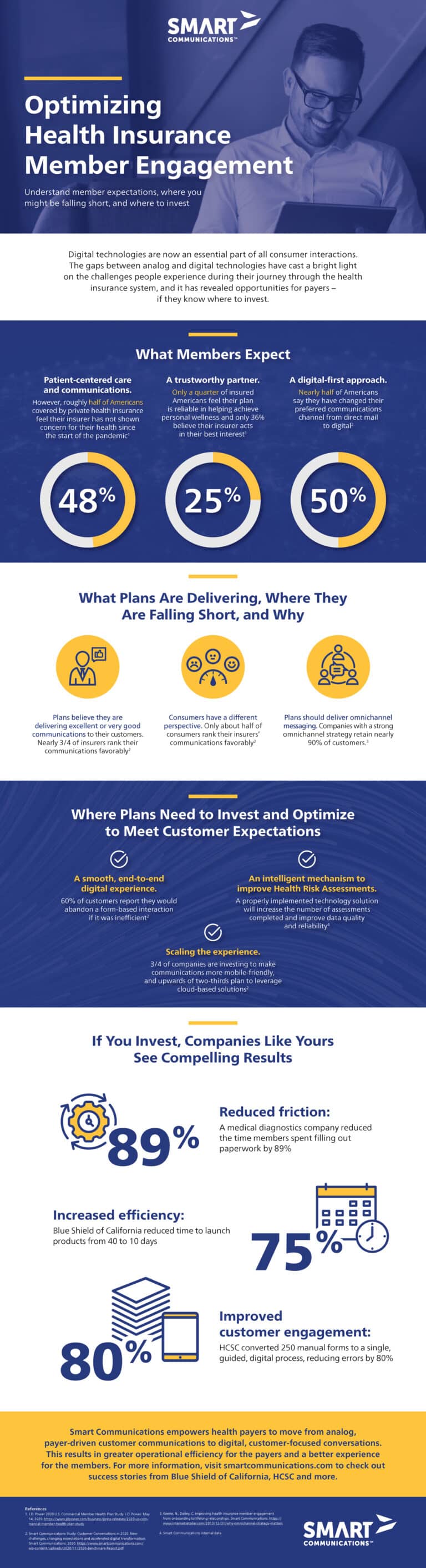
Many health insurers – roughly 75% — believe their member communications are excellent or very good. However, members have a different perspective, with only about half ranking their insurers’ communications favorably.

Unfortunately, health insurers all too often view member communications fine as-is. In today’s climate, however, where members expect a tailored, digital-first approach, insurers must better understand and meet these expectations to enhance the end-to-end member journey. This means optimizing every interaction, starting with enrollment and onboarding to managing the claims process and introducing care management initiatives.  For example, knowing that 60% of members would abandon an inefficient form-based process, a medical diagnostics company implemented a solution that cut the time members spent filling out paperwork by 89%.

In this infographic below, we highlight what members expect, where plans are falling short and where they should invest to succeed long-term. Keep reading to learn more:

To take a deeper dive into the member journey, check out our new white paper, Digital Enrollment and Onboarding for Health Insurance Plans. We explore every touchpoint of the enrollment process and identify key areas of optimization that will set your member experience apart from the competition.