Solutions

Archive and retrieve communications securely with cloud-native speed.

Orchestrate real-time, compliant interactions across every channel.

Simplify and standardize trade and relationship documentation workflows.

Industries

Improve customer engagement across policy, billing, and claims.

Create and deliver personalized, compliant customer communications at scale.

Heighten citizen experience with digital transformation.

Improve customer engagement across utilities.

Resources

Browse popular market research, articles, videos, written guides and more in one convenient location.

Explore upcoming events, webinars, and customer experiences shaping the future of customer conversations.

Get the latest updates on Smart Communications, including product news, and industry recognition.

Company

Learn more about our company, our leadership and how were growing the team!

Analysts

Access analyst research, market reports, and industry recognitions featuring Smart Communications.

Omnichannel Insurance Solutions – the Next-Generation of Greatness


By: Ruth Fisk, VP of Insurance Marketing at Smart Communications

We are living in an always-on world – everything from ordering dinner, to opening a new bank account or filing an insurance claim can be done from a mobile device, in real time and when it suits the customer rather than the business. This is forcing the insurance industry specifically to rethink how they interact with their customers across a variety of channels and puts pressure on them to invest in omnichannel insurance solutions to effectively orchestrate interactive, two-way conversations as opposed to transactional, one-way communications.

The insurance industry has a long history – centuries, in fact – of adapting to change like this. In this post, we dive into how an omnichannel distribution model is helping leading insurers to deliver upon their guiding principles at the same time that customer needs evolve. We also provide a real-world example of an insurer doing this today.

Omnichannel Insurance Solutions for the Future

Times have changed and so too have insurers – yet their principal purposes remain the same, including:

  • Payments of Losses – ensuring insured individuals are less dependent on public assistance or relatives
  • Anxiety Mitigation – lets people know they are covered if a loss occurs
  • Support for Credit – aids in obtaining loans if insured
  • Accident Prevention – lives and property are saved


While insurers continue to focus on delivering these same important benefits to society, today’s modern insurer depends on new technologies and strategies – including advanced omnichannel insurance solutions – to meet the changing needs and expectations of their policyholders.

It’s no secret that the industry has seen more rapid change in the last 10 to 15 years than in the combined 350 years before, with today’s most meaningful contrast tied to how insurers deliver their products and services.

Today, insurers must effectively manage – or orchestrate – customer interactions to make them part of a continuous conversation rather than isolated, disjointed transactions. An effective omnichannel distribution model enables insurers to add digital channels to their print efforts, automate common customer interactions, effectively promote two-way conversations and more. This ensures that approved, compliant communications are delivered in real time and initiated when the customer demands it.

Wawanesa Insurance and the Power of a SMART Integration with Guidewire

This rapid evolution in the last few years has prompted industry leaders to build an ecosystem that brings together the best of breed solutions with pre-built code, accelerating the delivery of this combined functionality for today’s modern insurer. Leading insurers like Wawanesa Insurance want to focus on delivering value to their customers, not on the intricacies of integrating platforms. They rely on SMART partners to make this as seamless – and effective – as possible for their teams and their policyholders.

To address this, Guidewire, a leading technology platform provider for property and casualty insurance carriers, created their Ready for Guidewire accelerators.  Smart Communications has worked closely with Guidewire to develop more than a dozen of connectors available to InsuranceSuite on the Guidewire Marketplace.

Smart Communications is proud to provide the #1 Customer Conversations Platform that Guidewire customers count on to uniquely deliver personalized, omnichannel conversations – empowering them to succeed in today’s digital-focused, customer driven world.

Wawanesa leverages Smart Communications pure-cloud communications platform to deliver hyper-personalized, omnichannel experiences that reinforce the organization’s commitment to member centricity. Through this work, the organization has streamlined communications, enabled greater consistency and improved the customer experience to:

  • Provide a fast and simple way to share information with policyholders
  • Boost productivity
  • Reduce reliance on IT to perform all CCM related work


By investing in cloud-based solutions like the Smart Communications Conversation CloudTM, Wawanesa has lowered operational costs and improved the user experience, so they’re always ready to deliver leading-edge service.

“The Smart Communications claims release is a game changer by automating a time-consuming process and rationalizing an inventory of more than a thousand documents to ensure that we provide consistent, professional and accurate customer communications. Wawanesa is committed to continuing to invest, listen, and more importantly, focus on being a trusted partner.”   – Wawanesa Insurance

At Smart Communications, we are proud of the innovation we’re seeing across the insurance industry, both with leaders at insurance companies around the world and with our technology partners like Guidewire. Together, we’ll continue to chart a path toward excellence, driven by efficiency inside the organization and a top-notch experience for the policyholders that together, we support.

As we look forward to next month’s Guidewire Connections event in Las Vegas, we are ready to convince you to add more power to your Guidewire investments – and improve your customer communications strategy. More than 100 Guidewire customers across the globe trust Smart Communications to deliver SMARTER conversations across the complete customer lifecycle.  We’re ready to tell you why live! See you at the Smart Communications booth (P2) at #GuidewireConnections!

Optimizing Member Engagement at Every Point of the Health Insurance Journey


By: John Zimmerer, VP Industry Marketing, Healthcare at Smart Communications

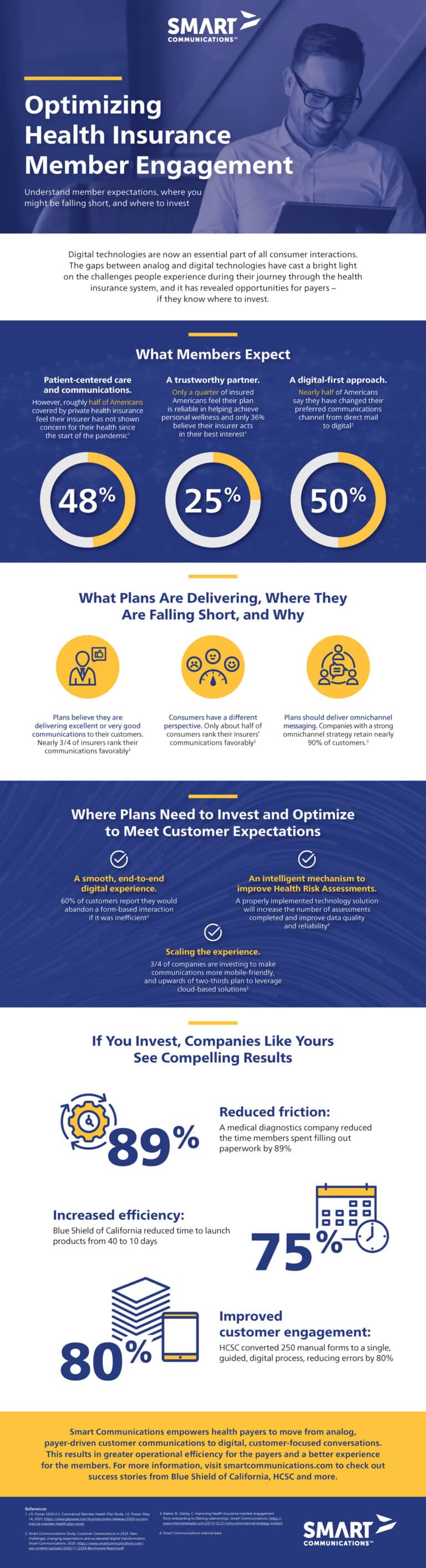
Many health insurers – roughly 75% — believe their member communications are excellent or very good. However, members have a different perspective, with only about half ranking their insurers’ communications favorably.

Unfortunately, health insurers all too often view member communications fine as-is. In today’s climate, however, where members expect a tailored, digital-first approach, insurers must better understand and meet these expectations to enhance the end-to-end member journey. This means optimizing every interaction, starting with enrollment and onboarding to managing the claims process and introducing care management initiatives.  For example, knowing that 60% of members would abandon an inefficient form-based process, a medical diagnostics company implemented a solution that cut the time members spent filling out paperwork by 89%.

In this infographic below, we highlight what members expect, where plans are falling short and where they should invest to succeed long-term. Keep reading to learn more:

To take a deeper dive into the member journey, check out our new white paper, Digital Enrollment and Onboarding for Health Insurance Plans. We explore every touchpoint of the enrollment process and identify key areas of optimization that will set your member experience apart from the competition.

Lessons Through a Lens: Pandemics Changing Communication in Insurance


By: Ruth Fisk, VP of Industry Marketing, Insurance at Smart Communications

More than 17 pandemics have plagued the world dating back as early as 430 B.C. Some are more well-known than others, but there is no doubt COVID-19 will be well remembered as a pandemic that changed the world. The 1918 Spanish Flu, the deadliest pandemic on record, and COVID-19 have a striking number of similarities. Just more than 100 years apart, each forced business to restrict operations, schools to close, stay at home orders to be enacted, masking and social distancing to become a must. The economic and social impact of each was devasting, forcing a shift in thinking about how we deliver products and services and – as importantly, how we communicate in new meaningful ways with the customers we serve.

Insurers too have been impacted by the outcomes of the pandemic, forcing them to readjust their business strategies so that they can better cater to the expectations of today’s consumers — especially during claims interactions where their customer retention and satisfaction rates are at the highest risk. There may be lessons insurers can glean from the pandemics to help them adjust to the next new normal. Let’s take a closer look.

Evolving the Way Products and Services are Delivered

Today’s “Hollywood” was born out of the 1918 pandemic, when 90% of movie theaters were shuttered. Adolph Zukor, co-founder of Paramount Pictures, had the vision to deliver full feature films through new channels, focused on the customer experience. Adolph purchased the closed theaters, built the movie empire, and transformed the movie industry. Similarly, insurance too will need to adapt to a new way of thinking by reevaluating the customer journey – every interaction can be a make-or-break moment in the retention strategy for that customer. It will not be enough to simply set up a digital front end, while still forcing your customer to engage in antiquated processes, e.g., filling out and returning a claim paper form.

EY reports “The COVID-19 pandemic is accelerating the transformational trends impacting the insurance sector and highlighting the need to take bolder actions in areas such as digital capability and effective engagement to address the customer’s needs post-pandemic.”

The insurance industry must rethink its business models to meet the expectations of policyholders. Consumers expect insurers to have the ability to have meaningful, two-way conversations whenever they need them to happen, across their preferred channels (mobile, web, human). Insurers must pivot in the way they deliver products and services; to do this, they should retool their communications platforms to have SMARTER conversations with their customers.

Technology Adoption Increases During Pandemics

Communications were difficult in 1918. Individuals relied solely on printed newspapers to receive updates on the pandemic. Businesses sought new and creative ways to reach customers. The 1918 pandemic dramatically changed the way we live and communicate today. One example – in-home telephones became a staple, helping individuals and households to feel less isolated and more connected.

Insurance companies can also learn from this lesson. The policyholder typically has little to no interaction with the insurer until a claim occurs and even then they often feel like communication is scarce, which makes them feel isolated during their greatest time of need. Best practices are now showing significant opportunities to improve customer satisfaction in claims if communications are approached as personalized, two-way conversations rather than broadcasting one-way messages that leave the insured feeling disconnected.

New Communications Methods Become Mainstream

As a result of the pandemics, we can now see the rapid adoption of essential technologies that offer new ways of doing things, driven by consumers’ demands for a more digital, personalized two-way interaction. As these technology imperatives become mainstream, insurers must take the necessary steps to implement a digital-first strategy to orchestrate conversations more effectively across all parties related to the policy.

Most significant will be the continued adoption of modern communications tools and platforms whose growth was fast-tracked because of the pandemic – think on-demand movies streamed via mobile or advanced video communications platforms like Zoom, where daily downloads have increased 30x to provide opportunities for online interactions. That alone is not enough. The digital age is accelerating at an even faster pace for the insurance industry, which now faces more urgency than ever to transform operations to be more nimble and agile. This requires an insurer to act with determination and speed in their adoption of a digital-first platform.

Insurance Industry Responding to New Demands

Insurance organizations have aspired to build truly digital-first businesses over the last several years, however most had not achieved this pre-COVID. Today, the “nice-to-have” imperative is no more, with a true ultimatum in place to shift priorities and focus aggressively on this new paradigm. The pandemic has brought a seismic shift in the way consumers expect insurers to be digitally available and to respond to their preferences or jeopardize their relationship.

Nearly 40% of consumers in the U.S. indicated they changed their preference from direct mail to digital communications due to factors related to the COVID-19 pandemic.

To survive, insurers must accelerate their digital-first approach, which includes modernizing communication platforms. A large percentage of existing insurers are still running legacy Customer Communications Management (CCM) platforms, which impedes their ability to respond to the real-time expectations of policyholders and claimants.

Insurers can build the foundational components of a digital-first strategy by changing their approach to communications including:

STEP 1: Customer Conversations Roadmaps

Create customer roadmaps that define all the communications intersection points and opportunities, as well as customer preferences throughout the claims process.

STEP 2: Modern Customer Conversations Platform

Embrace a modern, cloud-based SaaS Customer Conversations Platform to provide digital-first, automated solutions like chatbots, self-service portals and mobile apps – providing new communications channels to engage customers in meaningful two-way conversations.

STEP 3: Cloud-First Adoption

Future-proof your strategy. Provide the scale, agility, multichannel communications, seamless integration, responsiveness and speed to market by embracing a modern conversations platform purposefully built for the cloud.

STEP 4: Enjoy the Benefits

Achieve long-lasting benefits of modernizing your communications platform as a top priority within your digital-first strategy, maximizing your ability to exceed customer expectations today and into the future, while also reducing costs.

The outcome of the pandemics presents insurance organizations the opportunity to learn from the past, by adopting the newer technologies that have proven their worth in the marketplace. Doing so will enable insurers to build a solid foundation for their digital transformation strategy, making it easier to meet consumer expectations, provide long-term value and carve out new competitive advantages.

Ready to apply these lessons learned to insurance? Contact us today to learn more about how your peers used the experiences from the pandemic to provide SMARTER conversations.

Smart Communications has long been recognized by all major analysts (Gartner, Forrester, Novarica and IDC ) as a Leader & Innovator in enterprise-scale Workflow & Content Automation (WCA) & Customer Communications Management (CCM) – and most recently by Aspire in its 2021 Leaderboard Assessment,  based on our proven cloud approach, our strategy for enabling meaningful two-way customer conversations and our platform that’s purpose-built for a post-pandemic customer experience.

For Insurers, Ad Hoc Doesn’t Have to Be Difficult

Cell phones and claims correspondence


By: Ruth Fisk, VP of Industry Marketing, Insurance at Smart Communications

Today, most of us carry more computing power in the palm of our hands than all of NASA had back in 1969 when it sent two astronauts to the moon, and yet despite this, most insurers are still saddled with labor-intensive, manual processes to create ad hoc claims correspondence experiences.

The number of smartphone users in the world today is 3.8 billion

Modernization in insurance is slow and difficult, with many systems that must be updated in order to truly deliver on the experiences that we as always-on, real-time consumers expect in every interaction.  While many insurers have done their best to build digital façades in order to appear to be a digital-first organization for their claimants, behind the scenes, many of their processes – including the creation of claims correspondence – is still riddled with age-old structured and methodologies.

Years ago, to describe claims communications the industry coined the term “ad hoc correspondence.” By definition, ad hoc loosely describes the significant number of one-off pieces of correspondence that may be created in claims operations on any given day.

However, claims professionals would likely agree that the synonyms that explicitly describe ad hoc are even more fitting:

impromptu · improvised · rough and ready · makeshift · make-do · cobbled together · thrown together · jury-rigged · quick and dirty · as the need arises · when necessary · when needed

Still prevalent today are legacy communication tools that leverage manually created, word-based or other outdated word processing tool templates, stored in individual files or on network shares to accomplish their “ad hoc correspondence” needs.  Claims professionals have become so accustomed to – and quite frankly don’t even think twice – about using this approach because it gives them the freedom to “roll their own” ad hoc letters.  However, these outdated tools expose a claims organization to higher operational costs and increased liability exposure for noncompliance:

  • Content control within templates is critical as the wrong message can create significant risks to the insured.
  • Redundancy in template content often makes the selection of proper templates overwhelming and increases the costs of maintenance and control.
  • Claims correspondence is always created because of some adjudication activity that occurs in the claims administration system, yet legacy solutions have limited integration capabilities available.
  • Claims administration systems lack the interactive correspondence capability which most carriers require.
  • Coordinating communication across all interested/active parties is arduous. Adjusters must prepare correspondence with the claimant, agent, third-party service providers, investigators, witnesses, medical providers and contractors.
  • Legacy communication tools do not provide the customer-centric approach required in today’s insurance environments, leaving claims professionals that create impersonal experiences for their customers.


The insurance industry is focused on delivering personalized digital experiences to improve its customer-centric approach.  However, archaic processes still exist in claims operations which make it difficult to manage the creation of real-time two-way conversational communications without the proper solutions. The ultimate interactive claims correspondence solutions, like our Conversation Cloud, achieve the perfect balance between a business user’s flexibility and critical organizational control and auditability.  Claims professionals will be asking why they didn’t make this change years ago!

With the proper tools – ad hoc doesn’t have to be difficult.

Modern conversation platforms provide interactive, real-time, two-way conversational capabilities that enrich the customer experience, enable faster claims resolution and ensure compliance – all while increasing the claim adjuster’s productivity and improving their job satisfaction. Migration tools are accessible to reduce the time required so you can retire those antiquated tools quickly.

What are you waiting for?  Start having SMARTER conversations today.

Smart Communications can help you with your digital journey.  We’ve long been recognized by all major analysts (Gartner, Forrester , Aspire and IDC ) as a Leader & Innovator in enterprise-scale Workflow & Content Automation (WCA) & Customer Communications Management (CCM) – including Aspire’s 2021 assessment which rates Smart Communications the #1 leader in the industry.

Contact us to learn more! 

Why I Joined Smart Communications


By: Sam Couzens, VP of Global Demand Generation at Smart Communications

Sam Couzens, VP of Global Demand Generation

Sam Couzens VP of Global Demand Generation, Smart Communications

The last few weeks have been a flurry of activity as I start my new role with Smart Communications.  Many people have asked how I made the decision to join this dynamic organization so I thought I would share a bit about my journey!  Making the decision to leave an organization is sometimes easy.  In my case, in this instance, it was not. I had been with my former company for almost six years and worked with some great people.  When I learned about this opportunity, I was intrigued. Smart Communications’  reputation in the industry is strong.  They have earned accolades as an established CCM leader by numerous analyst firms and have a unique approach in the industry as a next-gen CCM provider. The newest addition of Smart IQ, the forms transformation solution had also created a positive buzz for them in the industry. Demand Generation is my passion, so I knew the role was a good fit.  It was when I met the leadership team that everything clicked and I was convinced that this was an opportunity worth exploring. It was obvious that they know their stuff, and that they are super passionate, driven, and SMART (pardon the pun).

As I thought through this life-changing decision, I came across an insightful article that helped me think through some of the important factors when joining a company.  The author suggested there are 4Ps to evaluate before joining a company.  Being a marketer, this caught my attention.  The 4Ps of Marketing are Product, Place, Price, and Promotion. This author had a different take on the Ps and it really resonated with me.

The first P mentioned was Product – does the organization deliver real value to markets and customers?  Check!  That was an easy one. The history of Smart Communications is built from the cloud up, giving their customers the ability to take advantage of what true multitenant SaaS can offer.  And, what an important time it is for the industries they serve.  There is an absolute need to be more customer-centric and more digital-first.

Moving on to the second P mentioned – Potential.  Can I achieve wins for the company and myself?  With the knowledge I had about Smart Communications, and reading about their recent successes in the trade publications, coupled with my passion for Demand Generation and the fact that the industries Smart Communications serves have never needed to scale their conversations more than they do now I was convinced there is great potential for myself and the organization.

The third P for this author is Purpose. Does the company have purpose?  Based on my conversations with the leadership team, this felt like a strength. The Smart Communications culture is healthy—with a team spirit,  a focus on customer success, and a dedication to keeping employees engaged while working remotely.  Having purpose in a time of crisis, such as a global pandemic, is essential for any organization, and this company is thriving.

And the last P, the one that may be the most important to me is People. Is the team passionate, intelligent, and committed?  To this, I could also answer 100 percent yes.  I could feel the passion, excitement, and organizational pride with each and every person I spoke to and so, I was hooked.

Making the decision to leave an organization is sometimes hard and shouldn’t be taken lightly.  But when you know you are moving on to a fantastic team, with a leading solution and committed leadership, it makes it that much easier.

How Insurance Companies Can Thrive in the New Normal


By: Larry Hogan, Account Executive at Smart Communications

So far in 2020, insurers have had to find unique ways to quickly respond and adapt to a unprecedented level of disruption. The good news is, depending on the approach, 2020 also brought an unexpected opportunity for insurers to be champions for digital change – setting an example for how digital transformation should be embraced when we settle into a new normal.

Here are a few common challenges facing insurance companies today, and how adopting a digital-first approach to communications will help insurers become more resilient.

Claims Volume Fluctuations
Depending on the area of insurance that you’re in, claims volumes have likely either significantly increased or decreased in recent months. For P&C insurers, as more people are required to work from home and vacation plans have been altered, the number of traffic accidents are dropping. Fewer accidents means fewer claims. While some P&C insurance carriers have made some progress toward digital transformation, when it comes to automation, much of the industry is still heavily reliant on manual processing and in-person interactions. The good news is, reduced claims volume provides an opportunity for P&C insurers to find new ways to connect with customers. Consumer Federation of America recently reported that 80 percent of American auto insurers have announced that they will refund or credit drivers more than $6.5 billion over the next two months. Touchpoints like this are great opportunities to keep customers engaged and loyal – so it’s important that your business is digitally equipped to deliver these types of communications quickly and efficiently.

On the contrary, health insurance companies have seen a significant increase in claims that need to be processed quickly. Life insurance companies have also experienced an increased demand for policy applications and new account openings.  Fabric, a provider of instant online life insurance says it has seen a 50 percent increase in life insurance applications since mid-February. Similarly, LifeQuotes, a national online life insurance agency, reports a 29 percent increase in applications requested since January 20. One way to adjust for a volume overload is to leverage a modern claims automation solution, which provides faster cycle times, increases employee productivity and ultimately yields higher customer satisfaction.

In both cases, either an increase in claims submissions or a decrease in claims submissions, insurers have been reminded of the importance of being a trusted resource to their customers all the time. It’s crucial to process claims quickly and effectively, but it’s also just as critical to the long-term relationship to maintain open lines of communications in between key milestones as well.

Call Center Overload
During a time of uncertainty, it’s easy to understand why customers would have more questions that usual and might want to seek out customer service representatives for assurance. Many insurance companies are seeing surges in operational volume with new claims being filed, general coverage and billing questions, and response to government mandated actions or new programs – the list goes on. As a result, insurance companies have experienced a spike in call center volume as individuals seek out immediate responses. If customers can’t reach you by phone due to high volumes and can no longer participate in the insurance processes that rely on face-to-face or paper-based transactions, you run the risk of losing the trust and personal touch that keeps customers loyal.

To ensure a consistent level of service during peak times, insurers have no choice but to rely on digital channels to communicate with their policyholders. With reduced mail and print processing and the delays that physical communications can be subject to, there’s a significant need to be able to process applications and correspondence faster. These challenges have forced those who lag behind in digital to catch up. According to VentureBeat, some companies are positioning AI as a solution to service gaps. While the use of AI and automation has been top-of-mind for many forward-thinking companies, most insurance companies still lack the digital tools and platforms needed to meet today’s on-demand customer expectations. Insurers should use this time as an opportunity to explore automated solutions, like chatbots, self-service portals, and mobile apps, which provide new communication channels that enable policyholders to engage in two-way conversations. These types of digital-first communication methods lead to smarter conversations and more consistent interactions throughout the entire customer lifecycle.

Finding the Solution Through Digital-first Communications
As customers become used to digital interactions as the new norm, there will be a changing level of expectation in how they are communicated with from now on. Life will not go back to normal – there will be a new level of expectation around digital-first communications. This is actually some much-needed good news. The changes made now will last long into the future– providing customers the digital-first experience they’ve been desiring can be achieved by embracing a modern cloud-based solution.

Are you ready to engage in SMARTER digital conversations with your customers? Connect with us today and we’ll show you how we can help.