Solutions

Archive and retrieve communications securely with cloud-native speed.

Orchestrate real-time, compliant interactions across every channel.

Simplify and standardize trade and relationship documentation workflows.

Industries

Improve customer engagement across policy, billing, and claims.

Create and deliver personalized, compliant customer communications at scale.

Heighten citizen experience with digital transformation.

Improve customer engagement across utilities.

Resources

Browse popular market research, articles, videos, written guides and more in one convenient location.

Explore upcoming events, webinars, and customer experiences shaping the future of customer conversations.

Get the latest updates on Smart Communications, including product news, and industry recognition.

Company

Learn more about our company, our leadership and how were growing the team!

Analysts

Access analyst research, market reports, and industry recognitions featuring Smart Communications.

Turning Missed Payments into Better Customer Outcomes with Journey Orchestration

By Gordon Tang, Product Marketing Manager at Smart Communications 

In the first part of this series, we explored why missed payments are rarely just billing events. While every missed payment may follow a similar operational path, the customer circumstances that created it can vary significantly. Behind every missed payment is a personal customer story. This creates a challenge for insurers trying to balance compliance requirements, operational consistency, customer experience, and commercial outcomes. 

The natural question is what happens next. 

If insurers already have payment recovery processes, communication platforms, business rules, and governance frameworks in place, what is missing? 

For many organisations, the answer is not another process. It is a better way of connecting operational events to customer needs. 

The Need for a Customer Resolution Mindset 

Many collections processes and programs are built around a single objective: recovering the outstanding premium. 

While that objective remains important, it is increasingly insufficient on its own. 

A customer who has forgotten to update payment details requires a different journey to a customer experiencing financial hardship. A customer who wants to maintain cover requires different support to a customer who is reconsidering the value of the policy altogether. 

The challenge is that the operational trigger remains the same in each case. A payment has been missed. Without additional context, insurers can only assume what should happen next. Those assumptions often lead to generic experiences that may fulfill compliance requirements but fail to address the customer’s actual needs. 

A more effective approach is to focus on customer resolution rather than simply payment collection. Resolution starts by understanding the customer’s situation and helping them move toward the most appropriate outcome. 

Why Understanding Intent Matters 

At the heart of every missed payment is a question that most systems cannot answer on their own. 

Why did it happen? 

Understanding customer intent allows insurers to move beyond the event itself and focus on the circumstances behind it. Rather than treating every customer the same, organisations can begin identifying the drivers behind different behaviours and determining the most effective response. 

This creates opportunities to deliver better outcomes across multiple areas of the business. 

Customers who simply need to update payment details can be guided toward a fast and convenient resolution. Customers experiencing hardship can be directed toward specialist support pathways. Customers questioning the value of their cover can receive information that helps them make informed decisions about their policy. 

The objective is not merely to classify customers. It is to understand enough about their circumstances to make the next interaction more relevant and more effective. 

Orchestrating the Right Next Action 

Insight alone is not enough. Once customer intent is understood, organisations need the ability to act on it. 

But rather than pushing every customer through the same sequence of interactions, insurers need the flexibility to guide customers toward the next best action based on their circumstances, business rules, and regulatory obligations. 

That action may involve updating a payment method, establishing payment arrangements, reviewing policy coverage, engaging a specialist support team, or accessing hardship assistance. The right answer depends on the customer, not simply the event that triggered the interaction. 

Importantly, this does not require organisations to abandon consistency. It requires them to become more intelligent about how consistent processes are applied and experienced, particularly at scale 

Personalisation and Compliance Can Coexist 

One of the most common misconceptions in insurance is that personalisation and compliance sit at opposite ends of the spectrum.   

In reality, they solve different problems. 

Compliance frameworks are designed to ensure fairness, governance, and accountability. Personalisation is designed to improve relevance and customer engagement. There is no inherent conflict between the two. 

Insurers do not need unique compliance rules for every customer. They need the ability to create experiences that feel relevant while still operating within a consistent and auditable framework. 

Customers should experience interactions that acknowledge their circumstances. Regulators should see evidence of control, consistency, and appropriate governance. The most mature organisations are increasingly focused on achieving both outcomes simultaneously. 

The Role of SmartPATH™ 

This is where SmartPATH comes into the picture. 

Rather than acting as another payment recovery solution, SmartPATH serves as the connective layer between customer needs, operational processes, and regulatory requirements. 

It helps insurers understand customer intent, identify potential vulnerability or hardship indicators, orchestrate appropriate next actions, and create more relevant customer journeys without compromising governance controls. 

The result is that organisations can maintain the consistency, compliance, and auditability required in a regulated industry while delivering experiences that feel much more personalised and customer-centric. 

The process remains governed. 

The experience becomes more relevant. 

That distinction is what allows insurers to move beyond a purely transactional approach and focus on creating better customer outcomes. 

From Payment Recovery to Customer Resolution 

The future of this challenge is not about recovering payments. It is about helping customers navigate the circumstances that led to the missed payment in the first place. 

Organisations that focus exclusively on collection activities may recover premiums, but they can miss opportunities to strengthen relationships, reduce churn, identify vulnerability, and improve customer trust. 

The insurers that lead in this space will take a broader view. They will recognise that missed payments are often signals of a deeper customer need and will invest in the capabilities required to understand and respond to those signals effectively. 

Learn How SmartPATH Enables Transformation for Insurers 

To see how missed payments can create opportunities and better customer outcomes, plus stronger policy retention, and compliant customer engagement, request a demo today.

How Customer Communication Orchestration Improves Engagement

By Gordon Tang, Product Marketing Manager at Smart Communications

As organizations look beyond individual touchpoints and toward more connected experiences, customer communications orchestration has become increasingly important in helping businesses deliver the right information, through the right channels, at the right time. 

As we’ve explored previously (here), delivering on those expectations is only getting harder as the goalposts continue to shift. For regulated industries especially, where the focus often leans heavily toward compliance, it’s easy to lose sight of what actually strengthens a customer relationship. 

Organizations can earn and maintain customer trust by communicating clearly, consistently, and through the channels customers prefer. But when communications are treated primarily as a compliance exercise, something important is lost. The opportunity to truly engage disappears, and with it, the visibility, responsiveness, and control customers now expect.  

Our continued focus on improving customer interactions has led to our inclusion in the Omdia Universe: Customer Engagement Platforms, 2026. As the Product Marketer for SmartPATH™, I—and the wider team—are incredibly excited to see our capabilities recognized. For the sake of this article, here’s what I’m covering: 

  • A high-level look at customer communications orchestration and how it works, plus the importance of it for highly regulated industries
  • How SmartPATH supports customer communication orchestration 

What Is Customer Communication Orchestration? 

Customer communication orchestration is the coordination and optimization of customer interactions across touchpoints and channels—to deliver experiences that are timely, relevant, and consistent throughout this customer journey. 

Customer engagement isn’t a new concept. Analyst firms have been studying it for years. Since 2018, Omdia has surveyed customers and vendors to better understand how organizations approach engagement, defining what they call the Customer Engagement Platform (CEP) market. In their 2026 report, Omdia’s Mila D’Antonio suggests that many organizations have reached a kind of inflection point: 

“They [technology buyers] know customer engagement is evolving faster than their tech stack, and they want to know which engagement platforms can actually take them into the future rather than bolting new features onto old foundations.” 

This captures a reality many organizations are grappling with today. In 2026, Smart Communications made its debut in this research, within a market valued at approximately $30 billion. Our inclusion reflects our ability to support engagement in regulated industries, where complexity is the norm: 

“From the beginning, Smart Communications focused on scenarios where customer engagement is not just about convenience or speed but about precision, compliance, security, and auditability. That heritage gives it credibility in complex, high–stakes interactions where traditional CCaaS platforms or lightweight CRM-driven engagement tools often fall short.” 

The report explores key areas of focus for CEP technology, including: 

  • Platform convergence: moving away from the multi-vendor, multi-interface approaches to technology that create disjointed databases, in favor of a simplified and unified platform (ideally from a single vendor)
  • Data unification: a solution that helps to create a clear and unified customer profile that updates in real time, rather than disconnected applications that create a segmented and outdated customer view
  • Technology modernization: a future-thinking technology solution that can adapt and evolve with the changing requirements of an enterprise (that are equally driven by the changing requirements of their customers), over legacy solutions that are no longer fit for purpose without supplementary integration into additional applications 

Each of these points in the same direction: organizations need a more connected, coordinated approach to engaging customers. 

Why Is Customer Communication Orchestration Important? 

It’s a deceptively simple question—and something of a trick. Customers don’t fit neatly into personas, their needs shift depending on the moment, the context, and the channel. They expect the right information at the right time—and they expect their experience to continue seamlessly, even when they switch channels, hit friction, or need follow-up. 

And those expectations are not standing still. Our 2026 CX benchmark research found that email remains the most widely preferred communication channel, while more than one-third prefer SMS, web portal/mobile app, or encrypted messaging depending on the context. At the same time, more than 80% of Gen Z and Millennials prefer digital self-service over speaking to customer service teams—yet many organizations still rely heavily on traditional outbound print communications. 

Omdia summarizes the challenge well: “As customer expectations continue to rise and digital engagement becomes more complex, enterprises are rethinking the foundations of how they operate. The challenge is no longer simply delivering better experiences via individual channels. It is coordinating every interaction, decision, and workflow across the entire organization in real time.”  That’s easier said than done. 

Organizations are being asked to deliver clearer, faster communication across a growing number of channels—while managing increasing regulatory pressure and tighter turnaround times. At the same time, they must maintain consistency across journeys that span multiple teams and systems. It’s a difficult balancing act. 

At times, it can feel like trying to juggle batons while riding a unicycle across a trapeze line—one that just happens to be moving toward a pit of flames. And to make things more interesting, the technology stack supporting you is often held together by years of custom integrations. 

How Does Customer Communication Orchestration Work? 

Simply put, customer communications orchestration works by continuously syncing real-time data across systems to deliver the right message, on the preferred channel at the exact moment the customers needs it. 

As a leader in CCM technology, Smart Communications understands how critical communications are to engagement. But in today’s environment, designing, creating, and sending messages isn’t enough. Sometimes, you need to ensure your message actually reaches the customer. This is where orchestration comes in. 

Orchestration is about making sure the right message reaches the right customer at the right time, even when things don’t go as planned. Maybe an email address has a typo. Maybe an SMS is blocked. Maybe a customer simply forgets to act and needs a reminder. Orchestration connects communication delivery to the broader customer journey. It introduces adaptability, persistence, and intelligence, while still supporting compliance and delivering on business outcomes. 

Benefits of Customer Communication Orchestration  

Sophisticated customer communication orchestration solutions will help organizations to: 

  • Quickly deploy and lower maintenance costs
  • Scale globally without sacrificing performance
  • Handle data and compliance support securely
  • Increase agility with the use of AI and automation 


How Does SmartPATH™ Support Customer Communications Orchestration? 

In 2025, SmartPATH joined Smart Communications’ suite of solutions following our acquisition of Pendula. This marked an important step forward, as it introduced orchestration capabilities that transform traditional communications into true engagement, especially for regulated industries. It’s also a key factor behind our inclusion in the Omdia CEP report. 

SmartPATH extends the value of our CCM proposition by enabling native omnichannel delivery and orchestrating communications across the entire customer journey. It connects what were previously separate capabilities, bringing them together into a more unified engagement solution. As part of a broader Customer Engagement Platform, SmartPATH aligns with what Omdia describes as a unified approach, bringing inbound and outbound communications together and expanding traditional CCM into full engagement capability. 

The result is a shift from disconnected interactions to cohesive, customer-driven experiences—delivering better outcomes and higher satisfaction. 

CEP as a Natural Extension for Smart Communications 

Our inclusion in Omdia’s 2026 report reinforces something we’ve long believed: Smart Communications belongs in this space. This isn’t about entering a new market. It’s about recognizing the natural evolution of what we’ve been building. 

Through SmartCOMM™ and SmartIQ™, we’ve built a strong reputation for enabling complex communications in regulated industries. SmartPATH builds on that foundation, extending those capabilities into the broader domain of customer engagement. It elevates communications from individual touchpoints into connected journeys, aligned with how customers experience organizations today. In many ways, this is about giving language to what we already do — and where we’re heading next. 

A Note from the Author 

This is my first blog for Smart Communications so, I’m finishing big with Gandhi. What if I told you that in 1890 he (allegedly) said:

“A customer is the most important visitor on our premises. He is not dependent on us. We are dependent on him. He is not an interruption of our work. He is the purpose of it. He is not an outsider of our business. He is part of it. We are not doing him a favour by serving him. He is doing us a favour by giving us the opportunity to do so.” 

The translation: everything you do should ultimately be for the customer’s benefit. And that still holds true today because when you give customers what they want, they reward you with trust and loyalty. 

For more, download a complimentary copy of Omdia Universe: Customer Engagement Platforms, 2026.  

Frequently Asked Questions 

Q: How is communication orchestration different from CCM? 

The two are related but distinctly different. Whereas CCM focuses on creating, managing, and delivering communications—communication orchestration focuses on the coordination of these communications, across an entire communication journey. If the former fulfils a single event, then the latter turns those events into something more for the customer—ensuring that the right message is sent at the right time, through the right channel. 

Q: Why do regulated industries need orchestration? 

When customer communications are often business–critical, compliance-sensitive, and tied directly to customer interactions—it makes sense to be able to send, manage, and ensure successful delivery of these autonomously and seamlessly. These communications are not just messages, they are the outputs of regulated business processes—orchestration through technology like SmartPATH unburdens manual resources from execution, drives down costs to serve, and ensures that organizations remain compliant as they scale their customer growth ambitions. 

Q: Why was Gandhi weighing in on customer service? 

Note that I said allegedly—the very powerful quote about the importance of the customer has been attributed to a speech by Gandhi in South Africa in 1890. There are no written records of why he may have said this, or even that he actually did—but equally if this was a misattribution, there is no record of when this happened either.  Still, how many articles have you read that reference Gandhi! And regardless of who said it, the quote is still a great one that perfectly encapsulates what the customer means for a business.

How SmartCOMM & SmartPATH Work Together to Build an Insurance Center of Excellence

By Eileen Potter, VP of Insurance Marketing at Smart Communications

For leading insurers, operational excellence means more than creating efficiency. It’s also about precision, agility, and trust. As customer expectations evolve, insurers are recognizing that excellence starts with content orchestration: the ability to deliver personalized, compliant, and connected communications across every stage of the customer journey.

SmartCOMM™ and SmartPATH™ work in tandem to make that possible. Together, they help insurance organizations build a Center of Excellence (CoE) for customer communications — one that balances control with innovation and drives measurable business outcomes.

Why Orchestration Is the New Core of Customer Communications

For years, insurance communications have been fragmented, with different teams managing correspondence across claims, underwriting, policy servicing, and marketing. Each function optimized in isolation, creating inefficiencies and inconsistencies.

Orchestration in customer communications changes that dynamic. It connects content, data, and decision logic so that every message — whether a claims update or policy renewal — is consistent, contextually relevant, and compliant.

By orchestrating communication workflows, insurers gain:

    • Unified governance: consistent messaging, brand, and compliance controls
    • Operational agility: faster response to market, regulatory, or customer changes
    • Scalable personalization: the right content, at the right time, in the right channel

This is the foundation of operational maturity — and the hallmark of a communications CoE.

SmartCOMM: Laying the Foundation for Operational Excellence

A Center of Excellence requires structure, and that begins with content. SmartCOMM helps insurers centralize, templatize, and link communication assets across lines of business.

By designing modular templates and reusable content blocks, you establish a transformation roadmap that reduces duplication and speeds up change management. Each update flows seamlessly through the enterprise, improving governance and compliance.

With structured, AI-ready content, teams can:

    • Reduce operational overhead and approval cycles
    • Standardize on best practices across regions or product lines
    • Accelerate the move toward omnichannel, customer-first experiences

SmartCOMM is what enables you to manage complexity without losing control — a cornerstone of operational excellence. (Discover how you can unlock the full power of AI to design, refine, and optimize customer communications.)


SmartPATH: Powering Orchestration Across the Enterprise

Where SmartCOMM structures content, SmartPATH orchestrates how it’s delivered. It connects the dots between systems, channels, and customer context, ensuring every communication follows the right set of rules. (Learn how to orchestrate journeys across channels.)

This orchestration layer is where real transformation happens. SmartPATH uses data and business logic to automate the flow of communications across journeys such as:

    • Policy issuance: Dynamically triggering the right communications after underwriting approval
    • Claims management: Coordinating notifications between adjusters, policyholders, and third parties
    • Renewals and retention: Personalizing outreach based on customer value, product type, or engagement history

Instead of managing communication touchpoints in silos, you’re orchestrating the entire lifecycle with transparency and control.

Building a Communications Center of Excellence

A true CoE doesn’t emerge from technology alone; it’s built on strategy and structure. Here’s a simplified roadmap to get started:

    1. Assess readiness: Identify where content silos and manual workflows create friction.
    2. Centralize assets: Use modular design and content linking to unify communications under shared governance.
    3. Automate intelligently: Introduce orchestration rules that reflect customer journeys, not internal processes.
    4. Measure and optimize: Track operational KPIs like cycle time, accuracy, and engagement across departments.
    5. Scale through collaboration: Expand best practices enterprise-wide, leveraging shared tools and standardized processes.

By linking operational excellence goals with content orchestration strategies, insurers can achieve more than just efficiency — they create resilient, customer-centric organizations ready for AI-driven transformation. (Related reading: Understand the key customer conversation trends reshaping insurance.)

Final Takeaway

Operational excellence isn’t realized by merely optimizing one department at a time — it’s achieved by connecting them. By combining the structure of SmartCOMM with the orchestration power of SmartPATH, insurers can transform fragmented communication processes into a cohesive, intelligent ecosystem that scales with the business.

Request a Demo

Frequently Asked Questions

1) What does orchestration mean in customer communications?
Orchestration is the coordination of data, rules, and delivery across all customer communication touchpoints. It ensures each message is timely, relevant, and consistent with brand and compliance standards.

2) How does orchestration improve operational excellence?
By reducing manual work and enforcing consistent processes, orchestration eliminates inefficiencies and human error. It connects departments and technologies, enabling faster, data-driven decision-making.

3) Why is orchestration important for insurers?
Insurance involves complex, multistep interactions — from underwriting to claims. Orchestration simplifies this by connecting workflows, ensuring that customers receive seamless and compliant communications throughout their journey.

4) How do SmartCOMM and SmartPATH contribute to orchestration?
SmartCOMM structures and manages content centrally, while SmartPATH automates and routes communications based on business logic and data. Together, they form a unified framework for orchestrated, enterprise-grade customer communications.

The ROI of Orchestration in Client Communications: A SmartPATH™ Perspective

By Cindy Griffin, Vertical Marketing Lead at Smart Communications 

Trust is the bedrock of the financial services industry. Clients trust their financial well-being to their bankers and financial advisors; they trust that their financial services institutions will orchestrate better financial outcomes for them. But how do financial services institutions build that trust? The answer: delivering faster, more personalized communications at the right time can orchestrate better financial outcomes for their clients and increase trust. 

Even with the desire and the pressure to deliver faster, more personalized communications, financial services institutions need to be mindful of ballooning costs or overwhelming internal teams. The question we hear on nearly every discovery call: “How much will this cost, and what’s the ROI?” 

If you’re evaluating SmartPATH or comparing orchestration solutions, you’re probably balancing immediate budget concerns with long-term strategic goals. That’s why understanding the ROI of orchestration in client communications is crucial. 

Let’s break down how sophisticated orchestration software helps institutions like yours achieve measurable gains—both operational and experiential. 

The Problem: Disconnected Channels, Redundant Workflows, High Costs 

Traditional client communication systems often rely on siloed tools for email, print, SMS, and in-app messages. This fragmentation creates:

  • Redundant processes and approvals
  • Compliance risks due to inconsistent messaging
  • Skyrocketing print and mailing costs
  • Delays in client response times
  • Poor client experience (CX) due to lack of personalization
  • Missed opportunities to improve a client’s holistic financial picture 

It’s a high-cost, low-flexibility environment that doesn’t scale—and doesn’t serve your clients.  

The Solution: Omnichannel Orchestration with SmartPATH 

SmartPATH, Smart Communications’ digital orchestration platform, centralizes your client communication workflows across all channels. The result? Faster approvals, unified messaging, dramatically lower manual workload, and better outcomes for your clients. 

Life events or milestones are perfect opportunities to orchestrate client journeys and avoid these problems. Imagine that your client has a newborn child and contacts you to update the beneficiary on an account. This is a simple enough service request—and you may even be completing these requests efficiently today—but what else does it mean to your client’s financial situation now that they have a child?  

Your client may not be thinking about the cost of their newborn’s education or how their family’s financial situation may be affected. With SmartPATH, you can design client journeys that are automatically triggered based on a life event such as the birth of a child.  

Imagine how this client journey could be designed for better outcomes. The first step could be an education planning packet—personalized by state or jurisdiction—sent to the client explaining education savings options.  

The next step offers the client a choice: open an account on their own or contact their advisor for more help. Either option triggers additional events in the client’s journey, eventually leading them to open an education savings account for their new child. Additional long-term financial wellness nudges like age-based milestones can be designed into the journey to continue the client’s path to better financial outcomes. 

ROI Drivers You Can Measure 

  1. Fewer Manual Touchpoints 
    Automate approvals, content routing, and compliance checks to increase staff efficiency. Automatically kick off related client journeys based on one life event or milestone. 

  1. Improved Client Experience 
    Personalized, omnichannel journeys reduce churn, increase engagement, and boost Net Promoter Scores (NPS). Automated channel shift ensures that you don’t lose client engagement. 

  1. Faster Time to Market 
    Launch communications in days, not weeks—with centralized workflows and reusable content blocks. Regulatory compliance becomes more efficient and less manual. 

Pricing vs. Value: The Real ROI Conversation 

We get it: software investments need to prove their worth. But when you factor in the cost of doing nothing—manual rework, compliance breaches, delayed responses—the value of SmartPATH is clear. 

What often starts as a pricing objection turns into an “aha” moment once teams calculate: 

  • How many hours are spent manually managing approvals
  • How much is spent annually on physical mailings
  • How often are messages delayed due to siloed systems 

And on top of the hard dollars you can save, SmartPATH ensures better financial outcomes and turns the client journey into a trust building journey. 

Ready to see SmartPATH in action and learn how leading financial institutions are cutting costs, accelerating workflows, and improving client experiences? Request a demo today. 

Frequently Asked Questions  

Q: How does SmartPATH use AI in client communication workflows? 

SmartPATH uses AI to enhance personalization, channel optimization, and workflow efficiency. AI-powered insights help tailor messages based on client behavior and preferences, while smart routing reduces manual decisions and approval bottlenecks. 

Q: What makes SmartPATH different from traditional workflow tools? 

Unlike rigid legacy platforms, SmartPATH is designed specifically for regulated industries like financial services. It offers omnichannel orchestration, built-in compliance tracking, and enterprise scalability—without needing a dozen disconnected tools. 

Q: How quickly can SmartPATH deliver ROI? 

Most institutions begin to see measurable cost savings and time reductions within the first 3–6 months post-implementation, especially in high-volume, high-complexity communication environments. 

Q: Is SmartPATH only for large enterprises? 

No. SmartPATH scales to meet the needs of mid-sized institutions as well as global banks and insurers. The platform’s modular design makes it easy to adopt at your own pace. 

Why Financial Institutions Need a Journey-Orchestration Platform

By Cindy Griffin, Financial Services Vertical Marketing Lead at Smart Communications 

You’ve used PDFs and DocuSign PowerForms for years. They’ve become the default for everything from onboarding forms to loan agreements. But let’s be honest—just because they work doesn’t mean they’re working well for today’s customers. 

Financial institutions like yours are under pressure to deliver seamless, omnichannel communications. Static PDFs and limited web forms can’t keep up with rising expectations for real-time, personalized, and connected experiences. 

That’s why leading financial institutions are turning to platforms like the Conversation Cloud™— combining SmartCOMM™, SmartIQ™, SmartHUB™, and SmartPATH™. Together, these solutions move you beyond one-off document automation to connected, data-driven journeys that adapt in real time across every channel. 

Static Forms vs. Omnichannel Orchestration Platforms: A Quick Comparison 

Capability 

PDFs & PowerForms 

Smart Communications’ Platform 

Customer experience 

Static, one-size-fits-all 

Dynamic, responsive, and personalized across the entire journey 

Channel flexibility 

Desktop-first, limited mobile usability 

Fully omnichannel (web, mobile, email, print, SMS) 

Data integration 

Manual rekeying or basic field mapping 

Real-time integration with core systems and CRMs 

Workflow automation 

Point solutions with limited orchestration 

End-to-end journey orchestration and intelligent automation 

Brand control & compliance 

Inconsistent formatting and outdated templates 

Centralized control with reusable, compliant content blocks 

AI-ready structure 

Flat, unstructured documents 

Structured data outputs for AI and analytics 

Scalability 

Hard to maintain, difficult to update 

Modular templates and orchestration rules that scale with your business 

Why “Good Enough” Isn’t Good Enough Anymore 

Your customers expect faster, simpler interactions—and they’re not comparing you to other banks. They’re comparing you to Amazon, Apple, and every on-demand app on their phone. 

PDF-based forms introduce friction: 

  • They’re hard to complete on mobile
  • They require manual processing or patchy integrations
  • They don’t adapt to the customer’s context or journey stage 

And when your workflows are fragmented, so is the experience. That’s when trust drops and abandonment rates rise. 

Working in unison with one another, our solutions solve for that friction through intelligent, connected workflows that span data collection (SmartIQ), document generation (SmartCOMM), orchestration (SmartPATH), and insight (SmartHUB). 

Real-World Use Cases 

Loan Applications: Replace multi-page PDFs with interactive, guided SmartIQ experiences that prefill with known customer data and feed directly into SmartCOMM for compliant documentation. Archive completed documentation in SmartHUB to meet books and records requirements and for easy retrieval.  

Customer Onboarding: Capture clean, structured data with SmartIQ to prefill onboarding forms and use SmartPATH to orchestrate a multi-step journey across channels—web, email, SMS—and track progress in real time. 

Compliance Disclosures: Ensure every disclosure meets legal and regulatory requirements while tailoring content based on jurisdiction and product, with audit trails automatically captured with SmartCOMM. 

Account Updates: Send dynamic, secure communications with SmartCOMM that are triggered by customer activity and managed through a single orchestration flow with SmartPATH. 

What Makes Smart Communications Different? 

You don’t need another form builder. You need a platform built for the complexity of modern financial services—one that unifies data collection, communication design, journey orchestration, and archiving from end–to–end. 

  • Structured, AI-ready data from the start
  • Omnichannel delivery from a single communication flow
  • Reusable content blocks for consistent branding and compliance
  • Seamless integration with your existing systems 
  • Customer-centric workflows that increase conversion and retention 

Stop relying on outdated processes and start designing journeys that put your customers first. 

Ready to see how the Smart Communications Platform—powered by SmartIQ, SmartCOMM, SmartPATH, and SmartHUB—can replace outdated PDFs and PowerForms with intelligent, connected experiences? Request a demo.

Frequently Asked Questions 

What is the Conversation Cloud?
The Smart Communications Platform brings together four powerful solutions—SmartCOMM, SmartIQ, SmartPATH, and SmartHUB—to help financial institutions create, manage, and deliver personalized, compliant, and connected customer conversations. From intelligent data collection to omnichannel delivery and journey orchestration, it’s a single ecosystem designed to help enterprises communicate smarter at scale. 

How does the platform handle journey orchestration?
Journey orchestration is powered by SmartPATH, which connects data, business rules, and communication flows across departments and channels. Whether it’s onboarding, loan processing, or compliance notifications, SmartPATH ensures the right message reaches the right customer at the right time—automatically and consistently. 

Can I replace my existing PDFs and DocuSign PowerForms? 
Absolutely. With SmartIQ and SmartCOMM, you can replace static, form-based processes with dynamic, mobile-friendly experiences. Customers can complete, sign, and submit data securely on any device—while your teams gain structured, AI-ready data that feeds directly into downstream workflows. 

How is this platform different from other communication tools?
Most solutions focus on one step in the process—like form completion or document delivery. The Smart Communications Platform connects every stage of the customer journey, from data collection and content creation to orchestration and analytics. It eliminates silos, reduces manual work, and enables continuous optimization across all communication touchpoints. 

Does it integrate with our existing systems? 
Yes. The platform is system-agnostic and connects easily to your existing infrastructure via APIs, batch processes, or third-party integrations. Whether you use Salesforce, Temenos, FIS, or other core banking systems, Smart Communications works alongside your current tech stack to deliver connected, compliant customer journeys.

Our Next Move: Accelerating the Future of Customer Conversations

By Leigh Segall, CEO at Smart Communications

Every great company has defining moments — the milestones that mark not just progress, but transformation. Today is one of those moments for Smart Communications. 

With the official close of our acquisition by international private equity firm Cinven, we continue to build on our strong foundation and unstoppable momentum — entering this next chapter not as a company preparing for growth, but as one already driving it. This partnership will fuel our trajectory, helping us reach even greater heights in innovation, scale, and impact. 

Cinven’s investment signals a deep conviction in our vision: that customer engagement in regulated industries can, and should, be smarter, more connected, and more human. Their global experience scaling technology leaders further strengthens our ability to accelerate that vision and continue setting the standard for what enterprise engagement should be. 

But make no mistake — this isn’t a new direction. It’s an acceleration of the success, leadership, and innovation that defines who we are.

A Future Built on Trust 

For more than two decades, Smart Communications has led the evolution of customer communications — helping the world’s leading enterprises simplify complexity, modernize operations, and deliver customer experiences that build trust. 

We’ve done this by anticipating what’s next — being first to market with a cloud-native CCM platform, expanding into intelligent data collection, and, most recently, launching solutions like SmartHUB™ and SmartPATH™ that have redefined what enterprise-grade engagement looks like in the AI era. 

This foundation — built on trust, innovation, and deep industry expertise — is what attracted Cinven to our business. They see what our customers see: a company already shaping the future of customer engagement and leading this market forward. 

“The conversation around customer communications has changed more in the past three years than it did in the previous decade. Artificial intelligence, automation, and data-driven engagement have captured every boardroom’s attention. Yet beneath the optimism lies a fundamental reality: innovation in customer communication is no longer about experimenting with new tools. It is about orchestrating the entire communication ecosystem so that intelligence, compliance, and customer experience operate in complete sync.” 

—Saurabh Raj, Principal Analyst at QKS Group  

This is the world Smart Communications is already enabling. While others are still defining what this new era means, we’ve been executing it — helping enterprises move from static communication management to intelligent communication orchestration, where every interaction is adaptive, explainable, and trustworthy.

Accelerating What Matters Most 

As we enter this next phase, our focus remains crystal clear: 

  • Advancing our technology with continued investment in AI, automation, and secure cloud innovation that delivers measurable value to our customers.
  • Expanding globally to meet rising demand for compliant, digital-first customer conversations in every market we serve.
  • Driving meaningful outcomes by helping highly regulated enterprises modernize legacy systems, reduce operational friction, and orchestrate connected experiences that build lasting trust. 

“Together with Smart Communications, we see tremendous opportunity to shape the next phase of enterprise customer engagement,” said Thomas Railhac, Partner and Head of TMT at Cinven. “This partnership is about scaling a proven platform, deepening innovation in AI and cloud, and helping customers around the world deliver smarter, more connected experiences.” 

Together, we can move faster, scale further, and deliver more impact than ever before — while staying true to what makes Smart Communications unique: our customer focus, our purpose-built technology, and our people.

Momentum for the Future

2025 has been a year of extraordinary momentum. We’ve launched two major new solutions, deepened our partnerships with global powerhouses like AWS, Salesforce, and Guidewire, and welcomed a growing number of enterprise customers — including some of the world’s most recognized brands. Just as importantly, we continue to earn the trust of long-standing customers who have partnered with us for a decade or more, reaffirming the strength and longevity of our relationships and the measurable value we deliver year after year. 

These milestones reflect more than growth — they represent clarity of purpose. As the lines between customer communications, experience management, and service interactions continue to blur, Smart Communications is already serving as the connective tissue between them. From generation to orchestration to compliance, we’ve unified the conversation layer, helping enterprises deliver interactions that are not only intelligent, but explainable and human at their core. 

We have the platform, the expertise, and the conviction to lead the industry forward. And we have a community of customers and partners who continue to inspire us every day with the bold moves they’re making to transform how they engage with the people they serve.

The Best Is Yet to Come 

This moment is a celebration — of our team, our customers, and the trust we’ve built together.  

With Cinven’s partnership, we are accelerating what’s already in motion. Scaling faster, innovating deeper, and expanding our impact across every industry we serve. 

Together, we’re writing the next chapter of the Smart Communications story. One defined by bold thinking, meaningful innovation, and the drive to make every customer interaction smarter than the last. 

We’ve built this momentum. Now, with Cinven, we’re taking it even further. 

The best is yet to come. 


Scaling Smarter: The Secret to Big-Bank Efficiency for Smaller Financial Institutions

By Cindy Griffin, Financial Services Vertical Marketing Lead at Smart Communications 

Large global banks have long relied on enterprise-grade platforms like Smart Communications’ Conversation Cloud™ to manage complex communications and streamline data-driven workflows. At first glance, it might seem like these technologies are built only for large financial institutions with vast operations. But the reality is that smaller deposit-taking institutions like community-owned banks and credit unions have just as much, if not more, to gain. These organisations are under pressure to scale efficiently, meet rising digital expectations, and deepen the trust that defines their member relationships.  

To compete effectively, smaller financial institutions must both modernise their technology and reimagine their approach to communications. Success depends on transforming data into a true strategic asset, delivering consistent and transparent experiences, and operating with the kind of efficiency that ensures growth without overextending resources.  

The Formula for Member Trust 

Community-owned banks and credit unions have long earned trust through a simple formula: personal service, face-to-face interactions, and community connection. But today, trust isn’t built on these concepts alone. It is increasingly built on the quality of digital interactions. 

Members expect seamless, transparent processes when opening an account, applying for a loan, or requesting a service change. Manual paperwork, unclear communications, and long turnaround times create friction that chips away at confidence. To protect and grow the trust they’ve earned, financial institutions must ensure every member interaction is consistent, clear, and reliable whether it happens in-branch, online, or through mobile. 

The Data Challenge 

To add to the trust challenge, every day, community-owned banks and credit unions collect valuable information through applications, forms, and service requests. Unfortunately, much of this data ends up siloed in PDFs, spreadsheets, or disparate systems, making it difficult to use strategically. 

This fragmented approach to data limits the ability to deliver personalised experiences.  Forward-thinking financial institutions already use structured data to anticipate member needs and deliver tailored services. Financial institutions that don’t adopt a modern communications tech stack that includes omnichannel and two–way communication, forms automation, and journey orchestration for their members risk falling behind. 

Extending Trust, Structuring Data, Orchestrating Journeys 

This is where a leading-edge platform like Conversation Cloud makes a difference: 

  • SmartIQ™ replaces manual forms with guided digital workflows that capture structured data at the source. Members complete applications more easily, staff spend less time chasing errors, and data flows seamlessly into downstream systems.
  • SmartCOMM™ then uses that structured data to generate personalised, compliant, and clear communications at scale—whether it’s a loan approval, account disclosure, or service update. 
  • SmartPATH™ extends these capabilities further through journey orchestration. It connects SmartCOMM and SmartIQ into cohesive, end-to-end experiences, ensuring that every step of a member journey is seamless, personalised, and consistent across channels. With SmartPATH, smaller financial institutions can deliver the kind of orchestrated, modern experiences members have come to expect from digital-first competitors. 

All together, they eliminate confusion, reduce errors, and ensure members get the right information at the right time all personalised to them. This not only builds trust but also improves operational control. 

Take Bendigo Bank, for example. By modernising its approach to member communications, Bendigo has been named Australia’s most trusted bank for the 12th time. Trust and technology can—and should—work hand in hand. 

The Power to Scale, No Matter Your Size 

While large financial institutions use these solutions to manage complexity, smaller institutions may have an even greater need for scalability and efficiency. 

  • Lean staffing models mean technology helps institutions handle more volume without adding headcount.
  • Peak demand readiness ensures surges in lending applications or times like tax season don’t overwhelm operations.
  • Consistent quality guarantees members receive reliable, personalised experiences regardless of workload or staffing changes.
  • Future growth can be supported without adding major operational strain when new products or membership expansions are introduced.
  • Compliance adaptability allows institutions to keep pace with shifting regulations without overburdening limited staff. 

In short, scalable systems make it possible to grow confidently even with lean resources. 

Strategic Benefits: From Data to Member Loyalty 

The benefits of the Conversation Cloud extend beyond scalability and efficiency, they’re strategic drivers of growth and loyalty: 

  • Trust reinforced: Clear, timely communications and faster responses deepen member confidence and reduce churn.
  • Better insights: Structured data from SmartIQ unlocks smarter product design, targeted offers, and deeper personalisation.
  • Operational resilience: Fewer errors, reduced NIGO (Not in Good Order) issues, and streamlined compliance reporting free up staff capacity and reduce risk.
  • Journey orchestration: SmartPATH ensures that these touchpoints are not isolated events but parts of a seamless, end-to-end journey. From account opening to loan servicing, members experience consistency and continuity that feels effortless.
  • Competitive positioning: With SmartCOMM, SmartIQ, and SmartPATH working together, smaller institutions can deliver digital-first experiences that rival big banks—without sacrificing the personalised, member-first culture that sets them apart. 

Smarter Growth for Member-First Institutions 

For COBAs and credit unions, the path forward isn’t about mimicking the big banks. It’s about using the right tools to amplify what already makes them unique: trust, agility, and member-first service. 

The Smart Communications Conversation Cloud transforms every member interaction into an opportunity to further build trust, improve efficiency, and unlock data-driven insights. For community-owned banks and credit unions, that means every communication is clear, every process is orchestrated, and every piece of data becomes a strategic asset. The result: the ability to compete, comply, and thrive in a digital-first future without losing the values of trust, community, and member-first service that make them matter most. 

Superannuation at a Crossroads: Why Member Experience Needs a Rethink

By Cindy Griffin, Financial Services Vertical Marketing Specialist at Smart Communications 

The superannuation industry is continuing to undergo profound change. At our recent Melbourne roundtable, one theme came through loud and clear: Member experience (MEX) must evolve if super funds are to thrive in the next decade. 

From regulatory reform and shifting demographics to rising member expectations, funds are facing a wave of change that will reshape how they communicate, engage, and deliver value. Paul Schroeder, CEO of AustralianSuper, recently underscored this urgency at his National Press Club address, calling for legislative changes that simplify retirement and place member outcomes at the centre. 

The Forces Reshaping Superannuation 

1. Structural Changes in Retirement Accounts 

Schroder’s proposal to unify accumulation and retirement accounts, and integrate super with the aged pension, represents more than just a regulatory proposal. It requires funds to rethink how they guide members through retirement. Manual applications and fragmented processes will need to give way to seamless transitions that demand smarter, more intuitive communications. This is a fundamental shift in how members experience their retirement journey. 

2. Rising Regulatory Pressures 

At the same time, regulatory pressure is mounting. SPS 515, effective July 2025, requires Australian trustees to demonstrate that all aspects of their operations—including communications—support member outcomes. This means funds must go beyond generic notices and show alignment with the best financial interests duty.  

Meanwhile, Payday Super, expected to roll out in July 2026, will significantly increase communication volume and complexity. Members will expect real-time updates with every pay cycle, and employers will need clear guidance to navigate new contribution processes.

3. Inclusivity and Trust as Strategic Imperatives 

Australia’s super system must serve diverse and under–represented groups — women returning from career breaks, gig economy workers, Indigenous Australians, and non-English speakers. Inclusivity equals trust, and it’s rising to the top of the agenda. Communication must evolve to be inclusive, accessible, and transparent. Inclusivity is no longer a nice-to-have; it’s a strategic imperative to build trust. 

AI and Trust in Superannuation 

At a recent superannuation roundtable, delegates raised concerns about members turning to popular AI tools for financial advice—despite these systems not being designed for accuracy in regulated domains. The risk of misinformation is real, especially as AI becomes more embedded in how members interact with their funds.  

According to KPMG’s “Trust, Attitudes and Use of Artificial Intelligence: A Global Study 2025,” only 36% of Australians broadly trust AI, with many more wary of its risks than excited by its potential. Yet, 65% still expect AI to deliver benefits like reduced manual tasks, improved efficiency, and more personalised experiences.  

Get More AI Insights From Our 2025 APAC Benchmark Report. 

For super funds, this presents a dual challenge: harnessing AI to enhance engagement while ensuring transparency, reliability, and ethical standards that resonate across generations.  

One of the attendees of the roundtable, Mario Garrido, co-authored this paper on trust, which emphasizes that for older generations, drivers of trust are more grounded in traditional cues: character, capability, and benevolence. Older members are less likely to be impressed by promises of innovation alone; they want proof of consistent performance, regulatory compliance, and clear ethical standards. 

For super funds, this generational divide means communications must be far more sophisticated and adaptive:  

  • Younger members expect transparency on how AI is used to personalise experiences and protect data
  • Older cohorts look for proof of reliability, governance, and ethical standards.  

Meeting both expectations requires modern platforms that can capture accurate member data, generate compliant communications across channels, and tailor messaging to different trust drivers at scale. 

How Smart Communications Helps Super Funds Lead Through Change 

At Smart Communications, we enable super funds to modernise their member engagement strategy with personalised, compliant, and scalable communications. Our solutions – SmartCOMM™, SmartIQ™, SmartHUB™  and SmartPATH ™– help funds meet regulatory obligations while improving the member experience. 

Compliance with Evidence: With SmartCOMM, super funds can standardise communications through pre-approved templates and centralised content management, ensuring every notice and disclosure is compliant, consistent, and on-brand. A full audit trail is captured, making it straightforward to demonstrate SPS 515 compliance. Automated version control further reduces risk, ensuring any regulatory changes are reflected across member touchpoints. 

SmartIQ supports compliance by guiding members through adaptive digital interviews that align with regulatory requirements. By capturing structured, validated data at the source, SmartIQ reduces the likelihood of incomplete or incorrect submissions and seamlessly feeds data into SmartCOMM-generated documents. 

Member Engagement by Life Stage: SmartCOMM orchestrates omnichannel, personalised communications tailored to member needs while SmartIQ powers guided digital interviews, enabling funds to capture member data once and reuse it across forms, advice documents, and onboarding workflows. Both solutions support multilingual and accessible formats to ensure that inclusivity is prioritised and every member is included.  

Employer Readiness for Payday Super: When it comes to the rollout of Padyday Super, SmartPATH ensures members receive real-time transparency through event-triggered contribution confirmations each pay cycle. SmartPATH orchestrates these communications across email, SMS, and online portals. By delivering clear, proactive communications, SmartPATH enables funds to reduce confusion, alleviate pressure on call centres, and lower overall service costs. 

Reimagine Member Experience: SmartPATH replaces manual, fragmented processes with intelligent, omnichannel orchestration—ensuring members receive timely, compliant, and personalised updates across email, SMS, and print. SmartPATH supports inclusive formats and AI-powered decisioning to guide diverse member cohorts through complex journeys like retirement transitions or Payday Super updates, while maintaining transparency and control to meet SPS 515 obligations and build trust across generations. 

Meet Customer Expectations: SmartHUB helps superannuation funds meet rising expectations for transparency, compliance, and inclusivity by securely storing all member communications—from emails to case records—in a central, audit-ready archive. With fast retrieval and seamless integration across SmartCOMM and SmartIQ, SmartHUB supports SPS 515 obligations, enables secure digital delivery, and reduces operational costs. It ensures members and staff can access the right information, at the right time, building trust through clarity and control. 

Turning Compliance into a Competitive Edge 

Super funds are truly standing at a crossroads. As Schroder noted in his address, more people with more savings are approaching retirement than at any other time Australian history. With Smart Communications, super funds can go beyond compliance to deliver the personalised, timely, and trustworthy experiences members expect and turn regulatory changes into a strategic advantage. 

Be Prepared For Change with Modern Solutions

If your fund is preparing for SPS 515, Payday Super, or broader retirement reform, now is the time to modernise your communications. Let’s talk about how Smart Communications can help you stay compliant, build trust, and improve outcomes. 

Optimizing the Omnichannel Customer Experience: 3 Quick Takeaways from Our Benchmark Research

By Smart Communications

People are using more communication channels than ever to interact with companies, with most sources pegging the figure between six and 10. These range from classics like email, phone, and print to newer options like SMS, RCS, self-service portals, and more.

Is your company ready? 

Smart Communications recently surveyed 3,000 consumers across regulated industries to better understand their experience. The results highlight both the importance of delivering a strong omnichannel experience and how far companies still need to go to match these expectations. (Explore the interactive Benchmark Experience.)

Let’s take a look at three key findings from the research, and what they mean for organizations aiming to improve customer engagement, boost journey completion rates, and earn deeper loyalty.

1) There isn’t a clear consensus on what channel customers prefer.

Despite the seemingly endless rumors of email’s demise, it remains the go-to choice for most customers to receive communications from businesses, with 43% selecting it as their top option. Yet four other communications channels—SMS, web portal/mobile app, encrypted messages, and print/mail—also scored in double digits, indicating there’s no dominant preference.

The picture gets even more muddled you when you drill into age and regional differences across the globe:

  • SMS: 27% of millennials favor this channel (the most of any age group), as do 38% in Austria, 37% in Japan and 25% in Germany 
  • Encrypted Messaging: About one-fourth of consumers in China, Hong Kong, and Taiwan prefer encrypted messaging platforms such as WhatsApp
  • Web Portal/Mobile App: Twenty percent of DACH consumers favor interacting with companies via this channel, the highest of any region in the study
  • Print: Nearly one in five in the UK prefer their communications via print—including 22% of Gen Xers and 24% of Boomers
  • Email: The #1 choice of consumers in nine of the 12 countries surveyed, but figures varied from a high of 73% (New Zealand) to a low of 18% (Austria)

The bottom line? Across your customer base, preferences are likely to vary regarding communication options—and they often shift within the same individual depending on the type of communication, timing, and context.

What You Can Do: Develop a strategy to begin to capture digital identifiers such as email addresses and phone numbers to align a more seamless transition to digital communications now (or when the time is right). Also, audit the processes and legacy technologies you have in place to ensure you can meet customers’ communication preferences while maintaining message consistency, brand standards, and compliance. Explore new approaches and solutions as needed.

2) Consistent omnichannel experience is critical.

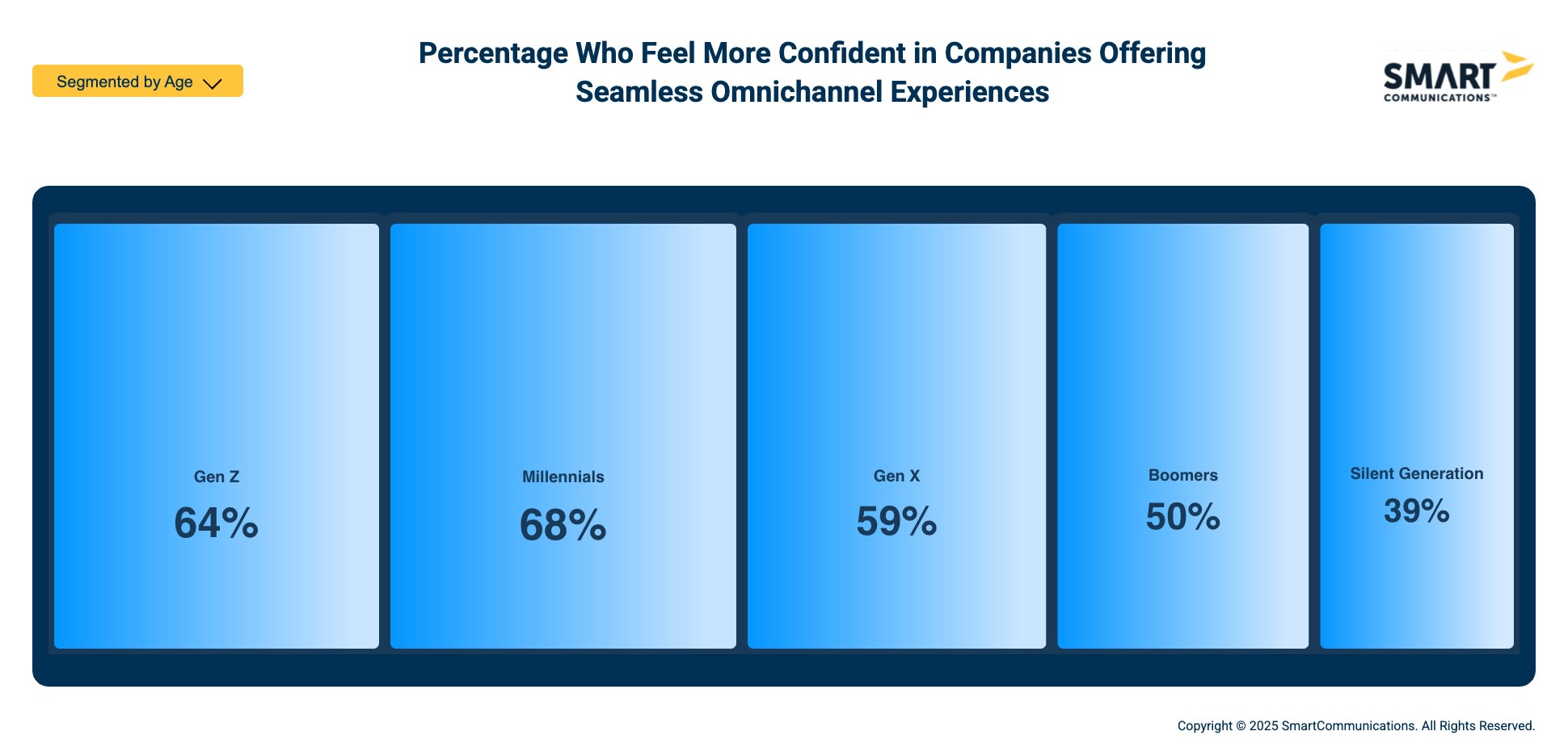
As communication channels have multiplied, customer experiences across them often vary widely—and that’s a costly mistake. Smart Communications’ benchmark research indicates 80% of consumers across financial services, healthcare, and insurance industries say cross-channel consistency is important to their relationship with providers. Specifically, 60% feel more confident in companies when the omnichannel experience is seamless.

Graph: Percentage Who Feel More Confident in Companies Offering Seamless Omnichannel Experiences

This sentiment isn’t just a soft metric—it directly affects the bottom line. According to the study, 67% of customers are likely to switch providers if their communications fall short of expectations. Beyond retention, the quality of the customer experience can fuel business growth: 78% will recommend providers to a friend if communications exceed expectations.

What You Can Do: Review the way communications are generated and delivered across channels. Are there mechanisms in place, from data collection to communication generation to journey orchestration, that ensure communications complement one another rather than confuse or frustrate customers?

3) Many companies are failing to deliver the experience customers want.

Barely half (54%) of customers in 2025 are satisfied with the omnichannel experiences their providers deliver. That’s a notable drop from 60% in 2024, and it should serve as a wake-up call for organizations who are simply pushing messages across multiple channels rather than orchestrating seamless experiences that drive the outcomes customers (and businesses) want.

What You Can Do: Review the customer journey and look for opportunities to enhance the experience, such as:

  • Duplication of content between channels, which can damage your brand reputation
  • Points of frustration that lead to high-cost customer service calls or unnecessary administrative tasks
  • Failure to switch channels for follow-up, which can lower completion rates

Once you’ve pinpointed areas for improvement, map out processes and technologies that can help automate these tasks—or even leverage AI innovations to level up your efforts. With Smart Communications’ SmartPATH™ solution, for example, agentic AI-empowered workflows can gauge customer sentiment during two-way text messaging and adjust interactions in real time. 

Want to take a deeper dive into all things omnichannel? We’ve got you covered—our “Ultimate Guide to Omnichannel Orchestration” provides a comprehensive manual for creating and delivering personalized journeys that keep customers engaged and interactions moving forward. Check it out now.


Frequently Asked Questions

1) Where should companies start if they’re just beginning their omnichannel journey?

Start small by selecting a single workflow or journey to improve, rather than trying to transform everything at once. Focus on automating repetitive tasks, centralizing templates for consistency, and testing how different channels integrate with one another.

This phased approach builds quick wins and creates a strong foundation you can scale—expanding into multiple campaigns or business units and layering in AI decisioning for sentiment analysis and smarter routing across channels. Over time, AI can make it far easier to scale these personalized, automated, and secure experiences across the enterprise—faster and more efficiently than human teams alone could achieve.

2) What role does AI play in improving the omnichannel experience?

AI is rapidly becoming a critical driver of enhancements in the omnichannel experience. Beyond traditional automation—also a key component of omnichannel orchestration—AI can help perceive customer sentiment through various data inputs, independently adapt communications based on customer behavior, and learn continuously from outcomes and feedback. It can also understand natural questions, interpret intent, and determine the most effective response or next step in the journey. By increasing personalization and reacting to customer behaviors at scale, AI is powering the next generation of omnichannel customer experience.

3) How can Smart Communications help organizations improve their omnichannel strategy?

SmartPATH™ brings omnichannel orchestration to the Conversation Cloud™ platform, purpose-built to manage mission-critical, regulated communications across every channel. With intelligent decisioning, AI agent-enabled workflows, and real-time analytics, SmartPATH keeps conversations connected and customers engaged—whether through email, SMS, WhatsApp, RCS, or traditional print failover when digital delivery isn’t possible. (Related reading: “4 Ways SmartPATH Helps Unlock the Power of Omnichannel Orchestration.”)

Its low-code orchestration canvas empowers business users to design and adapt workflows quickly, while enterprise-grade compliance ensures regulatory alignment at every step. By unifying channels, automating manual tasks, and delivering personalized interactions at scale, SmartPATH reduces costs, accelerates digital transformation, and drives more consistent outcomes for customers and enterprises alike.

Check out the video below for a quick primer on SmartPATH:

4 Ways SmartPath Helps Unlock the Power of Omnichannel Orchestration

By Scott Draeger, SVP of Product Marketing and Vertical Solutions at Smart Communications 

Leading organizations look to Enterprise Forms Automation, Customer Communications Management (CCM), and digital archiving technology from Smart Communications to improve data collection experiences, customer communications, and digital storage and retrieval. Critically, enterprises require innovative solutions to build and maintain lasting customer relationships in the most regulated industries.  

With the April launch of SmartPATH™ in North America and the acquisition of Pendula in August, Smart Communications expands the digital delivery and omnichannel orchestration available in Conversation Cloud™.  

In this article, we look at four ways SmartPATH will help your organization prepare for the future by harnessing the power of omnichannel orchestration. 

1. Accelerates Digital Delivery with Omnichannel Capabilities 

SmartCOMM™ and SmartIQ™ clients are accustomed to rapid implementations for customer communications and data collection elements of critical business transactions. Integrating technology often gets trapped in an endless project queue for backlogged IT teams. SmartPATH accelerates projects by adding email, SMS, and other delivery options that move you into production without delay, which is critical in a time when the world moves faster than your IT backlog can handle. 

While SmartPATH’s ability to deliver email and SMS to compresses project timelines, it is also ready to improve your conversion rates, offer self-service options, and impress your executives. SmartPATH launches new SmartIQ and SmartCOMM experiences for your prospects and customers at key moments in key channels. 

Saurabh Raj from QKS Group considers how orchestration allows SmartPATH to bolster customer engagement, “By embedding AI-driven decisioning, channel failover, and guardrail-based automation directly into the Conversation Cloud™, Smart Communications can now move beyond document generation into orchestrated, two-way customer engagement.” 

2. Improves Customer Engagement with Omnichannel Communication 

Improve your conversion rates by incorporating gentle omnichannel nudges that remind prospects to complete an important step in their journey: Invite them to complete their onboarding, answer those extra questions, upload a photo or document, or eSign a document. SmartPATH brings together processes that turn prospects into customers, streamlining processes usually designed, owned, and maintained by multiple teams with separate budgets.   

When your message needs to be delivered, SmartPATH makes sure it reaches the recipient with capabilities like omnichannel channel failover, multichannel delivery, and fail to print. If a customer doesn’t respond to their preferred channel, SmartPATH fails over to the next best channel, until the message is delivered.

As a part of the Conversation Cloud, SmartPATH listens as well as it delivers, allowing for interactive responses that improve self-service adoption and reduce customer effort. This omnichannel approach ensures customers are continually engaged, boosting the likelihood they’ll follow through on critical actions across different channels.

Omdia’s Mila D’Antonio posted about the acquisition of Pendula, “This isn’t just about adding features — it’s about enabling enterprises to move from ‘multichannel’ to truly agentic, outcome-driven engagement at scale.” 

3. Streamlines Onboarding and Data Collection 

SmartIQ™ users typically start a process with an email, SMS message, or a link. Now, SmartPATH kicks off SmartIQ processes at scale that invite clients via SMS or mobile communications. With SmartIQ’s device–agnostic experiences, SmartPATH invites them to complete the experience on their preferred channel, leveraging SmartIQ’s multibrand feature to deliver responsive experiences.

SmartPATH not only helps streamline onboarding but also enhances the data collection process. By reaching customers on their preferred devices and channels, the process becomes faster and more efficient, improving both customer satisfaction and data accuracy. If a customer abandons an experience, SmartPATH is there to get them back on their journey with specific reminders to reengage, provide the necessary information, and complete the transaction.

Aragon Research’s Jim Lundy sees SmartPATH as, “The race to automate customer communications has taken on a new sense of urgency in the AI era. Smart Communications acquisition of Pendula provides an enhanced set of omni-channel capabilities, including the addition of Agentic AI Agents which will help teams be more productive.”

4. Enables Seamless Handoff Across Omnichannel Touchpoints 

Many SmartCOMM™ clients are rapidly executing digital transformations, delivering expertly–designed omnichannel customer communications while reducing the complexity, coordination, and expense required to create better experiences. SmartPATH can either leverage your email and SMS gateway or supply key services to bring digital delivery, omnichannel failover, and multichannel communications to the CCM workflow.

Organizations with advanced digital transformations often use SmartIQ early in customer journeys to streamline onboarding and data collection experiences required to convert prospects to customers while collecting information completely and accurately. Later in the customer journey, they use SmartCOMM to deliver omnichannel customer communications to welcome the client, deliver critical communications, and secure renewals.  

As part of the SmartPATH journey orchestration, clients can even leverage Smart Communications’ digital archiving solution, SmartHUB™, to store these communications—and instantly retrieve them down the line to reduce customer interaction times and improve satisfaction.

Kaspar Roos, founder of Aspire CCS, sees how SmartPATH elevates experiences throughout the customer lifecycle, “Smart Communications can accelerate beyond static document generation to deliver conversational customer experiences that enable real-time, intelligent engagement throughout the entire customer lifecycle.” 
 
SmartPATH connects these experiences to ensure that your internal handoffs go unnoticed by your customers through smooth integration, scalable omnichannel designs, and easy connections within the Conversation Cloud.  

Learn more about how SmartPATH brings digital delivery to your SmartIQ and SmartCOMM applications.