Solutions

Archive and retrieve communications securely with cloud-native speed.

Orchestrate real-time, compliant interactions across every channel.

Simplify and standardize trade and relationship documentation workflows.

Industries

Improve customer engagement across policy, billing, and claims.

Create and deliver personalized, compliant customer communications at scale.

Heighten citizen experience with digital transformation.

Improve customer engagement across utilities.

Resources

Browse popular market research, articles, videos, written guides and more in one convenient location.

Explore upcoming events, webinars, and customer experiences shaping the future of customer conversations.

Get the latest updates on Smart Communications, including product news, and industry recognition.

Company

Learn more about our company, our leadership and how were growing the team!

Analysts

Analysts

Access analyst research, market reports, and industry recognitions featuring Smart Communications.

Situations Change, So Too Must Your Processes


By: Nick Smith, VP Sales & General Manager, APAC at Smart Communications

In the digital era, there’s no shortage of data. Most organizations in both the private and public sectors have an abundance of it—in fact, many have more than they know what to do with. According to a recent survey, 55% of data that companies collect goes unused.1


Not just data, insights

Getting the most out of your data starts with how you collect it. While many organizations have moved away from relying solely on outdated paper-based processes, simply becoming more digital-first doesn’t necessarily mean you’re making the most of the process. Static forms and generic questions only provide point-in-time snapshots of the people submitting them. While this information is useful at that moment, its value is limited because that data soon becomes outdated. In order to gain more valuable insight organizations need to transform one-way intake processes into two-way conversations.

Agility in action

Most organizations collect at the outset of the relationship, but many fail to continually update the information they have on file. However, needs and preferences change every day, and companies need to stay one step ahead in order to stay relevant. For government organizations, educational institutions, and healthcare companies, it’s even more vital to have data that’s current, which means users need an easy way to update their information.

This recently came into play for the Australian National University (ANU). With 25,000 students, approximately one-third of them international students, the onset of the COVID-19 crisis called for immediate action. The University needed to quickly gather important circumstantial information that would help them provide vital support as well as minimize the potential health impact on their community. ANU formed a crisis management team and, using SmartIQ, very quickly distributed a smart form to all international students to inquire about recent travels and what support they would need in order to stay safely engaged with their learning community.

And when it became clear to ANU that a broader lockdown would be put in place, they expanded the process to include all students, with the goal of enabling targeted communications and support based on immediate needs—from health status and access to groceries for anyone self-isolating, to housing needs and access to the internet and online learning materials.

The University recognized that student needs were likely to change just as the situation was evolving. ANU students were able to return to the smart form and update their answers as circumstances changed—for example, once they completed a self-isolation period, when they reached their destination, or when their access to the internet changed.  Especially in a time of rapid change and increasing uncertainty, it is vital for respondents to be able to update their information as needed.

Better insights, better outcomes

While we have known for some time that digital transformation and more customer-centric processes were necessary, the events of this year have significantly increased the need for organizations to find better ways to collect information and use that information to deliver exceptional experiences throughout the relationship. The forms process of the past must be transformed into adaptive, intelligent conversations that allow for flexibility and deeper insight. And they must be digital-first, mobile-friendly and frictionless.

Ideally, the lessons learned in 2020 will continue well beyond the return to the new normal.  When you get to know people better, you’re able to serve them better. And transforming static processes into interactive, two-way conversations at scale, is an excellent way to start.


  1. Priceonomics, 2019: “Companies Collect a Lot of Data, But How Much Do they Actually Use?”

Having SMARTER Customer Conversations Requires Forms Transformation


By James Brown, CEO of Smart Communications

It was less than one year ago that we announced we had acquired Intelledox. We knew at that time that this decision would allow us to empower our customers to deliver the smartest, most interactive communications possible, throughout the entire customer lifecycle—from acquisition to servicing, and every interaction in between. Today, we are making that vision a reality for companies that want to bring to their customers a customer-centric, digital-first experience that is truly rewarding. To do this most effectively required a deepening of the integration between the forms transformation capabilities that Intelledox was already delivering to the market and the next-generation customer communications management capabilities made possible by SmartCOMM.

The result?  Intelledox is now SmartIQ, a key component of our customer conversations management platform. The timing of this important shift is critical. To be successful today organizations must become more digital-first and engage their customers in dynamic conversations. To achieve this, they must first more effectively collect customer information and then use that information to respond appropriately, quickly and via preferred channels. If interactions are still paper-based and static, enterprises risk creating a significant gap between what customers expect and what is being delivered. This starts from the very beginning of the customer relationship and remains critical throughout every stage of the lifecycle.

To evaluate the experience they are delivering, companies need to ask themselves a few very important questions:

  • Are all of your forms online (and preferably mobile-friendly), or are you still requiring paper or scanned PDFs you then have to extract?
  • Can you be sure customers are using the most recent version of the form?
  • Are the fields pre-populated with what you already know, so the individual only needs to confirm data rather than rekey it in?
  • Do you know your NIGO (Not In Good Order) rates of incomplete or inaccurate submissions?
  • Are you asking only relevant questions? (For example, do you ask single customers to enter information about their spouse? Do you ask people in different states or countries the same compliance questions?)
  • How much time does it take your internal IT team to launch new forms or make changes to existing ones?
  • Do you allow for users to start in one device and finish on another, even allowing that to take place offline?
  • What happens when you receive a returned form?
  • Is manual work required to rekey information introducing the risk of human error and taking time away from valuable employees?
  • What’s the risk you’re creating if you are not building an interactive, digital conversation with your customers today?

Your answers to these questions might reveal that your processes are tedious, time consuming, outdated and not customer-centric. Today’s consumers prefer instant gratification.

How do you deliver that? We would propose that the form of the future isn’t really a form at all.

Forms transformation needs to be a top priority as companies focus on digital transformation. Companies must embrace the concept of adaptive interviews, that turn forms into intuitive, guided journeys that are contextually aware based on the customer’s personal preference, device and location. In an adaptive interview, you ask intelligent questions based on known data and new responses. This eliminates unnecessary fields and the need to enter and re-enter information into a static form. Ideally, customers should be able to easily submit information, track their progress and quickly pick up where they left off. Furthermore, companies must also understand that at some point in the process the customer will likely be using a mobile device and the experience must reflect that and be able to adapt accordingly. Now is the time to transform processes and shift to more adaptive interview-like processes. This improves customer experience and speeds up the business process.

So much has happened in the last year. Not just for our company, but for the entire world. At a time when delivering digital-first customer interactions is more important than ever, cloud-based technologies, like SmartIQ, allow companies to be agile and empowered to respond to rapid change while also keeping their customer relationships front and center. When companies recognize the need to digitally transform in order to meet or exceed customer expectations, the benefits to the customer are tremendous and so too is the impact on the bottom line. We are thrilled to be able to enable our customers to achieve all of this and more. Let us know if we can tell you more about how we do that.

From Legacy to Flexibility: 3 Benefits of a Cloud-based Customer Communications Management Platform


By Chris Murphy, Senior Director of Product Marketing at Smart Communications

Digital transformation is obviously a key priority for nearly all strategic leaders today, but companies have been experimenting with new digital ways of conducting business for decades. Yet, its importance has never been so keenly felt. Even well before COVID-19 IDC predicted that 80 percent of revenue growth by 2022 will depend on digital offerings and operations. However, when it comes to customer communications, many companies are still using a combination of business intelligence applications, home-grown document processors, and manual document templates to manage their customer communications.

The reality is that these legacy architectures can no longer keep up with the demands of modern communication due to poor integrations with core systems, costly maintenance, and time-consuming production processes. Not to mention, these outdated systems make it extremely difficult to provide consistent and timely messaging – which is key to meeting customer experience expectations. Here are three key benefits of breaking free of the status quo:

Organizational Agility

One of the key benefits to moving from an outdated legacy system is building an organization’s ability to be agile – increasing both the speed and the efficiency in being able to respond to changes. Whether organizations are looking to adapt to changing market dynamics, launch new products, reach new market segments, scale up agile teams with new services for their customer-base, or incorporate a newly acquired business into their existing infrastructure, having the ability to design, integrate, test, launch and ultimately maintain supporting communication services with minimal friction is paramount.

The use of in-house document creators, ad-hoc word templates, and the reliance on business intelligence applications to locate data and populate forms are all blockers to being able to promote agility and speed in your organization. We’ve seen several instances where organizations can drastically decrease the number of labor hours required to make template edits once transitioning to a modern customer communications management (CCM) platform. A more streamlined and efficient template process allows IT staff to work on more pressing business objectives. Shifting template changes to line-of-business workers allows everyone to focus on what they do best. In fact, Smart Communications helped one customer reduce their number of templates from 1700 to 300, a reduction of around 82 percent!

 Cost Savings

With the ability to engage customers via digital channels and offer on-demand access to important relationship documents, companies can reduce the reliance on sending this information via standard mail. According to recent findings from our Forrester TEI Report, companies can expect a 25 percent reduction in annual paper and postage spend by simply shifting communications to electronic forms.

Additionally, the cost of maintaining an on-premise solution can add up significantly. Depending on the number of environments, companies typically require at least one full time employee, if not more, that is solely dedicated to maintenance and upgrades. Not to mention the hardware and support costs that coincide.  By transitioning to a digital-first CCM solution, future updates and necessary upgrades are performed in the cloud, which means that budget that was typically associated with labor and maintenance costs can now be allocated to other areas – like digital transformation initiatives.

 Improved Brand Recognition

With the reliance of business users having to create their own templates, on-premise systems typically prohibit a consistent branding environment. Without a system that centralizes various logo files, fonts and formatting, there’s a lot of room for messaging and branding errors. Modern CCM platforms empower organizations with clearly defined enterprise-level customer communication standards that need to be adhered to across the business. They eliminate the usage of ad-hoc templates historically used by individual agents or business users. Organizations can appreciate a consistent look and feel across all its customer communications touchpoints and channels – which ultimately improves brand recognition.

Need further convincing? Moving to a cloud-based and digital-first CCM solution won’t only empower a more rewarding customer experience, but also provides material financial benefits, including a three-year risk-adjusted ROI of 139 percent and payback in less than six months. Download The Total Economic Impact™ of Smart Communications and learn how one customer experienced these benefits firsthand.

How to Deliver “High-Touch” Digital Experiences in Wealth Management


By Neal Keene, Field CTO at Smart Communications

Financial services firms, particularly those in wealth management, pride themselves on providing “high-touch” digital experience services to clients.  Agents and advisors often meet customers in person, and then spend hours understanding their needs, family relationships and goals, before working to create customized plans. Building a long-lasting relationship based on trust is key to success and certainly requires a personal touch.

However, times are changing, as is the understanding of what a personal touch really means. Customers’ communications preferences had already begun to drastically change and shift more toward digital before COVID-19 ever entered the picture. As revealed in a recent report from analyst firm Aite Group and Refinitiv, 86 percent of wealth managers consider adoption of digital-servicing capabilities as highly important, with 46 percent only partly or not satisfied at all with their current digital experience.

But in the past few months, the need to “digitalize to personalize” became an understatement. Social distancing and stay-at-home orders made it difficult, if not impossible, to meet face-to-face to conduct business. However, customers never stopped needing advice. In fact, in some ways it seems that agents and advisors are busier than ever, struggling to adjust to working from home while also finding new ways to communicate with customers.

The good news is, the shift toward digital experiences doesn’t have to compete with or diminish the personal relationships you have with your clients, it should complement them!

Better leveraging digital experiences allows firms to connect with customers anytime, anywhere on their preferred digital channels— including text, email, and even digital assistants like Alexa or Siri. And even more importantly, lets them seamlessly move between channels as it suits them. To achieve this level of digital transformation, firms should explore which customer touchpoints would be best suited for digital delivery, ideally those that can be quickly tested. A good place to start is to look for processes that rely on printed communications (e.g. customer service correspondence) or fillable forms and prioritize those for digital delivery.

Because evolving to become more digital-focused provides agility and scalability, incorporating this approach into a customer communications strategy also helps firms operate more efficiently and be better prepared for whatever the future holds. Advisors and agents with digital-first firms will be more productive and responsive to individual customer needs by using more modern communication tools. Not only does this allow for more timely updates to content as rules and regulations change but also leads to more personalized communications that still adhere to compliance standards.

Moving to a digital-first communications approach doesn’t mean that you lose personal connections with clients.  In many ways the connection can become even more personal as you begin to interact with them on their terms, via their preferred channels—anytime and anywhere.

For more tips on ways to achieve digital agility in the Age of COVID-19, check out my recent post.

How Insurance Companies Can Thrive in the New Normal


By: Larry Hogan, Account Executive at Smart Communications

So far in 2020, insurers have had to find unique ways to quickly respond and adapt to a unprecedented level of disruption. The good news is, depending on the approach, 2020 also brought an unexpected opportunity for insurers to be champions for digital change – setting an example for how digital transformation should be embraced when we settle into a new normal.

Here are a few common challenges facing insurance companies today, and how adopting a digital-first approach to communications will help insurers become more resilient.

Claims Volume Fluctuations
Depending on the area of insurance that you’re in, claims volumes have likely either significantly increased or decreased in recent months. For P&C insurers, as more people are required to work from home and vacation plans have been altered, the number of traffic accidents are dropping. Fewer accidents means fewer claims. While some P&C insurance carriers have made some progress toward digital transformation, when it comes to automation, much of the industry is still heavily reliant on manual processing and in-person interactions. The good news is, reduced claims volume provides an opportunity for P&C insurers to find new ways to connect with customers. Consumer Federation of America recently reported that 80 percent of American auto insurers have announced that they will refund or credit drivers more than $6.5 billion over the next two months. Touchpoints like this are great opportunities to keep customers engaged and loyal – so it’s important that your business is digitally equipped to deliver these types of communications quickly and efficiently.

On the contrary, health insurance companies have seen a significant increase in claims that need to be processed quickly. Life insurance companies have also experienced an increased demand for policy applications and new account openings.  Fabric, a provider of instant online life insurance says it has seen a 50 percent increase in life insurance applications since mid-February. Similarly, LifeQuotes, a national online life insurance agency, reports a 29 percent increase in applications requested since January 20. One way to adjust for a volume overload is to leverage a modern claims automation solution, which provides faster cycle times, increases employee productivity and ultimately yields higher customer satisfaction.

In both cases, either an increase in claims submissions or a decrease in claims submissions, insurers have been reminded of the importance of being a trusted resource to their customers all the time. It’s crucial to process claims quickly and effectively, but it’s also just as critical to the long-term relationship to maintain open lines of communications in between key milestones as well.

Call Center Overload
During a time of uncertainty, it’s easy to understand why customers would have more questions that usual and might want to seek out customer service representatives for assurance. Many insurance companies are seeing surges in operational volume with new claims being filed, general coverage and billing questions, and response to government mandated actions or new programs – the list goes on. As a result, insurance companies have experienced a spike in call center volume as individuals seek out immediate responses. If customers can’t reach you by phone due to high volumes and can no longer participate in the insurance processes that rely on face-to-face or paper-based transactions, you run the risk of losing the trust and personal touch that keeps customers loyal.

To ensure a consistent level of service during peak times, insurers have no choice but to rely on digital channels to communicate with their policyholders. With reduced mail and print processing and the delays that physical communications can be subject to, there’s a significant need to be able to process applications and correspondence faster. These challenges have forced those who lag behind in digital to catch up. According to VentureBeat, some companies are positioning AI as a solution to service gaps. While the use of AI and automation has been top-of-mind for many forward-thinking companies, most insurance companies still lack the digital tools and platforms needed to meet today’s on-demand customer expectations. Insurers should use this time as an opportunity to explore automated solutions, like chatbots, self-service portals, and mobile apps, which provide new communication channels that enable policyholders to engage in two-way conversations. These types of digital-first communication methods lead to smarter conversations and more consistent interactions throughout the entire customer lifecycle.

Finding the Solution Through Digital-first Communications
As customers become used to digital interactions as the new norm, there will be a changing level of expectation in how they are communicated with from now on. Life will not go back to normal – there will be a new level of expectation around digital-first communications. This is actually some much-needed good news. The changes made now will last long into the future– providing customers the digital-first experience they’ve been desiring can be achieved by embracing a modern cloud-based solution.

Are you ready to engage in SMARTER digital conversations with your customers? Connect with us today and we’ll show you how we can help.

The Path Toward Easy, Pain-Free Contract Negotiations


By Sienna Quirk, Senior Director, Product Marketing at Smart Communications

A contract is often the beginning of a formal relationship between your company and its suppliers, partners and most importantly – your customers. Whether that contract is a quote, proposal, SOW, or a more complex contractual agreement, they all bond you with your customers. The experience during the contract negotiation process can set the tone for the rest of your relationship so making sure that process as easy and pain-free as possible can benefit all parties involved.

Are Contract Negotiations Holding You Back?

As digital transformation and improved customer experience are increasingly recognized as a focus for enterprises across the globe, has your company taken the time to think about how to best apply these throughout all your business, including your contract negotiation process?

Think about your existing process from a customer viewpoint – is your contract process cumbersome and challenging? If so, this could leave the impression that your company may be viewed as difficult to do business with, which is a less than ideal way to start the relationship.  With one in three customers willing to leave a brand they love after just one bad experience, you can’t risk leaving your contracting process up to chance.  That is why Gartner says that by the end of 2019, more than 50 percent of organizations will redirect their investments to customer experience innovations.

It’s Time to Optimize Your Process

So how do you make the contract negotiation process less painful for all parties involved? One way is to automate, or digitally transform, your own internal contract process. An outdated contract negotiation process can result in frustration, causing internal struggles between departments. The last thing you want is a customer to have a poor experience before they’ve even begun a formal relationship with your company.  The first step in improving contract negotiations with your customers is to look at how you can improve your internal operations. Optimize your own internal process first, and you’ll be well-positioned to speed up your negotiation and sales cycles, reduce cross-departmental friction, and drastically improve the contract negotiation process for your team and your customers.

When your company can address contracts more effectively everyone wins, and your customers reap the benefits! Smart Communications customers see real results digitalizing and streamlining their contract process, including one who saw a 98 percent reduction in the time to generate a contract.

Optimizing your internal operations doesn’t have to be a daunting process, and it may be easier than you think. Learn more about how to optimize and speed up contract negotiations in our latest whitepaper: Speed Up Contract Negotiations in Salesforce in Five Easy Steps.

Embracing the Future of Customer Communications Management Today


By Chris Murphy, Senior Director of Product Marketing at Smart Communications

The customer communications management (CCM) industry has been around for some time. Born out of a need for companies to be able to produce compliant, yet highly personalized communications, enterprises invested in platforms that allowed them to produce mission-critical business and customer communications at massive scale.  

Yet, despite its extensive and tenured history and the disruption caused by industry consolidation, innovation is still alive in the CCM space. During a recent webinar, Craig LeClair, vice president and principal analyst of Forrester Research, painted a vision for where the industry is moving and where vendors who support customer communications will need to shift focus in order to realize success for the modern customer. With movement to the cloud, eDelivery promotion across digital channels, and customer experience improvements, the future of SMARTer customer communications is looking bright. 

Communication Types Require Specialty Focus Areas  

Craig adeptly broke down the types of customer communication management areas of focus, and the different business use cases that each are well-designed to meet.  

  • Structured offerings are largely on-premise and are ultimately designed to handle high-volume print outputs.  
  • Interactive offerings allow for deeper personalization and afford high-levels of business user control in order to customize the type, channel, and content of the communication.  
  • Cloud-based offerings, often delivered via hybrid-cloud or in a true multi-tenant fashion, signify a future where they can interact with cloud-based analytics services to gain an understanding of the customer’s true intent and to then seamlessly choose from an array of dynamic templates in order to deliver the right content.  

Movement to the Cloud 

One of the key trends mentioned in the webinar was the movement of CCM vendors to the cloud. This pivotal shift will allow CCM to begin to play a much more integrated role in the wider technology ecosystem and can be more easily informed by analytics from other technologies will be predominantly cloud-based in the future. The modern customer is not predictable, nor linear in the methods and channels that they engage with you through. The ability to consume information from these third-party analytics systems will allow CCM vendors to hone in on what the customer is ultimately trying to achieve, and how to get them there with hyper-focused communications. Ultimately CCM vendors will adopt a Communications-as-a-Service (CaaS) strategy, where a callable infrastructure is used to generate and initiate communications based on real-time customer actions as well as triggers from third-party systems.  

Communication Trends are Changing………Toward the Customer 

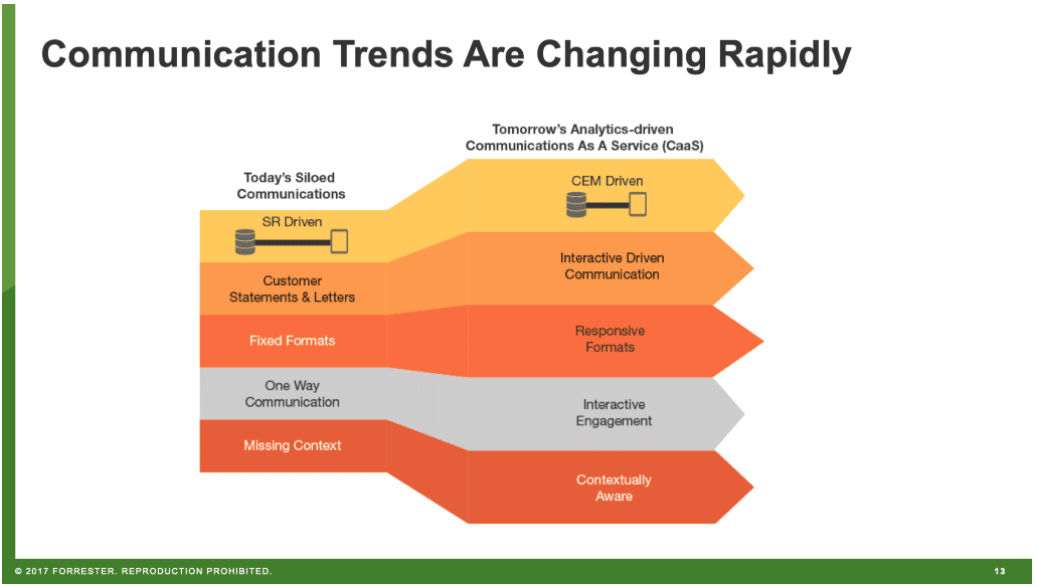
Communications trends are changing from a siloed, line-of-business run approach to one that is much more centralized and has the customer firmly in the center. There has been a movement from focusing on the template approach driven by systems of record to reimagining how these communications are received – and perceived – by the end customer.  

customer communications management

Image courtesy of Forrester Research.


With an emphasis on interactivity, responsiveness, engagement, and contextual understanding, the future of communications will be analytics-based and incorporate digital communications. 

The Critical Impact of Language 

“You say tomato, I say tomahto.” While we’re all familiar with the song, I think that we can agree that this approach just doesn’t work in print. Similarly, much of the language used in current communications often fails to articulate the core message we’re trying to portray to our customers and makes it difficult to understand the meaning, definitions and ultimately next steps. As a result of overly stringent legal input into the language used in these communications, what often ends up protecting the company can also end up confusing the end recipient. There is a growing trend to begin to use shared language libraries made up of definitions and shared content that is easily understood and leveraged across a variety of communications.  

Key Areas to Look for When Building Next-Gen CCM 

While everything should be driven by core business requirements, there is an energetic movement of CCM vendors to the cloud. As a result, Craig cautioned against falling into the trap of assuming managed services are the same as true cloud-based solutions. 

In Craig’s words, “You want to look for a cloud-ready solution. You want something that has proven multi-tenancy, that has browser and thin-based clients, and a good set of APIs that can work to get to on-premise information. Look for an architecture that has a more generic type of format as core content to make it easy to switch from one channel to another.” 

Future Innovations Driving CCM and Customer Experience Innovation 

The growing interest in customer journey mapping and Design Thinking will firmly move the focus towards a customer-centric point of view and this will be the driver for the next generation of communications. The combination of core system data with a customer’s behavioral activity will represent the foundation of machine-readable content to which machine learning can be applied to analyze, learn and ultimately predict the most optimized communication, content and even channel to engage through.  

As customer experience (CX) becomes a source of competitive advantage for more companies, customer communications – both the communications that you share with them as well as the opportunities that you provide for them to communicate with you – will continue to play a crucial role in the creation of those experiences.  

To listen to a complimentary recording of this webinar, please visit the following page. 

The Cloud Is Now: Why 2019 Is the Year to Go Cloud-First

AWS cloud


By Simon Tindal, CTO of Smart Communications

It’s no surprise that a growing number of today’s organizations are implementing a cloud-first strategy as they shift their spending away from servers, and other on-premise, legacy systems and technologies. In fact, Gartner predicts that 28% of spending within key enterprise IT markets will shift to the cloud by 2022, up from 19% in 2018. Furthermore, Forbes recently released the State of Enterprise Cloud Computing which revealed that 77% of enterprises currently have at least one application, or a portion of their computing infrastructure, in the cloud. With the public cloud services market projected 17.3% percent growth, totaling $206.2 billion in 2019, it’s clear that a cloud-first approach is no longer just an option – it’s becoming a necessity for organizations to scale.

As cloud becomes widely adopted, it will begin to influence even greater portions of enterprise IT decisions as organizations aim to improve their system infrastructures. We’ve already touched on how moving to the cloud can lead to more personalized and impactful customer conversations, but there are even more reasons migrating to the cloud should be at the top of your to-do list in 2019.

Overcoming the Fear of Digital Disruption

These days, “digital disruption” is no longer a concern for the future, it’s a reality NOW! Whether it’s a fear of migration, a need to adhere to strict compliance regulations, stringent privacy issues, or geographic barriers, every organization is experiencing their own set challenges, regardless of the stage of digital transformation they are in.

Knowing Your Options

The good news is, there are several cloud deployment options designed to fit your unique business needs. Here’s a quick overview of the three main cloud deployment models that could transform your business:

  • Public Cloud: Public Cloud services are offered by third-party providers over the public internet, meaning they are available to anyone willing to purchase them. Amazon Web Services (AWS), Microsoft Azure, IBM Cloud and Google Cloud platforms are some of the more well-known public cloud providers.
  • Private Cloud: A private cloud model is a single-tenant environment where the hardware, storage and network are purchased and provisioned for a single client or company.
  • Hybrid Cloud: One of the more popular deployment models, the hybrid cloud uses a combination of public/private cloud with on-premise services.

Why We’re Running With AWS

Earlier this year, we announced our plans to support SmartCOMMTM, and SmartCOMMTM for Salesforce solutions on the AWS to provide additional deployment flexibility to our already available cloud and hybrid-cloud options. Running on the AWS infrastructure adds yet another layer of innovation to our platform and additional deployment flexibility. In addition to receiving amazing benefits including elastic scalability, and improved efficiency, our customers are better positioned to be at the forefront of digital transformation within their respective industries.

As demand has increased for our technology to support AWS across APAC and EMEA, as well as in the US and UK. AWS is a mature, globally-enabled secure environment – enterprises can trust that it will continue to enable them to scale as their needs and volumes evolve over time.

To learn more about our latest AWS announcements, visit our resources page or click here.