Solutions

Archive and retrieve communications securely with cloud-native speed.

Orchestrate real-time, compliant interactions across every channel.

Simplify and standardize trade and relationship documentation workflows.

Industries

Improve customer engagement across policy, billing, and claims.

Create and deliver personalized, compliant customer communications at scale.

Heighten citizen experience with digital transformation.

Improve customer engagement across utilities.

Resources

Browse popular market research, articles, videos, written guides and more in one convenient location.

Explore upcoming events, webinars, and customer experiences shaping the future of customer conversations.

Get the latest updates on Smart Communications, including product news, and industry recognition.

Company

Learn more about our company, our leadership and how were growing the team!

Analysts

Analysts

Access analyst research, market reports, and industry recognitions featuring Smart Communications.

Beyond Integration: How to Achieve CCM Consolidation for Operational Success

By Chris Murphy, VP of Product Marketing at Smart Communications 

It’s a typical Monday morning, and you’re gearing up for a new project at the office. The company’s call center phone number is changing, and you’ve been tasked to track down every instance of its existence across all communication technologies, both physical and digital. As you dive into the maze of legacy systems and diverse communication channels, it becomes evident that this won’t be a quick fix; it’ll end up being an initiative that will unfold over the coming weeks and months.

Now, imagine all customer communications are managed – regardless of delivery channel – by one centralized system, allowing you to make those changes in just a few mouse clicks and with the right controls in place to fully understand each instance of where the phone number is used and any dependencies from a single location. With the ease and speed with which you can make these updates, you’ll enhance the customer experience and reduce risks for the company. This might be like scenarios that you’ve experienced in the past, especially when you consider how businesses are ever mindful of increased regulations and improving operational efficiency but can’t quite figure out how to reach those goals with their current legacy customer communications management (CCM) systems.

In this article, we’ll shed light on the downsides of managing customer communications across multiple systems and the benefits of CCM consolidation. First, let’s look at what CCM consolidation means.

What is CCM Consolidation?

CCM consolidation involves unifying disparate customer communication processes and tools into one streamlined, enterprise-grade CCM solution. CCM is the linchpin of meaningful customer interactions, and operational efficiency. Many large organizations have acquired channel-specific tools and solutions for managing customer communications over many years. This approach to creating, delivering, and managing customer communications has proven to be a waste of resources and money, often requiring manual upgrades and maintenance from already stretched departments.  

As organizations adopt cloud-based solutions to stay agile and responsive, integrating CCM becomes key to maintaining a unified and effective communication strategy, reducing costs, and increasing efficiency.  

The Top 5 Benefits of CCM Consolidation

Here are five benefits to consolidating your customer communications management systems. 

1. Enhanced Optimization & Efficiency 
Organizations today need to do more with less. CCM consolidation serves as the catalyst for optimizing and streamlining communication processes and driving operational efficiency. By centralizing tools and processes, businesses can reduce redundancies, eliminate silos, and operate with peak efficiency, ultimately delivering a more responsive and agile customer experience. 

2. Attract the Right Talent 
Candidates in the market who possess the necessary skills to manage and maintain legacy applications is becoming more difficult. In fact, a report from Aspire asserted that 25% of employees with some level of communications responsibility overwhelmingly cite outdated technology as the primary driver behind their efforts to seek new employment. Modern, user-friendly solutions will help your business attract and retain top talent who have the skills to focus on more innovative projects that help your company grow into a future-ready brand. 

3. Cost Reduction  
Beyond operational efficiency, CCM consolidation brings substantial financial benefits by eliminating the ongoing maintenance costs of having multiple CCM solutions. As we touched on in the point above, doing away with aging platforms means you won’t need to sift through a diminishing group of skilled resources to find someone who knows how to make manual upgrades and/or perform maintenance on legacy systems.  

Furthermore, a consolidated approach not only enhances compliance but also reduces the costs associated with managing disparate systems. It’s a strategic move that aligns financial prudence with operational excellence. 

4. Improved Customer Experience 
In a world where customer experience reigns supreme, a unified and consistent approach is paramount. CCM consolidation plays a pivotal role in crafting a seamless and engaging digital communication experience for customers. By ensuring consistency across all touchpoints, businesses can elevate customer satisfaction, loyalty, and glean invaluable insights for continuous improvement. 

5. Empowered Digital Transformation 
Digital transformation is no longer a buzzword but a strategic imperative for businesses. CCM consolidation emerges as a linchpin in aligning with broader digital transformation goals. By integrating seamlessly into a single, modern CCM solution, your business can focus on what any modern business needs to do: enhance agility, adapt to shifting consumer demands, launch new products and services, add new channels, and integrate with key technologies. 

What’s Your Stake in CCM Consolidation?

Depending on your job role, the stake you place in CCM consolidation and its importance in achieving business priorities/goals, may vary. We’ve taken this into account and compiled job function insights below: 

IT Decision Makers
In this role, the weight of strategic technology decisions rests on your shoulders. The alignment of infrastructure with consolidated CCM platforms is more than just a cornerstone—it’s the bedrock of your responsibilities. Consolidation ensures not only the robustness of your technological backbone, it also gears it towards maintaining a tech-savvy and customer-centric environment. Integrating and streamlining communication systems helps you empower your team to navigate the digital landscape with agility, fostering an environment where technology is not just a tool but a strategic asset. 

Customer Experience Executives 
As a Customer Experience Executive, orchestrating an exceptional care plan and customer journey is your mission. With consolidated communication platforms, you can ensure that every communication touchpoint contributes to a cohesive narrative, elevating customer satisfaction and loyalty. Your pursuit of excellence in CX finds its perfect partner in CCM consolidation. 

Digital Transformation Leads 
If you’re at the helm of digital transformation initiatives, you undoubtedly recognize the pivotal role of CCM consolidation in shaping the future. Making CCM consolidation a big part of your strategic digital plans is super important for accomplishing a transformation. When you blend consolidation into your existing projects, you’re setting your company up to not just keep up with tech changes, but to use them for long-term success. 

Operational Heads 
Operational efficiency is your domain, and as a leader in this space, CCM consolidation will help you enhance processes across the business. It’s more than streamlining communication processes; it’s about enhancing workflow management and contributing to overall operational efficiency. Consolidating your communication platforms will lead to cost-effectiveness and a more efficient, responsive operational landscape. 

Line of Business Users 
Line of Business Users need the ability to take ownership over certain aspects of customer communications. As subject matter experts, they understand the impact of being able to make changes quickly and without the reliance on IT. This is made possible by consolidating to a cloud based CCM solution that empowers users to make updates easily and efficiently. 

Recognizing and addressing these challenges is not just a hurdle; it’s a strategic maneuver towards ensuring a successful implementation. It’s a proactive stance that prepares you for the process of CCM consolidation. 

Conclusion 

In short, CCM consolidation streamlines operations, amplifies customer engagement, and ensures a future-ready approach to communication.  

As your business stands at the crossroads of digital evolution, the call to action is clear: embrace CCM consolidation to achieve operational efficiency and elevated customer experiences.  

If you’re ready to take the first step into a transformative journey, visit our CCM consolidation webpage to learn more. Or, get in touch with one of our experts today to begin the process of seamless CCM migration.

What is Interaction Experience Management (IXM) For Insurance?

By Eileen Potter, VP of Insurance Marketing at Smart Communications 

Today’s customers demand more than just efficient policy management and claims processing—they seek a seamless, personalized experience at every touchpoint. As insurers strive to meet these new standards, the focus is shifting towards creating interactions that are easy to understand and enable prospects and policyholders to conduct business with them at their convenience.  This is where Interaction Experience Management (IXM) for insurance comes into play.

IXM represents a transformative approach to managing customer interactions, leveraging advanced technologies to turn traditional, often cumbersome processes into streamlined, engaging conversations. For insurance companies, IXM is not just about enhancing communication; it’s about redefining how they connect with customers throughout the entire lifecycle. 

Watch the video, ‘IXM and Insurance’ to hear more about this topic from Aspire’s Senior Research Analyst, Will Morgan.  

What is IXM?

Interaction Experience Management (IXM) is an emerging segment of technology that focuses on optimizing customer interactions across various channels. Unlike traditional methods, which often rely on static, paper-based forms or fragmented digital solutions, IXM enables dynamic, two-way communications. This approach ensures that customer data collection and management are both efficient and personalized, driving a more cohesive customer experience. 

Industry experts, including Aspire CCS and IDC, highlight that while many insurers have made strides in customer communications, they often overlook the critical need to modernize their forms processes. The result? Operational inefficiencies, missed opportunities for personalization, and a disjointed customer experience. Our own Benchmark study found that 67% of insurance customers are likely to end an interactions with a company if the way they collect information is too difficult — up from 54% in 2023. 

Why IXM Matters Now  

The insurance sector is witnessing a significant shift in customer expectations. Customers now expect interactions to be as seamless and efficient as those they experience with leading digital platforms like Netflix and Amazon. They want fast, personalized, and convenient interactions across their preferred channels. 

Our Benchmark research also indicated that 83% of customers value a mobile or web-friendly experience when completing forms. This shift underscores the need for insurers to move beyond outdated, manual processes and embrace technologies that facilitate smooth, interactive experiences.  

The unfortunate reality is that many insurers still gather and store customer data on multiple disconnected point solutions, forcing them to navigate the complexity of regulations across a web of different business units, systems, and channels. This increases compliance costs with regulatory frameworks like CPRA, GDPR, and other consumer-focused data handling and reporting regulations. 

Furthermore, in traditional forms processing, first-party data collection offers only low-quality data that businesses cannot easily share across silos or leverage to inform larger initiatives. Finally, many insurers still rely on paper-based HTML or fillable PDF files. That inefficient complexity comes at a cost: licensing fees, skyrocketing technical debt and mismanaged time, rising employee frustration, and—as we’ve already noted—a slow and muddled customer experience. 

By leveraging cloud-based IXM solutions like SmartIQ, Insurers can transform and streamline critical touchpoints along the customer journey, including:

  • New Business Applications, both primary and supplemental
  • Policy Changes and collecting renewal information
  • Claims Submissions, including the submission of additional information
  • Beneficiary Management 

Benefits of IXM For Insurance Organizations

Enhanced Customer Engagement: IXM allows insurers to integrate various interactions channels, enabling customers to engage through their preferred platforms and ensuring a more connected and engaging experience. 

Personalized Experiences: With IXM, insurers can offer tailored, digital-first data collection experiences. This level of personalization helps meet customer needs more precisely, enhancing overall satisfaction. 

Relevant, High-Quality Data: IXM helps in collecting and managing data effectively. Structured, high-quality data facilitates informed decision-making and improves the accuracy of customer interactions. This is crucial, as poor-quality data can lead to compliance issues and hinder business operations. 

Cost Efficiency: By automating data collection processes and providing intuitive self-service options, IXM reduces the reliance on costly customer support and call centers, leading to significant cost savings. 

Reduced Compliance Risk: Automation and improved data management reduce the likelihood of errors, particularly in sensitive interactions like those involving personal information. This minimizes the risk of regulatory fines and reputational damage. 

Improved Employee Experience: With a diverse and often remote workforce, providing the right tools for managing customer interactions is essential. IXM enhances employee productivity by streamlining processes and ensuring access to the necessary information, leading to a better customer experience overall. 

Interested in learning more about IXM? Read our comprehensive guide on “Next-Gen Enterprise Data Collection: The Role of Forms in Interaction Experience Management (IXM)” to discover how this innovative approach can transform your insurance business. 

Conclusion

As the insurance industry continues to evolve, embracing IXM is crucial for staying competitive and meeting modern customer expectations. With 74% of enterprises expanding their investment in customer experience technologies, IXM represents a vital advancement in your tech stack.  

Register today to gain complimentary access to the Aspire Leaderboard IXM Grid.

5 Reasons CCM Software and a Customer Experience Management Strategy Work Well Together

By Smart Communications

Businesses today are operating in an era where customers demand that the brands they interact with provide a personalized, consistent, and seamless experience. If the goal of your organization’s customer experience management strategy is to meet this requirement, then a cloud-based customer communications management (CCM) software solution should be a critical component of your comprehensive strategy.  

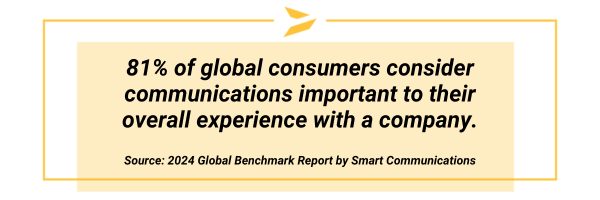
Graphic quote: 81% of global consumers consider communications important to their overall experience with a company.

Why cloud-based CCM software? 

Because the majority of on-premise legacy customer communications platforms are outdated. These systems were fine in the past when it was acceptable to deliver one-way, transactional communications. That isn’t the case anymore. 

Today’s customers want and expect two-way, interactive conversations with brands. Legacy systems can’t provide this. Instead of creating pathways, their lack of flexibility and capabilities create roadblocks.  

With a pure cloud communications tool in place, you’ll have a solution that is more customizable, agile, and scalable—enabling you to produce better customer experiences on your customers preferred channels. This article dives into the five ways employing cloud-based communications can have a positive—and oftentimes dramatic—impact on the customer experiences you deliver as well as your overall business success. 

 1. Cloud CCM Makes Personalized Conversations Possible

By leveraging data from various sources, a cloud-based communications platform will allow your company to generate messages tailored to individual customer preferences and needs, whether through email, SMS, or direct mail. This level of personalization will not only enhance customer satisfaction but also drive engagement and loyalty. 

Business Type 

Personalization Benefit Example 

Insurers 

CCM software could be used to send personalized policy updates, reminders, and renewal notices based on individual customer profiles.  

Financial Services Institutions 

CCM software could be employed to send customized financial advice and product recommendations to clients based on their transaction history and financial goals.  

Healthcare Providers 

CCM software could be leveraged to deliver personalized health tips, appointment reminders, and follow-up care instructions to patients.  

Healthcare Payers 

CCM software could help expedite resolution times, reduce administrative costs, and enhance trust and engagement between payers and their members. 

Engage Customers on Their Terms
Reach customers via their preferred channels with cloud-based CCM software designed to optimize their experience. Request a Demo of SmartCOMM™ Today! 

2. Enhance Operational Efficiency 

Cloud-based customer communications software streamlines the process of creating, managing, and distributing customer communications. This will significantly reduce manual effort and errors and allow your company to send out communications in a timely and accurate manner, ultimately enhancing the overall customer experience. 

Business Type 

Operational Efficiency Benefit Example 

Insurers 

CCM software can be used to automate claims processing notifications which would ensure customers receive timely updates on their claims status, reducing call center inquiries and improving customer satisfaction. 

Financial Services Institutions 

Account statements and transaction alerts can be generated automatically with CCM software reducing manual effort, minimizing errors, and ensuring clients receive accurate and timely information. 

Healthcare Providers 

CCM software can automate appointment scheduling and reminder notifications,helping to reduce no-show rates, improve operational efficiency, and ensure patients receive timely care. 

Healthcare Payers 

CCM software can streamline communication, personalize member engagement, ensure regulatory compliance, reduce costs, improve resource allocation, and enable data-driven decision-making. 

3. Ensure Consistency Across Channels 

Your customers can interact with your brand through multiple channels i.e., social media, website, call center, physical location, etc. Having a centralized, cloud-based communications software as a component of your comprehensive customer experience management strategy will ensure that no matter which touchpoint a customer uses, the experience will be in alignment with your brand’s voice, messaging and values. Having this consistency will reinforce your brand identity and build trust. 

Business Type 

Brand Consistency Across Channels Example 

Insurers 

By using CCM software to standardize communication templates across email, SMS, and mail, insurance companies can ensure that customers receive consistent messages whether they interact through digital or traditional channels. 

Financial Services Institutions 

With CCM software, financial services companies can produce marketing campaigns and customer service communications that have consistent branding across online banking, mobile apps, and in-branch interactions. 

Healthcare Providers 

CCM software will allow healthcare providers to ensure that patient communications–from appointment reminders to health education materials–maintain a consistent tone and branding across email, SMS, and patient portals. 

Healthcare Payers 

CCM software will make for clear, unified communication which will enhance member trust, reduce confusion, improve compliance, and streamline operations. 

4. Drive Customer Engagement and Loyalty

At the end of the day your customer experience management strategy will be judged by the level of engagement and loyalty it produces. Engagement and loyalty are the cornerstones of a successful strategy. A cloud-based communications platform will enable you to create proactive, timely, and relevant customer communications that foster engagement and loyalty. This will help build long-term relationships, reducing churn, and increasing customer lifetime value. Plus, engaged and loyal customers are more likely to promote your brand to others, which will help boost inquiries, trial and your customer base. 

Business Type 

Driving Customer Engagement and Loyalty Example 

Insurers 

An insurance company can use CCM software to send proactive risk management tips and personalized policy recommendations which will help customers feel valued and build loyalty. 

Financial Services Institutions 

CCM software can be leveraged by financial institutions to provide personalized financial education content and exclusive offers to keep clients engaged and strengthen customer loyalty. 

Healthcare Providers 

With CCM software it’s possible for healthcare providers to deliver personalized health management plans and wellness tips. This  helps patients feel supported and connected to their care providers. 

Healthcare Payers 

By implementing CCM software healthcare payers will be able to deliver personalized, timely, and consistent communications, enhancing member satisfaction, fostering trust, and ensuring members feel valued and informed about their healthcare options. 

5. Leverage Data for Informed Decision-Making

To fine tune and optimize a comprehensive customer experience management strategy going forward you’ll need insightful data. This is another benefit to having a cloud-based communications tool embedded into your strategy and your tech stack. It will track and measure the performance and effectiveness of your communications initiatives, providing you with a window into the behaviors, preferences, and feedback of your customers. This data can then be analysed to identify trends and leveraged to make better-informed decisions on enhancements to your brand’s customer experience management strategy and communication initiatives. 

Business Type 

Leveraging Data for Informed Decision-Making Example 

Insurers 

An insurance company could analyze data from CCM software to identify trends in customer inquiries and adjust their communication strategies and initiatives accordingly.  

Financial Services Institutions 

A bank could use data from CCM software to track the effectiveness of different communication channels and tailor future campaigns based on customer preferences and engagement rates. 

Healthcare Providers 

A healthcare provider could use CCM software data to identify patient engagement patterns and adjust communication strategies to improve patient outcomes and satisfaction. 

Healthcare Payers 

A healthcare payer could leverage CCM software to analyze patient data and identify trends and patterns, track costs and outcomes to assess the effectiveness of care, optimize reimbursement rates and contract negotiations, and develop targeted interventions to improve patient care and reduce costs. 

Conclusion

Cloud-based CCM software is not just a tool for managing customer interactions but a vital component of a comprehensive customer experience management strategy. By integrating a cloud-based communications platform within your strategy your business will be empowered with the engine it needs to generate customer experiences that are able to meet and, in many cases, exceed customer expectations.

Discover why leading enterprises like yours have switched to SmartCOMM. Review our case studies and see how SmartCOMM is enabling companies to deliver the personalized, seamless customer experience they envisioned.

What is Interaction Experience Management (IXM)?

By Smart Communications

Regardless of your industry, customer expectations will (and should) always drive your organization’s innovative investments. When it comes to crafting an exceptional customer communications strategy, staying ahead means more than just delivering information – it’s about creating meaningful interactions that truly resonate with your audience. 

Enter Interaction Experience Management (IXM)—a transformative approach that reshapes how organizations collect data from and communicate with their customers. IXM enables personalized, seamless customer experiences across preferred channels, allowing you to scale meaningful interactions like never before. 

Watch the video, ‘Introduction to IXM’ to hear more about this topic from Aspire’s Research Director, George Parapadakis. 

What is IXM? 

IXM, or Interaction Experience Management, is an emerging market segment focused on technologies that facilitate seamless customer interactions across digital channels. IXM covers solutions that transform traditional one-way interactions such as manual or paper-based forms into two-way, interactive conversations. These technologies streamline the process of collecting and managing customer data, ensuring they are efficient, personalized, and consistent.  

Industry analysts such as Aspire, Madison Advisors, and IDC have long emphasized that while many companies have made significant strides in improving their customer communications management, many have overlooked the importance of modernizing their forms processes. Traditional forms, whether paper-based or digital, have remained static and disconnected from the broader customer experience strategy. This gap has created friction in interactions, leading to operational inefficiencies and missed opportunities for personalization and growth. 

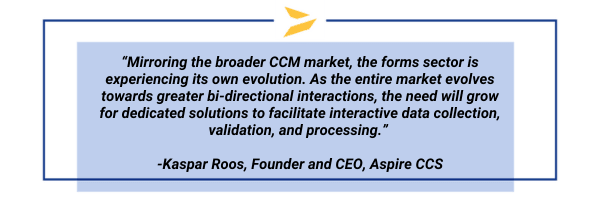
This is a graphic: “Mirroring the broader CCM market, the forms sector is experiencing its own evolution... As the entire market evolves towards greater bi-directional interactions, the need will grow for dedicated solutions to facilitate interactive data collection, validation, and processing.” 

Why IXM Matters Now

With the explosion of communication channels, customers now expect more than just a transactional relationship. They want to interact through their preferred channels, have a streamlined experience, and engage in conversations that feel personal and efficient. Research from our latest Benchmark report found that 83% of customers stated a mobile/web-friendly experience is among one of the most important factors when completing a form. 

While businesses historically had a laser focus on reducing costs and minimizing risks, the new obligation is to meet consumer demand by enhancing the experiences they provide. There’s no doubt that the streaming giant, Netflix, and eCommerce king, Amazon, played a large part in guiding how consumers expect to interact with brands. They want their interactions to be fast (instant), personalized, and efficient.  

With this expansion of priorities, future-forward organizations are connecting the dots between data collection and communications while simultaneously breaking down the barriers thar prevent data from being shared across the organization and used for consistent, accurate interactions. However, the traditional approach isn’t aligning with these evolving priorities.  

Many businesses still gather data via a number of point solutions and manual processes. The data is stored across disconnected systems, limiting their ability to leverage the data to create highly personalized experiences. This not only exposes them to regulatory risk, but it also increases compliance costs and makes for low-quality, unstructured data that requires cleanup before it can be used to offer additional services or make important business decisions.  

Do you know which channels your customers prefer to interact on? Access the 2024 Global Benchmark Report to find out how to leverage a multigenerational, omnichannel approach to customer conversations. 

Benefits of IXM For Your Business 

1. Enhanced Customer Engagement: With the ability to integrate multiple interaction channels, IXM ensures that customers can reach you in the way they prefer, leading to more engaging and efficient touchpoints. 

2. Personalized Experiences: IXM technology allows your brand to provide tailored , digital-first data collection experiences, making customers feel like their needs are being met with precision. 

3. Relevant High-Quality Data: IXM helps collect and manage data effectively, in a structured format, allowing you to make informed business decisions and improve overall customer satisfaction. Consider that low-quality data may be worse than no data at all, potentially leading to manual cleanup, compliance risk, and ill-informed business decisions that can set your company (or worse, the customer journey) back. 

4. Cost Efficiency: Leveraging intuitive forms and self-service applications to facilitate the data collection processes lead to a reduction in expensive calls to customer support/call centers.  

5. Reduced Compliance Risk: Errors throughout sensitive interactions—like the collection of personal identifiable information in a healthcare or financial services setting—can put your business at risk, leading to punitive fines and reputational damage. Traditional methods that are managed and overseen by humans are known to be more error-prone than those that are automated. 

6. Improved Employee Experience: With such a diverse workforce, including employees working remotely or on a hybrid basis, maintaining and boosting productivity has been at the forefront of business leaders’ minds. Giving staff the right solutions and information they need to effectively manage customer interactions (from wherever they’re working) is a necessity.  IXM has the propensity to improve the employee experience by doing just that, which also leads to a better customer experience. 

Conclusion

With 74% of enterprises expanding their CX spend, IXM is the next logical iteration for your customer experience tech stack. If you’re curious about how IXM can specifically impact your industry, stay tuned. In upcoming posts, we’ll delve into industry-specific examples and explore how IXM will elevate your customer relationships. 

Register today to gain complimentary access to the Aspire Leaderboard IXM Grid.

Elevate Your Member Experience: Key Insights from the 2024 Global Healthcare Benchmark Report

By John Zimmerer, VP of Healthcare Marketing at Smart Communications 

The research is in —and healthcare payers have much to do in the way of enhancing the member experience. The 2024 Global Benchmark Report provides crucial insights into how healthcare payers can stay ahead in an increasingly competitive market.  

As you navigate the challenges of rising costs and shifting consumer expectations, understanding these key findings can help you supercharge your communications strategy and create a member experience that drives  retention and loyalty.  

Let’s get into the data. 

Key Finding 1: Clear and Personalized Communications are Imperative

Today’s healthcare consumers demand more from their interactions with payers. They expect communications to be not only clear and accurate but also personalized and timely. Despite these expectations, the reality is that many healthcare organizations (HCOs) are falling short. Our research reveals that while 86% of healthcare customers value clear communications, only 46% rate the communications they receive as very good or excellent. This gap represents a significant opportunity for improvement. 

Key Takeaway: To meet these rising expectations, deliver tailored messages based on individual data, ensuring that your communications are relevant and engaging.  For example, an omnichannel strategy can help when interacting with a multi-generational customer base. Millennials prefer a mobile/web approach while some Baby Boomers and the Silent Generation may still favor traditional channels like call centers and paper-based communications. 

Key Finding 2: The Critical Role of Data Collection and Forms 

The efficiency of your data collection processes directly impacts member satisfaction and retention. Consumers today are less tolerant of outdated, cumbersome forms. They prefer digital, mobile-friendly options that save time and reduce friction. 74% of consumers will abandon a form when it is difficult and 64% abandon forms that are repetitive, highlighting the need for streamlined, user-centric solutions. 

Key Takeaway: Take the necessary steps to increase accuracy and compliance, ultimately enhancing the healthcare payer member experience. As it stands, 74% of Millennials are willing to switch payers due to one bad experience. Providing clear, accurate, and compliant communications makes the difference between creating a loyal member or one that takes their business to your competitors. 

Graphic: Blue pie charts on a white background that explain the most important factors for customers when completing healthcare forms. 

Key Finding 3: Data Security is Non-Negotiable 

In an era where data breaches are increasingly common, ensuring the security of member information is paramount. Our report highlights that 64% of healthcare customers almost always trust their healthcare organizations, but there’s room for improvement. Transparency and robust security measures are essential for building and maintaining trust. 

Key Takeaway: Make it a company-wide initiative to safeguard sensitive data. Clearly communicate your data protection practices to reassure members and strengthen their trust. 

Key Finding 4: Embracing Mobile and Web-Friendly Interfaces 

The shift towards digital interactions is undeniable. Consumers now prefer managing their healthcare needs through mobile and web interfaces. Offering these options not only meets current expectations but also positions you as a leader in convenience and accessibility. 

Image: Data table with three columns broken down into multiple communication channels (mobile, web, paper) with multigenerational rankings to the left, denoting which generations prefer health insurers to contact them on a preferred channel. Navy blue background with cloud graphics. 

Key Takeaway: Prioritize mobile and web-friendly solutions for all member interactions, from appointment scheduling to claims processing. This alignment with consumer preferences will enhance satisfaction and streamline operations. 

Key Finding 5: Navigating GenAI with Transparency and Ethical Use 

Generative AI (GenAI) presents exciting possibilities for improving healthcare communications. However, its integration must be handled with care. While 47% of consumers see GenAI as a potential benefit, there are significant concerns about security and ethical use. 

Key Takeaway: Ensure transparency in your use of GenAI, and maintain human oversight to address ethical and security concerns. By doing so, you can leverage AI’s benefits while building trust with your members. Partner with a provider who prioritizes safeguarding critical interactions and provides expert guidance on the responsible, high-value use of GenAI. 

Graphic: 77% of healthcare customers feel it's important that it's explicitly called out when GenAI is used, and 81% believe a human should always be checking suggested content. 

How Can You Create a Winning Healthcare Payer Member Experience? 

To effectively respond to changing consumer demands and boost member retention, your organization should focus on: 

  • Modernizing Communications: Adopt a CCM system that offers personalization and clarity.
  • Streamlining Data Collection: Move towards automated, user-friendly forms.
  • Enhancing Data Security: Invest in secure communications and transparent data practices.
  • Prioritizing Digital Interfaces: Ensure seamless mobile and web access.
  • Transparent AI Use: Implement GenAI with clear communication and human oversight. 

Understanding and acting on these insights will position your organization to better meet member expectations and drive long-term loyalty. 

Curious about how to account for changing consumer demands and retain members? Download the Global Healthcare Benchmark Report for more insights on how to enhance the healthcare payer member experience in today’s evolving landscape.

Streamlining Stakeholder Communications: Smart Solutions for Complex Transactions

By Scott Draeger, SVP of Product Marketing and Vertical Solutions 

 Most Customer Communications Management (CCM) articles focus on Customer Experience (CX). Sometimes, CCM articles focus on the Employee Experience (EX) and improvements of customer-facing interactive solutions. These are often the main characters in the CCM market, but many transactions require the support, involvement, or approval of important third parties.  

 Delivering the right communication to these stakeholders in the right format is critical to the customer’s transaction being processed quickly and accurately. 

 In this article, you’ll find helpful information about how to deliver great communications at the right time and for the right audience. 

 Who Needs to Know About the Transaction? 

Important transactions, like establishing mortgages, creating a trust, assigning power of attorney, or submitting death claims require the creation of documents for a variety of people with specialized roles. Some of these people include: lawyers, notaries, custodians, guardians, family managers, beneficiaries, real-estate agents, and others. Generating communications for involved stakeholders is often complex with traditional CCM offerings, and it’s becoming more difficult as data privacy, record keeping, and clear communication regulations grow in complexity. 

 Trying to remain compliant in your customer communications processes? Discover how the power of SmartCOMM™ from Smart Communications can help. 

Carbon Copies, Enclosures, and Disclosures Add Complexity 

Sometimes these communications require more, or fewer, pages. Carbon copies are required for some parties, but may need to have data redacted or obscured. Enclosures may be required for the customer’s information, but an agent may not want this unnecessary clutter clogging up an inbox. A mortgage customer needs to supply a lot of data, but their data should not be shared without redaction to others involved in the transaction. These professionals may not need all the enclosures, just the ones that matter to their steps.  

 Third-Party Communications Affect Your CX Scores  

If the business cannot accurately and quickly generate communications with the right level of data, privacy, and delivery requirements, the transaction can be delayed. A delayed transaction, even if it is the fault of a third party, often reflects poorly on your customer experience. That means your CX scores can suffer if the third parties around your transactions are not receiving accurate communications quickly and completely. Generating them from the same CCM transaction ensures accuracy, consistency, and traceability.

Leading Cloud-Based CCM Software Brings All Parties Together 

SmartCOMM™ addressed this issue with a “Business Events” feature that streamlines the management of data, pages, redactions, and enclosures for complex multi-party interactions. Since SmartCOMM generates batch, interactive, and on-demand communications from the same user interface, it is possible to manage these complex scenarios with the necessary level of involvement from the right people.  

Business Events Uses the Right Skills at the Right Time

Your business analysts know all about the transactions. They know which party requires which communication. They know who needs to be involved in the signing process and who needs a copy of that signed document to move it along. They also know about those new regulations regarding data privacy, translation requirements, and how those regulations are translated into policy within their business. With Business Events, business analysts control who receives what and when, without adding to the templates’ complexity.  

Your template designers make sure the data, design, content, and branding assets are available to be applied to the communications. With Business Events, their work is readily available to the business analyst, who can create the right mix of communications for the right stakeholders without having to collaborate on a collection of “almost the same, but not quite the same” templates that boost the cost of CCM applications, increase the opportunities for errors to creep in, and create technical debt in the future.   

Your system administrators appreciate Business Events because their communication channels, once configured, are readily available for business analysts to selectively use. The problem of special queues and channel setups for hundreds of permutations disappears, allowing their attention to return to smoothly running infrastructure for the business.  

With Smart Communications’ Business Events, Complex Transactions Become Easy

By bringing the right skills of your business analysts, template designers, and system administrators together, creating, assembling, and delivering complex combinations of documents to all of the relevant parties in your transactions, you can deliver amazing customer experience to your clients. You also put yourself in position to be the favorite vendor for the third parties, which puts you in position to get referrals, recommendations, and positive feedback from the professionals you need to keep your organization growing. 

With Business Events, you impress more people in less time while ensuring compliance. That’s how you scale the conversation. To learn how to implement these features in your organization, get in touch with us today.

Mastering Communications Compliance: Trends, Challenges, and Best Practices for Heavily Regulated Industries

By Smart Communications 

In today’s digital world, where every interaction matters, ensuring communications compliance is not just a regulatory checkbox—it’s a cornerstone of trust and operational integrity. Imagine this: you’re the compliance lead of a dynamic enterprise navigating the complexities of global markets and digital communication channels.  

Your goal? To safeguard your organization’s reputation while delivering seamless customer experiences. How does a busy enterprise like yours, with many moving parts and stakeholders, begin to strike that balance? We’ve outlined a few ways below. 

The Importance of Communications Compliance 

In an era defined by shifting regulations and heightened data privacy concerns, communications compliance emerges as a crucial safeguard. It’s more than just adhering to rules; it’s about fostering trust and transparency in every customer interaction. At Smart Communications, we understand the delicate dance between compliance and customer experience better than anyone.  

Regulations are changing rapidly, with new ones emerging daily, making it difficult for companies to keep up and adapt in time. Compliance deadlines are tighter than ever, leaving companies with less time to adjust. Large enterprises, with their complex organizational structures and technology infrastructure, particularly struggle to implement these changes quickly.  
 
Additionally, compliance costs can escalate with mergers, rapidly evolving tech teams introducing new technologies for emerging channels, and the presence of new departments managing their own communications independently. 

Understanding Communications Compliance 

At its core, communications compliance encompasses the policies, processes, and technologies that ensure all customer communications meet regulatory standards. From GDPR in Europe to MiFID II in financial services, the regulatory landscape is multifaceted and ever-changing.  

Non-compliance poses significant risks, including legal repercussions, financial penalties, and damage to brand reputation. By staying ahead of regulatory shifts and leveraging innovative solutions, enterprises can navigate these challenges while maintaining compliance integrity. 

Risks Associated with Non-Compliance 

 1. Legal Issues 

  1. Failure to disclose information on time/clearly

  2. Failure to make information accessible 

  1. Continuing to send to consumers that have opted out 

  1. Communicating through a useful, but not approved channel 

  1. Soon, failing to disclose AI involvement in communication-related processes 

 2. Financial Penalties 

  1. Fines for mismanaging data, not honoring data privacy settings 

  1. Fines for mismanaging communication preferences 

  1. Fines for not offering communications in preferred languages 

  1. Lawsuits for not delivering accessible data  

3. Reputational Damage 

  1. Communicating a breach 

  1. Being called out as a poor communicator. (Did you hear about the “lying” chatbot that led to bad press for a Canadian airline?) 

  1. Having non-compliance turn into a news story 

  1. Having a large fine turn into a news story 

Trends and Challenges in Communications Compliance

As regulations evolve and digital channels proliferate, enterprises face the challenge of maintaining compliance without compromising on agility and personalization. Imagine navigating these waters smoothly, adapting to new rules swiftly while still delivering tailored experiences that resonate with each customer. 

It’s easy to complain about the rising cost of compliance because it almost always seems to become more complex. Often, compliance complexity grows from your organization’s leading technical innovations, intense customer focus, and bold business strategies.  

Adopting new technology to communicate on new devices, platforms or social channels multiplies the types of isolated technologies that require compliance. Increasing customer focus increases the amount of content you manage to more narrow personas across steps in a customer journey. Bold business strategies, like mergers and acquisitions, multiply the number of core systems that must conform to compliance requirements. With these many forces increasing compliance costs, it may be time to simplify the underlying technology stack. 

Best Practices for Effective Communications Compliance 

When it comes to the use of AI, our latest Benchmark study found that 71% of consumers have security concerns about the use of GenAI in customer communications.  

Here’s where strategy meets execution. Implementing a robust compliance policy, leveraging AI for automation, and ensuring ironclad data security are not just best practices—they’re your toolkit for staying ahead of regulatory shifts and operational demands.  

The Smart Communications Solution 

Enter the Conversation Cloud™ by Smart Communications—the beacon of hope for compliance leaders everywhere. With SmartCOMM™, SmartDX™, and SmartIQ™, our platform empowers you to manage customer communications, trade documentation, and forms-based processes seamlessly. Cloud-based and endlessly customizable, it integrates flawlessly with your existing systems to deliver compliance without compromise. 

Key Features and Benefits 

  • Centralized Management 
    Whether you’re delivering batch or on-demand personalized communications with SmartCOMM or collecting customer data through SmartIQ, our solutions are channel-agnostic. This means you can quickly implement changes and apply them across all your communication and form templates from a single, centralized platform. There’s no need to coordinate multiple teams or manage various channel-specific systems to stay compliant with new regulations. With Smart Communications, everything is streamlined, allowing for rapid adaptation and comprehensive tracking for auditing purposes 

  •  Cloud-based architecture for scalability and agility. Cloud-based architecture ensures you can easily scale resources up or down based on demand, accommodating business growth without hefty upfront costs. It also allows for quick deployment of updates and new features, keeping your system flexible and current.  
  • Compliance monitoring and management. Sophisticated tools automatically track and enforce compliance with regulations, reducing the risk of errors and saving time. This proactive monitoring ensures you stay compliant and helps you make data-driven decisions with valuable insights into your communication processes.  

  • Seamless integration with existing systems. The software integrates smoothly with your current CRM, ERP, and other core systems, streamlining workflows and reducing manual data entry. This seamless integration enhances efficiency and provides a unified view of customer interactions, improving overall operational effectiveness.

Actionable Insights for Enterprises 

Picture this: you assess your current compliance framework, identify gaps, and forge a holistic strategy that unites compliance, customer experience, and IT teams. It’s about collaboration, optimization, and a relentless pursuit of excellence in compliance management.  

You can stay up-to-date with changing regulations by investing in cloud solutions. For instance, the Consumer Duty rule requires firms to “offer helpful and accessible customer support.” This means answering customer questions quickly to avoid frustration. Compliance will need centralized information systems for support agents and better self-service options. 

Conclusion 

In conclusion, mastering communications compliance isn’t just about meeting regulations—it’s about shaping a future where trust and innovation coexist harmoniously. Smart Communications stands ready to empower your enterprise with tools and expertise that ensure compliance excellence while enhancing customer relationships. 

Additional Resources

Explore further with our white papers, webinars, and expert insights available through Smart Communications. Remember, compliance isn’t a burden—it’s your gateway to building trust and driving success in a digital-first world. Stay informed, stay compliant, and stay ahead. 

Ready to navigate the future of communications compliance with confidence? Contact us today and embark on a journey towards secure, compliant, and customer-centric communications. 

The Critical Role of Communication in Patient Outcomes: 2024 Benchmark Research Insights

By John Zimmerer, VP of Healthcare Marketing at Smart Communications

Effective communication is not just a nicety in healthcare; it’s a necessity. The recent issues within the NHS in England underscore the critical role of communication in patient outcomes. Our 2024 Benchmark Research findings reveal that effective patient communication is increasingly vital for enhancing the overall healthcare experience and building trust. This research highlights significant trends and preferences, providing valuable insights for healthcare providers aiming to improve their communication strategies. 

The Growing Importance of Patient Communications 

According to our Benchmark research, the importance of effective communication in healthcare is on the rise globally. An impressive 85% of healthcare customers now consider communications to be somewhat or very important to their overall customer experience, up from 81% in 2023. Despite this, less than half (46%) of patients rate the communications from their providers as very good or excellent. This gap signifies a substantial opportunity for healthcare providers to enhance patient satisfaction and trust through better communication practices. 

Patient Trust and the Impact of Communication Failures 

Trust and data security remain pivotal in healthcare transactions. Alarmingly, 36% of patients occasionally or rarely trust their providers. Our research revealed that patients are increasingly willing to switch health providers if communications do not meet their expectations, with 69% likely to do so—up from 53% in 2023. The most critical factors in establishing trust through healthcare communications are accuracy, ease, and security. These elements are essential in building and maintaining patient trust, which is foundational to effective healthcare delivery. 

Demographic Variations in Communication Preferences 

Healthcare providers must recognize and accommodate the diverse communication preferences across different demographics. Gender and generational differences significantly influence how patients prefer to receive and interact with information. Millennials, for instance, are the most likely to terminate an interaction if the information collection process is too difficult, with a striking 72% indicating they would do so. Regionally, the USA has the lowest tolerance for difficult information collection methods, with 71% of patients likely to end an interaction under such circumstances. 

Overcoming Barriers to Effective Communication 

Our study identified key barriers to effective communication in healthcare. The primary reason patients abandon forms is the difficulty in providing necessary supporting documentation. Other major obstacles include the need to repeat or re-enter the same information multiple times, redundant questions, and the inability to save progress. Addressing these issues can significantly enhance the patient experience and reduce the likelihood of patients abandoning important forms. 

The Ideal Patient Information Collection Experience 

Patients show a growing preference for mobile and web-friendly interfaces for submitting personal health information. With 43% of patients favoring these digital methods over call centers or paper forms, it’s clear that healthcare providers must prioritize digital solutions. The top factors for digital healthcare communications across all generations are clarity and ease of understanding, accuracy, and timeliness. By focusing on these aspects, providers can improve patient satisfaction and engagement. 

Conclusion 

Effective communication in healthcare is more critical than ever. The insights from Smart Communications’ 2024 Benchmark Research highlight the significant impact of communication on patient outcomes, trust, and overall experience. To delve deeper into these findings, including patient perspectives on data security and the use of GenAI in healthcare communications, download the full report. By prioritizing clear, accurate, and secure communication, healthcare providers can revolutionize the patient experience and improve outcomes. 

For additional insights and detailed findings, download the full report from Smart Communications. Discover how your organization can enhance patient trust, satisfaction, and outcomes through effective communication strategies.

Omnichannel Customer Engagement: Connecting with Customers on Their Terms

By Smart Communications

Whether interacting with your company via desktop, tablet, or mobile—or through web, email, or an app—today’s customers have high expectations for what that customer experience should be. Most importantly, they want to connect with your company on their terms.  

But, what are those terms? Let’s explore them and why they’re important to delivering omnichannel customer engagement. 

1. Provide Truly Personalized Interactions

Customers give companies personal information. Knowing that they have that data and insight at their disposal, it only makes sense that today’s customers expect brands to deliver a more personalized experience–one that goes beyond just addressing them by name. Some of the ways you can supply a more personalized experience are by: 

  • Leveraging customer data to customize recommendations and offers via a centralized, modern customer communications management (CCM) solution that bridges data silos. Incorporating dynamic content that will modify based on customer behavior.
  • Delivering emails, messages, and advertisements that are targeted based on personalized data.
  • Proactively reaching out to the customer to provide guidance and value based on the products/services they have with your organization. 

The Business Benefit: By personalizing interactions, customers will feel more valued and understood by your brand. This will strengthen the relationship customers feel they have with your company and help promote brand loyalty. 

2. Be Available on the Channel They Prefer 

When it comes to what channel(s) they use to communicate with friends, family, and colleagues, everyone has their personal preferences. It’s no different when they want or need to engage with a company. Customers expect to be able to communicate using whatever channel they prefer. To make that possible your organization needs to commit to the following: 

  • Have a presence on your customers’ most-used platforms.
  • Offer live chat support on your website.
  • Ensure you are providing user-friendly web and mobile experiences.
  • Leverage an industry-leading CCM solution that enables you to create channel-agnostic customer communications delivered on your customers’ preferred channels. 

The Business Benefit: Being on your customers’ preferred channels will show that you’re a customer-centric company that believes interacting with your brand should be as convenient as possible for your customers. 

3. Offer Two-Way Conversations in Real Time 

Customer communication is no longer a one-way street. Speaking at customers isn’t good enough. In the world of omnichannel customer engagement, two-way conversation is the new norm. It’s about talking, listening and responding and, in most cases, in real time. It’s what customers expect from every company in every industry. Here’s how your company can facilitate two-way conversation in real time:  

  • Monitor all touchpoints for customer inquiries/feedback and respond.
  • Leverage known customer information to prepopulate forms and provide highly personalized, tailored experiences.
  • When emails or messages are received from customers, respond in a timely fashion. 

The Business Benefit: By having two-way conversations with customers in real time you will show that your company is responsive, which will enhance the trust customers have in your brand. 

4. Ensure Consistency Across All Communication Channels

Throughout communicating with your brand, a customer may begin engaging in the morning on their cell phone, continue the process at lunchtime on a laptop, and complete the task that evening on a tablet. No matter what the touchpoint though, your customer is expecting the experience to be cohesive. An omnichannel customer engagement experience can’t be considered seamless unless it is consistent. Your company can accomplish this by: 

  • Mirroring your messaging and branding across all channels.
  • Delivering the same degree of service and support across all channels.
  • Employing systems/software that enable continuity and consistency across all touchpoints. 

The Business Benefit: A seamless omnichannel experience across all channels will make the customer journey even smoother and take customer satisfaction and trust to new heights.  

5. Anticipate The Customers’ Needs

Within your database you have collected personal information about your customers. That information provides insight that your customers expect you to analyze and use to predict what solutions they need. To take your brand to this level, consider these omnichannel customer engagement strategies: 

  • Add predictive analytics to your toolbox so you can foresee what customers require.
  • Review past purchases by customers to determine what to recommend next.
  • Don’t wait for issues to arise; anticipate them instead and address them before they become reality. 

The Business Benefit: By anticipating their needs, each customer will feel like their experience with your brand is even more tailored to them. 

6. Protect Their Data

Data privacy is probably the biggest concern customers have when it comes to divulging their personal information to your brand. Their level of concern is underscored by the strict regulations and compliance standards governments have for data security, especially in the financial services, insurance and healthcare industries. Without a doubt, ensuring customer data is secure is an important component of the omnichannel customer engagement picture. Here are some ways your company can be compliant with customers and regulators:  

  • Deploy vigorous security measures to protect customer data.
  • Eliminate the need for manual rekeying by implementing an automated, intellilgent data collection solution.
  • Always ask for explicit consent before collecting and using personal information.
  • Stay up to date and comply with the latest data protection regulations. 

The Business Benefit: If customers are reassured that their personal data is safe with your brand, they are more likely to share it with you. In turn, by gaining that information and insight your brand will be empowered with the ability to deliver the personalized experience customers expect. 

A CCM Makes It Possible to Connect with Customers on Their Terms 

Connecting with customers on their terms is a tall order, especially if your organization is trying to do so with a hodge podge of legacy systems that are not capable of integrating with one another. 

The simple solution to achieving the omnichannel customer engagement you envision is to transition to a customer communications management (CCM) system. A cloud-based CCM solution will give you the centralized, scalable infrastructure you need to easily: 

  • Provide truly personalized interactions with your customers.
  • Communicate on whatever channel your customers prefer.
  • Facilitate two-way conversation in real time.
  • Ensure the customer experience is consistent across all channels.
  • Anticipate customer needs and take proactive action.
  • Deliver on your promise that personal data is safe and secure. 

Conclusion 

Omnichannel customer engagement is essential for your business to thrive in today’s digital-first marketplace. By implementing a CCM you’ll be able to connect with your customers on their terms. This will lead to stronger customer relationships, greater brand loyalty and fuel growth for your business. 

Searching for customer communications management (CCM) software? Then the “Ultimate Guide to CCM Software & Strategic Solutions” is for you.

Learn about CCM software, explore why a cloud-based CCM solution positions you for omnichannel customer engagement success, find questions you should ask when choosing a CCM vendor and much more. Read the guide now. 

Modernizing P&C Insurance Communications: Addressing the Needs of The Business to Elevate Customer Engagement

By Eileen Potter, VP of Insurance Marketing, Smart Communications

Insurers are faced with a growing list of challenges. Technology-driven disruptions. Evolving consumer expectations. Intense cost and competitive pressures. Regulatory change. Environmental sustainability. Lingering economic uncertainty. The pressure on insurers is real as the pace of change only continues to accelerate.  

But it is interesting to note that on some level, the insurance industry has not changed. And by that, I mean the fundamental operational areas of insurance – which are policy administration and claims management, and the functions fall under those – are the same, quoting, underwriting, billing, FNOL, etc. But traditional insurance business models are being challenged by new thinking, new competitors, and new ways of working.   

Earlier this year, Smart Communications, in collaboration with Guidewire and AWS, hosted a webinar titled “Get Future-Ready with Modern Digital Insurance Communications.” I was fortunate enough to moderate a panel of industry experts for a conversation focused on the transformative potential of digital communications within the insurance sector, and how the powerful combination of our technologies accelerates time to value, boosts agility and efficiency, and ultimately empowers insurers to deliver superior customer experiences at every moment in the policy and claims lifecycles.   

Keeping Pace with Customer Expectations  

As customer expectations continue to rise, insurers must find ways to enhance policyholder communications and elevate the overall customer experience, and one of those ways is to change the way that communications are managed in their organization.  

Traditionally, policyholder communications have been centralized, with limited input or control from individual business units. This approach often results in generic messages that fail to resonate with customers on a personal level. However, by decentralizing communication management and placing it in the hands of business units, insurance companies can tailor their messages to better meet the unique needs and preferences of different customer segments, while also addressing the specific needs of each area of the business.  

Some examples:  

Business Unit 

Need 

Information Technology  

Focus on core functions, Standards based, Secure and Resilient 

Legal & Compliance   

Protection from risk, Control of content  

Marketing & Sales  

Brand consistency, Customer experience  

Customer Service  

Flexibility, Speed, Accuracy  

Lines of Business (Policy, Claims, Billing)  

Ability to adapt, New products, Acquisitions 

A diagram of a company's insurance policy

Empowering business units to contribute to policyholder communications not only allows for greater customization but also fosters a sense of ownership and accountability. When teams have input into crafting and delivering messages, they are more invested in ensuring the content is relevant, timely, and effective. This sense of ownership can lead to a higher quality of communication that resonates with policyholders and strengthens their relationship with the insurance company.  

Taking a Strategic Approach to Change  

Leveraging modern technology and digital tools streamlines the communication process and improves efficiency. With access to sophisticated customer relationship management (CRM) systems and communication platforms, teams can easily track interactions, analyze data, and identify opportunities for optimization. This data-driven approach enables business units to make informed decisions about communication strategies, ultimately enhancing the overall customer experience.  

This type of collaboration fosters innovation and agility within an organization. By decentralizing control, companies can tap into the diverse expertise and insights of different teams, driving creativity and experimentation. This flexibility allows for rapid iteration and refinement of communication strategies, ensuring they remain relevant in a dynamic market landscape.  

In addition to enhancing customer engagement, this strategy can also yield operational benefits for insurance companies. Decentralizing communication management reduces bottlenecks and streamlines processes, leading to greater efficiency and cost savings. Furthermore, by aligning communication efforts with business objectives, companies can drive growth and profitability in the long term.  

Conclusion  

Modernizing P&C insurance requires a fundamental shift in how policyholder communications are both managed and delivered. By giving stakeholders from each business units input into customer interactions, insurance companies can tailor messages to better meet the needs of their diverse customer base. This approach not only enhances customer engagement but also fosters innovation, agility, and operational efficiency. As the insurance industry continues to evolve, empowering business units will be essential for staying competitive and delivering exceptional customer experiences.  

The bottom line is that insurers need to be able to adapt to new business models, distribution channels, and types of communication – but to be successful they need a technology ecosystem that will enable them to do that. And the most cost-effective, way for them to do this – with speed and at scale – is to leverage partnerships between organizations like AWS, Guidewire, and Smart Communications, with solutions built based on best practices, along with a proven track record of success.   

To learn more and discover actionable strategies that can help you modernize your communications infrastructure and drive sustainable growth in a rapidly evolving market, we encourage you to listen to the on-demand recording of the webinar.