Solutions

Archive and retrieve communications securely with cloud-native speed.

Orchestrate real-time, compliant interactions across every channel.

Simplify and standardize trade and relationship documentation workflows.

Industries

Improve customer engagement across policy, billing, and claims.

Create and deliver personalized, compliant customer communications at scale.

Heighten citizen experience with digital transformation.

Improve customer engagement across utilities.

Resources

Browse popular market research, articles, videos, written guides and more in one convenient location.

Explore upcoming events, webinars, and customer experiences shaping the future of customer conversations.

Get the latest updates on Smart Communications, including product news, and industry recognition.

Company

Learn more about our company, our leadership and how were growing the team!

Analysts

Access analyst research, market reports, and industry recognitions featuring Smart Communications.

How the Conversation Cloud™ Earned Leader Status on Four Aspire Leaderboard Grids

By Scott Draeger, SVP of Product Marketing and Vertical Solutions 

Smart Communications is proud to see Conversation Cloud™ solutions placed in the Leader category on four distinct Aspire Leaderboard Grids in the July 2025 revision of the Aspire Leaderboard. Aspire CCS’ research recognizes early shifts in customer engagement technologies by technology capabilities, vertical industries, firmographics, location, and use cases.  

The Smart Communications team is excited to have fresh research that validates our strong market position and technology, but we’re prouder of how our customers engage with their clients every day. Visit our case study library for more on that. According to the updated vendor profile, “Smart Communications’ strategy is to empower enterprises to transform their customer communications through three core capabilities that directly impact business outcomes.”

Leadership Positions Across Four Market Categories 

Smart Communications earned leadership positions in the following categories on the Aspire Leaderboard’s July 2025 update: 

  • AnyPrem CCM
  • Vendor Hosted SaaS CCM
  • Interaction Experience Management (IXM)
  • CXP markets   

Furthermore, Smart Communications achieved a platform strength score of 97 in Vendor Hosted SaaS CCM—the highest score given to any vendor on any Aspire Leaderboard grid.  

Aspire’s scoring also reflects Smart Communications lead in Go to Market Strategy in both AnyPrem CCM and Vendor Hosted SaaS CCM, recognizing our focus on quickly solving the challenges of the highest stakes communications in highly regulated industries with leading SaaS capabilities.  

The Conversation Cloud Has Grown Since the 2024 Update 

The April acquisition of Joisto brought SmartHUB™’s powerful cloud-native archive capabilities to the Conversation Cloud in June. The addition enables our clients to seamlessly connect their communications and forms from creation to archival and retrieval and Aspire recognized this integrated approach with Leader placements in key Leaderboard grids. Check out the video below to learn more about SmartHUB:


Vendor Hosted SaaS CCM: Strong Platform Performance 

In the grid for Vendor Hosted SaaS, Smart Communications earned a platform strength score of 97. Out of 15 vendors evaluated, this represents the highest score for any vendor in any grid in this cycle of the Aspire Leaderboard. This score reflects the clear focus, maturity, and capabilities of Smart Communications’ cloud-native platform architecture.  

Smart Communications’ technology received the highest overall strategy score in this segment, supported by focused go-to-market execution. The Product and Vertical Marketing team members, including Eileen Potter for Insurance, John Zimmerer for Healthcare, Cindy Griffin for Financial Services, Sally Schulte for SmartIQ, and Chris Murphy for SmartCOMM, spend time with customers, prospects, and partners to collect data, refine use cases, and find solutions for the problems of complex communications in regulated industries.  

Interested in more industry- and technology-specific insights from our experts?
Click their names above for more advice to help you optimize the digital experiences you provide your customers. 

Customer Success Documentation 

While Smart Communications’ investment in people contributes to Smart Communications’ reputation as a reliable partner for enterprise transformation through their industry expertise and customer relationships, it also allows us to collect a lot of content. We maintain an extensive library of customer case studies and educational videos that demonstrate practical applications and business outcomes across various industry verticals, providing evidence of successful implementations. 

Our SmartIQ sample library has increased by a third since the last Aspire Leaderboard release, as more ready-to-use experiences are available for common data collection challenges across finance, insurance, and healthcare applications. Check out the video below to see how one our clients, The Bancorp, leveraged SmartIQ to reduce loan origination times by 98%, significantly enhancing the customer experience in this area: 


AnyPrem CCM: Navigating Market Evolution 

The AnyPrem CCM market reflects the present status of CCM technology as new communication applications move to the Vendor Hosted SaaS CCM market at increasing rates. As legacy technologies in the AnyPrem CCM market are decommissioned, this trend will continue to accelerate.  

Smart Communications earned Leader placement on this grid by offering a future-ready route  for organizations seeking to modernize customer and employee experiences. By providing clear migration paths away from many of the outdated technologies featured on this grid, Smart Communications empowers companies to meet the expanding needs of today’s digitally native customers as well as print-first customers. 

IXM: Advancing Interactive Experience Management 

Within the Interaction Experience Management grid, Smart Communications strengthened its position in IXM Differentiation. With a 2025 score of 67, Smart Communications broke from a four-vendor group with the same top score in 2024 to be recognized as the sole vendor with the top score in the differentiation category. Shifting to the scoring for the benefits of IXM, SmartIQ’s score of 70 represents a 40% advantage over the closest competitors, reflecting the transformational business outcomes, as demonstrated by customers like The Bancorp. 

Key Findings from Aspire 

The refreshed Aspire Leaderboards also include revised summaries and descriptions of the Smart Communications business and technology. Aspire observes, “Smart Communications has evolved from individual product offerings to an integrated platform approach, addressing enterprise requirements for seamless integration across multiple communication channels and consistent brand experience.” 

The research also offers, “This [Joisto] acquisition, as well as the launch of SmartPATH, puts Smart Communications in much stronger position for expansion in the rapidly evolving AI landscape, where communications tracking, real-time orchestration, and the analysis of document metadata is a vital component of superior customer experiences.”  


Market Position and Future Outlook 

Smart Communications’ recognition across four Aspire Leaderboard grids reflects a comprehensive strategy that has strengthened the company’s market position as well as the technology stacks of our customers. The combination of technical capabilities, strategic market approach, and customer focus has created competitive advantages across multiple market segments. 

As enterprises continue to prioritize customer communications management projects to meet rising customer expectations and reduce operating expenses, Smart Communications is positioned to support transformation initiatives while delivering measurable improvements in customer experience and operational efficiency. 

Ready to See What The Hype is All About?
Request a demo to see our products in action. Or, for more on how Smart Communications achieved the rankings outline in this blog, access the full Aspire Leaderboard Grids. 

Don’t Let Budget Season Catch You Unprepared: The Critical Importance of Early Vendor Research

By Scott Draeger, SVP of Product Marketing and Vertical Solutions 

Enterprise software budget processes are easy to delay, until it’s too late. Then, you find yourself stuck with legacy limitations for another year.  

Budgeting is complex and time-sensitive, yet too many organizations wait until the last minute to gather essential vendor information. This reactive approach leads to delayed decisions, incomplete evaluations, and ultimately, poor ROI outcomes that plague your organization for years. 

The Hidden Cost of Inadequate Vendor Research

When budget season arrives and you’re scrambling to compile vendor pricing, feature comparisons, and implementation timelines, you’re already behind. The most successful enterprise software investments begin with thorough vendor research conducted months before budget discussions even start.  

This preparation allows you to present comprehensive business cases backed by detailed cost-benefit analyses rather than rough estimates and hopeful projections. This type of preparation puts your project in position to get a “yes!” 

Transaction Structure: The Make-or-Break Factor for ROI

Beyond basic pricing and features, understanding how flexible vendors can structure their transactions is critical for achieving positive ROI quickly. Many publicly traded vendors are bringing heavy legacy approaches to their SaaS offerings.  

They continue to demand substantial upfront payments, extensive and expensive professional services contracts with high attach rates, and additional fees that delay meaningful returns by years. These legacy models from legacy providers prioritize vendor cash flow over client success, creating financial strain that undermines transformation initiatives. 

A Different Approach to Enterprise Partnerships 

Smart Communications represents a fundamentally different philosophy in vendor relationships. Rather than demanding large upfront investments that strain budgets and delay ROI, Smart Communications partners with clients through multiyear arrangements designed to accelerate time-to-value to deliver profit and performance faster than expected.  

Smart Communications’ innovation isn’t limited to our leading SaaS offerings. Innovation extends through the entire business, offering financing options that enable organizations to begin transformation and migration processes without the crushing financial burden that typically accompanies enterprise software implementations. 

Analyst reports are a powerful source of knowledge when researching vendor options. Get started by checking out our latest insights here. 

 Breaking Down Vendor Silos That Block Your Success

Traditional vendors often operate with internal silos that prioritize their own revenue recognition over client outcomes. This misalignment creates friction throughout implementation and ongoing support. Separate sales teams compete for product revenues in competitive portfolios.  

Any professional services discounts can create carve–outs and revenue deferrals that cause a salesperson to rapidly shift focus to another prospect. Smart Communications’ transaction structure aligns vendor success with client success, ensuring that your transformation goals remain the primary focus throughout the partnership. 

Start Your Research Today 

Don’t wait for budget season to begin your vendor evaluation process. Start gathering comprehensive vendor information now, with particular attention to transaction structures that support rapid ROI achievement.  

Done right, budget discussions will become strategic conversations rather than frantic scrambles that leave you and your customers to deal with legacy limitations for another year. Position your project for success in 2026 by partnering with a vendor aligned to your rapid ROI. 

Not The Decision Maker, But Interested in Making a Change?

Check out “Building a Business Case for Change: How to Secure Stakeholder Buy-In When Purchasing Enterprise Customer Communications Management (CCM) Software” to arm yourself with the right information to make the case for better CCM software. 

Enhancing Patient Financial Assistance with IXM Solutions: Benefits, ROI, and Impact

By John Zimmerer, VP of Healthcare Marketing at Smart Communications 

In today’s healthcare landscape, improving patient experience and operational efficiency is paramount. Hospitals are increasingly recognizing the need to streamline their financial assistance processes to better serve patients and optimize internal operations. One promising approach is the adoption of Interaction Experience Management (IXM) solutions. This blog post will explore the requirements, benefits, and return on investment (ROI) of implementing an IXM solution for patient financial assistance. 

Interested in learning more about Interaction Experience Management solutions?  
Check this blog out later! 

Understanding the Requirements for an IXM Solution 

To effectively enhance the digital experience for patients applying for financial assistance, an IXM solution must meet several key requirements: 

  1. User-Friendly Interface: The solution should offer an intuitive and accessible interface, enabling patients to easily navigate the application process. This includes mobile compatibility, multilingual support, and clear instructions to accommodate diverse patient populations. 

  1. Integration with Existing Systems: Seamless integration with electronic health records (EHR), billing systems, and patient portals is essential. This ensures a smooth data flow, reduces manual entry, and minimizes errors. 

  1. Security and Compliance: Robust cybersecurity measures are crucial to protect patient data and comply with regulations such as the Health Insurance Portability and Accountability Act (HIPAA). This includes encryption, multi-factor authentication, and regular security audits. 

  1. Automated Eligibility Verification: The system should automatically verify patient eligibility for financial assistance programs, reducing the administrative burden on staff and speeding up the application process. 

  1. Real-Time Status Updates: Providing patients with real-time updates on the status of their applications enhances transparency and reduces anxiety, leading to a better overall experience. 

  1. Analytics and Reporting: Comprehensive analytics and reporting capabilities are necessary to monitor application trends, identify bottlenecks, and measure performance. This data-driven approach helps in continuous improvement of the financial assistance process. 

Desired Business Outcomes 

Implementing an IXM solution for patient financial assistance can lead to several desirable business outcomes: 

  1. Improved Patient Experience: A streamlined application process reduces patient stress and improves satisfaction. This can lead to higher patient retention and loyalty, as patients feel more supported and valued. 

  1. Operational Efficiency: Automation of manual processes reduces the administrative workload, allowing staff to focus on higher-value tasks. This leads to increased productivity and better resource allocation. 

  1. Cost Savings: Reducing the time and resources spent on manual processing can result in significant cost savings. This includes savings from reduced labor costs, decreased paperwork and mailing costs, and lower IT maintenance costs. 

  1. Enhanced Data Security: Implementing advanced cybersecurity measures protects patient data and reduces the risk of breaches, ensuring compliance with regulatory requirements. 

  1. Better Financial Performance: Improved efficiency and patient satisfaction can lead to better financial performance, including reduced bad debt and improved cash flow. 

Calculating Return on Investment (ROI) 

To justify the investment in an IXM solution, it is essential to calculate the ROI. This involves considering both hard operational cost savings and soft benefits. 

  1. Operational Cost Savings: 

  • Reduction in Manual Processing Costs: Calculate the savings from reduced labor costs due to automation. For example, if the hospital currently spends $500,000 annually on manual processing, and automation reduces this by 50%, the savings would be $250,000. 

  • Decrease in Paperwork and Mailing Costs: Estimate the savings from reduced use of paper and postage. If the hospital spends $100,000 annually on these costs, and the IXM solution reduces this by 70%, the savings would be $70,000. 

  • Lower IT Maintenance Costs: Consider the savings from integrating with existing systems and reducing the need for multiple platforms. If the hospital spends $200,000 annually on IT maintenance, and the IXM solution reduces this by 30%, the savings would be $60,000. 

  1. Improved Business Outcomes: 

  • Improved Patient Retention: Quantify the potential increase in patient retention and loyalty, which can lead to higher revenue. For example, if improved patient experience leads to a 5% increase in patient retention, resulting in an additional $500,000 in annual revenue, this should be included in the ROI calculation. 

  • Enhanced Staff Productivity: Estimate the value of increased staff productivity due to reduced administrative workload. If staff productivity increases by 20%, leading to an additional $100,000 in value, this should be factored into the ROI. 

  • Reduced Bad Debt: Calculate the potential reduction in bad debt as a percentage of gross revenue due to more efficient financial assistance processing. If bad debt is currently 5% of gross revenue – let’s say, $1,000,000 – and the IXM solution reduces this by 20%, the savings would be $200,000. 

By summing these savings and benefits, we can calculate the total net financial gains and determine the ROI. For example, if the total net financial gains are $1,180,000 and the investment cost is $500,000, including software, implementation, training, and support, then the ROI would be: 

ROI = ($1,180,000 / $500,000) x 100 = 236% 

Impact on Key Management Performance Indicators (KPIs) 

Implementing an IXM solution can positively impact several key management performance indicators: 

  1. Aging of Accounts Receivables: A more efficient financial assistance process can reduce the aging of accounts receivables by accelerating the approval and payment process. This leads to improved cash flow and reduces financial risk. 

  1. Cost to Collect: Automation and improved efficiency can lower the cost to collect by reducing the resources needed for manual processing and follow-up. This results in significant cost savings and better financial performance. 

  1. Bad Debt as a Percentage of Gross Revenue: By improving the accuracy and speed of financial assistance approvals, the IXM solution can help reduce bad debt as a percentage of gross revenue. This leads to better financial health and sustainability for the hospital. 

Consider SmartIQ™ for Patient Assistance 

Investing in an IXM solution like SmartIQ to enhance the digital experience for patients applying for financial assistance is a strategic move that can yield significant benefits for your hospital system. SmartIQ can streamline the application process, improve patient satisfaction, and enhance operational efficiency. By automating manual processes, you can achieve substantial cost savings and allow your staff to focus on more complex tasks. 

An investment in SmartIQ will pay off through hard operational cost savings and soft benefits such as improved patient experience and staff productivity. Additionally, our solution can positively impact key management performance indicators, including the aging of accounts receivables, cost to collect, and bad debt as a percentage of gross revenue. 

If you’re looking to improve patient experience, operational efficiency, and financial performance while mitigating cybersecurity risks, consider using SmartIQ for patient assistance. By adopting our IXM solution, you can ensure your hospital system remains competitive and continues to provide exceptional care to your patients. 

About the Author 
John Zimmerer is the Vice President of Vertical Marketing, Healthcare at Smart Communications, where he acts as a subject matter expert on the digital transformation of customer communications and data-centric, often form-based workflows. Most recently, John has been researching and writing about improving customer experience in healthcare and is regarded as a thought leader in this area. John has over 20 years of software product marketing experience. His areas of expertise include market research, analyst relations, public relations and digital marketing. 

Focus on CX: “IDC MarketScape: Worldwide Automated Document Generation and Customer Communication Management 2024 Vendor Assessment”

By Scott Draeger, SVP of Product Marketing and Vertical Solutions at Smart Communications

IDC has earned a great reputation for identifying the upcoming trends in the CCM market, and Marci Maddox’ 2024 research builds upon a strong body of work that has covered several generations of Automated Document Generation Customer Communications Management (ADG/CCM) CCM technology[SD1] . In this blog, we will explore how Smart Communications helps clients focus on CX to avoid falling behind in a time where organizations are under pressure to improve experiences or lose business to competitors.

The research suggests that organizations that have postponed projects to improve customer communications are about to fall behind in terms of both customer experience (CX) and employee experience (EX,) as leading ADG/CCM technologies deliver benefits to prospects, customers, and employees that are beyond the capabilities of legacy CCM technologies. The report targets technology evaluators by suggesting; “Buyers should proactively consider an expansive set of use cases across automated document generation and customer-facing functions to fully leverage the value an ADG/CCM application can provide.” The ADG/CCM technology is designed not to address communication obligations one document or channel at a time, but to enable seamless, journey-wide customer engagement. It achieves this by sharing content across channels, ensuring accessibility, and supporting consistent, cohesive interactions throughout the entire customer journey. 

ADG/CCM technology has grown to support more steps of the customer journey by including more types of communication across more channels. According to the research, “ADG/CCM applications tailor the user experience to generate documents and communications within the context of a task, use case, or business value stream.” Legacy ADG/CCM technologies focus on discreet communications, almost totally ignoring context. With features like Conversation History, Smart Communications captures communication metadata for later repurposing in downstream systems to optimize customer experience and reduce costs. 

If you haven’t looked at CCM technology to improve customer experience, you risk falling behind as advancements continue to accelerate while you remain static. As a Leader in the space, Smart Communications has continuously improved on our award-winning cloud-native CCM technology for automated document generation. In the market, “Vendors have advanced document generation to include personalization elements by pre-populating communication workflows with data-driven rules or the newer AI and generative AI (GenAI) capabilities.” Smart Communications is ready to support you as you make your next move.

In the automated document generation space of CCM, our SmartCOMM™ technology stands out by offering a unified environment. It transforms applications capable of generating billions of batch communications into self-service, on-demand communications – or even employee-assisted interactive experiences – all without the need for redundant designs, deployments, or approval cycles.  Additionally, SmartCOMM can deliver tailored communications to multiple parties using multiple channels by leveraging capabilities like interactive merge, editions, and draft editor.

As we look to the future of your customer conversations, consider this important message from the report; “Despite the level of change, planning should start immediately to outline a communication strategy focusing on the CX or risk of falling behind customer expectations and its implications for customer loyalty, lifetime value, and profit margins for the business.” If you have been sitting out of the market by postponing investments, your competitors may be beating you on experiences. 

The good news is that Smart Communications cloud-native technologies have a reputation for delivering value quickly by combining flexible low code interfaces with the instant availability of cloud-based architecture. You can catch up to your competitors, and pass them, faster than you think.

Download the report today and get started on your CCM transformation.

About the Author
Scott Draeger is the SVP of Product Marketing and Vertical Solutions at Smart Communications. He has a passion for collaboration, and over 25 years of innovating customer communications technology, around the globe. He focuses on improving communications for the recipient while improving performance for the business. He started as a document designer using a collection of hardware and software technologies, before moving to the software side of the industry. He finds connections across disciplines with certifications in graphic design, customer experience, electronic documents, and an MBA in international business.

Outsourcing Customer Communications: Balancing Cost, Control, and Consistency

By Scott Draeger, SVP of Product Marketing and Vertical Solutions at Smart Communications 

When organizations grow to a certain size, new managers and external consultants often suggest outsourcing business processes that are not directly connected to the primary product or service offering. As a result, some organizations consider outsourcing customer communications. At the highest level, leadership teams may view the design, composition, production, and delivery of customer communications as a “non-core activity” that could be more efficiently managed by a specialized firm.  

However, in the context of today’s customer experience (CX) landscape, reconsidering your sourcing strategy involves making tradeoffs that impact how you use your brand voice and communicate with customers. As the bar for CX continually raises, selectively outsourcing customer communications can create challenges in maintaining consistency throughout the customer lifecycle. 

To make informed decisions, it’s essential to evaluate outsourcing through the lens of cost,   control, and consistency. If not managed carefully, you risk losing control over your organization’s image, intellectual property, and ability to communicate effectively and efficiently.  

Evaluating Cost Implications of Outsourcing Customer Communications

Outsourcing customer communications has both obvious and hidden cost implications. When cost reduction is the primary driver for outsourcing customer communications, it may seem logical for a management task force, a finance team, or the C-suite to consider outsourcing customer communications. However, if this group lacks a full understanding of the organizations’ customers, prospects, partners, and other stakeholders; they may overlook critical cost factors. 

Globally, the price of producing and delivering physical communications has been rising faster than inflation as mail volumes decline due to the adoption of faster and cheaper digital channels. In the United States, postage costs have increased 38% in the past ten years1. Since 2020, paper prices have increased 34%2. The fluctuation of input costs results in price risks to your communications that you cannot control. A long-term contract with an outside firm may obligate you to cover rising costs for ink or toner, paper, postage, and envelopes over time even as your customers’ preference for paper decreases over time. According to Treeline Research, enterprises will accelerate print suppression programs when a first-class stamp costs $0.88, which will likely happen within two years.  

Additionally, the structure of your outsourcing contract matters significantly, especially when it comes to design work. Service providers handle design efforts in different ways: some may include initial design and migration work in exchange for a multi-year commitment, while others may charge separately for each design-related task. The more design work that’s bundled into the contract, the more the vendor is motivated to minimize the scope and frequency of changes. On the other hand, if design work is charged a la carte, the vendor has an incentive to suggest frequent changes. 

The model that you use with your vendor has implications for both expense and flexibility now and in the future. Production and delivery costs can fluctuate wildly, and after a complex communication design is implemented, it may take months or years to change to switch vendors. If you rebrand frequently, work in an industry with rapidly changing regulations, or frequently acquire businesses; you could neglect to accurately forecast significant design costs into your sourcing strategy. If you engage multiple vendors for separate solutions, these design costs will be incurred for each vendor and each project you outsource. 


Need help convincing multiple stakeholders that it’s time for a new CCM solution? Read ‘Building a Business Case for Change: How to Secure Stakeholder Buy-In When Purchasing Enterprise Customer Communicaitons Management (CCM) Software’ 

The Hidden Costs of Outsourcing Communications: Overhead and Quality Control

Outsourcing customer communications is rarely a singular decision for an organization. Sales, Operations, and Marketing budgets usually have different owners with separate decision-making authority. This can result in fragmented sourcing strategies, where different divisions make independent decisions about quality, price, and the outsourcing partner’s role in customer interactions. 

If your sourcing strategy empowers each department to make these decisions in isolation, you may find that the effort required to coordinate, review, and manage these partnerships outweighs the expected savings. Production minimums and technology limitations can lock you into solutions that do not align with current customer preferences. 

You need to fully understand the internal costs associated with design, content maintenance, project management, and approvals. While many service providers have deep experience in production, they may not understand the nuances of your communications. You’ll be required to review additional design iterations, absorb extra approval steps, and schedule internal reviews to ensure that the design updates are accurate and in production at the right time. Your internal effort may require more work and quality control as you train your vendor on the nuances of your industry and organizational voice. 

Sophisticated customer communications management solutions provide a single template design so you can generate output for many channels. As your production needs change, the same application that makes a customer communication in print one month can generate that same communication digitally the next month. This offers your organization options to control production costs while also reducing design and management costs. For example, Smart Communications’ cloud-native Customer Communications Management (CCM) and Interaction Experience Management (IXM) technologies can be provisioned in under two hours, are built on reliable AWS infrastructure, and require no hardware or infrastructure investments.  

Learn more about this emerging market segment focused on technologies that facilitate seamless customer interactions across digital channels. 

Protecting Intellectual Property When Partnering with Outsourcers

If you‘ve run the numbers, and included the risk of increasing production costs, increasing postal costs, design fees, and management costs, you may believe that your business case is solid. Let’s consider the intellectual property (IP) behind your customer communications. Once you work with an outsource provider, you lose some control of your communications–related IP.  

Your vendor will translate your application’s words, images, charts, tables, and business rules into designs within the vendor’s chosen CCM system(s). Depending on your arrangement with the vendor, you may or not retain rights to the translation of your communications into CCM designs. Even if you have access to the IP, it is probably a moot point, as the applications will be built with software you do not have and processed by systems you do not need. 

The vendor may incorporate internal applications that transform data, convert images, translate legacy formats, add production tracking, or other pre and post processing operations. Large service providers often standardize data layouts to create applications that are most efficient in their own production environment. Any software and systems used for these purposes are generally not part of your arrangement. Even if you were to receive the application’s source files, you would need to obtain a similar version of the software, strip out the proprietary production systems, remap the data, and purchase access to a CCM platform that was not chosen based on your needs.  

In late 2023, many organizations in the UK found out that their service provider had gone into administration after their holding company, OSG Holdings, went through a bankruptcy process. This placed their clients in a difficult position, as their communication-related IP had changed ownership. The new owner, Paragon, has a great reputation, so the work would ultimately go to a reputable vendor.  

These impacted clients did not negotiate their contracts with the new owner. They did not have a chance to security audit their operations. As a result, one of their clients on a ten-year contract made the decision to proactively switch customers to online statements. This likely caused considerable disruption to the client – ramping up online statement volume, managing infrastructure, and bringing new types of work to a new channel. 

A Smart Approach to Retaining Control of Your Communication IP

With Smart Communications, organizations design applications for omnichannel delivery. Then, they often partner with service providers who use their high–speed production facilities to print, process, finish, and mail communications at scale.

Smart organizations find great partners to produce the communications, while keeping control of the IP represented by their communications. This treats the IP related to communications appropriately as a core activity, while sending out production and mailing, which is clearly not a core activity for all but the largest organizations.  

The Smart approach is to retain control, avoid vendor lock-in, and ensure business continuity. 

Maintaining Consistency Across Customer Communications in the CX Era

Consistency is critical in today’s CX-driven world, but outsourcing can make it challenging to maintain a unified voice across all customer interactions. If you’ve run the numbers and you plan to outsource your communications but still maintain control over your, you may be feeling good about your business case. However, you might be damaging your customer experience with inconsistent design, approach, or tone. If separate departments select their own vendors, they will choose vendors with the specialties that are needed for their work. 

Separately managing individual outsourced tasks creates opportunities for mismatched customer experiences. If you find yourself with five or more vendors that you employ for different situations by division, type of output, location, turnaround time, cost, relationship, or quality; you run the risk of inconsistent customer experiences. 

Even if your divisions agreed on a single CCM vendor to handle the full range of your organization’s customer communications, the vendor would likely use multiple technologies. When you rely on a vendor or vendors that employ multiple technologies, every change you request will be implemented multiple times. As a result, your customer experiences will absorb the limitations of all the platforms being used, giving you the lowest common denominator for customer experience. Additionally, this adds billing cost, complexity, and calendar delays that you must absorb. So, you move slower, spend more, and harm your customer experiences. With a sophisticated customer communications management solution, the experiences across your customer lifecycle can be coordinated to release quickly and consistently. 

Wondering what a sophisticated CCM solution looks like? Download our complimentary CCM evaluation checklist to learn more.

Coordinating changes and content across multiple teams becomes a responsibility for you to manage. This creates barriers to consistency in the look, feel, and tone of the communications that undermine the customer experience. Customers expect communications from you to look, feel, and sound the same across all touchpoints. This consistency is part of your organization’s brand promise. 

Imagine if you want to add a tagline for sponsoring an event, change a logo for a month to support a cause, integrate an acquisition, or execute a rebranding; you will have to manage a project across multiple outsource vendor teams that you do not directly control. This could impact your timing, as you will have to choose to either lose time by holding back an application for consistency or knowingly show an inconsistent image to your customers. If you choose to delay redesigning post-sale communications like statements, policies, or welcome kits, you risk confusing your customers in ways that increase call center expenses. 

Conclusion

With Smart Communications, your organization can manage multiple departments’ communications in a way that shares assets, delivers to multiple channels, and ensures consistency. When you centralize omnichannel communication design and composition, you ensure consistency in every customer interaction, while reducing the opportunity for errors. 

Outsourcing customer communications presents organizations with significant opportunities and challenges that must be navigated carefully in the context of the evolving customer experience landscape. While the allure of cost savings and access to specialized expertise can drive companies to consider outsourcing, it is imperative to thoroughly assess the implications of cost, control, and consistency. 

The financial risks associated with fluctuating production costs, coupled with potential loss of control over intellectual property and the nuances of brand voice, underscore the need for a strategic approach. Relying on multiple vendors can lead to fragmented customer experiences, jeopardizing brand integrity and customer satisfaction. 

By leveraging solutions like Smart Communications, organizations can retain control over their communication strategies while efficiently managing production processes. This integrated approach not only enhances the consistency of customer interactions but also aligns with the organization’s brand promise.

Ultimately, the choice to outsource should be informed by a comprehensive understanding of its impact on both operational efficiency and customer experience, ensuring that organizations can thrive in a competitive marketplace while maintaining a unified and compelling brand voice. If you’re ready to get started, get in touch with our experts today.

Navigating Customer Expectations and Life Insurance Digital Transformation

By Eileen Potter, VP of Insurance Marketing at Smart Communications 

The life and annuity (L&A) sector—once defined by steady, long-term relationships and predictable revenue streams—is now transforming rapidly under the weight of evolving customer expectations, regulatory changes, and technological advancements.

In this first part of our two-part blog series, we’ll look at how digital transformation is reshaping the life insurance industry, posing both challenges and opportunities for L&A organizations.  

The Rise of the Digital-First Customer in Life Insurance

Today’s customers are more connected, informed, and empowered than ever before. Digital technology has fundamentally altered how individuals interact with financial services, including life insurance and annuities. Policyholders now demand seamless, personalized experiences across all touchpoints, from initial research to policy purchase and ongoing customer service. 

One of the most significant shifts is the expectation for a digital-first approach. Policy shoppers prefer to research life insurance products online before speaking to an agent. And, most policyholders express a desire for digital channels to manage their policies. While this varies by age, the use of digital channels is increasing with 39% of customers preferring mobile and web-based channels to manage their insurance needs. This demand for online accessibility and self-service options is pushing L&A organizations to rethink traditional business models. 

However, many L&A companies struggle to meet these digital expectations. Legacy systems and processes, often rooted in paper-based operations, hinder their ability to deliver the frictionless digital experiences customers now expect. Bridging this gap requires investments in both Interaction Experience Management (IXM) solutions and modern Customer Communications Management (CCM) platforms, which can help insurers automate and personalize communications, like beneficiary documents, at scale. With these modern technology investments, L&A organizations ensure they remain competitive in the era of digital transformation. 

Learn more about the Benchmark research findings in our latest blog, ‘2024 Global Benchmark Report: Enhancing Insurance Customer Experience with Technology Investments’. 

Personalization:  A Cornerstone of Life Insurance Digital Transformation 

Beyond digital access, customers now expect highly personalized interactions. Thanks to modern trends, consumers increasingly demand policies and communications tailored to their unique needs, life stages, and financial goals. 

This expectation extends beyond the initial purchase. Policyholders want ongoing engagement , with regular updates and personalized advice that reflect changes in their lives.  For example, a customer nearing retirement may expect tailored recommendations on managing  their annuities to ensure a steady income stream during their golden years. 

Personalization, however, presents a significant challenge for L&A organizations, particularly those with outdated systems that cannot easily integrate customer data across different channels and touchpoints. The key to overcoming this challenge lies in leveraging modern digital tools that streamline data collection and enable real-time insights. This ensures that personalized customer experiences become a core part of life insurance.  

Building Policyholder Trust with Transparency and Simplicity 

Trust has always been a pillar of the life insurance industry, but in the era of digital transformation, maintaining trust has become increasingly complex.  Customers, especially younger generations, demand greater transparency and simplicity in their interactions with insurers according to recent Benchmark research.  

This is a graphic that shows statistics related to consumer trust among insurance customers. 

To build and maintain trust, L&A organizations need to simplify processes and communications.  This means demystifying complex insurance jargon, providing clear explanations of policy terms and benefits, and offering transparent fees and fee structures.  

Finally, insurers must proactively address customer concerns and inquiries with speed and precisely. In an era where a single negative review can go viral, providing exceptional customer service is more critical than ever.  AI-driven chatbots and virtual assistants, powered by digital transformation, can help insurers respond quickly and accurately to customer queries, thereby enhancing the overall experience and reinforcing trust. 

Agility is Key to Life Insurance Digital Transformation 

To keep pace with these evolving customer expectations, L&A organizations must embrace agility as a core principle of their digital transformation journey. Agility, in this context, is about flexibility and adaptability. Insurers need to be able to pivot strategies in response to market shifts, whether that means launching digital products, updating existing policies, or reimagining the customer journey.

This requires a cultural shift within L&A organizations, where agility becomes ingrained in every aspect of the business, from product development to customer service. It also necessitates the adoption of modern technologies that enable real-time data analysis, rapid prototyping, and seamless communication across internal teams and departments. 

Looking Ahead

As customer expectations continue to evolve, L&A organizations face an uphill battle to meet these demands while maintaining profitability and compliance. However, those that successfully navigate this by embracing digital transformation, personalization, transparency, and agility can position themselves for success going forward. 

In the second part of this series, we explored how regulatory shifts and technological advancements are further shaping the landscape for L&A organizations and what steps they can take to stay ahead of the curve.

What is Interaction Experience Management (IXM) For Financial Services?

By Scott Draeger, SVP of Product Marketing and Vertical Solutions at Smart Communications 

In the financial services industry, customer expectations are evolving rapidly. Today’s customers demand more than just efficient policy management and claims processing—they seek a seamless, personalized experience at every touchpoint. As your organization strives to meet these new standards, the focus is shifting towards creating interactions that truly resonate with clients. This is where Interactions Experience Management (IXM) for financial services comes into play. 

IXM represents a transformative approach to managing customer interactions, leveraging advanced technologies to turn traditional, often cumbersome processes into streamlined, engaging conversations. For financial services companies, IXM is not just about enhancing communication; it’s about redefining how they connect with customers throughout the entire lifecycle. 

Watch the video, ‘IXM and Financial services’ to hear more about this topic from Aspire’s Senior Research Analyst, Will Morgan.  

What is IXM?  

Interaction Experience Management (IXM) is an emerging technology category dedicated to enhancing customer interactions across multiple channels. Unlike conventional approaches that frequently depend on static, paper-based forms or fragmented digital tools, IXM facilitates dynamic, interactive communication. This method ensures that collecting and managing customer data is both efficient and tailored, leading to a more integrated customer experience. 

According to industry authorities like Aspire CCS and IDC, although many banks and financial service institutions have made progress in improving customer communication, they often neglect the essential task of updating their forms or data collection processes. This oversight leads to operational inefficiencies, missed opportunities for personalization, and a fragmented customer experience. Our Benchmark study revealed that 67% of financial services customers are likely to end their interactions with a company if the data collection process is overly cumbersome, a significant increase from 54% in 2023. 

Why IXM is Important for Financial Services Organizations 

The financial services sector is witnessing a significant shift in customer expectations. Customers now expect interactions to be as seamless and efficient as those they experience with leading digital platforms like Netflix and Amazon. They want fast, personalized, and convenient interactions across their preferred channels. 

Our 2024 Benchmark research found that 83% of customers value a mobile or web-friendly experience when completing forms. This shift underscores the need for organizations to move beyond outdated, manual processes and embrace technologies that facilitate smooth, interactive experiences.  

The unfortunate reality is that many organizations still gather and store customer data on multiple disconnected point solutions, forcing them to navigate the complexity of regulations across a web of different business units, systems, and channels. This increases compliance costs with regulatory frameworks like CPRA, GDPR, and other consumer-focused data handling and reporting regulations. 

Furthermore, in traditional forms processing, first-party data collection offers only low-quality data that businesses cannot easily share across silos or leverage to inform larger initiatives. Finally, your organization could likely still rely on paper-based, HTML, or fillable PDF files. This approach comes at a high cost: licensing fees, skyrocketing technical debt, compliance risk, overhead costs, rising employee frustration, and—as we’ve already noted—a slow and muddled customer experience. 

By leveraging cloud-based IXM solutions like SmartIQ™, financial services organizations can create innovative processes to manage key touchpoints throughout the customer journey, including:   

Digital Client Service Requests & Information Gathering 

  • Digital onboarding
  • Loan applications
  • Portfolio reviews
  • Creating account review books
  • Change of beneficiary
  • Documentation requests
  • Transaction requests
  • Updating powers of attorney
  • Signing legal forms
  • Uploading account documents
  • Trade Confirmations  

Document Management 

  • Forms used to fill out or populate internal
  • CRM systems
  • Legally binding forms requiring specific formats and official signatures
  • W9s
  • 1099s
  • IPS statements
  • Letters of Direction 

Benefits of IXM For Financial Services Organizations 

Enhanced Customer Engagement: IXM enables banks and financial services institutions to seamlessly integrate various interaction channels, allowing customers to connect through their preferred platforms. This results in a more unified and engaging experience. 

Personalized Experiences: IXM provides financial services organizations with the ability to deliver customized, digital-first data collection experiences. This personalization aligns closely with customer needs, boosting overall satisfaction. 

Relevant, High-Quality Data: IXM streamlines the collection and management of data, ensuring that the information is well-structured and high-quality. Accurate data is essential for informed decision-making and improves the quality of customer interactions. Poor data quality, on the other hand, can lead to compliance issues and operational challenges. 

Cost Efficiency: By automating data collection and offering user-friendly self-service options, IXM reduces dependence on expensive customer support and call centers, resulting in notable cost savings. 

Reduced Compliance Risk: Automation and enhanced data management decrease the chances of errors, especially in sensitive scenarios involving personal information. This helps mitigate the risk of regulatory penalties and damage to reputation. 

Improved Employee Experience: For a diverse and often remote workforce, providing effective tools for managing customer interactions is crucial. IXM boosts employee productivity by simplifying processes and ensuring easy access to necessary information, thereby enhancing the overall customer experience. 

Read our comprehensive guide on “Next-Gen Enterprise Data Collection: The Role of Forms in Interaction Experience Management (IXM)” to discover how this innovative approach to customer experiences can transform your financial services business. 

Conclusion  

As the financial services sector advances, adopting IXM is essential for remaining competitive and addressing contemporary customer demands. With 74% of enterprises increasing their investment in customer experience technologies, IXM is a key advancement to incorporate into your solutions stack. 

Register today to gain complimentary access to the Aspire Leaderboard IXM Grid.

What Is Interaction Experience Management (IXM) for Healthcare?

By John Zimmerer, VP of Healthcare Marketing at Smart Communications 

Patient and member expectations continue to evolve, influencing how payers and providers engage with their customers. Today, these individuals demand more than just efficient claims processing and care management—they expect seamless, personalized experiences at every touchpoint. As payers and providers work to meet these rising expectations, the focus is shifting towards creating interactions that truly resonate with their audience. This is where Interaction Experience Management (IXM) comes into play for healthcare organizations. 

IXM is an innovative solution for handling these essential interactions, utilizing sophisticated technology to transform conventional and often complex processes into efficient and engaging experiences. For payers and providers, IXM goes beyond merely improving how they communicate with members or patients; it revolutionizes the way they interact with them across the entire care journey. 

Hear more about this topic in the video, ‘IXM and Healthcare’ with Aspire’s Senior Research Analyst, Will Morgan.  

What is Interactions Experience Management (IXM)?  

Interaction Experience Management (IXM) is a growing technology segment designed to optimize patient and member interactions across various channels. Unlike conventional practices that depend on static paper forms or disjointed digital tools, IXM facilitates interactive, bidirectional communication. This method enhances both the efficiency and personalization of data collection and management, creating a more integrated experience for patients and members. 

Industry thought leaders such as Aspire CCS and IDC highlight that although numerous healthcare orgs are striving to refine their communication methods, they frequently neglect the essential task of updating their forms processes. This gap can result in operational inefficiencies, lost chances for customization, and a fragmented patient experience. 

Benchmark research from earlier this year reveals that while 74% of members/patients are likely to remain a loyal customer if the forms/data collection process exceeds expectations, 71% will abandon a forms process if it’s too difficult to complete. 

Why IXM Matters Now for Healthcare Payers and Providers

Over the last decade, Netflix and Amazon have set customer expectations high, requiring healthcare organizations like yours to answer the call. Members and patients want interactions that are quick, personalized, and easy to navigate across their preferred channels. 

In our recent Benchmark study, 83% of survey respondents stated they prefer mobile or web-friendly experiences when completing forms. This means payers and providers must leverage tech solutions that allow them to provide engaging, seamless, and interactive experiences versus static, outdated, manual processes.  

Unfortunately, many healthcare organizations still rely on multiple disconnected point solutions to gather and store patient data. Navigating the complexity of regulations across various business units, systems, and channels significantly increases compliance costs associated with frameworks like CPRA, GDPR, as well as other consumer-focused data handling and reporting regulations. 

Traditional forms processing often involves first-party data collection that yields low-quality data, which is difficult to share across organizational silos or leverage for broader initiatives. Additionally, the reliance on outdated PDF files introduces inefficiencies that result in substantial costs like licensing fees, escalating technical debt, mismanaged time, and growing employee frustration. These factors collectively contribute to a slow and cumbersome customer experience. 

With cloud-based IXM solutions like SmartIQ™, healthcare payers, providers, and pharma companies can transform and streamline critical touchpoints along the member/patient journey, including:   

  • Administering Health Assessments
  • Facilitating Prior Authorizations
  • Explaining Healthcare Plan Benefits
  • Simplifying Discharge Instructions
  • Orchestrating Communications
  • Coordinating Enrollment and Plan Changes
  • Managing Member/Patient Onboarding
  • Streamlining Patient Intake and Admissions 

What are the Benefits of IXM For Healthcare Organizations?

  • Reduce customer effort by unlocking existing customer data and integrating with services, from as simple as address, credential, or coverage verification to as complex as applying artificial intelligence to parse, summarize, or otherwise utilize clinical data. 

  • Lower costs by leveraging intuitive forms and self-service applications, thereby reducing expensive calls to customer support. 

  • Improve employee experience and boost productivity by giving customer service agents, benefit administrators, and other third parties the tools and information they need to effectively manage health care and insurance transactions, from the simple to the complex. 

  • Ensure interactions are compliant with regulatory requirements, reducing the risk of punitive fines and reputational damage. 

If healthcare organizations put off digital transformation in the data collection space, they risk falling behind and losing a competitive edge. 

Interested in learning more about IXM? Read our comprehensive guide on “Next-Gen Enterprise Data Collection: The Role of Forms in Interaction Experience Management (IXM)” to discover how this innovative approach can transform your organization. 

Conclusion  

As you look at opportunities to invest in digital transformation and innovation at your healthcare organization, remember that meeting customer expectations will continue to grow in importance. With 74% of enterprises expanding their investment in customer experience technologies, IXM represents a vital advancement in your tech stack.  

Register today to gain complimentary access to the Aspire Leaderboard IXM Grid.

What is Interaction Experience Management (IXM) For Insurance?

By Eileen Potter, VP of Insurance Marketing at Smart Communications 

Today’s customers demand more than just efficient policy management and claims processing—they seek a seamless, personalized experience at every touchpoint. As insurers strive to meet these new standards, the focus is shifting towards creating interactions that are easy to understand and enable prospects and policyholders to conduct business with them at their convenience.  This is where Interaction Experience Management (IXM) for insurance comes into play.

IXM represents a transformative approach to managing customer interactions, leveraging advanced technologies to turn traditional, often cumbersome processes into streamlined, engaging conversations. For insurance companies, IXM is not just about enhancing communication; it’s about redefining how they connect with customers throughout the entire lifecycle. 

Watch the video, ‘IXM and Insurance’ to hear more about this topic from Aspire’s Senior Research Analyst, Will Morgan.  

What is IXM?

Interaction Experience Management (IXM) is an emerging segment of technology that focuses on optimizing customer interactions across various channels. Unlike traditional methods, which often rely on static, paper-based forms or fragmented digital solutions, IXM enables dynamic, two-way communications. This approach ensures that customer data collection and management are both efficient and personalized, driving a more cohesive customer experience. 

Industry experts, including Aspire CCS and IDC, highlight that while many insurers have made strides in customer communications, they often overlook the critical need to modernize their forms processes. The result? Operational inefficiencies, missed opportunities for personalization, and a disjointed customer experience. Our own Benchmark study found that 67% of insurance customers are likely to end an interactions with a company if the way they collect information is too difficult — up from 54% in 2023. 

Why IXM Matters Now  

The insurance sector is witnessing a significant shift in customer expectations. Customers now expect interactions to be as seamless and efficient as those they experience with leading digital platforms like Netflix and Amazon. They want fast, personalized, and convenient interactions across their preferred channels. 

Our Benchmark research also indicated that 83% of customers value a mobile or web-friendly experience when completing forms. This shift underscores the need for insurers to move beyond outdated, manual processes and embrace technologies that facilitate smooth, interactive experiences.  

The unfortunate reality is that many insurers still gather and store customer data on multiple disconnected point solutions, forcing them to navigate the complexity of regulations across a web of different business units, systems, and channels. This increases compliance costs with regulatory frameworks like CPRA, GDPR, and other consumer-focused data handling and reporting regulations. 

Furthermore, in traditional forms processing, first-party data collection offers only low-quality data that businesses cannot easily share across silos or leverage to inform larger initiatives. Finally, many insurers still rely on paper-based HTML or fillable PDF files. That inefficient complexity comes at a cost: licensing fees, skyrocketing technical debt and mismanaged time, rising employee frustration, and—as we’ve already noted—a slow and muddled customer experience. 

By leveraging cloud-based IXM solutions like SmartIQ, Insurers can transform and streamline critical touchpoints along the customer journey, including:

  • New Business Applications, both primary and supplemental
  • Policy Changes and collecting renewal information
  • Claims Submissions, including the submission of additional information
  • Beneficiary Management 

Benefits of IXM For Insurance Organizations

Enhanced Customer Engagement: IXM allows insurers to integrate various interactions channels, enabling customers to engage through their preferred platforms and ensuring a more connected and engaging experience. 

Personalized Experiences: With IXM, insurers can offer tailored, digital-first data collection experiences. This level of personalization helps meet customer needs more precisely, enhancing overall satisfaction. 

Relevant, High-Quality Data: IXM helps in collecting and managing data effectively. Structured, high-quality data facilitates informed decision-making and improves the accuracy of customer interactions. This is crucial, as poor-quality data can lead to compliance issues and hinder business operations. 

Cost Efficiency: By automating data collection processes and providing intuitive self-service options, IXM reduces the reliance on costly customer support and call centers, leading to significant cost savings. 

Reduced Compliance Risk: Automation and improved data management reduce the likelihood of errors, particularly in sensitive interactions like those involving personal information. This minimizes the risk of regulatory fines and reputational damage. 

Improved Employee Experience: With a diverse and often remote workforce, providing the right tools for managing customer interactions is essential. IXM enhances employee productivity by streamlining processes and ensuring access to the necessary information, leading to a better customer experience overall. 

Interested in learning more about IXM? Read our comprehensive guide on “Next-Gen Enterprise Data Collection: The Role of Forms in Interaction Experience Management (IXM)” to discover how this innovative approach can transform your insurance business. 

Conclusion

As the insurance industry continues to evolve, embracing IXM is crucial for staying competitive and meeting modern customer expectations. With 74% of enterprises expanding their investment in customer experience technologies, IXM represents a vital advancement in your tech stack.  

Register today to gain complimentary access to the Aspire Leaderboard IXM Grid.

What is Interaction Experience Management (IXM)?

By Smart Communications

Regardless of your industry, customer expectations will (and should) always drive your organization’s innovative investments. When it comes to crafting an exceptional customer communications strategy, staying ahead means more than just delivering information – it’s about creating meaningful interactions that truly resonate with your audience. 

Enter Interaction Experience Management (IXM)—a transformative approach that reshapes how organizations collect data from and communicate with their customers. IXM enables personalized, seamless customer experiences across preferred channels, allowing you to scale meaningful interactions like never before. 

Watch the video, ‘Introduction to IXM’ to hear more about this topic from Aspire’s Research Director, George Parapadakis. 

What is IXM? 

IXM, or Interaction Experience Management, is an emerging market segment focused on technologies that facilitate seamless customer interactions across digital channels. IXM covers solutions that transform traditional one-way interactions such as manual or paper-based forms into two-way, interactive conversations. These technologies streamline the process of collecting and managing customer data, ensuring they are efficient, personalized, and consistent.  

Industry analysts such as Aspire, Madison Advisors, and IDC have long emphasized that while many companies have made significant strides in improving their customer communications management, many have overlooked the importance of modernizing their forms processes. Traditional forms, whether paper-based or digital, have remained static and disconnected from the broader customer experience strategy. This gap has created friction in interactions, leading to operational inefficiencies and missed opportunities for personalization and growth. 

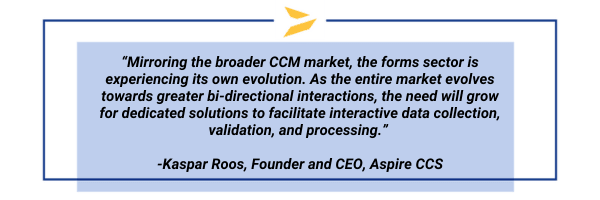
This is a graphic: “Mirroring the broader CCM market, the forms sector is experiencing its own evolution... As the entire market evolves towards greater bi-directional interactions, the need will grow for dedicated solutions to facilitate interactive data collection, validation, and processing.” 

Why IXM Matters Now

With the explosion of communication channels, customers now expect more than just a transactional relationship. They want to interact through their preferred channels, have a streamlined experience, and engage in conversations that feel personal and efficient. Research from our latest Benchmark report found that 83% of customers stated a mobile/web-friendly experience is among one of the most important factors when completing a form. 

While businesses historically had a laser focus on reducing costs and minimizing risks, the new obligation is to meet consumer demand by enhancing the experiences they provide. There’s no doubt that the streaming giant, Netflix, and eCommerce king, Amazon, played a large part in guiding how consumers expect to interact with brands. They want their interactions to be fast (instant), personalized, and efficient.  

With this expansion of priorities, future-forward organizations are connecting the dots between data collection and communications while simultaneously breaking down the barriers thar prevent data from being shared across the organization and used for consistent, accurate interactions. However, the traditional approach isn’t aligning with these evolving priorities.  

Many businesses still gather data via a number of point solutions and manual processes. The data is stored across disconnected systems, limiting their ability to leverage the data to create highly personalized experiences. This not only exposes them to regulatory risk, but it also increases compliance costs and makes for low-quality, unstructured data that requires cleanup before it can be used to offer additional services or make important business decisions.  

Do you know which channels your customers prefer to interact on? Access the 2024 Global Benchmark Report to find out how to leverage a multigenerational, omnichannel approach to customer conversations. 

Benefits of IXM For Your Business 

1. Enhanced Customer Engagement: With the ability to integrate multiple interaction channels, IXM ensures that customers can reach you in the way they prefer, leading to more engaging and efficient touchpoints. 

2. Personalized Experiences: IXM technology allows your brand to provide tailored , digital-first data collection experiences, making customers feel like their needs are being met with precision. 

3. Relevant High-Quality Data: IXM helps collect and manage data effectively, in a structured format, allowing you to make informed business decisions and improve overall customer satisfaction. Consider that low-quality data may be worse than no data at all, potentially leading to manual cleanup, compliance risk, and ill-informed business decisions that can set your company (or worse, the customer journey) back. 

4. Cost Efficiency: Leveraging intuitive forms and self-service applications to facilitate the data collection processes lead to a reduction in expensive calls to customer support/call centers.  

5. Reduced Compliance Risk: Errors throughout sensitive interactions—like the collection of personal identifiable information in a healthcare or financial services setting—can put your business at risk, leading to punitive fines and reputational damage. Traditional methods that are managed and overseen by humans are known to be more error-prone than those that are automated. 

6. Improved Employee Experience: With such a diverse workforce, including employees working remotely or on a hybrid basis, maintaining and boosting productivity has been at the forefront of business leaders’ minds. Giving staff the right solutions and information they need to effectively manage customer interactions (from wherever they’re working) is a necessity.  IXM has the propensity to improve the employee experience by doing just that, which also leads to a better customer experience. 

Conclusion

With 74% of enterprises expanding their CX spend, IXM is the next logical iteration for your customer experience tech stack. If you’re curious about how IXM can specifically impact your industry, stay tuned. In upcoming posts, we’ll delve into industry-specific examples and explore how IXM will elevate your customer relationships. 

Register today to gain complimentary access to the Aspire Leaderboard IXM Grid.