Solutions

Archive and retrieve communications securely with cloud-native speed.

Orchestrate real-time, compliant interactions across every channel.

Simplify and standardize trade and relationship documentation workflows.

Industries

Improve customer engagement across policy, billing, and claims.

Create and deliver personalized, compliant customer communications at scale.

Heighten citizen experience with digital transformation.

Improve customer engagement across utilities.

Resources

Browse popular market research, articles, videos, written guides and more in one convenient location.

Explore upcoming events, webinars, and customer experiences shaping the future of customer conversations.

Get the latest updates on Smart Communications, including product news, and industry recognition.

Company

Learn more about our company, our leadership and how were growing the team!

Analysts

Analysts

Access analyst research, market reports, and industry recognitions featuring Smart Communications.

Your Archive Strategy Isn’t Ready for the AI Era

By Scott Draeger, SVP of Product Marketing and Vertical Solutions at Smart Communications 

When you think about what you archive, you expect your data to be static, stored, and tucked away. But in an environment of constant disruption, your archive needs to be searchable, connected, and ready on demand. 

Too often, organizations assume their archive solution still offers predictable costs, proven technology, and lasting relationships. That’s the complacency talking, because your archive systems and strategies have likely been in place for 10-plus years.  

Your archive and retrieval strategy is probably not ready for the AI Era, and it needs your fresh thinking now. Trends toward customer self-service and AI summarization technology put retrieval-optimized archive technologies like SmartHUB™ in position to transform your organization when legacy approaches may fail to scale while costing you more than you anticipate. 

Why Is Older Technology Problematic?

If you’ve had your archive technology longer than a full retention period, you may consider it reliable and dependable. This may have been true for the scale you operated at when your predecessors initially selected the technology, but a lot has changed since then.  

Most archive solutions deployed around the time of the Sarbanes-Oxley Act were architected around the challenges of the day, which were rising retention periods and high storage costs. The use cases of that era focused mainly on storage and less on retrievals, so they missed opportunities to: 

  • Incorporate metadata for better search and context
  • Manage multiple file formats
  • Reduce retrieval times 

As the context window of LLMs increases, so does the LLM’s appetite for data, documents, and attachments. Some legacy systems attempt to mask these limitations by adding real-time cache technology that sits on top of the legacy architecture. This introduces complex data mapping and prevents your archive from being a single source of truth. 

Today, customers requesting a document from an archive system have attention spans that are in the hundredths of a second. As your CX and Operations teams demand you move more of your customer experiences to self-service, your retrieval needs will exponentially increase. You may be archiving more types of communications from a wider variety of channels. When you add AI summarization to the mix, you may be summarizing thousands or tens of thousands as many documents. This strain will inevitably test your system, adding further delays that erode customer trust. 

Why Will Costs Be Unpredictable?  

Legacy archive solutions were priced around the assumption that storage activity was common, and retrieval activity was rare. To offer more predictability to clients, models about the ratio of storage to retrieval drove pricing discussions. Since storage outnumbered retrievals, vendors and customers agreed that focusing the discussion on storage resulted in a more predictable arrangement for both parties. The storage to retrieval ratio was thousands, or even tens of thousands, to one. 

As organizations look to reduce costs through automation and self-service, the archive’s storage to retrieval ratio starts to change. Customers are using the portal to look at documents and communications in the archive to verify a transaction, share information, or understand more before they expand their relationship. The more they look at older records, the more retrievals they create. Add in AI summarization, and now an AI Agent may read five to 20 documents from your archive to answer a question. This could boost retrieval activity hundreds, or even thousands, of times. 

If your legacy offering attempts to offer a real-time cache solution to reduce retrieval costs, that complexity will come with an additional price tag. As your complexity increases, so does your budget. 

What About My Valuable Vendor Relationships? 

As you look at your legacy technology provider, you may put a lot of value on the relationships you have with your account team. But if your account team hasn’t helped you plan for the impacts that customer self-service and AI summarization place on your archive system, they may not be the best partner. In fact, your account team may eagerly anticipate your CX and AI initiatives, because an extra zero (or two, or three, or four) on your retrieval counts might be the expansion that gets them to President’s Club. 

There’s a Better Way Forward 

The challenges with legacy archive systems aren’t insurmountable—rather, they require a fundamentally different approach. Sophisticated archive solutions like SmartHUB enable rapid migration, migrating hundreds of millions of pages (or more) per week with scalable cloud-based ingestion capabilities. You can retire your legacy technology in months, while bringing the benefits of retrieval–optimized archiving to your customers, employees, and even AI agents.  

To learn more about how Smart Communications helps customers bring their archive and retrieval strategy into the AI era, check out the video below and request a demo of SmartHUB today. 

Our Next Move: Accelerating the Future of Customer Conversations

By Leigh Segall, CEO at Smart Communications

Every great company has defining moments — the milestones that mark not just progress, but transformation. Today is one of those moments for Smart Communications. 

With the official close of our acquisition by international private equity firm Cinven, we continue to build on our strong foundation and unstoppable momentum — entering this next chapter not as a company preparing for growth, but as one already driving it. This partnership will fuel our trajectory, helping us reach even greater heights in innovation, scale, and impact. 

Cinven’s investment signals a deep conviction in our vision: that customer engagement in regulated industries can, and should, be smarter, more connected, and more human. Their global experience scaling technology leaders further strengthens our ability to accelerate that vision and continue setting the standard for what enterprise engagement should be. 

But make no mistake — this isn’t a new direction. It’s an acceleration of the success, leadership, and innovation that defines who we are.

A Future Built on Trust 

For more than two decades, Smart Communications has led the evolution of customer communications — helping the world’s leading enterprises simplify complexity, modernize operations, and deliver customer experiences that build trust. 

We’ve done this by anticipating what’s next — being first to market with a cloud-native CCM platform, expanding into intelligent data collection, and, most recently, launching solutions like SmartHUB™ and SmartPATH™ that have redefined what enterprise-grade engagement looks like in the AI era. 

This foundation — built on trust, innovation, and deep industry expertise — is what attracted Cinven to our business. They see what our customers see: a company already shaping the future of customer engagement and leading this market forward. 

“The conversation around customer communications has changed more in the past three years than it did in the previous decade. Artificial intelligence, automation, and data-driven engagement have captured every boardroom’s attention. Yet beneath the optimism lies a fundamental reality: innovation in customer communication is no longer about experimenting with new tools. It is about orchestrating the entire communication ecosystem so that intelligence, compliance, and customer experience operate in complete sync.” 

—Saurabh Raj, Principal Analyst at QKS Group  

This is the world Smart Communications is already enabling. While others are still defining what this new era means, we’ve been executing it — helping enterprises move from static communication management to intelligent communication orchestration, where every interaction is adaptive, explainable, and trustworthy.

Accelerating What Matters Most 

As we enter this next phase, our focus remains crystal clear: 

  • Advancing our technology with continued investment in AI, automation, and secure cloud innovation that delivers measurable value to our customers.
  • Expanding globally to meet rising demand for compliant, digital-first customer conversations in every market we serve.
  • Driving meaningful outcomes by helping highly regulated enterprises modernize legacy systems, reduce operational friction, and orchestrate connected experiences that build lasting trust. 

“Together with Smart Communications, we see tremendous opportunity to shape the next phase of enterprise customer engagement,” said Thomas Railhac, Partner and Head of TMT at Cinven. “This partnership is about scaling a proven platform, deepening innovation in AI and cloud, and helping customers around the world deliver smarter, more connected experiences.” 

Together, we can move faster, scale further, and deliver more impact than ever before — while staying true to what makes Smart Communications unique: our customer focus, our purpose-built technology, and our people.

Momentum for the Future

2025 has been a year of extraordinary momentum. We’ve launched two major new solutions, deepened our partnerships with global powerhouses like AWS, Salesforce, and Guidewire, and welcomed a growing number of enterprise customers — including some of the world’s most recognized brands. Just as importantly, we continue to earn the trust of long-standing customers who have partnered with us for a decade or more, reaffirming the strength and longevity of our relationships and the measurable value we deliver year after year. 

These milestones reflect more than growth — they represent clarity of purpose. As the lines between customer communications, experience management, and service interactions continue to blur, Smart Communications is already serving as the connective tissue between them. From generation to orchestration to compliance, we’ve unified the conversation layer, helping enterprises deliver interactions that are not only intelligent, but explainable and human at their core. 

We have the platform, the expertise, and the conviction to lead the industry forward. And we have a community of customers and partners who continue to inspire us every day with the bold moves they’re making to transform how they engage with the people they serve.

The Best Is Yet to Come 

This moment is a celebration — of our team, our customers, and the trust we’ve built together.  

With Cinven’s partnership, we are accelerating what’s already in motion. Scaling faster, innovating deeper, and expanding our impact across every industry we serve. 

Together, we’re writing the next chapter of the Smart Communications story. One defined by bold thinking, meaningful innovation, and the drive to make every customer interaction smarter than the last. 

We’ve built this momentum. Now, with Cinven, we’re taking it even further. 

The best is yet to come. 


SmartCOMM™ vs. Legacy Communication Systems: A Buyer’s Guide

By Smart Communications 

When organizations evaluate customer communication systems/tools/software/technology, the decision often comes down to whether to maintain legacy systems or move to a modern, unified solution. Legacy tools may have been sufficient in the past, but today they can create complexity, higher costs, and slower response times. 

In this blog, we compare legacy approaches with SmartCOMM, and outline the differences in efficiency, scalability, and compliance. The goal is to give you a clear, factual framework to support your CCM vendor evaluation. 

What Is SmartCOMM? 

SmartCOMM is an enterprise-level, cloud-based customer communications management (CCM) solution designed to streamline how organizations create, manage, and deliver communications. It replaces fragmented, multi-vendor setups with a single solution that supports both document generation and omnichannel delivery. 

By integrating with existing systems, SmartCOMM helps ensure your customer communications are accurate, consistent, personalized, and compliant. It also adapts easily as business needs, customer expectations, and regulatory requirements evolve. 

Why Legacy Communication Systems Fall Short 

Legacy CCM systems typically rely on disconnected tools to handle print, email, SMS, and archiving. While workable, these setups often create hidden costs and operational inefficiencies that limit growth. 

Other notable challenges with legacy CCM systems include: 

  • High IT overhead: Multiple contracts, upgrades, and maintenance cycles drain resources.
  • Compliance gaps: Disconnected workflows increase the risk of errors and inconsistencies.
  • Slow time-to-market: Making updates can take weeks or months due to siloed processes.
  • Fragmented experiences: Customers receive communications and documents that lack consistency across channels. 

SmartCOMM vs. Legacy CCM Systems: A Side-by-Side Comparison 

Feature 

Legacy Systems 

SmartCOMM 

Inputs 

Manual data entry, limited integrations 

API-based; integrates with core business systems 

Outputs 

Print-heavy, siloed channels 

Omnichannel: email, SMS, portals, print 

Compliance 

Manual checks, higher error rates 

Centralized rules, automated compliance 

Scalability 

Difficult to adapt 

Cloud-based, scales with demand 

Time-to-Market 

Weeks or months 

Days or hours 

User Experience 

Inconsistent and fragmented 

Personalized, consistent, real–time 

Why Buyers Choose SmartCOMM 

Consolidating wtih SmartCOMM has been shown to reduce costs, improve compliance, and deliver better communications. Keep reading to see how one of our customers did just that. 

Case Study: Priority Health 

Priority Health, a leading health insurer, modernized its communications infrastructure with SmartCOMM™. This transformation led to: 

  • 80% Reduction in Development Time: Streamlined claims and authorization processes, significantly cutting down the time required for development.
  • Positive Return on Investment (ROI): Achieved a favorable ROI through enhanced operational efficiency and reduced costs. 
  • Eased IT Administrative Burden: Simplified IT management, allowing internal teams to focus on strategic initiatives rather than routine maintenance.
  • Significant Reduction in External Vendor Costs: Lowered reliance on external vendors, leading to substantial cost savings. 

Looking ahead, Priority Health plans to integrate more documents into SmartCOMM, collaborate with their marketing team for digital transformation, and utilize SmartIQ for enhanced interactive communication and data collection 

To learn more, check out the video below:

See SmartCOMM in Action

Ready to compare for yourself? Schedule a demo and see how you can replace your legacy systems with a modern, unified communication platform. The best part? SmartCOMM demos take less than 30 minutes, are no obligation, and completely free! 

Frequently Asked Questions 

Q: What makes SmartCOMM different from legacy CCM systems? 
SmartCOMM unifies communication and document generation in one system, while legacy systems rely on multiple disconnected tools. 

Q: What formats does SmartCOMM support for input and output? 
SmartCOMM integrates with core business systems using APIs, batch files, or real-time data feeds. On the output side, it supports true omnichannel delivery — including email, SMS, secure portals, and print — ensuring consistent and personalized customer experiences across all touchpoints. 

Q: How difficult is it to migrate to SmartCOMM from a legacy system? 
While any migration requires planning, SmartCOMM is designed to make the transition as smooth as possible. The platform offers flexible integration options, proven implementation methodologies, and expert support to guide teams through the process. Many organizations are able to phase the migration, starting with high-impact use cases and scaling over time. The result is a streamlined communications ecosystem with significantly lower long-term complexity and cost. 

Q: How does SmartCOMM handle compliance?  
SmartCOMM ensures compliance by centralizing rules and automating compliance checks, significantly reducing manual errors and associated risks. By consolidating your communications ecosystem onto a single cloud-based platform, organizations can improve internal efficiency and decrease reliance on IT teams. Regulatory language can be maintained and updated seamlessly across your entire communication portfolio from one place, ensuring consistency and accuracy. Built-in approval workflows, audit trails, and locked regulatory content blocks provide additional safeguards, giving teams confidence that all communications meet compliance standards while streamlining the review and approval process.  

Q: Can SmartCOMM scale as my organization grows?  
Yes. SmartCOMM is cloud-native and built to adapt to increasing volume and evolving needs. 

Top Customer Experience Stats in 2025: Forms & Communications

By Smart Communications 

As you’re thinking about planning and strategy in the year ahead, here’s a quick-hit roundup of some of the most compelling insights from Smart Communications’ 2025 Global CX Benchmark Report—broken into two critical categories: forms and communications. 

Communications 

  1. 84% of customers say communications impact their overall experience with a company—this jumps to 88% among Millennials and 89% in markets like the U.S. and Singapore. 
  2. 75% say communications directly influence their satisfaction with a company. Nearly half (48%) say it drives loyalty—with the U.S. leading at 54%. 
  3. A striking 67% say they’d switch providers if communications don’t meet expectations. That’s up from 51% in 2023—a 16-point jump in just two years. 
  4. 78% say they’d recommend a company if communications exceed expectations. 
  5. Only 62% currently rate the communications they receive as “good” or “excellent”—despite massive investments in CX tech. 
  6. Trust is on the line: Just 63% say they trust their providers most of the time. This dips to 57% among Gen Z. 
  7. 60% of consumers trust companies more when communications are consistent across channels—and younger generations care even more (Millennials: 68%). 
  8. Preferred channels: 
    • Email (43%)
    • SMS (18%)
    • Web/app-based communication (13%).  
  9. Response time matters most in good communications—cited by 89% globally. 
  10. AI’s role is growing: 
  • 61% believe GenAI will improve CX
  • 46% want a human in the loop to check content AI generates
  • 53% see faster response times as AI’s biggest benefit in communications 

11. Channel usage gaps exist across industries (e.g., only 56% of banks use preferred channels, and this is down from 60% in 2024).

12. Generational views differ (e.g., Millennials are most likely to recommend a company based on comms).

13. Trust levels vary by region (e.g., trust highest in USA at 71%, lowest in Australia at 59%).

14. Only 54% overall are satisfied with omnichannel experiences.  

15. GenAI confidence gaps linger (only 46% confident it handles info securely). 

16. AI usage transparency matters to 37%. 

17. Only 13% think GenAI is better than humans at communications. 

18. Biggest benefits of AI in comms: faster responses (53%), accuracy (44%), cost savings (42%). 

19. Top concerns with AI: privacy (49%), lack of human oversight (43%), potential errors (39%). 

Forms/Data Collection 

  1. 66% of people say they’d abandon an interaction entirely if a form is too hard to complete. 
  2. The most important features in a form are: 
    • 92% demand 100% security 
    • 90% want it fast and easy 
    • 85% say only relevant questions should be asked 
    • 83% expect mobile/web-friendly design 
    • 84% want to save progress and return later 
  3. Frustration drivers include: 
    • Repeating info: 60% 
    • Redundant questions: 57% 
    • Lack of save/resume: 49% 
    • Paper/manual processes: 40%, higher among Millennials at 47% 
  4. If the data collection experience is positive: 
    • 64% say they’d stay loyal 
    • 56% would buy more 
    • 54% would leave a good review 
  5. 71% prefer digital self-service over calling—rising to 83% among Millennials. 
  6. 63% prefer guided digital forms over PDFs. This is even higher among Gen X and Boomers (67% each). 
  7. 77% say digital intake is important—especially in healthcare (79%) and among Millennials (84%). 
  8. 66% consider data collection a form of communication. 
  9. Form updates matter: 
    • Over 50% want status updates after submission. 
    • In healthcare specifically, 51% actively want to know the status of their submitted forms. 

10. When people inquire about the status of a request, most still rely on email (44%) or phone (45%). Chatbots remain underused, at just 9–12% usage. 

11. Real-time help desired by 81%. 

12. Status updates post-submission matter to 83%. 

13. Guided digital forms preferred by 63%. 

14. Form issues drive drop-off: too time-consuming (57%). 

15. Too hard to upload documentation: 62% abandon. 

16. Forms are described as time-consuming by 41%. 

17. Forms are a method of communication according to 66% of respondents. 

18. Self-service is preferred by 71% overall. 

19. 79% of healthcare consumers say digital intake matters. 

20. 56% would engage with an organization more if the intake process exceeds expectations. 

Quick Recap and Takeaways of the 2025 CX Benchmark Research 

  • Forms that frustrate users drive immediate drop-offs. Even one confusing step can push users to give up—permanently. 
  • AI-powered customization during intake builds trust—but only if it’s clearly explained and ethically implemented. Over 40% still worry about data privacy and human oversight. 
  • Poor communications fuel churn. It’s no longer just about what you say—but how fast, how clear, and how personal it is. 
  • Consistency across channels isn’t a nice-to-have—it’s a trust builder. Younger generations especially expect seamless, cross-channel experiences. 

Why These 2025 Stats Matter Across Industries 

Customer expectations are rising across the board—but what really matters differs slightly depending on your industry. Here’s how the findings play out in four key sectors: 

Insurance: Retention Is on the Line 

  1. Only 23% of insurance customers say they are very satisfied when making account or policy changes. 
  2. 55% say insurers communicate on their preferred channels—but 14% say they rarely or never do. 
  3. 45% of insurance customers still rely on phone calls for status updates, while email matches at 45%. Chatbots trail at just 9%. 
  4. If the data collection process exceeds expectations, 56% would recommend their insurer and 64% would remain loyal. 
  5. Data privacy and human oversight are major concerns for insurance customers: 
  6. 47% are concerned about privacy 
  7. 43% worry about lack of human involvement in AI-driven comms 

Takeaway: Personalized, omnichannel communications and streamlined digital intake are critical to both winning trust and avoiding churn in a competitive market. 

Get more exclusive insights in our full 2025 Insurance Benchmark Report. 

Financial Services: Communication = Confidence 

  1. Only 28% of FS customers are very satisfied with their experience making changes to their account. 
  2. Banks & FS providers are only hitting the mark 56% of the time when it comes to using a customer’s channel of choice—down from 60% in 2024. 
  3. Trust is fragile: Only 63% of customers say they trust their bank or FS provider “always” or “almost always.” That’s down from 68% last year. 
  4. 61% say they’d drop out of a form-based process if it’s too difficult. 
  5. When submitting forms, 43% want updates on their request status—but only 12% use chatbots to inquire. 

Takeaway: In Financial Services, clarity and confidence go hand-in-hand. Fast, secure, and intuitive interactions—especially around data collection—are table stakes. 

Watch the video below for more FS benchmark insights, then check out the full report. 

Healthcare: Data Intake Drives Loyalty 

  1. Only 24% of customers are very satisfied with their service when making changes to an account. 
  2. 51% of healthcare customers want status updates after submitting forms—more than any other industry. 
  3. 70%+ say they’d abandon a form if it’s too time-consuming or asks for the same information repeatedly. 
  4. 79% of healthcare customers say it’s important to offer digital data collection instead of manual processes. 
  5. Healthcare organizations lead in AI adoption willingness: 
    • 54% find AI-generated health advice valuable 
    • 57% of Millennials say AI-generated health recommendations would improve their experience 

Takeaway: Simplifying forms and communicating proactively—especially around coverage, claims, and status—can significantly improve satisfaction and trust. 

Discover more surprising stats in our full 2025 Healthcare Benchmark Report. 

Healthcare Communications Should Be Personalized and Prompt 

  1. Just 24% of healthcare customers are very satisfied with provider experiences when making account or information updates. 
  2. Email and phone are still dominant—but 57% of customers prefer communications via web, mobile app, or encrypted messaging. 
  3. 51% of healthcare consumers expect updates on form status, especially Gen Z and Millennials. 
  4. 63% of healthcare customers say they’re likely to use digital self-service for support tasks—rising to 73% among Gen Z and Millennials. 
  5. 81% of healthcare customers say they’re more likely to recommend a provider if communications exceed expectations. 

Takeaway: Healthcare organizations have an opportunity to deepen trust by offering fast, secure, and channel-flexible experiences—especially with younger, digital-first patients and members. 

For more insights into the research, including filterable views across geographies, demographics, and industries, access the full interactive Benchmark experience now. 


Smart Spotlight: Alvyn Cheang on Life at Smart

By Smart Communications

At Smart Communications, our people are at the heart of everything we do. Through our Smart Spotlight series, we celebrate team members whose passion, dedication, and impact help shape our success. 

This month, we’re excited to feature Alvyn Cheang, Senior Solutions Consultant in Singapore. Keep reading to learn more about Alvyn, what he loves about the work he does at Smart, and what he gets up to when he’s not working. 

1. What is your role at Smart and how long have you been with the company? 

I am the Senior Solutions Consultant based in Singapore. Prior to holding this position, I was with Smart Communications from March 2020 to September 2022. In my current role as a Solutions Consultant, I work to ensure our prospects and customers understand how our products and services solve some of their business challenges and help achieve better customer experiences as part of their communications journey. 

2. What did you do for work prior to joining Smart, and why did you make the switch? 

Prior to joining Smart Communications, I worked for a CPaaS company called Vonage (now part of Ericsson) as a Solutions Consultant helping customers in their last mile communication journey via multiple different channels from Messaging, Voice and Video experiences. 

Rejoining Smart Communications was a natural step, as the quality of the team was always the company’s greatest asset. Having worked with some of them previously, the decision to come back and make an impact on a newly expanded region was an easy one. 

3. What’s kept you at Smart? 

The strength of the company lies not only in its SaaS-first product stack but also in the people and the culture of support across the organization. The combination of innovative technology and a collaborative environment creates a truly unique experience. The product stack itself is constantly evolving—keeping pace with, and often moving ahead of, market expectations.  

The challenges that arise in an ever-changing business environment bring a sense of adventure and purpose. Each challenge brings an opportunity to grow, experiment, and contribute to solutions that have real impact. Supportive colleagues and exciting problem-solving makes the day-to-day experience both rewarding and enjoyable. 

4. What skills are needed to be successful in your role/on your team? 

Combining strong technical skills with consultative skills is key to success. The ability to tell a story and bridge the gap between business and technical capabilities is critical to this role. Success also requires adaptability in a dynamic environment with the ability to think on the spot, but most important is to have empathy. Building trust will drive the engagement through with the customers.  

5. What’s your favorite aspect of your job? 

Not knowing what you are getting into when you meet the customer. The best and most fun part of the job is trying to understand the prospect’s challenges, as each is unique in its own way; this requires creative problem solving and adaptability. Helping customers understand not just what the product does, but also how it solves their pain points in a practical way, keeps things engaging at the same time.  

Most important is the impact the solution presented to the customer. It’s great when they come back and tell you what you pitched to them really made their lives easier and had a meaningful impact on their operations.  

6. What are you doing when you’re not working? 

Outside of work, I’m a total movie junkie. Nothing beats grabbing some popcorn, sinking into those cinema seats, lights dimming, and being completely immersed in a story with surround sound booming around you and the big screen magic. Streaming at home is great, but nothing beats the cinematic experience  

Inserting image... 

If you’re interested in joining our dynamic team, we invite you to explore our current opportunities on our Careers page. 

Navigating the Future of Healthcare Engagement: Smart Communications Included in Forrester’s Q4 2025 Customer Experience Platforms Landscape

By John Zimmerer, VP of Healthcare Marketing at Smart Communications

Payers and providers looking to create personalized and empathetic healthcare customer experiences will need to modernize their engagement strategies. Forrester’s “The Customer Experience Platforms For Healthcare Landscape, Q4 2025” (Forrester Research, October 2025) offers a comprehensive overview of 27 vendors with engagement offerings. Among them, Smart Communications stands out for its robust capabilities in addressing extended use cases that are critical to improving healthcare customer experience.

This blog post summarizes key insights from the report and explores how Smart Communications’ suite of products—SmartCOMM™, SmartIQ™, SmartPATH™, and SmartHUB™—can help healthcare organizations meet rising consumer expectations, particularly in areas like benefits and coverage inquiries, chronic condition management, and estimating cost of care.

The Evolving Healthcare Experience Landscape

Forrester defines customer experience platforms for healthcare as technologies that orchestrate personalized experiences across every touchpoint—from plan selection to care delivery and payment. These platforms are designed to foster sustained engagement, build trust, and unlock operational efficiencies.

The report’s authors note that healthcare organizations (HCOs) are under pressure to:

  • Deliver a better total experience that drives loyalty.
  • Sustain engagement to improve clinical and financial outcomes.
  • Reduce costs through automation and streamlined operations.

The report highlights that the U.S. health insurance industry ranks lowest in customer experience among 10 tracked industries. This underscores the urgency for payers to invest in healthcare customer experience platforms that can clarify benefits, respond empathetically, and empower consumers with actionable information.

Smart Communications: A Notable Vendor in the CX Landscape

Smart Communications is one of the 27 vendors included in Forrester’s report. Our company is recognized for its focus on extended use cases that go beyond basic transactions like scheduling and care navigation. Specifically, Smart Communications selected the following top three extended use cases as areas of strategic focus:

  1. Benefits and Coverage Inquiry
  2. Chronic Condition Management
  3. Estimating Cost of Care

These use cases are increasingly important as consumers demand clarity, personalization, and transparency in their healthcare journeys. Smart Communications’ inclusion in this report signals its commitment to helping HCOs meet these healthcare customer experience demands through intelligent, scalable communication solutions.

Addressing Benefits and Coverage Inquiries with Smart Communications

One of the most frequent and frustrating pain points for healthcare consumers is understanding their benefits and coverage. Confusing language, inconsistent formats, and lack of personalization often lead to member dissatisfaction and increased call center volume.

Smart Communications addresses this challenge through:

  • SmartCOMM, which enables dynamic, personalized document generation—turning complex benefit information into clear, easy-to-understand communications.
  • SmartIQ, which powers intelligent forms that guide members through interactive coverage inquiries, reducing friction and improving self-service.
  • SmartPATH, which orchestrates communication workflows to ensure timely delivery of benefit updates and responses.
  • SmartHUB, which centralizes member communications across channels, allowing for compliant and cost-effective communication storage and retrieval.

By leveraging these tools, payers can reduce inbound inquiries, increase member satisfaction, and build trust through transparency and responsiveness. Providers can reduce patient effort and relieve staff burden while securely handling health information.

Supporting Chronic Condition Management

Managing chronic conditions requires ongoing engagement, personalized education, and proactive communication. Forrester notes that many vendors are investing in capabilities that support this use case, and Smart Communications is among them.

Smart Communications enables chronic condition management by:

  • Delivering personalized care plans and educational materials through SmartCOMM.
  • Using SmartIQ to collect patient-reported outcomes and health status updates via interactive digital forms.
  • Coordinating outreach campaigns through SmartPATH to remind patients of appointments, ensure medication adherence, and provide lifestyle tips.
  • Providing a centralized communication hub via SmartHUB that streamlines the storage and retrieval of critical communications.

These capabilities help providers stay connected with patients, reduce readmissions, and improve health outcomes—all while enhancing the patient experience.

Estimating Cost of Care: Empowering Consumers with Transparency

Cost transparency is a growing priority for healthcare consumers. Forrester’s healthcare customer experience report emphasizes the importance of clear, fast resolution to cost-related inquiries, which are often a source of confusion and anxiety and drive calls to call centers.

Smart Communications supports cost estimation by:

  • Generating personalized cost-of-care summaries using SmartCOMM, tailored to individual coverage and treatment plans.
  • Enabling members to submit cost estimation requests through SmartIQ forms that guide them through the necessary inputs.
  • Automating responses and follow-ups via SmartPATH, ensuring timely and accurate communication.
  • Providing a centralized view of cost-related communications through SmartHUB, helping members make informed decisions.

These tools empower consumers to understand their financial responsibilities, avoid surprise bills, and plan for care more effectively.

Why Smart Communications Stands Out

Smart Communications differentiates itself in several key ways:

  • End-to-end communication orchestration: Unlike point solutions, Smart Communications offers a unified platform that spans document generation, form automation, workflow orchestration, and omnichannel delivery.
  • Personalization at scale: The platform uses data-driven logic to tailor every interaction, ensuring relevance and clarity.
  • Compliance and trust: Smart Communications embeds data protection and privacy into its workflows, helping HCOs meet regulatory requirements while building consumer trust.
  • Flexibility and integration: The platform integrates with existing systems and adapts to evolving business needs, making it a future-proof investment.

The Road Ahead: What Forrester Predicts

Forrester’s report outlines several trends that will shape the future of healthcare customer experience platforms:

  1. Agentic AI will become essential—but must be deployed thoughtfully to avoid overpromising and underdelivering.
  2. Consolidation will accelerate, with HCOs seeking end-to-end platforms to replace fragmented point solutions.
  3. Rapid change will continue, driven by regulatory shifts, economic pressures, and rising consumer expectations.

Smart Communications is well-positioned to thrive in this environment. Its platform not only meets current needs but also provides the agility and innovation required to adapt to future challenges.

Smart Communications: A Strategic Partner for Healthcare Engagement

As healthcare organizations strive to improve engagement, reduce costs, and build trust, the choice of a healthcare customer experience platform becomes a strategic imperative. Forrester’s Q4 2025 report provides valuable guidance, and Smart Communications emerges as a strong contender for payers and providers looking to address complex use cases like benefits inquiries, chronic condition management, and cost estimation.

With its intelligent, integrated platform, Smart Communications helps HCOs transform transactional interactions into meaningful engagements, driving better outcomes for both consumers and organizations.

For more on the future of healthcare engagement, download a complimentary copy of Forrester’s report.

Why Data Quality and Data Literacy Matter—For Everyone in Your Organization

By Sally Schulte, Senior Product Marketing Director

In today’s data-driven world, the success of any organization hinges not just on having data, but on having pristine, consistent, traceable data. High-quality, reliable data is no longer a “nice to have.” It’s a strategic asset that powers speed, decision-making, innovation, and growth.

Despite this, many organizations still treat data as a necessary burden to conduct business versus a strategic product that offers a competitive edge. And many employees view data as someone else’s responsibility—something technical and distant from their day-to-day work. But bad data impacts every part of the business, from product development and analytics to automation and efficiency.

That’s why data literacy must extend beyond IT departments and data teams. Everyone in your organization, from marketing and communications to operations and customer service, needs to recognize the value of reliable, accurate, and accessible information—and understand the role they play in ensuring and protecting good data.

Treating Data as a Strategic Product

To succeed today, organizations must adopt a new mindset where data is seen not as a secondary output of operations, but as a core product—deliberately gathered, maintained, and optimized for use. Making this shift requires intentional decisions from business leaders to:

  • Assign ownership across the organization
  • Enforce standardization to ensure consistency
  • Maintain version control and tracking
  • Align on how data will be used across the company

In the CIO.com article “5 actions to build an AI-ready data culture,” executives like Mike Kreider, CIO of DHL Supply Chain North America, explain why their organizations have fully embraced this approach. “We don’t want orphaned data products no one feels responsible for,” explains Kreider, because shipment data products support everything from daily operations to business development and also fuel generative AI tools like DHL’s proposal generator. “If the data product doesn’t exist or isn’t clean, the tool won’t work,” he emphasizes.

The Hidden Cost of Poor Data

When data is incomplete, inaccurate, and old, the effects ripple across the organization:

  • Inefficiency: Teams spend hours making corrections, chasing down missing information, and entering the same data in multiple systems.
  • Flawed decisons: Business strategies get built on erroneous assumptions.
  • Eroded trust: Customers feel the pain through incorrect outcomes, delayed service, and irrelevant (and potentially insensitive) messaging.

According to Gartner, bad data can cost organizations as much as $12.9 million per year. That’s not just inefficiency—it’s an alarmingly large, missed opportunity.

While your company deals with databases that don’t reconcile or forms that never made it back from the mailroom, your competitors are making real-time decisions, extending automation, and strategically capitalizing on AI-based initiatives. They’re innovating faster, responding to customers quicker, and identifying trends before you do. In the modern landscape, poor data isn’t just a nuisance—it’s a competitive risk.

Outdated Collection Methods Are Holding You Back

Legacy data collection processes—like fillable PDFs, mailed forms, or manually entered spreadsheets—are unreliable and inefficient. They’re prone to human error, data loss, and delays. Worse, they create silos that slow down collaboration and decision-making.

Organizations that still rely on these outdated processes are falling behind. Cloud-based digital tools, automated workflows, and real-time data integration have raised the bar. If your team is still waiting on mailed-in forms or deciphering handwritten notes, you’re not just behind the times—you’re making decisions in the dark.

Data Literacy is Everyone’s Job

To unlock the value of high-quality data, organizations must foster a culture of data fluency where every employee understands how data is used, why accuracy matters, and how their work contributes to data quality. This doesn’t mean everyone needs to become a data scientist. It means giving people the tools and training to handle data responsibly and thoughtfully.

From the frontline employee entering customer data, to the manager interpreting reports, to the executive setting strategy—everyone plays a role. One careless entry or one unvalidated data source can ripple across systems and decisions.

The Bottom Line

High-quality data fuels confident decision-making, better customer experiences, and faster innovation. But it doesn’t happen by accident. It requires modern tools, reliable collection processes, and a shared commitment across your organization.

Companies that continue to rely on legacy methods and treat data as someone else’s job will find themselves increasingly outpaced by more agile, data-savvy competitors. In contrast, organizations that prioritize data quality and fluency will be positioned not only to survive—but to lead.

Now’s the time to ask: Is your organization treating data like the critical asset it is?

Ready to take your data collection up a notch? Our “Ultimate Guide to Forms Automation” is packed with info you can use to optimize data intake and deliver more impactful interactions with customers. Read it now.

Reflecting on LIMRA: Meeting Market Challenges Through Better Connections

By Eileen Potter, VP of Insurance Marketing at Smart Communications 

Attending LIMRA’s annual conference this year was both energizing and thought-provoking. As always, it provided a chance to connect with industry leaders, explore the latest research, and reflect on how Life & Annuity (L&A) organizations can adapt in a challenging market. The sessions covered a wide range of topics, including future-proofing the workforce, shifting consumer expectations, and the role of technology. 

One standout session was “Engaging the Next Generation – Global Strategies for Attracting Under 40 Consumers,” which featured insights from Luca Russignan, Head of Insurance, Capgemini, and Aaron Seurkamp, SVP & President, Protective Life Insurance, and was moderated by Bryan Hodgens, Senior Vice President, Head of Research, LIMRA and LOMA.  

Drawing on joint LIMRA and Capgemini research, the discussion highlighted how younger consumers view life insurance through a very different lens than prior generations. They expect transparency, simplicity, and a digital-first experience that mirrors what they receive from tech and retail leaders.  

The panel emphasized that reaching this demographic requires more than just new products – it requires rethinking how insurers communicate value, simplify the buying process, and create interactions that feel relevant to life stages and lifestyle needs. For me, it reinforced how critical modern communication strategies are, not only to build awareness but also to educate, engage and earn trust from the next generation. 

Life Insurance Awareness Month: A Timely Reminder 

September is Life Insurance Awareness Month, which makes this an especially good time to consider how well our industry is connecting with customers. The campaign helps shine a spotlight on the importance of life insurance in protecting families and ensuring financial security. But awareness alone does not move the needle. 

Customers need to understand not only why life insurance matters but also how to navigate the process of researching, buying, and maintaining a policy. That requires clear, consistent, and personalized communication at every stage of the journey. Unfortunately, many people still find insurance communications confusing or overwhelming – and the idea of life insurance either irrelevant, unaffordable – or both.  

If customers can’t understand what they’re buying or feel unsure about their insurer’s ability to support them, they are more likely to look elsewhere. Improving how we communicate isn’t optional – it directly impacts trust, satisfaction, and long-term relationships. 

Pressures from Rising Expenses 

Another challenge that came through clearly at LIMRA is the ongoing pressure insurers face to reduce expenses. The cost of maintaining legacy systems, processing paper-heavy workflows, and managing manual interactions continues to strain budgets. Add to that rising distribution costs, regulatory compliance requirements, and talent shortages, and the financial pressure only intensifies. 

But cutting costs cannot come at the expense of customer experience. The real opportunity lies in finding ways to drive efficiency while improving engagement. Streamlining processes, eliminating redundant systems, and enabling more digital self-service can significantly reduce operational expenses. At the same time, these improvements can make communications faster, clearer, and more personalized – turning cost control into a customer-centric strategy. 

This balance between efficiency and empathy will be critical for L&A organizations that want to remain competitive in a marketplace where margins are tightening, and expectations are rising. 

Compliance Pressures as an Industry-Wide Challenge 

A theme that surfaced throughout many sessions was the operational pressure created by compliance and regulatory change. Speakers from across the industry noted how increasing oversight adds complexity to already resource-constrained environments, and how organizations are looking for ways to respond without overwhelming staff or customers. What struck me was the repeated emphasis that compliance-driven communications don’t have to feel like obligations or distractions – they can be reframed as opportunities to build clarity and trust.  

Ultimately, modernizing communication processes and embedding transparency into every interaction can ensure that L&A organizations can meet regulatory requirements and strengthen their relationships with their customers.  

Moving from Obligation to Opportunity 

Traditionally, customer communications in insurance were often treated as a compliance obligation: required notices, regulatory disclosures, and policy documents. While those are still essential, they shouldn’t define the entire communication strategy. 

Forward-thinking L&A organizations are reframing communications as opportunities for engagement. Imagine the difference between a dense, jargon-filled letter and an interactive digital message that not only explains a policy update but also provides links to additional resources, FAQs, or even a short video. One feels like a chore to read; the other feels like support. 

This shift from obligation to opportunity will separate the leaders from the laggards in the years to come. And it’s not just about technology – it’s about mindset. 

Enhancing the Human Side of Digital 

One concern that often comes up in conversations about modernization is the risk of losing the human touch. When digital tools are used thoughtfully, they enhance empathy and personalization. 

For example, rather than sending a one-size-fits-all communication, insurers can tailor messages based on life events, customer preferences, or behavioral insights. Instead of asking customers to fill out lengthy paper forms, they can guide them through digital interactions that are clear, intuitive, and supportive. 

This is especially critical in life insurance, where the subject matter is inherently emotional. Customers want reassurance that their insurer understands them as individuals, not just policy numbers. By combining digital efficiency with empathetic communication, insurers can strengthen trust and loyalty.  

Looking Ahead 

LIMRA reminded me that while the challenges facing L&A organizations are significant, they are also surmountable. We are not powerless in the face of rising expectations, market volatility, or cost pressures. We have the tools – and, increasingly, the urgency – to modernize the way we communicate and engage. 

As Life Insurance Awareness Month highlights, this work is not just about balancing budgets or managing operations; it’s about ensuring that more people understand the value of life insurance. That means every communication, every interaction, and every engagement must be clear, relevant, and meaningful – helping insurers reduce costs while also deepening connections. 

The industry may not be able to control interest rates, regulatory shifts, or the next disruptive competitor. But we can control how we connect with customers. And that, more than anything, will define the insurers who succeed in the years ahead.  

Interested in learning more about how Life & Annuity insurers are rethinking customer engagement? Download our latest white paper and see how your organization compares. 


Meeting Section 1557 Language Access Requirements with SmartIQ: A Smarter Way to Translate Vital Forms

By John Zimmerer, VP of Healthcare Marketing at Smart Communications 

Ensuring equitable access to health services is more than a moral imperative, it’s now a legal requirement. Section 1557 of the Affordable Care Act (ACA) is the cornerstone of nondiscrimination in healthcare, prohibiting discrimination based on race, color, national origin, sex, age, or disability. One of its most impactful provisions mandates meaningful language access for individuals with limited English proficiency (LEP).

For health insurers, this means translating “vital documents” which includes forms, into multiple languages—a complex, resource-intensive task. Fortunately, there is a solution. 

Understanding Section 1557 and Its Language Access Mandate 

Section 1557 applies to any health program or activity that receives federal financial assistance, is administered by the Department of Health and Human Services (HHS) or was established under Title I of the ACA. This includes most health insurers, managed care organizations, and marketplace plans. 

The 2024 Final Rule, effective July 5, 2024, and enforceable by July 5, 2025, strengthens language access requirements. Covered entities must take “reasonable steps” to provide meaningful access to LEP individuals who are eligible to be served or likely to be directly affected by their health programs. This includes: 

  • Providing qualified interpreters and translators
  • Ensuring timely and accurate language assistance services
  • Translating written materials deemed “vital documents”
  • Avoiding reliance on unqualified interpreters or machine translation without human review 

What Are Vital Documents? 

Vital documents are those which are critical to accessing services, understanding rights, or making informed decisions. Examples include: 

  • Enrollment forms
  • Claims and appeals forms
  • Prior authorization requests
  • Consent forms
  • Appeal and grievance forms 

Failure to translate these documents can result in unintentional discrimination, legal liability, and poor health outcomes. 

The Challenge for Health Insurers 

Translating vital documents is not just about converting words, it’s about ensuring cultural and linguistic accuracy, maintaining regulatory compliance, and managing operational complexity. Health insurers face several challenges: 

  • Volume and variety of forms: Insurers manage hundreds of forms across different lines of business.
  • Multiple languages: Depending on the state, insurers may need to translate documents into the top 15 non-English languages spoken in their service area.
  • Frequent updates: Regulatory language, branding, and form content change regularly.
  • Decentralized processes: Forms are often managed by different departments, leading to inconsistencies and inefficiencies. 

These challenges make compliance with Section 1557 both critical and difficult. That’s where SmartIQ comes in. 

SmartIQ: A Smarter Way to Translate and Manage Forms 

SmartIQ by Smart Communications is a low-code enterprise forms automation platform designed to streamline data collection, form management, and digital workflows. For health insurers, SmartIQ offers a powerful solution to meet Section 1557’s language access requirements efficiently and effectively. 

Key Capabilities That Support Section 1557 Compliance 

1. Centralized Form Management 

SmartIQ enables insurers to manage all form processes from a single platform. Whether forms are used for enrollment, claims, appeals, or prior authorizations, SmartIQ centralizes design, updates, and deployment. This ensures consistency across departments and reduces the risk of non-compliance. A single digital experience can orchestrate data collection from multiple parties, with each person viewing the experience in their native language. At the end of the process, collected data and documents can be passed to core systems or archived (including in our SmartHUB™ solution). 

2. Multi-Language Support in a Single Project 

One of SmartIQ’s standout features is its ability to support multiple translations within a single form project. Form designers can upload translations for all text elements—titles, questions, instructions, and page names—using a CSV file. The platform then dynamically presents the form in the user’s preferred language based on their profile or a query string parameter (e.g., ?lang=es-ES).  

This eliminates the need to create and maintain separate form versions for each language, dramatically reducing administrative overhead. 

3. Human-Validated Translation Workflow 

Section 1557 requires that machine translations be reviewed by qualified human translators when accuracy is essential. SmartIQ supports this by allowing form designers to manually input and validate translations. The CSV export/import process ensures that translations are accurate, culturally appropriate, and compliant with regulatory standards. 

4. Mobile-Responsive and Accessible Design 

SmartIQ’s mobile-responsive technology ensures that translated forms are accessible on any device. This is crucial for reaching LEP individuals who may rely on mobile phones for internet access. The platform also supports accessibility standards, helping insurers meet broader nondiscrimination requirements under Section 1557. 

5. Role-Based Authorization and Audit Trails 

SmartIQ includes role-based access controls, ensuring that only authorized users can make changes to form projects. This supports compliance with privacy and data integrity requirements. Audit trails track changes and approvals, providing documentation for regulatory reviews. 

6. Real-Time Data Integration and Workflow Automation 

SmartIQ integrates with core systems using RESTful APIs and supports real-time data validation. This means that translated forms can be pre-filled with known information, reducing errors and improving user experience. Automated workflows route completed forms to the appropriate departments, speeding up processing and reducing delays. 

Real-World Impact: Efficiency, Compliance, and Equity 

By leveraging SmartIQ, health insurers can: 

  • Ensure compliance with Section 1557’s translation requirements
  • Reduce costs associated with manual translation and form duplication Improve speed to market for new or updated forms
  • Enhance member experience by providing culturally and linguistically appropriate services
  • Mitigate legal risk by maintaining accurate records and audit trails 

In essence, SmartIQ transforms a regulatory burden into an opportunity for operational excellence and health equity. 

Getting Started with SmartIQ 

Implementing SmartIQ is straightforward. The platform offers: 

  • Drag-and-drop design tools for non-technical users
  • Sandbox environments for testing translations and workflows
  • Training options ranging from online courses to hands-on sessions
  • Usage-based pricing aligned with form volume 

Health insurers can start by identifying their most critical forms—those classified as vital documents—and uploading translations using SmartIQ’s CSV template. From there, they can build workflows, integrate with core systems, and deploy forms across multiple languages. 

Conclusion: SmartIQ as a Strategic Compliance Asset 

Section 1557’s language access requirements are clear: health insurers must provide meaningful access to LEP individuals by translating vital documents and offering qualified language assistance services. While the mandate is complex, SmartIQ offers a smart, scalable, and compliant solution. 

By centralizing form management, supporting multi-language projects, and enabling human-validated translations, SmartIQ empowers health insurers to meet regulatory requirements while improving member engagement and operational efficiency. 

In a healthcare system striving for equity, SmartIQ is more than a technology platform—it’s a strategic partner in delivering inclusive, accessible care. 

To learn more about how SmartIQ handles language translation, request a demo to see how one project can support multiple languages. 

Optimizing the Omnichannel Customer Experience: 3 Quick Takeaways from Our Benchmark Research

By Smart Communications

People are using more communication channels than ever to interact with companies, with most sources pegging the figure between six and 10. These range from classics like email, phone, and print to newer options like SMS, RCS, self-service portals, and more.

Is your company ready? 

Smart Communications recently surveyed 3,000 consumers across regulated industries to better understand their experience. The results highlight both the importance of delivering a strong omnichannel experience and how far companies still need to go to match these expectations. (Explore the interactive Benchmark Experience.)

Let’s take a look at three key findings from the research, and what they mean for organizations aiming to improve customer engagement, boost journey completion rates, and earn deeper loyalty.

1) There isn’t a clear consensus on what channel customers prefer.

Despite the seemingly endless rumors of email’s demise, it remains the go-to choice for most customers to receive communications from businesses, with 43% selecting it as their top option. Yet four other communications channels—SMS, web portal/mobile app, encrypted messages, and print/mail—also scored in double digits, indicating there’s no dominant preference.

The picture gets even more muddled you when you drill into age and regional differences across the globe:

  • SMS: 27% of millennials favor this channel (the most of any age group), as do 38% in Austria, 37% in Japan and 25% in Germany 
  • Encrypted Messaging: About one-fourth of consumers in China, Hong Kong, and Taiwan prefer encrypted messaging platforms such as WhatsApp
  • Web Portal/Mobile App: Twenty percent of DACH consumers favor interacting with companies via this channel, the highest of any region in the study
  • Print: Nearly one in five in the UK prefer their communications via print—including 22% of Gen Xers and 24% of Boomers
  • Email: The #1 choice of consumers in nine of the 12 countries surveyed, but figures varied from a high of 73% (New Zealand) to a low of 18% (Austria)

The bottom line? Across your customer base, preferences are likely to vary regarding communication options—and they often shift within the same individual depending on the type of communication, timing, and context.

What You Can Do: Develop a strategy to begin to capture digital identifiers such as email addresses and phone numbers to align a more seamless transition to digital communications now (or when the time is right). Also, audit the processes and legacy technologies you have in place to ensure you can meet customers’ communication preferences while maintaining message consistency, brand standards, and compliance. Explore new approaches and solutions as needed.

2) Consistent omnichannel experience is critical.

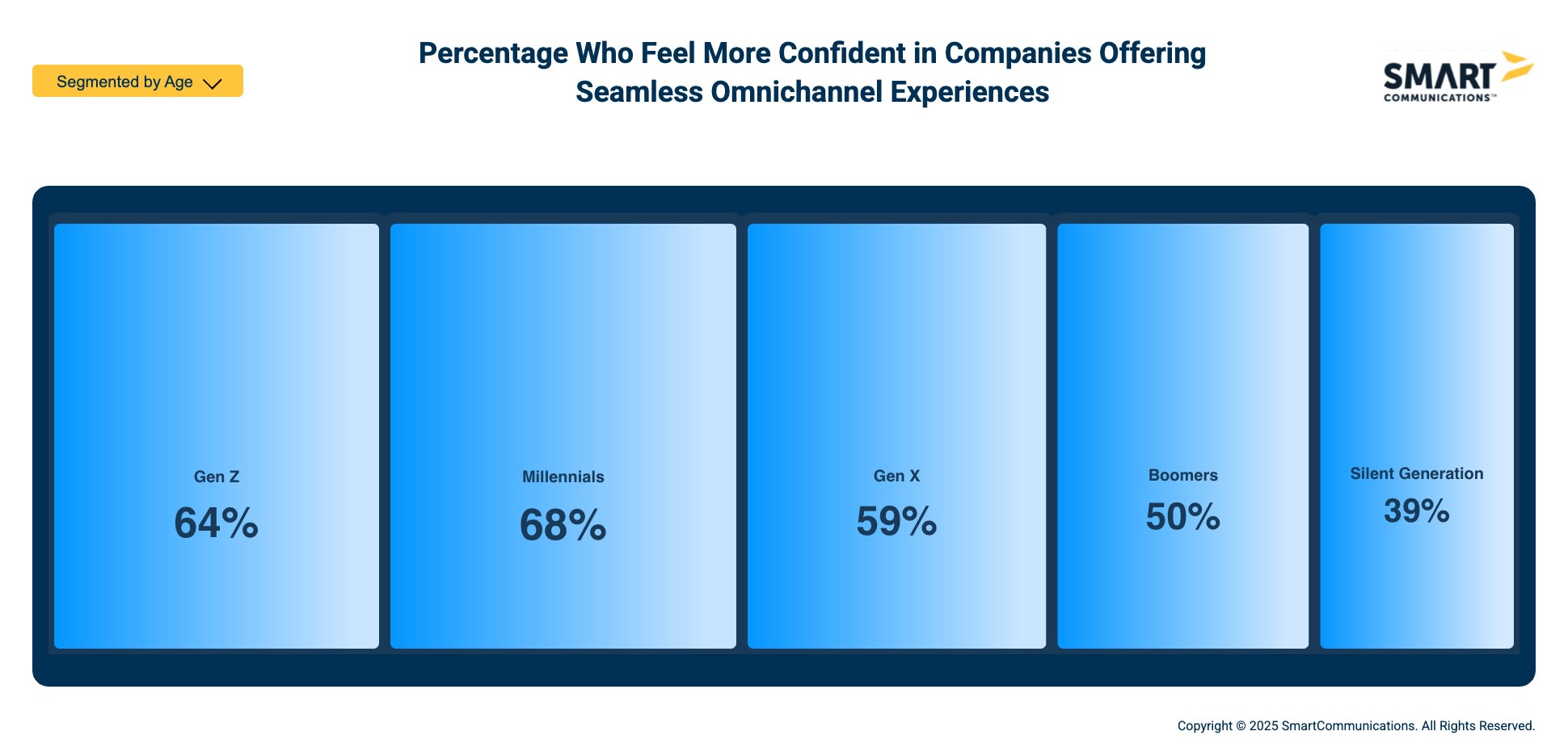
As communication channels have multiplied, customer experiences across them often vary widely—and that’s a costly mistake. Smart Communications’ benchmark research indicates 80% of consumers across financial services, healthcare, and insurance industries say cross-channel consistency is important to their relationship with providers. Specifically, 60% feel more confident in companies when the omnichannel experience is seamless.

Graph: Percentage Who Feel More Confident in Companies Offering Seamless Omnichannel Experiences

This sentiment isn’t just a soft metric—it directly affects the bottom line. According to the study, 67% of customers are likely to switch providers if their communications fall short of expectations. Beyond retention, the quality of the customer experience can fuel business growth: 78% will recommend providers to a friend if communications exceed expectations.

What You Can Do: Review the way communications are generated and delivered across channels. Are there mechanisms in place, from data collection to communication generation to journey orchestration, that ensure communications complement one another rather than confuse or frustrate customers?

3) Many companies are failing to deliver the experience customers want.

Barely half (54%) of customers in 2025 are satisfied with the omnichannel experiences their providers deliver. That’s a notable drop from 60% in 2024, and it should serve as a wake-up call for organizations who are simply pushing messages across multiple channels rather than orchestrating seamless experiences that drive the outcomes customers (and businesses) want.

What You Can Do: Review the customer journey and look for opportunities to enhance the experience, such as:

  • Duplication of content between channels, which can damage your brand reputation
  • Points of frustration that lead to high-cost customer service calls or unnecessary administrative tasks
  • Failure to switch channels for follow-up, which can lower completion rates

Once you’ve pinpointed areas for improvement, map out processes and technologies that can help automate these tasks—or even leverage AI innovations to level up your efforts. With Smart Communications’ SmartPATH™ solution, for example, agentic AI-empowered workflows can gauge customer sentiment during two-way text messaging and adjust interactions in real time. 

Want to take a deeper dive into all things omnichannel? We’ve got you covered—our “Ultimate Guide to Omnichannel Orchestration” provides a comprehensive manual for creating and delivering personalized journeys that keep customers engaged and interactions moving forward. Check it out now.


Frequently Asked Questions

1) Where should companies start if they’re just beginning their omnichannel journey?

Start small by selecting a single workflow or journey to improve, rather than trying to transform everything at once. Focus on automating repetitive tasks, centralizing templates for consistency, and testing how different channels integrate with one another.

This phased approach builds quick wins and creates a strong foundation you can scale—expanding into multiple campaigns or business units and layering in AI decisioning for sentiment analysis and smarter routing across channels. Over time, AI can make it far easier to scale these personalized, automated, and secure experiences across the enterprise—faster and more efficiently than human teams alone could achieve.

2) What role does AI play in improving the omnichannel experience?

AI is rapidly becoming a critical driver of enhancements in the omnichannel experience. Beyond traditional automation—also a key component of omnichannel orchestration—AI can help perceive customer sentiment through various data inputs, independently adapt communications based on customer behavior, and learn continuously from outcomes and feedback. It can also understand natural questions, interpret intent, and determine the most effective response or next step in the journey. By increasing personalization and reacting to customer behaviors at scale, AI is powering the next generation of omnichannel customer experience.

3) How can Smart Communications help organizations improve their omnichannel strategy?

SmartPATH™ brings omnichannel orchestration to the Conversation Cloud™ platform, purpose-built to manage mission-critical, regulated communications across every channel. With intelligent decisioning, AI agent-enabled workflows, and real-time analytics, SmartPATH keeps conversations connected and customers engaged—whether through email, SMS, WhatsApp, RCS, or traditional print failover when digital delivery isn’t possible. (Related reading: “4 Ways SmartPATH Helps Unlock the Power of Omnichannel Orchestration.”)

Its low-code orchestration canvas empowers business users to design and adapt workflows quickly, while enterprise-grade compliance ensures regulatory alignment at every step. By unifying channels, automating manual tasks, and delivering personalized interactions at scale, SmartPATH reduces costs, accelerates digital transformation, and drives more consistent outcomes for customers and enterprises alike.

Check out the video below for a quick primer on SmartPATH: