Solutions

Archive and retrieve communications securely with cloud-native speed.

Orchestrate real-time, compliant interactions across every channel.

Simplify and standardize trade and relationship documentation workflows.

Industries

Improve customer engagement across policy, billing, and claims.

Create and deliver personalized, compliant customer communications at scale.

Heighten citizen experience with digital transformation.

Improve customer engagement across utilities.

Resources

Browse popular market research, articles, videos, written guides and more in one convenient location.

Explore upcoming events, webinars, and customer experiences shaping the future of customer conversations.

Get the latest updates on Smart Communications, including product news, and industry recognition.

Company

Learn more about our company, our leadership and how were growing the team!

Analysts

Analysts

Access analyst research, market reports, and industry recognitions featuring Smart Communications.

3 Ways Insurers Can Prioritize Technology Investments to Improve CX

3 Ways Insurers Can Prioritize Technology Investments to Improve CX

By: Neil Greathead,  CCO at Smart Communications

Having meaningful customer conversations has always been important, especially for insurance companies. But due to COVID-19, more customers are looking to insurers for security and guidance, forcing them to challenge the status quo in order to effectively respond to the drastic increase in customer demands. As a result, many insurers are questioning where they should prioritize their investments. Here are three important thoughts to consider to ensure you are focusing on the most important elements.

Determine Where You Want to Go First

Be realistic and pick your battles! When it comes to making technology investments to support digital transformation initiatives, remember it’s a marathon not a sprint. How do you need the investment to make a difference within your organization? Is the goal to grow revenue? Reduce expenses? Improve customer satisfaction? Knowing the answers to these questions will help identify which technology systems will bring the most value to the company – these are likely the systems you’ll want to get in place first. Investing in a modern customer conversations platform can move the needle on all of these priorities.  By enabling enterprises to engage in interactive, real-time conversations across multiple channels, and giving consumers choices when it comes to channel preference will lead to deeper customer trust and loyalty, and ultimately increased ROI.

Identify The Right Integration Approach

Now more than ever, insurance providers need to be able to take full advantage of insurtech and other CX-focused technologies to meet the growing needs of the customer. To create a more seamless customer journey, McKinsey & Company reveals it’s crucial that insurers build a flexible API-based architecture that supports a quick integration of offerings that are vital to providing a more cohesive customer experience.  By selecting a customer conversations platform that allows for key pieces of customer-facing technologies to be easily integrated, insurers can provide a more holistic view of the customer, quickly adjust and adapt to customer communication preferences and leverage data insights to break down silos in order to increase internal efficiency as well. According to Patrick Knight, Regional Vice President, UK Insurance at Salesforce, “Insurers need to leverage the wealth of data they have been collecting for all these years across all of their businesses and silos to make journeys that are easy, joined up and use the customer’s channel of choice.”

Consider The Entire Customer Lifecycle

Keep in mind that customer experience is informed at multiple points across the entire customer lifecycle. Look at the various reasons a customer interacts with you and identify all your customer touchpoints.  Are there interactions that are causing friction? This will give you a better idea of which interactions should you hone in on more urgently. For example, think about your forms processes. Are you still expecting customers to complete paper-based forms or fillable PDFs that are not mobile friendly and are prone to errors, or are you collecting information via more intelligent, conversational user experiences?  By selecting a conversations platform that can transform the forms experience and then use the information collected to deliver more personalized and relevant communications you can have a positive impact on customer experience from onboard to servicing and every interaction in between. You’ll also gain a better understanding of customer workflows and can identify which interactions can be done strictly via chatbots and virtual assistants and which require more in-depth, personal conversations.

There’s no denying that the increased importance on digital interactions has taken unprecedented priority for insurers. If you’re looking for more inspiration on how to overhaul your customer conversations strategy by capitalizing on new technologies, watch our webinar, Leveraging technology to drive the next phase of customer engagement:  from trust to hyper-relevance, or download the full summary here.

FCA Compliance: Consumer Duty and the Impact on Financial Services Communications

By: Karen Oakland, VP of Financial Services Marketing at Smart Communications 

One of the key industry regulators in the U.K., the Financial Conduct Authority (FCA) has introduced a new directive aimed at protecting banking and financial advisory consumers, which has significant compliance implications for more than 58,000 businesses in the region. Following on the heels of its Vulnerable Customer regulation, the FCA’s new Consumer Duty regulation addresses not only the ways in which financial institutions communicate with their customers, but also how easy they make it for customers to engage in return. 

Consumer Duty was rolled out quite quickly – and with the FCA’s final guidance spanning 121 pages, it’s a lot to take in. Many organizations are wondering exactly how it will affect them and what they need to do to ensure FCA compliance. Let’s look at what this new regulation means and how you can leverage it as an opportunity to improve customer communications and service, rather than an obstacle to work around. 

What is Consumer Duty and When Do FCA Rules Apply?  

Consumer Duty is a set of rules for financial services firms that enforces greater consumer protections. Banks must align to its overarching principles: that communications sent to consumers should be easy to understand, products and services should meet their needs and offer fair value, and consumers should be able to get the support they need, when they need it.  

The FCA developed these Consumer Duty compliance guidelines to enforce these principles as part of a paradigm shift it hopes to influence in both the culture and conduct of financial institutions. Financial services and insurance firms operating in the U.K. were required to have an implementation plan in place for FCA compliance with Consumer Duty by October 2022, and need to have rules in place for open products and services by July 2023 and for closed products and services by July 2024. (Note that organizations in the U.S. market are seeing similar regulations from the Consumer Financial Protection Bureau / CFPB.) 

FCA Compliance Implications for Financial Services 

Several of the Consumer Duty’s key requirements call for firms to improve the customer experience. If your business operates in the U.K., while it’s easy to view these as more regulatory hoops to jump through, they present an opportunity for your organization to assess current communications across the entire customer journey and identify where and how you can do better. Here are three examples. 

1) Fast-Tracking Customer Support 

One Consumer Duty requirement dictates that firms must “provide helpful and accessible customer support.” That means making it faster and easier for consumers to get the answers they need, and not making them wait so long for an answer that they give up.  

To comply with this mandate, firms will need to centralize processes for collecting client information, so that it can be used to trigger automated responses and so that it’s available to support contact center agents or financial advisors in real time. In addition, firms will need to offer more robust self-serve options on digital and mobile channels, such as smarter chatbots, to save customers from having to call a contact center and wait on hold. The goal should be to make it possible for customers to get whatever help they need in the most convenient way possible – on the channel of choice. 

2) Revising Communications for Clarity and Readability 

Consumer Duty also requires firms to provide timely and clear information so consumers can understand the products and services they buy and make sound financial decisions. Rather than burying key details in lengthy terms and conditions that few people actually read, firms must work to make communications clear and readable, and be able to prove that they’ve taken steps to optimize their communications. 

Additionally, financial services firms must provide products and services that are right for clients – that is, personalized to their needs. This means organizations must provide clear, transparent communications that guide clients to the right decision for their unique circumstances. This also means maintaining a full audit trail showing when and how communications are updated for FCA reporting. 

3) Shining the Light on Communication Pain Points 

Consumer Duty is all about making things easy for the customer by asking financial institutions to optimize their communications – to make sure customers understand things like the cost of the financial products they own and how to use their benefits. In addition to reviewing and optimizing customer communications, firms can take this opportunity to review common journeys to identify when and where customers or even employees get hung up or are likely to abandon a process and find ways to improve.  

Solving for common pain points is also an opportunity to boost customer satisfaction and retention. In an uncertain economy, customer trust is more important than ever – and can become a key differentiator as consumers tighten their purse strings and approach new products and investments warily.  

FCA Compliance in Practice Across Financial Services 

Let’s take a closer look at Consumer Duty by considering three use cases where clear communication is essential to allow customers to make informed choices. 

Lending Communications 

To ensure positive lending experiences, banks need to make it easy for customers to understand the cost of credit. That means providing total transparency into interest rates, fees and penalties, and clear guidance on how to complete processes such as closing an account or paying off a loan. All customer communications must be consistent and accessible to facilitate informed decision making. 

One roadblock to achieving streamlined lending transactions is disparate communication streams which limit visibility, introduce the chance of costly errors and increase compliance risks. Using a cloud-based communication platform that’s integrated with core systems like CRM and other data sources is important for breaking down internal silos and ensures a single source of truth for a unified approach to agreements. By applying the directives of Consumer Duty, banks can offer customers clearer access to the capital they need. 

Communicating About Investing Risks 

FCA compliance with Consumer Duty also compels wealth management companies to improve transparency in how they communicate with investors; firms must disclose advisor incentives up front as well as potential risks. They need to make it easier to engage, for example enabling clients to complete risk assessment interviews over digital channels instead of blank fillable PDF or web forms. 

Further, as clients increasingly expect advisor availability across multiple channels and time zones, organizations will need to adapt to deliver on Consumer Duty’s customer support requirements. By embracing two-way, digital-first conversations, wealth management companies can steer clients toward gainful investments no matter where they are. 

Insurance Interactions Made Easier 

Consumer Duty will shift the pension and life insurance industry toward greater customer-centricity as firms are required to make their products easier to understand and use. In the realm of claims in particular, insurers will have to show urgency, empathy and proactiveness in the way they communicate. Digital-first technologies like AI, automation and omnichannel communication delivery can help bring policyholders the efficiency, speed and service consumers deserve. 

Three Ways Smart Communications Can Help with FCA Compliance 

Smart Communications can help your organization comply with Consumer Duty by simplifying and automating customer conversations across every channel.  

First, our forms automation software enables you to turn static, paper- or PDF-based forms into dynamic, two-way digital conversations powered by data in your core system. By eliminating unnecessary questions and complex if/then statements, it’s easier for customers to understand what they’re signing up for. In addition, pulling customer data from connected systems reduces the effort required to fill out applications for loans, credit cards and other products, while also increasing accuracy. Forms automation also supports the need to deliver better digital and mobile self-service, so customers can stop and start processes on different devices for added convenience. 

Next, our SmartCOMM™ customer communications management (CCM) platform enables you to centralize and manage all of their customer communications for greater visibility and transparency across every line of business. Using business rules, you can deliver across any channel, from digital to print, with just a single template. In addition, SmartCOMM provides an audit trail detailing when communications were changed, what was changed, and by whom, to enable reporting for the FCA or other regulators. 

Finally, our built-in content intelligence capabilities mean that you can gain true insight into the effectiveness of both communications and forms processes. Understand where customers are getting stuck in an interview, where questions or processes can be improved, and how to enhance customer communications across the lifecycle. With our Content Intelligence module you can evaluate the readability, sentiment and tone of communications to make sure they are both empathetic and effective.  

Compliance with FCA Consumer Duty: An Opportunity in Disguise 

While the FCA’s Consumer Duty rules only apply to firms serving customers in the U.K., it’s part of a global movement by regulators towards increasing consumer protections in financial services—one that’s also being advanced in the U.S. No matter where in the world your business operates, it’s time to improve customer communications and add transparency to product offerings. It’s time to put customers first.  

Given the constantly changing requirements in financial services, insurance and other highly regulated industries, compliance teams need the ability to manage and monitor changes to customer communications. Adopting an agile, cloud-based CCM platform alongside a forms automation solution will allow firms to provide consumers with clear, consistent, accessible information to make better decisions. That’s good for the consumer, and the business.  

Ready to discuss your compliance challenges and how Smart Communications can help you mitigate risk? Let’s Talk! 

7 Questions to Ask a New Vendor Before Switching from Legacy to Cloud CCM Software

By: Brad McGeown, Vice President of Strategy, Financial Services at Smart Communications 

Making the most out of every customer interaction is an essential part of any enterprise and having the right SaaS Customer Communications Management (CCM) software in place makes a big difference as organizations across all industries continue to focus their investments into sophisticated tech that enables their workforces to be more agile, efficient and future-ready. While many business leaders are on board with the digital transformation from legacy to cloud, there’s still a lot of progress to be made. Here’s what Kaspar Roos, Founder & CEO at Aspire, had to say about investing in newer tech: “If there’s a gap between where your business is today and where the industry is going, the longer you wait, the bigger that gap becomes and the deeper the chasm that you need to cross. It’s not a question of ‘if’ you need to make the leap to newer tech, it’s ‘when’.” 

If you’re looking at making a switch from a legacy on-premise to cloud-based CCM solutions, it’s important to ask certain questions before signing a new vendor contract. In this article, we highlight key questions to ask a CCM vendor when planning to migrate (or consolidate CCM systems) – to help you streamline the planning process and ensure a justifiable investment. 

RELATED READING | ‘Building a Business Case for Change’ 

Top Questions to Ask a CCM Vendor 

  1. Is subscription-based more expensive than licensed? Not necessarily. With a license, you pay a large purchase fee upfront to buy the software, then usually pay perpetual maintenance fees that are a percentage of the purchase price. With a subscription, the upfront software license cost is typically lower, and then annual license fees are typically broken out evenly across the life of the subscription agreement. However, that license also gives you the benefit of software upgrades, without having to spend money on new licenses and IT resources to implement the changes, so your total cost may end up lower. One thing to note is that companies can get upgrades with on-premise software, so long as they’re prepared to manage the upgrade process in-house or hire professional services, depending on the number of customizations needed. 

  2. Will I have to pay maintenance costs and/or do maintenance of the software? No, all hardware and software purchases and maintenance of the software are part of the subscription fee. Your software provider/vendor maintains the environment and keeps it patched to the latest versions and standards in alignment with your terms of purchase. This minimizes IT involvement – a relief for many! 

  3. What are the business benefits of operational expenditures (OpEx)? Historically, many technology purchases fell into capital expense budgets amortized over time, which made them more challenging to manage in the budget. However, with cloud-based software, many organizations manage them as operational expenses instead. This provides for greater flexibility in finance, allowing businesses to adjust their expenses quickly in response to changing market conditions or business needs. That flexibility enables companies to stay agile and adapt to new opportunities or challenges quickly.  More on this topic is at the end of the article.  

  1. What hardware will I need to purchase? Cloud-based CCM solutions have little to no hardware to purchase, procure, implement and manage. All infrastructure needs are handled by the solution provider and in most cases, your new tenant environment can be stood up within hours of an agreement being finalized. On a private cloud, versus public cloud servers like AWS or hybrid, each tenant’s data is isolated from, and invisible to, the other tenants sharing the application instance.  

It’s also important to note the benefits of retiring legacy systems. Retiring legacy infrastructure can lead to significant cost savings and security improvements for organizations. This article from CIO.com dives into the true cost of aging infrastructure, emphasizing the importance of deploying modern solutions that reduce maintenance costs, improve security and reduce the risk of downtime or data loss. There are also cost savings associated with more efficiency and productivity as teams are equipped with software that helps them work more effectively. 

KEEP READING | ‘Smart Communications Recognized as a Leader in the Aspire Leaderboard for Vendor Hosted SaaS CCM, AnyPrem CCM & CXP!’ 

  1. What security measures are in place to protect my customer data? A reliable SaaS provider will uphold strict physical, technical and administrative security measures. They will provide you with all independently certified standards. For example, SmartCOMM has a robust security team dedicated to maintaining certification IRAP, PCI DSS, SOC 1 and SOC 2, HIPAA, ISO/IEC 27001 certifications, and other industry standards.  

  2. Where will my data be stored? It depends on the software that you are acquiring; some SaaS solution providers only use the data to process and return results and do not store data in the cloud. Some may have a need to store it, so it is important to understand what data is used, how it is used and stored, as well as who has access to it. A quality SaaS provider will have the latest encryption standards in place to protect data.  

  3. How do you handle disaster recovery? Check with your SaaS provider to understand where their disaster recovery site is located, if it stays within the same national borders and how and when the data between the two sites is synced. They will provide insight and results from past and planned disaster recovery tests. 

How CapEx and OpEx Budgets Are Impacted by Cloud Software 

Capital budgeting is a financial planning approach that focuses on long-term investments. Capital expenditures (CapEx) involve purchasing assets that will benefit the company over time, such as equipment or property.  On the other hand, operational expense (OpEx) budgeting focuses on the day-to-day operational costs of the business. For instance, SaaS CCM software that is hosted on the cloud and is subscription-based, is considered an operating expense. 

Capital expenditures associated with private cloud/hybrid may encompass the acquisition of hardware, such as servers or the establishment of a data center, thereby qualifying as CapEx. A pure SaaS CCM software subscription will require zero hardware purchases. Traditionally, the purchase of on-premises software constituted a capital expense that could be amortized over time for accounting purposes. In such cases, software was accounted for as a one-time expenditure as opposed to a subscription model. It was feasible to procure the software once and continue using it indefinitely, even ceasing to pay maintenance fees if so desired.  

Today, subscription-based software purchases typically result in the buyer obtaining a license but they do not own anything so it can only be expensed not capitalized. This can be an advantage in terms of flexibility and reduced hardware costs, but it also means that businesses do not have full control over the software's development or customization. 

Overall, a SaaS CCM software model helps businesses reduce the high costs associated with on-premises technology which requires a significant investment in hardware, licensing and maintenance, whereas SaaS allows businesses to scale to real-time needs and avoid the need to track the ‘highest need’ day. 

Conclusion 

Ultimately, the vendor you choose when switching from legacy to cloud CCM software should have rigorous standards for security and data privacy. Also consider which professional partnerships they offer as any leading CCM provider should be able to provide integrations that help enterprises be more agile, efficient and less dependent on IT resources. Don’t forget to look for these additional benefits: 

  • Reduced total cost of ownership

  • Enhance customer experience 

  • Consistent innovation and product investments 

  • Enhanced speed and agility 

Want to learn more about how a leading cloud CCM provider can enhance your business? Read ‘The Ultimate Guide to CCM Software & Strategic Solutions’  

Digital Acceleration in Insurance

Digital Acceleration in Insurance

By: Thomas Harrington, Global Industry Markets Leader for Insurance at Pega

As the COVID-19 pandemic continues to wax and wane across the globe, now is the time for insurers to use the digital acceleration triggered by the crisis to reinvent themselves as digital-first businesses fit for the 21st century.

In the U.S., the unemployment rate reached 14.7% in April, a level not seen since the Great Depression in the 1930s. The U.K. saw its highest rate of welfare support claims in six years; and a 3% rise in unemployment is forecast for Asia Pacific. Many insurance regulators have implemented guidance for payment grace periods or temporary protections to prevent policy cancellations. But as mandated forms of help expire, a significant number of consumers will reach out with questions and concerns about their insurance portfolios.

Tackle customer service volumes with digital channels

Industry leaders are asking, “How do we weather immediate customer service challenges and prepare for the new normal?” Requests related to premium holidays, policy options, hardship withdrawals, and rebates are increasing, yet closed offices and distributed workforces slow the ability to respond. As the volumes of inquiries increase, the ability to scale capabilities to distributed workforces, capture a policyholder’s questions or concerns, connect the data from all of these channels and mobile apps, and provide an accurate response is exposing major operational gaps.

The insurance business over the last few decades was built around an inbound model where you wait for something to happen and then react. By contrast, a digital-first experience creates opportunities for customers to engage how they want, and when they want. Increasingly, this means self-service through digital interfaces. This frees time and capacity to deliver more personal and empathetic service to customers who have more complex queries. It’s not just taking some volume off the plate; it’s a fundamentally different thought process.

Digital servicing options help address these pressures now and prepare for the increasingly digital-first preferences of future consumers. In many cases, you can stand up a digital service capability that connects with your systems of record and other apps within days. Examples of the most cost-efficient ways to do this are:

  • Reduce manual work by automating email – Email bots can process thousands of incoming emails and email attachments fast. Natural language processing capabilities can read, triage, and route incoming mail. You can even automate responses to simple inquiries and personalize the messaging.
  • Intake and track requests to provide responsive and accurate customer service – Integrate your current systems and apps to capture, triage, and route customer inquiries to the right person or team. Systems should be designed to adapt to changing business processes and regulatory requirements, to help you streamline operations and provide an auditable trail of actions for all customer inquiries.
  • Unify messaging in a single desktop – Seamlessly connect digital channels and enable agents to smoothly navigate among conversations to deliver efficient user experience. Virtual assistants work alongside agents to help contain service volumes and deliver immediate answers to common inquiries.

Examples of success with this digital servicing approach include an insurer with an at-home workforce that used both chat and email bots to help improve customer service response times; and a government agency that was able to design and implement a case management-based economic assistance app in just five days.

Start engaging proactively with your policy holders

Another way to mitigate customer service volumes is to get ahead of them. Don’t wait for that phone call. If your data shows a customer is experiencing a financial hardship or their needs have changed, proactively reach out. Provide something as simple as the initial steps to submit a claim or arrange a payment to mitigate policy cancellation. An empathetic approach goes a long way in letting customers know you understand their situation and value their relationship.

Think big, start small, scale fast

Companies trying to navigate their way through an uncertain world can be forgiven for feeling overwhelmed. So, start with something small and grow. Do not think about the end point in five years’ time, but about what you can achieve in the next two weeks, the next 60 days, or the next 90 days to deliver value that will make a tangible difference to your customers.

It’s important to think pragmatically as you start any project in the digital space; recognize that you are making initial forays and it’s highly likely that what you do will be changed at some point. This mindset of build and grow puts you in a different stance to build long-term success. More importantly, immediate improvements should be foundational elements of a digital experience that enables insurance carriers to change, expand, and automate servicing today and in the future.

Luckily, implementing new digital tools and leveraging a case-based approach to eliminate operational complexity and deliver customer outcomes does not require ripping and replacing existing systems. It just requires focusing on one customer outcome at a time and building from there. For example, think about the steps needed to respond to and complete a claim status request. Pega calls this a microjourney – an interaction that is part of a customer’s overall journey with your business. By focusing on the steps needed to complete that one microjourney, you define the data you need to access and define the rules for the channels you’ll use to connect with your customers. When you build those processes and rules into the operational layer of your architecture, you can easily reuse and modify them for other microjourneys. Pega calls this building from the center out – an approach that helps businesses transform across all channels and systems. A center-out approach not only frees staff to spend more time helping customers with complex inquiries now, but also enables them to deliver the customer experiences of the future.


About the Author
Tom Harrington, Global Industry Markets Leader for Insurance at Pega

In his role as Global Industry Markets Leader for Insurance at Pega, Thomas Harrington works with leading organizations to drive performance, customer experience, and revenue growth through digital transformation.

To hear more from Thomas and Neal Keene, Field Chief Technology Officer at Smart Communications, watch the on-demand webinar: Digital Acceleration in Insurance: Meeting New Demands at Speed or read the webinar recap.  

Customer Experience Takes Center Stage at Bank Automation Summit

Automation has always been seen as a pathway to greater operational efficiency, but most banking operations and IT people I met at the Bank Automation Summit this month are aiming at a different higher purpose: better customer experience – for both external clients and internal employees and teams.

We were delighted to sponsor this spring event and get back to meeting with banking executives face to face in Charlotte, N.C. I was particularly excited to discuss trends in automation around commercial lending in a panel alongside Daniel Seay, SVP of Wholesale Transformation at Fifth Third Bank, Ahul Verma, CIO of BMO Personal and Business Banking and Chris Gufford, General Manager of Commercial Product at our partner nCino. We talked about a variety of issues and best practices, including how banks are looking to remove friction to meet changing customer expectations for speed of delivery.

Seay noted that the biggest area of focus for Fifth Third is leveraging third-party services and data in smarter ways to support faster turn times. We also discussed the importance of taking a hybrid approach, empowering clients to interact digitally while still supporting the human element provided by relationship managers.

Panelists discuss trends in automation around commercial lending In addition to the panel discussion I was a part of, I also enjoyed several of the other sessions led by banking executives. Here are a few highlights and takeaways from the sessions:

Using Automation to Make Banking Seem Effortless

John Elton, CIO for TIAA Bank, said he views the goal of process automation as making banking transactions easier so that they feel almost effortless to clients. “We need to take a look at the industry to change our focus from looking at single departments to looking at all of the interactions in the process and the customer journey,” Elton said. That’s one reason the company has an enterprise Center of Excellence focusing on automation projects.

The team breaks down customer expectations into five key areas of focus:

  1. Safety and security
  2. Availability
  3. Performance
  4. Speed to market
  5. Cost

Customers know when something is inefficient, Elton stressed. Even if they can’t see inefficiency in the back office, they can feel it. Echoing the comments from Seay of Fifth Third Bank, Elton said turnaround time is a key part of improving that customer experience, especially for areas like commercial lending that require a lot of documentation and data collection. Improving business processes around new customer acquisition is a priority for the bank this year.

Eliminating Human Error and Reducing Banking Compliance Risks

Changing the culture of a bank that’s been around for 200+ years isn’t easy. But that’s just what Dominic Cugini, CIO of Service Digitization for KeyBank, has been doing to help the bank look and operate like one that was born digital. Like TIAA Bank, the team has focused on removing human error from repetitive tasks through Robotic Process Automation (RPA). “We had people rekeying data from system to system. To maintain data quality, we need to keep digital data digital,” Cugini said.

In automating processes around the Paycheck Protection Program, the KeyBank team was able to squeeze what he estimated was nine years of work into just two weeks, putting approximately 160 automated bots in production in that time. “RPA saved our bacon,” he declared. Current focus areas for RPA include looking at automating fraud reduction and reducing overall security risks to the business.

Improving Employee Experience Equally Important

In addition to external customers, internal employee experience is also a key focus area for banking automation, as noted by Ami Iceman Haueter, VP of Research and Digital Customer Experience from MSU Federal Credit Union. “Identifying pain points from the people perspective is important,” she said. “Simplifying their day-to-day so they can do less monotonous work.” The company has invested in an internal chatbot named “Gene” that has created significant efficiency in employee-to-employee communications, she added.

Some of the biggest applause came for Cugini as he inspired attendees with a line from basketball great Michael Jordan: “Some people want it to happen, some wish it would happen, others make it happen.” It takes mental strength to create and manage change in organizations, he noted. But for people who push back and say they don’t have time to innovate, or they think a process is too complex and difficult to change, he says: “Great – you know what happened to the dinosaurs.”

If you’re comfortable with a mask or otherwise feel safe, I hope you’ll take the opportunity to head out to meet with your peers at a conference this year. We have a full events calendar in the next few months that includes DocuSign Momentum in San Francisco, Digital Banking Summit in Austin, Texas, and Financial Services Customer Experience in London. And of course, we’re excited to meet you at our annual INNOVATE conference in Nashville May 18-20. Stay tuned for INNOVATE dates for London and Sydney later in 2022.

Could Postal Delays Lead to an Increased Focus on the Digital Customer Experience?

By: Sally Schulte, Director of Product Marketing at Smart Communications

Beginning Oct. 1, the U.S. Postal Service implemented “new service standards” that could slow target delivery times by about 30%. While this will obviously have implications for online holiday shoppers in the near term, it will also have a long-term impact on how industries like insurance, healthcare and financial services communicate important information to their customers. Wells Fargo even notified customers of the potential interruptions – pointing out that the delivery delays could impact customers’ mailed payments.

As enterprises face disruptions on all fronts – whether it’s USPS, supply chain delays, natural disasters or a global health crisis– it’s critical for businesses to reimagine interactions with their customers—and focus on their digital customer experience.

This post highlights why digital customer experience solutions are key to business continuity, how companies can efficiently reach customers on their preferred channels and how an enterprise cloud-based customer conversations solution can protect the business.

Accelerating Digital Transformation for Business Continuity

The latest development from USPS has the potential to disrupt millions of individuals and companies—and further solidifies how important business continuity and contingency planning are. Constant change and disruptions mean enterprises need to be responsive and agile – something only achievable via digital transformation.

When COVID-19 took hold, 65% of business leaders indicated that the pandemic led them to identify digital-first approaches they could implement quickly. In many industries, employees continue to work from home at least part time while customers now overwhelmingly expect (and prefer) digital-first interactions. Investing in digital customer experience solutions and implementing organizational changes will allow enterprises to put the customer at the center and seamlessly manage the experience across functional areas.

Orchestrating Omnichannel Customer Experiences

With the recent announcement from USPS, companies need to rethink how they get critical information to their customers – and vice versa. Today’s customers expect to be able to initiate conversations on their own terms, making two-way, digital conversations more important than ever.

Every interaction a business has with a customer is an opportunity to shape their overall experience and in today’s always-connected landscape, customers’ expectations are increasing quickly. With the majority of customers more comfortable with digital, they prefer to interact with businesses across a number of channels.

SMS, in-app messaging and WhatsApp are just a few of the channels where customers want to be able to initiate conversations with businesses. Unfortunately, many organizations have siloed tools that only allow for one-way, single-channel communications. This ultimately leads to internal inefficiencies, compliance risks and an inconsistent customer experience. An omnichannel, orchestrated approach, however, puts the customer at the center of two-way, interactive conversations – achievable with a cloud-based platform that optimizes the entire customer experience.

Owning the Customer Experience with Two-way Conversations

Whether it’s USPS or another service provider, relying too heavily on third parties to shape the customer experience poses risk for businesses. And, this risk will only continue to grow. Today, leading enterprises should own the entire digital customer experience, from start to finish.

Conversations between businesses and customers have never been more important, especially as customers prefer a digital-first, personalized approach. And since customers’ expectations will only continue to increase, enterprises must optimize the end-to-end experience to succeed. Businesses must provide the tailored, personalized conversations today’s customers expect. Investing in pure cloud platform that delivers personalized, omnichannel conversations across the entire customer lifecycle is the best way to succeed.

—

Customer expectations will only continue to evolve, making it more critical than ever for enterprises to invest in the resources and technology that future-proof their businesses. No one knows what the future holds or what the next disruption will be, but investing in the right technology (and technology partners) that evolves and scales as customer needs change over time will be critical to long-term success.

How can businesses deliver impactful, relevant and personalized conversations at scale? Check out “Deliver SMARTER Customer Conversations in the Cloud” to learn more. 

Cloud-based Customer Communications: Choosing the Best CCM Solution for Your Business

By Simon Tindal,  CTO of Smart Communications

No longer a buzzword, the cloud is here to stay! With an anticipated 17.3 percent growth in public cloud revenue in 2019, more and more organizations are turning toward cloud-based customer communications to strengthen satisfaction and retention. Anyone who has done their research already knows there are a multitude of terms being used to describe cloud deployment models.  And even the most tech-savvy agree that interpretations of “the cloud” can get a bit foggy.

If your organization is starting to warm up to the idea of a cloud-based customer communications solution, it’s time to familiarize yourself with the various deployment options available to find the solution that best fits your needs. To help guide you in your cloud-buying journey, here are four criteria to look for as you choose a modern CCM system to ensure you find the solution the best fits your needs and allows you to fully reap the benefits only a solution truly built for the cloud can deliver.

Faster Time to Market

According to a Keypoint Intelligence-InfoTrends report, speed of production and execution was a top reason many enterprises opt for a cloud-based customer communications solution. Sure, your on-premise solution will eventually get the job done, but is the downtime and maintenance hindering your speed to market? Those still holding on to their legacy systems are likely leaving innovation on the table and falling behind the competition.  A cloud-based solution improves speed by drastically reducing time spent maintaining a local IT infrastructure, freeing up resources to allow organizations to better prepare for anticipated market changes. The cloud also improves business agility, allowing companies to go to market faster, thus maintaining a competitive edge. On-premise legacy solutions that are now hosted in the cloud are limited with fixed resources, making it challenging to scale.

PRO TIP: Ask vendors how frequently their platform is updated. Platforms that are updated frequently and automatically push these updates live to their customers (vs. relying on IT departments to manage complicated upgrades), making it easy to stay ahead of the curve.

Interoperability

Legacy platforms initially built for on-premise deployment likely still rely on outdated technology standards, offer limited APIs, and are unable to integrate with key elements within the customer’s technology stack. As cloud services become more important to today’s organizations, so is the need for interoperability, or the ability for cloud services to connect with and understand each other’s APIs. A true cloud-based CCM solution is equipped with a suite of API integrations and is built with modern standards to enable seamless implementations, giving enterprises immediate access to the latest innovative tools. For example, SmartCOMMTM’s Conversation CloudTM is an all-in-one cloud solution that connects all your data, applications, and history to build conversations that are relevant and impactful, time after time, making it easier to increase internal efficiencies and scale personalized interactions.

The key is finding a platform that offers the flexibility needed to take your customer communications to the next level.

PRO TIP: Examine how extensive a vendor’s API suite is and look for technology that’s built with modern standards to facilitate interoperability. Look for vendors that have a published API set as this will lead to easier interoperability.

Enhanced Organizational Efficiency

A CCM solution that’s truly built with the cloud in mind increases productivity by enabling employees to work together through the number of tools available in the cloud. Cloud-based communications solutions have the power to break down organizational data silos, making it easier for employees, customers and third-parties to communicate and collaborate. Rather than relying on IT as the go-to data source, a cloud-based CCM solution equips organizations with enhanced data visibility across departments, making it easier to decide which users have what level of access to what data. This also streamlines work efficiencies and increases collaboration as staff will know which communication documents are directly assigned to them.  Imagine having one version of a document that can be worked on by different people – with the cloud, there’s no need to have multiple copies of the same document in circulation!

PRO TIP: Ask vendors how users can interact with the software to avoid reliance on other divisions within the company for data insights and how quickly important upgrades are implemented. A software that’s truly designed with business users in mind should be more than willing to demonstrate these essential capabilities.

Improved Customer Satisfaction

Easier access to customer data allows organizations to create a more consistent and rewarding experience throughout the entire lifecycle as they have greater insight into behavior patterns and individual communication preferences.  As technology continues to grow and evolve, customers expect organizations to keep up or else they will gladly find another option that better serves their communication preferences. As you explore cloud-based communications solutions, it’s important to look for platforms that can easily deliver communications via multiple channels based on customer preferences and allow for recent interactions to inform subsequent outreach to that customer—even allowing a conversation to start on one channel and continue on to another.

PRO TIP: Look for a platform that is poised to deliver interactive, on-demand, and batch communications across multiple delivery channels, and can future-proof your customer preferences as new channels emerge.

Making the choice to invest in a cloud-based customer communications solution is an important step in an organization’s digital transformation journey. It’s also likely one of the biggest investments your business will make. Make sure you fully understand the nuances and the benefits only a platform built from the cloud up can deliver.

For more insight to help guide your cloud-based CCM buying journey, download our latest thought leadership, Conquering the Brave New World of Modern, Cloud-Based Customer Communications Management: A Buyer’s Guide.

An Exciting New Chapter in Next-Generation CCM

By James Brown, CEO of Smart Communications

On July 18, we announced our acquisition of global digital transformation software company, Intelledox. We are thrilled about this exciting new chapter as the combination of our companies is a game-changer, resulting in the industry’s only cloud-based, next-generation customer communications management platform. We truly are SMARTer together, and enterprises that want to intelligently transform the conversations they have with customers in today’s increasingly digital world will reap the benefits.

To be successful today, companies must deliver personalized, relevant and interactive communications – all at tremendous scale. Ensuring the best possible customer experience means these communications must be consistent and meaningful throughout the entire customer lifecycle—from acquisition to servicing, and every interaction in between. By joining forces with Intelledox, we will redefine customer engagement, allowing enterprises to deliver best-in-class, two-way customer conversations throughout the entire customer journey while improving internal efficiency and creating ROI that is unmatched in our industry.

If you are not already familiar with Intelledox, its cloud platform connects to any system of record and provides next-generation forms, built-in workflow, and on-demand customer communications. It is designed to digitally transform traditional forms-based processes into intelligent, conversational user experiences that streamline internal systems, manage risk and reduce demand for support services and, as a result, deliver more customers ready to transact. The company has enabled hundreds of enterprise and government organizations and more than 22 million users globally to rapidly transform paper or PDF-based processes into intelligent, data-driven customer experiences.

We couldn’t be more excited to welcome them to the Smart Communications family and look forward to sharing more details in the coming weeks and months about what this means for our current customers and what it could mean for any enterprise who wants to take its customer communications programs to the highest level possible.

In the meantime, we invite you to watch this video to learn even more!


Achieving Digital Transformation the SMART Way

By Hitesh Bhindi, Director of  Professional Services at Smart Communications


According to IDC, worldwide spending on digital transformation initiatives will reach nearly $2 trillion by 2022. So, what’s keeping your organization from jumping onboard? Let’s face it, digital transformation for any organization large or small is a huge commitment, not to mention a big financial investment. There are reasons why some are hesitant to pull the trigger, but that doesn’t hide the fact that digital is here to stay. Transforming to a digital-first organization and in turn, selecting a modern customer communications management (CCM) platform are both critical decisions for any company that wishes to maintain its competitive edge.

While revamping your customer communications strategy and incorporating new technologies does invite certain complexities, the tradeoff of improved communications across a wide range of channels will be well worth it. But, before you reach out to your boss with an exciting new idea on how to push your organization along the digital route, take some time to think things through and develop a comprehensive plan of action.

Why Upgrade to a Modern, Cloud-Based CCM Solution?

It’s important to clarify why now is the time to modernize your customer communications strategy and emphasize the need for change. Shockingly, many people still have the mindset, “If it’s not broken, why fix it?” According to Forbes, a recent study found 83 percent of enterprise workloads will be running on cloud servers instead of on-premises platforms by 2020. The cloud has come of age! Companies that don’t embrace the cloud, and the internal and customer-facing benefits it affords, risk falling behind their competition.

How to Gain Buy-in Across Your Organization

Key to the success of a digital transformation project is employee engagement. Barriers to this often include people feeling that either the new program doesn’t relieve their pain points, or it was imposed on them with little or no input. It’s important to be aware of these sentiments within your organization to identify how going digital can help address their needs. In our latest whitepaper, Setting the Stage for Change in the Digital Age: How to Gain Organizational Buy-In, we reveal five key steps to follow that will help the process run smoothly.

Crafting a Plan for Digital Transformation

Once you’ve done your homework and connected with key stakeholders across your organization, it’s time to develop a proposal for your executive team. You’ll want to start by articulating how a cloud-based CCM will help your organization improve your communications. Then, you’ll need to address how you’ll update your operational model to match a new, digital-focused communications strategy. Using the data gathered during the fact-finding process, you can create a digital content roadmap highlighting where digital communications can be incorporated. Finally, you’ll want to showcase areas of opportunity for quick wins and demonstrate ROI early. Seems straightforward, right?

While it might not be a one-day project, it will be well worth the process!

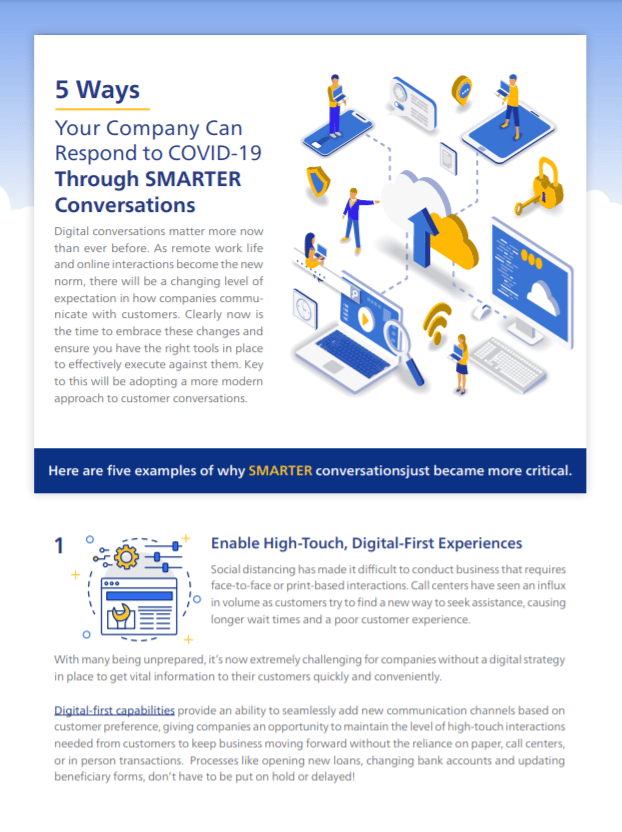
5 Ways SMARTER Conversations Ease the Impact of COVID-19

By Chris Murphy, Senior Director of  Product Marketing at Smart Communications

The impacts of COVID-19 may be with us for quite some time, so companies will continue to deal with a vast amount of uncertainty when it comes to planning for a new normal. However, one thing is certain—the demand for digital solutions to support remote work and collaboration while continuing to continue to deliver a high-touch customer experience when face-to-face interactions aren’t possible will be a catalyst for accelerated digital transformation initiatives. Embracing a digital-first approach to the way you communicate with your customers will build a solid foundation of much-needed trust and loyalty and will help companies survive this unexpected challenge.

We’ve pulled together a quick guide that helps clarify how a modern approach to customer communications will help ease the impact of COVID-19 for companies looking to embrace change.


Click here to download the full tip sheet, 5 Ways Your Company Can Respond to COVID-19 Through SMARTER Conversations.